Introduction
Digital technologies have revolutionised the way that businesses, governments and individuals access, manipulate and utilise data. Cloud computing has been the backbone of today’s IT infrastructure for years, enabling enterprises to store data, execute applications, and leverage robust computing resources remotely, in data centers located away from their physical points of presence. However, with the rise of the need for quick responses, real-time decision making and connected devices, traditional cloud-based systems have new challenges. Technologies like autonomous vehicles, smart cities, industrial automation, and the Internet of Things (IoT) devices generate massive amounts of data, which are not always easily managed by transmitting all data to centralized cloud servers.
This challenge has prompted the development of edge computing, which utilizes local data processing in an edge location, rather than cloud data centers entirely. Edge computing, as per IBM, makes it possible to move computation and storage facilities nearer to devices and users to enhance application performance and reduce latency for apps that demand timely responses. Edge computing is a complementary technology to cloud computing that offers enhanced performance capabilities for today’s digital world, complementing cloud large-scale storage and complex processing. The distinction between the two methods is an important one for IT students, businesses, and decision makers when evaluating which technology to adopt for their needs.
What is Cloud Computing?
Cloud computing is a technology paradigm that enables the delivery and access to computing services including software, data, applications and storage over the internet. Cloud service providers can offer more scalable resources on demand, eliminating the need for organizations to invest in and manage costly physical resources.
Cloud computing offers a scalable and flexible solution that can be used by businesses of all sizes, allowing them to scale up or down as needed.
Cloud Computing Architecture
Cloud architecture is a style of computing that relies on centralized data centers run by cloud providers. These Data Centers are equipped with powerful servers for data processing, application hosting, and storage. When the user or device sends data, it is sent through the internet to the cloud provider’s infrastructure where it is processed before the results are returned.
Popular cloud platforms include Amazon Web Services, Microsoft Azure, and Google Cloud, which offer tools for enterprises to develop software, programs, and artificial intelligence, among other applications.
Scalability and Performance of Cloud Computing
Scalability is one of the most important benefits of cloud computing. A huge amount of computing power can be utilized with little investment in hardware. As an example, an e-commerce company getting more visitors throughout a holiday sale may be able to temporarily scale cloud resources to accommodate for more customers.
Cloud computing can also enable collaboration, enabling workers to access shared applications and data from different locations. At the same time, cloud solutions rely on the internet and central processing, which can result in latency issues, particularly for applications that require immediate responses.
What is Edge Computing
Edge computing is a form of distributed computing that pushes data to the edge of the network, near the place of information creation. Edge devices or local computing devices analyze and process data locally rather than transmitting it all to a centralized cloud server.
These may be sensors, modems or routers, Internet of Things (IoT) devices, industrial machines, or local servers used for computing before relaying vital data to the cloud.
How Edge Computing Works
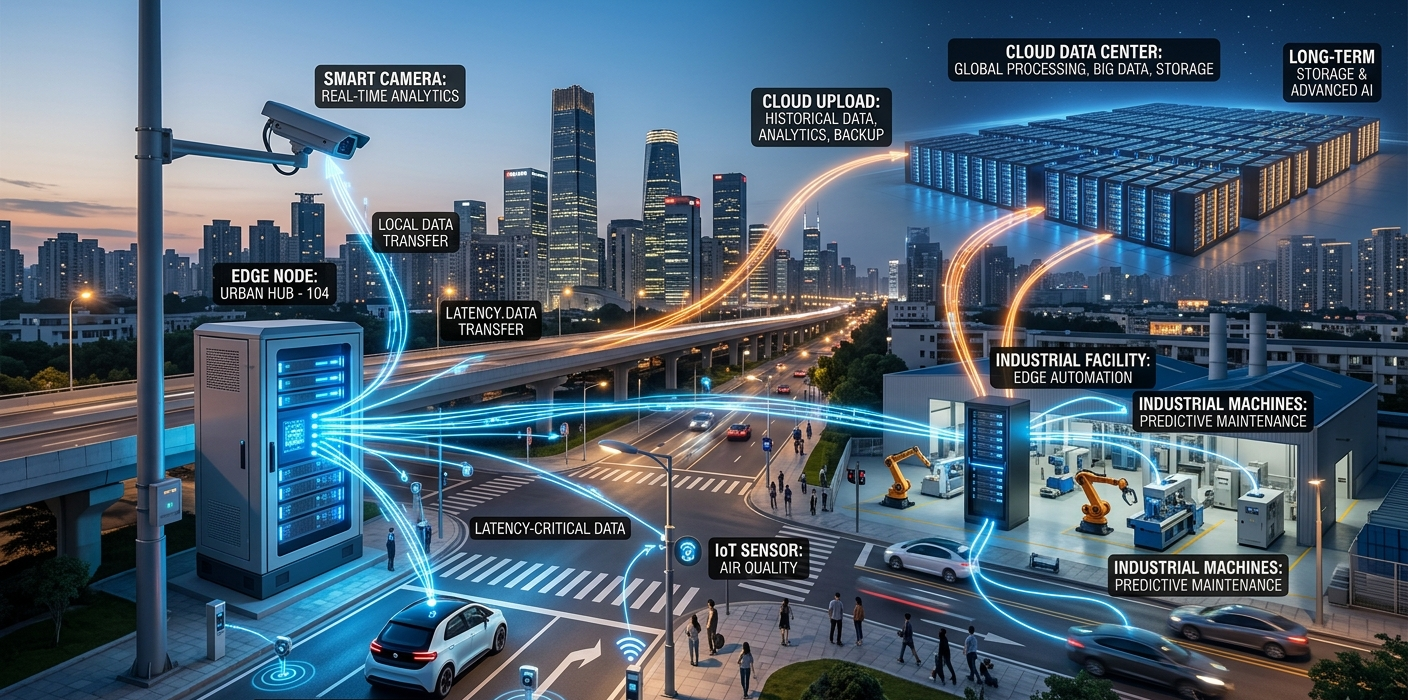
The primary goal of edge computing is to minimise the distance data has to travel. This cuts down on delay, less response time and more effective app functionality. For instance, a smart security camera with edge computing can perform local video analysis and alert immediately if it identifies any suspicious behavior, rather than transmitting each video frame to a distant cloud-based server. This skill is particularly useful when there is a need to be fast in tasks that could potentially impact safety, performance or user experience.
Edge Computing and Cloud Integration
Edge computing will not supplant cloud computing but complement it. Currently, many systems are built around both technologies, with edge devices processing data in real-time and the cloud storing data, performing advanced analytics and large-scale operations in the background. This hybrid solution establishes a more efficient computing environment that meets the increasing connected technology demand.
Key Differences Between Edge Computing and Cloud Computing
Architectures and Data Processing
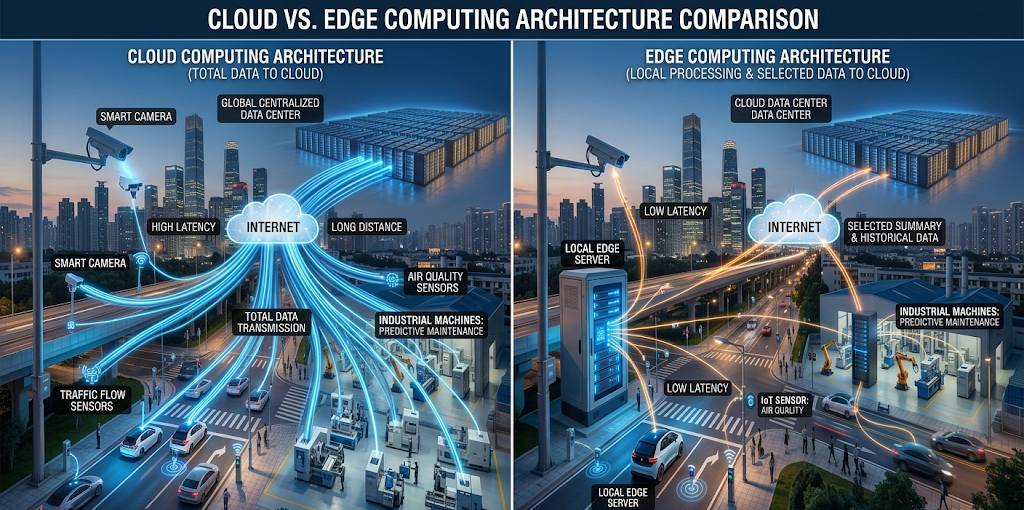
The primary difference between edge computing and cloud computing is where data processing takes place. Cloud computing is based on the concept of centralized infrastructure, or sending data to massive data centers located away from the user. This is suitable for applications that demand a substantial amount of processing power, storage capacity and central management. But due to physical separation between user and cloud server, there can be a lag to this, particularly in scenarios involving large amounts of real-time data.
Edge computing has a distributed system, processing is done closer to data sources. Rather than push all data to a central place, edge systems process data at their base stations and only push back only what is needed to the cloud. This helps to alleviate traffic congestion and enhances efficiency. Edge computing can help organizations process large amounts of data without straining network resources, particularly when they have thousands or millions of connected devices.
Speed and Performance
The speed is one of the key differences between edge computing and cloud computing. Cloud computing offers some great processing power, but there’s a need for data to be transferred from users, devices, and remote servers. This communication process adds latency, and can impact applications that need immediate responses. For instance, manufacturing companies employing robotic systems or automation equipment can’t always afford to wait for the processing on the clouds, as even a short delay can affect operations.
By processing data nearer to where it’s created, edge computing enhances performance. This helps to minimize latency and enables almost immediate response from systems. The applications include autonomous vehicles, medical monitoring systems, and smart manufacturing, where decisions have to be taken within seconds or milliseconds. Edge computing decreases reliance on remote servers, supplying quicker and much more reliable performance for time-sensitive applications.
Security & Privacy Considerations
Security is a key concern both at the edge and in the cloud. Just like with major cloud service providers, cloud computing relies on state-of-the-art security measures such as encryption, access controls, monitoring, and frequent updates of infrastructure. Centralized management means the cloud provider can ensure robust security measures are in place throughout their network. But, when data is stored in one place in large quantities, it can be a tempting target for cybercriminals.
One way edge computing can help is that sensitive data can remain near its source and the flow of information across networks is minimized. For instance, there are organizations that process some of the information locally instead of transferring everything to external servers, if they have personal data or confidential business data. Edge environments bring other security concerns, however, as there could be thousands of devices spread out that need protection. As each edge device is a possible point of entry for cyber threats, it is crucial for organizations to have robust authentication, encryption, and monitoring systems in place.
Cost Differences
Cloud and edge computing costs are dependent on an organisation’s long-term aspirations, infrastructure needs, and the type of application. The cloud computing model helps businesses to decrease the requirement to buy and maintain costly hardware by subscribing to the resources. Cloud solutions are appealing for startups and organisations that require versatility, as they just pay for the computing power and storage capacity that they use.
Investing in local hardware, edge devices, and maintenance systems are possible requirements for edge computing. It can, however, help to lower data transfer to central servers and thus network usage and cloud processing expenses. If your company produces a great deal of data, then storing and processing information on-site can save you a lot of bandwidth costs. So it’s best to take a hybrid strategy of edge and cloud, rather than sticking with just one solution.
The Advantages of Edge Computing
Edge computing offers several valuable advantages, making it more relevant in today’s tech world. One of the big benefits is the ability to increase the speed at which applications perform in real-time. Edge systems can provide applications with quicker decision-making without relying on cloud communication, by processing data closer to the site where it is created. This is crucial in sectors where time-sensitive operations can impact productivity, safety, or customer satisfaction.
Another upside is that it is more reliable. Some processing is done locally, allowing edge devices to continue functioning even if the internet connection is unstable. This can be especially beneficial in remote places, industrial environments, and transportation systems where it is not always possible to have a continuous connection. Edge computing also enhances data management by minimizing the amount of data moved and enabling enterprises to prioritize the storage and analysis of the most valuable data.
Advantages of Cloud Computing
Cloud computing is still one of the most significant technologies for businesses today, thanks to its scalability, level of accessibility and impressive capabilities. Organizations can rapidly deploy applications, grow resources and have access to advanced technologies without the need of building their own data centers. Cloud platforms can also be used for enterprise software solutions, data analytics, machine learning, and AI applications that need high computing power.
Centralized management is another big plus of cloud computing. Applications, security policies, data storage can be managed at a single environment. This is why all organizations that need collaboration among their employees, departments or locations can benefit from cloud computing. Edge computing is expanding, but cloud technology still will be fundamental in supporting massive digital operations.
Popular Applications for Edge Computing and Cloud Computing
Use Cases of Edge Computing

The use of edge computing is growing in importance in industries where rapid processing and real-time decision making are crucial. Smart cities rely on edge technology to control traffic and public safety cameras, energy networks, environmental monitoring devices, etc. Smart city systems that can process the information locally can react to the changes in situations and optimize the efficiency of the urban environment.
Edge computing also has a role to play in healthcare, with the use of wearable technology and remote patient monitoring. Medical devices are able to analyze data as it happens and notify healthcare providers of the need for attention. Edge computing is being employed in industrial automation, predictive maintenance, and robotics by manufacturing companies to make rapid decisions without relying solely on cloud communication.
Use Cases for Cloud Services
Cloud computing has a wide variety of applications across various industries. The cloud is utilized by companies to host websites, store data, manage customer relations, collaborate online, and develop software. Cloud services are essential for e-learning platforms and digital resources in educational institutions, offering access from anywhere.
Cloud computing is also integral to big data analysis and artificial intelligence projects. Organizations can put massive amounts of data in the cloud and then leverage the power of cloud computing to find patterns, create insight and make better decisions. Cloud computing is a core element of digital transformation strategies, thanks to these capabilities.
The Future Outlook: A Combined Edge and Cloud Computing Approach
Edge and cloud computing are not going to be mutually exclusive, but will likely coexist in the future. With the growing number of connected devices, organizations must deliver solutions that offer both real-time processing and massive analytics. Edge computing will be used for real-time processing, and cloud computing will be utilized for storage, sophisticated analytics, and centralized management.
The adoption of the edge computing approach will gain momentum thanks to emerging technologies like 5G networks, artificial intelligence, autonomous systems, and smart infrastructure. The edge devices will communicate more effectively with the aid of faster networks, and the cloud will offer the necessary resources to enable complex analysis and innovation. Companies that are able to seamlessly integrate both will be in a stronger position to meet the increasing demands of the digital world.
Conclusion
Edge computing and cloud computing are complementary technologies, solving the challenges of computing in different ways. Because of the power of centralized resources, scalability and advanced services, cloud computing is ideal for large-scale applications and data management. Edge computing is vital for applications that demand speed, reliability, and efficiency, such as IoT devices, smart cities, and real-time applications.
Given the continued digital transformation, businesses need to take care while selecting their technology when deciding between edge and cloud. Combining these two technologies will normally be the best option. The global digital infrastructure will continue to be built on cloud computing, with edge computing playing a growing role in providing faster, smarter and more responsive systems to the world.