Introduction
Buying Used Tesla is the smart way to enter the electric market without paying full price for a new Model 3, Model Y, Model S or Model X. Models like these present strong performance, latest tech, low routine maintenance and access to Tesla’s charging network. That said buying a used Tesla comes with different issues than a traditional gas car. Instead of engine condition or oil leaks, buyers must check battery health, charging performance, remaining warranty, software features, suspension parts, displays and accident history. A car may look great outside but still have very expensive components that must be very carefully looked at before the deal goes through.
The good news is that when you buy a used one you do not have to go into it blind. Tesla has a pre owned program which includes inspection and repair services, also their Certified Pre Owned cars come with extended warranty in addition to any that may still be left from the factory. Tesla reports that their Certified Pre Owned cars are looked at in areas which include the battery, brakes, tires, suspension, interior, displays, and control systems. (Tesla) What we have is a framework which buyers can use to make informed decisions instead of just going by mile age or what the car looks like. Whether you are buying from Tesla or an independent seller, info on what to look for is key to identifying big issues, to put together a budget for the car’s future and to determine if the price is right. Also note that while you may find a great deal on a car which is cosmetically great it may have large issues which will end up costing you more in the long run.
What to look for when purchasing a used Tesla.
Check out the Vehicle’s History and Ownership Records.
When it comes to a used Tesla you first must determine which car you are interested in and how it has been used. Check the VIN, model year, trim, battery type, mileage, registration history, number of previous owners, and accident records. The car’s history is important as two Teslas with the same mileage may have very different pasts. A car that has mostly had gentle use and regular home charging may have worn differently from one which saw a lot of long distance travel, ride sharing, or frequent high power charging. Look for signs of structural damage, flood damage, major repairs, or a lot of owner changes. Tesla’s used car program reports that they check for structural damage history and air bag deployment but an independent used car purchase still requires its own in depth history review. (Tesla).
Also it is important to compare what the mileage says with the car’s overall condition. That which parts of the car are worn out beyond normal use like the steering wheel, seats, pedals, tires, suspension, and interior controls may indicate how much the vehicle was used. Ask the seller for service history and reports of large scale repairs, also if the Tesla in question is a few years old. Check to see which repair work was done by Tesla and which by another certified repair shop and also that the parts used in repair were either original or equivalent quality. Also it is wise to confirm that the vehicle will in fact go into your Tesla account post purchase. Tesla’s used car buy in to account policy notes that a private party may put a used Tesla into their account once the vendor releases the vehicle. (Tesla).
Inspect the Exterior, Tires, and Suspension
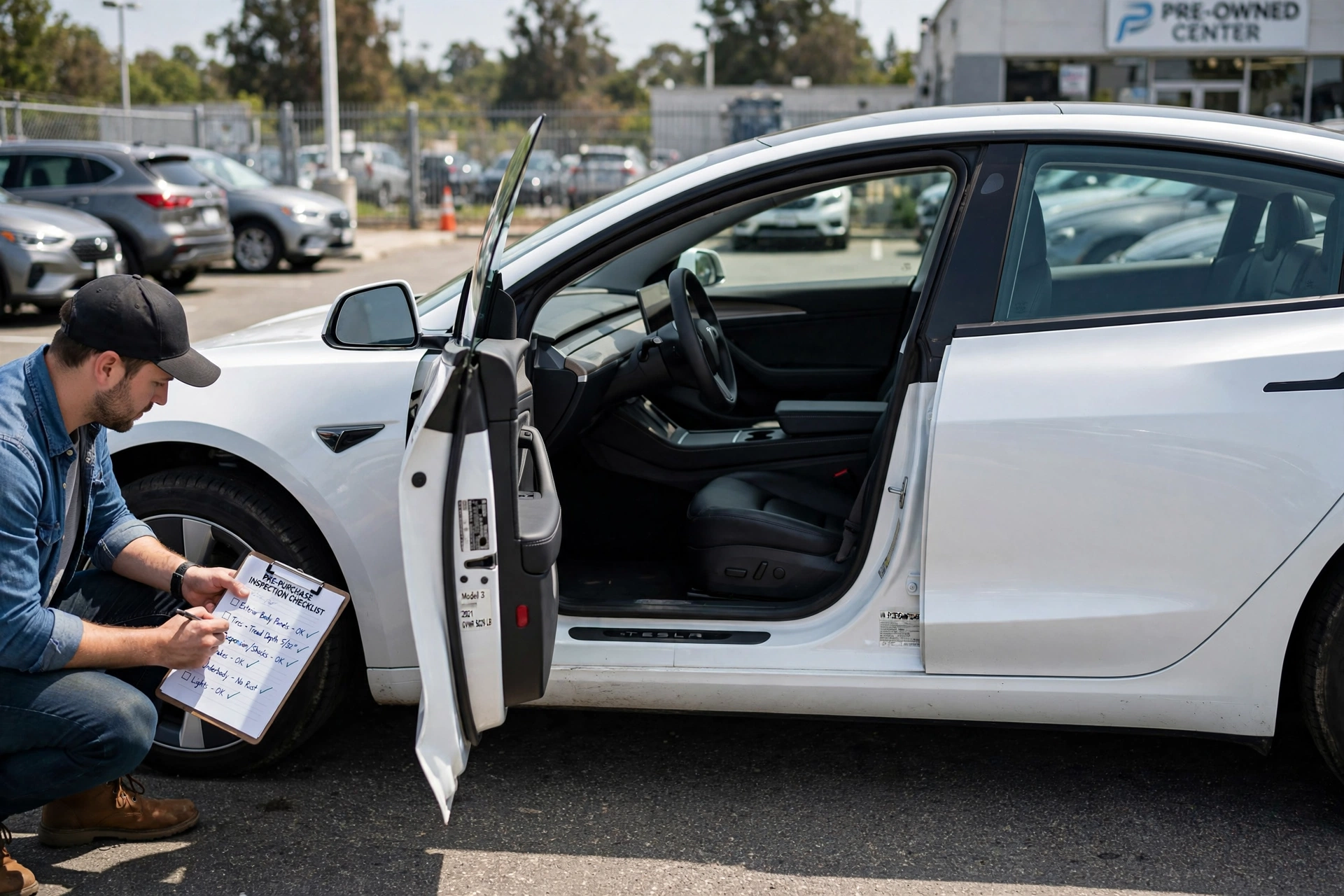
A physical inspection still is a must even as Tesla has fewer traditional mechanical components than a gasoline car. Go around the car in good light and look at each body panel for out of place paint, uneven gap between panels, dents, scratches, corrosion and signs of past repair. Pay special attention to the front and rear bumpers, doors, rocker panels, trunk areas, and underbody. Also check the charging port area for damage which may indicate past impact damage as well as issues with charging. Look at all the windows, lights, cameras, door handles, mirrors, and weather seals. A car which has had a poor repair job from an accident may have cosmetic issues that may go unnoticed during a quick look over.
Tires and suspension are a focus which is to say that heavier electric vehicles put great stress on tires and suspension components. Check tread depth and look for uneven wear and to that include the condition of all four tires. Uneven inner edge wear is sometimes a sign of alignment or suspension issues instead of just worn out tires. During the test drive pay attention for atypical knocking, clunking, squeaking, or shaking which will present itself when you go over bumps or rough patches. Tesla’s Certified Pre-Owned program includes in the inspection steering, suspension, wheels, tires, and other mechanical parts which is to say that these areas do see the most action and wear. Also if the car is pulling to a side, is unstable or is making odd sounds get it in for a pre purchase inspection. (Tesla).
How to assess the health of a used Tesla battery.
Understand Battery Degradation
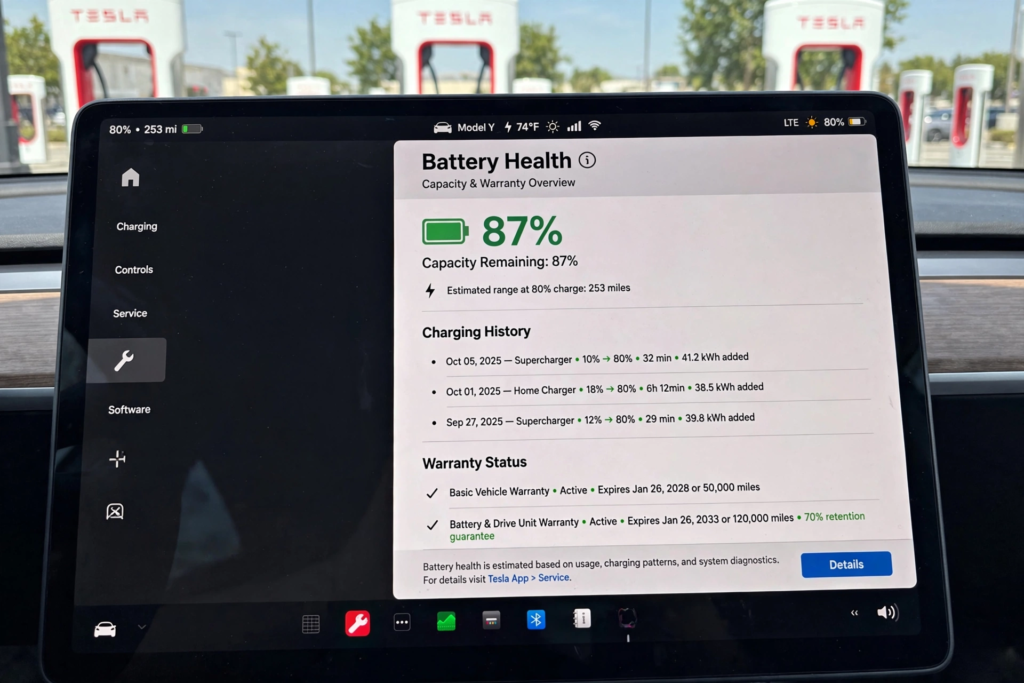
Battery condition is what you should really look at when purchasing a used Tesla as the high voltage battery is the main component in the car. Also it is a known fact that every lithium ion battery over time loses some of its performance which is why a used Tesla will not have the same range as when it was brand new. This does not mean the battery is failing. What you as a buyer should do is to see if the remaining capacity is what you would expect for the car’s age, mileage, what type of battery it has and its use history. Tesla’s present warranty info states that for eligible Battery and Drive Unit warranties there is a 70% battery capacity retention which is guaranteed during the warranty period which of course varies by model and configuration. (Tesla).
Do not use the range number on the dash as a single indicator of your battery health; it will vary based on config, driving conditions, temperature, wheel size, software calculations, and recent use. A better way is to see how the vehicle’s range at a high state of charge compares with what is expected from that config when new. Also Tesla reports out on the battery health of pre owned cars’; in their present pre owned program they include a battery range estimate for each car which is to help buyers know the battery capacity before purchase. (Tesla) What we really should be looking for is evidence of very large-scale degradation which in turn will indicate a problem, not that the used Tesla will still have 100% of its original capacity.
Test Charging Performance
Charging issues may present themselves which do not come to light during a short test drive. Before you buy a used Tesla do what you can to test the charging system. Check that the charging port opens as it should, the connection locks in properly, and the vehicle identifies the charger without repeat errors. If you are able to run a charge cycle see how the vehicle does it charge as it should for the type of charger, battery temperature, and state of charge. A car that repeatedly stops charging, reports strange errors during charge, or has trouble with the charging equipment itself is a cause for more in depth investigation.
Battery temperature, state of health, charger performance, and other parameters may also play a role. Also it is not true that a single out of expected charging report will point out a battery issue. We aim to recognize repeated issues, abnormal activity, or charging restrictions that still stand out after we have looked at normal operating parameters.
Understand the Remaining Tesla Warranty
Check Basic Vehicle Warranty Coverage
Never put out that all used Teslas have the same warranty as new ones. What you see is what you get really does not apply here. Warranty includes the original delivery date of the car, mileage, model, config, and the type of part which is involved. Presently Tesla reports that the Basic Vehicle Limited Warranty is for 4 years or 50,000 miles whichever comes first but always check the specific vehicle’s warranty document for exact info. (Tesla) Also a used Tesla that looks to be in great shape may still have very little remaining coverage if it has high mileage.
The battery and drive unit warranties are separate from the base vehicle warranty and may last much longer. At present Tesla reports eight year battery and drive unit coverage which does vary by model and configuration and also the car must retain at least 70% of its battery capacity during the warranty period. Also buyers should note the original delivery date and current odometer reading before you determine what warranty coverage you have left. Do not take a seller’s word that “the battery is still under warranty” go out and get the exact expiration date and mileage limits, and also see if the issue you are having is covered by what is included in the warranty.
Understand Certified Pre-Owned Coverage
A Certified Pre Owned Tesla may present a better option for buyers that are looking to decrease the unknowns in a private used car purchase. Tesla’s UK Certified Pre Owned program reports that which are eligible vehicles are checked out and repaired and also include a Used Vehicle Limited Warranty, also at the same time any original New Vehicle Limited Warranty and Battery and Drive Unit Limited Warranty which still remain. (Tesla) That is to say that the detail of the warranty included with the individual vehicle is very important. Buyers should read the coverage for the specific car listed rather than assume that all Teslas have the same protection.
A Tesla which is Certified Pre-Owned also has the benefit of going through a more in depth inspection which Tesla reports includes the battery, brakes, tires, suspension, control systems, displays, interior, and structural condition. (Tesla) But do not use the CPO status as a reason to skip over the car’s condition or warranty details. Still take a proper test drive, research the vehicle history, check out the charging system, look at the tires, and make sure the price is what you pay for it. The great thing is you get the peace of mind of additional manufacturer support which in turn reduces the financial risk of an unexpected failure.
Common issues with Tesla’s to be aware of.
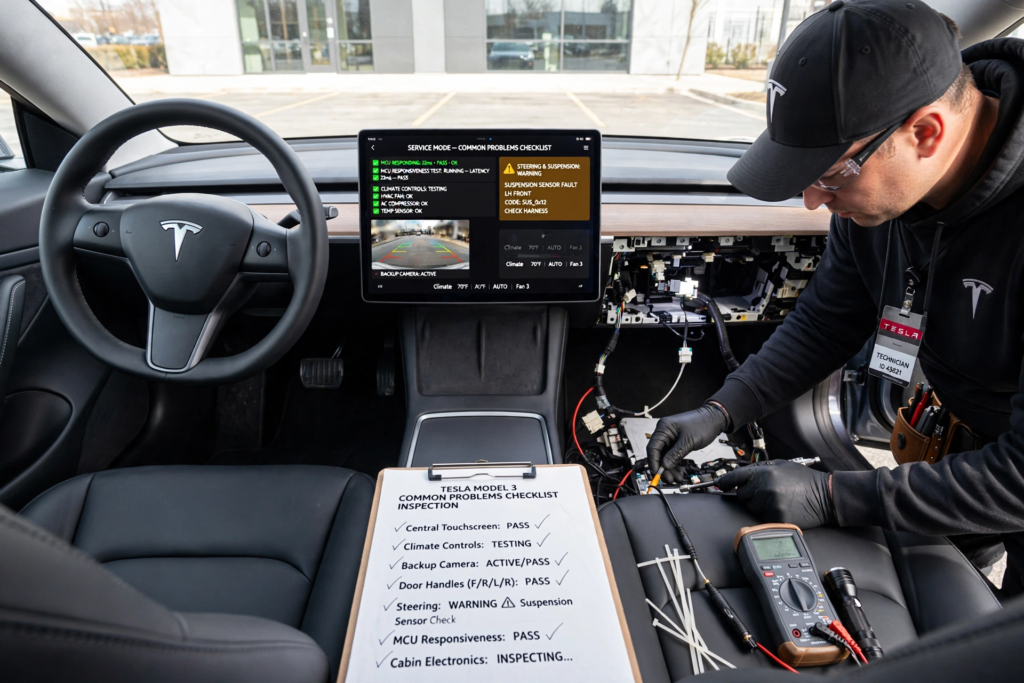
MCU and Touchscreen Problems
The display and media control aspects are at the core of what Tesla does which is why issues with the display or MCU are very disruptive in Tesla cars. By Tesla generation the MCU controls or displays important functions of navigation, entertainment, climate settings, vehicle info, cameras and other features. As you go to look at a used Tesla do not just see if it turns on that is the first thing to do but also run through the menu options, play with the climate system, test out the nav, check the back up camera, see what the connectivity features do, and that the screen reacts the same way to touch and swipe input.
In the case of older Tesla cars we see that electronic components age in different ways as compared to traditional mechanical parts. Pay attention to delayed response times, sudden reboots, stuck screen images, missing functions or continuous warning reports. At present Tesla’s warranty manual provides for different coverage of some touchscreen and media control unit parts for those which are bought new from Tesla, but for pre owned vehicles it is by the terms of their specific warranty. (Tesla) Also when you see that the touchscreen is having issues during an inspection do not assume a software update will fix it. Try to find out if the issue was repaired in the past and get any proof that you can.
Suspension and Steering Wear
Suspension wear out is an issue which should get the attention of used electric vehicle buyers, specially that of which applies to older and higher mile Tesla owners. EV’s are heavy and their suspension elements are put to task with every road imperfection, pothole, speed bump as well as routine drive cycles. On the test drive pay close attention for any knock or clunk from the front and rear suspension. Note the car’s performance over rough roads, also note the steer response, there should be no issues of instability. Also look out for excessive vibration, atypical pull, inconsistent tire wear, or atypical sounds over bumps as those may be signs that parts need to be looked at.
Do not assume a suspension issue is minor just because the car is still running fine. Worn out bushings, links, control arm components, dampers, or other suspension elements can play a role in tire wear and how the car handles if left unattended. Tesla reports to include in its Certified Pre-Owned program a detailed mechanical inspection which includes the suspension and steering; this supports the fact that these areas do require attention when looking at a used car. (Tesla) For a private sale, get an inspection from a professional technician that is also familiar with Teslas’ issues; this may give you extra peace of mind in particular if the car has high mileage or was driven on bad roads.
Door Handles, Windows, Cameras, and Electronics
Because of the high degree in which electronics play in Tesla’s systems, buyers should really put in the time to test out a great deal more than just the drivetrain. Go through each door handle, window, mirror, seat adjustment, light, camera, speaker and climate control function. Also check out the central locking system and see that doors open and close properly. Try the trunk and if it is a model that has one, the powered liftgate. See that the charging port door functions as it should and that the car recognizes the charging cable. What may at first seem to be small electrical issues may in fact not be that serious in isolation but when you have a number of electronic faults at the same time they may end up being very expensive or very frustrating to diagnose.
The issue of which to check is that the vehicles’ cameras and related driver assistance hardware should be appraised. Also see to it that the cameras’ output is of high quality and that the safety features’ performance does not have issues of which you are made aware repeatedly. Don’t buy a used Tesla which the seller says has a certain Autopilot or Full Self-Driving feature just because he says it. Instead get down to the nitty gritty and check out the actual software and what features the car you are looking at comes with. Tesla’s CPO program reports that their cars come with Autopilot, also which features beyond that are available is a variable by car. Thus buyers should play it smart between what the hardware, software features, subscriptions, and permanently included options are with each car.
Perform a Thorough Test Drive
Pay Attention to Driving Behavior
A proper test of a Tesla should cover a range of scenarios which are not limited to a block or two. Begin with easy speeds and pay attention for any out of the ordinary sounds from the suspension or powertrain. As you pick up speed, evaluate the steering, braking, acceleration, and the car’s overall stability. The car should react in a predictable and controlled way. Also because Tesla’s present high torque from the electric motors expect a smooth and consistent performance which should not include vibrations, hesitations or warning messages.
Try out different road surfaces when you can, which include smooth pavement and roads that have normal potholes. Pay attention to sounds inside the car and from the suspension. Also test out the regenerative and the conventional brake functions at the same time which to note is that regenerative brake performance may change with battery temp and charge. Also note the vehicles warning messages pre and post drive. It is also true that a Tesla which does great on the mechanical front but which puts out repeated warnings should not be put aside without first determining what caused those warnings to come on.
Check Climate Control and Cabin Systems
Climate systems should get more of a design focus in EVs than perhaps they do in traditional cars which is in part due to their role in performance and comfort. Test out the A/C, heating, fan settings, vents, seat warmers if included, and the temperature controls. See that the system responds properly to the temperature change and doesn’t produce strange sounds. Also check the windscreen de-icing and that the cabin reaches a comfortable temp without delay or error.
Inspect the car’s interior for signs of heavy use, water damage, worn out trim, loose panels, stained carpets, and strange smells. Check the seats, seat belts, steering wheel, dashboard, floor mats, storage areas, and cargo compartments. Used Teslas may have very basic interior controls as compared to regular cars which is why it is even more important to make sure that all the electronics are working right. If the car has had water damage in the past or poor repair jobs from accidents, electrical issues may show up later, so pay close attention to any signs of moisture.
Final Used Tesla Buying Checklist
Before you buy a used Tesla make a detailed list of what to check and use it don’t depend on your memory. Verify the VIN and vehicle history, check the body for past accidents, see if the tires are worn unevenly, pay attention to suspension sounds, test out the brakes and steering, look at the charging port, try out the AC and fast charging when you can, also check the battery’s estimated range. Also go over the touchscreen, cameras, climate system, lights, windows, doors, trunk, seats, connectivity and other electronic features. At the end look into the Tesla account and the vehicle info to see that the car’s config and features match what the seller said.
Warranty check should be the final and very important step. We note down the original delivery date, present mileage, balance in basic warranty, balance in battery and drive unit warranty, also any extra used car warranty. Tesla’s present issue is that they report which warranties cover what components and that mileages play a large role as do time. Also when going through Tesla’s Certified Pre-Owned program look at the specific warranty for that car’s info includes both remaining original warranties and added used car protection. (Tesla).
Is a Used Tesla Worth Buying?
A used Tesla is a great buy when the car has a healthy battery, good balance of warranty left, great charge performance, reliable suspension and which also has fully working electronics. The main error is in thinking only of purchase price and mileage. A less expensive Tesla with poor battery health, worn out suspension, bad tires, electronic issues, or low left over warranty may end up costing you more in the end than a slightly more expensive option which has a better past. For budget conscious buyers the aim should be to find the best mix of purchase price, battery health, warranty coverage, service history and overall condition instead of which is the cheapest car available.
The best approach is to think of your Tesla as a high tech used car instead of a maintenance free entity. Tesla does away with many traditional maintenance issues, but this does not mean all components are for life or that repair bills are low. Tesla reports that their cars require little in the way of routine maintenance and also that pre owned vehicles go through an inspection and refit process. (Tesla) Through a careful inspection, a battery health check, warranty check, charge test, and extensive road test buyers can greatly reduce the risk of buying a faulty used Tesla. The best used Tesla is not always the newest or cheapest, it is the one which condition and remaining warranty terms fit what you are looking for.