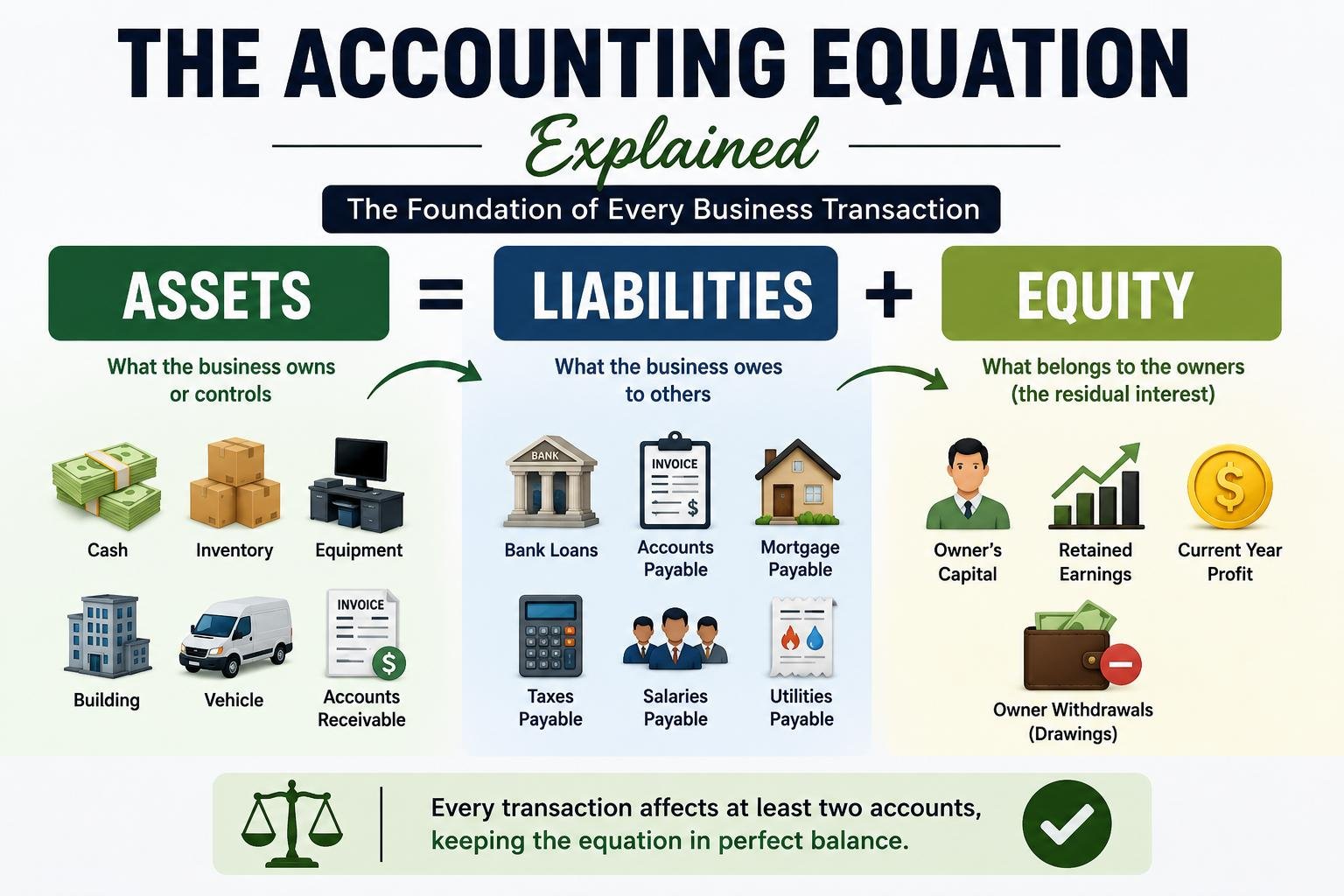
Introduction
Maintaining a business’s financial records goes beyond the journal. After the transactions are journalized they need to be posted to the general ledger where each account keeps a running balance. This is also referred to as posting, and is the basis of all sound accounting systems. If posting isn’t done properly, businesses are unable to create accurate trial balances, financial statements and management reports.
When you learn accounting for the first time, or you’re running a small business and have to manage the books, or even if you’re taking a bookkeeping exam, it’s crucial to know how to complete journal transfers properly. Many users don’t know how to make a journal entry, but can get thrown off by transferring the entry to the related ledger accounts. Fortunately, if you know the “how” and “why” of ledger posting, it is easy and systematic.
You may also want to watch this additional accounting resource while you’re following this step-by-step guide to ledger posting, for a detailed overview of ledger posting.
In this article you will learn what the general ledger is, the importance of ledger posting, the proper way to post a journal entry, how to balance the ledger accounts, some of the most common posting mistakes, and some examples to make the process easy to follow.
What is General Ledger?
The general ledger is the main record in which all transactions of the company are recorded under various accounts. The ledger is a summary of transactions by account (Cash, Accounts Receivable, Equipment, Sales Revenue, Rent Expense, and Accounts Payable) rather than by date as in a journal.
The journal would be a daily diary listing all transactions and the general ledger would be a place where all similar transactions are summarized. Each debits and credit that occurs in the journal, eventually ends up in a corresponding ledger account. This way accountant can get the balance of each account at any time without having to look at each journal entry separately. An accurate general ledger is one of the most critical bookkeeping tasks as all financial statements are prepared from a view of the general ledger balances. Posting errors may impact account balances, alter financial statements and pose major problems when preparing trial balances or auditing. Therefore, proper ledger maintenance is vital to the accounting cycle of businesses of all sizes.
The Link between the Journal and Ledger
Knowledge of the reason why accounting has journals and ledgers, rather than keeping one record, is helpful before any entries are made.
The journal is used for recording transactions according to the chronological order. Each transaction has a date, accounts, debit, credit and a brief description. This chronological record shows a complete record of business activities and is the source of accounting information. The transactions, however, involve numerous accounts, and if the balances of one account were known directly from the journal, this would be extremely time consuming. Ledger resolves this issue by centralizing all the transactions which occur to a particular account. All the journal entries are posted to the correct ledger accounts, enabling an accountant to quickly see balances, check on account activity, find unusual account changes and provide financial reports. The Journal and the general ledger are a complete and organized accounting system that enhances accuracy and transparency.
Parts of a General Ledger Account
All ledger accounts are organized in a consistent format allowing transactions to be recorded and easily reviewed. While businesses can have different layouts the majority of ledger accounts will have information that is similar.
Commonly, a ledger account will have the following columns: Account Title, Date, Journal Number, Description, debit column, credit column, running balance. Each time there is a transaction in that account, a new line is added with the increase or decrease of that account’s balance. If you don’t know how to do this by hand, it won’t help you understand how the computer does it, but if it helps you to understand, you can benefit from that. Knowing these elements also helps to detect posting mistakes, to reconcile accounts and to gain an understanding of how financial statements are generated from accounting records.
What is the meaning of the word posting in Accounting?
The posting is the action of transferring the information from journal to the proper ledger accounts. All debits and all credits to a journal need to be duplicated in the appropriate ledger account.
There are no new transactions when you post. Rather, it structures the existing information, allowing each account to have a full history of its own activity. For instance, with a customer paying in cash, the complete transaction is recorded in one journal when the money is received. In posting the debit will be recorded on the Cash account and the credit will be recorded on the Sales Revenue or Accounts Receivable account, depending on the type of transaction. As every entry in the journal will impact on at least two accounts, posting is always a task involving several ledger accounts. This makes sure that the accounting equation is balanced and that each account will contain a sum that will accurately reflects the account’s activity over time.
A Guide on How to Perform Posting of Journal Entries Step-by-Step
Step 1: Read and understand the Journal Entry.
Begin by carefully examining the journal entry. Before transferring to the ledger, check the date of the transaction, the names of the accounts, the amount of the debit, the amount of the credit, and the narration. It is very easy to correct errors at this stage as compared to having to find them later when multiple entries have been published. The individual entries in the journal can also be reviewed to ensure consistency of the accounting records and minimizing the chance of posting information to the wrong account.
Step 2: Find the Right Ledger Accounts
Then find the corresponding ledger accounts in the ledger. Each account should already have a page of the accountant’s ledger or an electronic accountant’s ledger. If an account has not been established, it should be set up as per the company’s chart of accounts prior to posting. Having a comprehensive and well-structured chart of accounts assists not only in keeping things consistent, but also as a way to stop duplicate or unnecessary accounts from showing up in the accounting records.
Step 3: Copy over the Debit Entry.
Find the correct ledger account and enter the amount of the debit in the journal entry format. Enter the date of the transaction, the transaction number, transaction description, and the amount of the transaction. The running balance should then be adjusted in line with account’s normal balance. Completing all the details allows back-tracing to be performed more easily at the time of reconciliation and audit and provides a clear audit trail in the accounting system.
Step 4: Transfer Credit Entry
Repeat the above for each credited account in the journal entry. Debit the ledger account for the transaction and credit the amount of the transaction. Once you’ve entered the credit, adjust the account balance. This is a critical step as the accuracy of this step can result in variances that will ultimately result in the trial balance not balancing.
Type in the Posting Reference
When transfer is finished, note on the journal and the ledger that the transfer was posted. In many accounting systems, journal entries are referenced to a page or page number, or a reference code, to relate it to a ledger account. These references help with record keeping, and allow for the easier tracing of transactions on which questions may arise or corrections may be required.
A Practical Example of Ledger Posting is illustrated
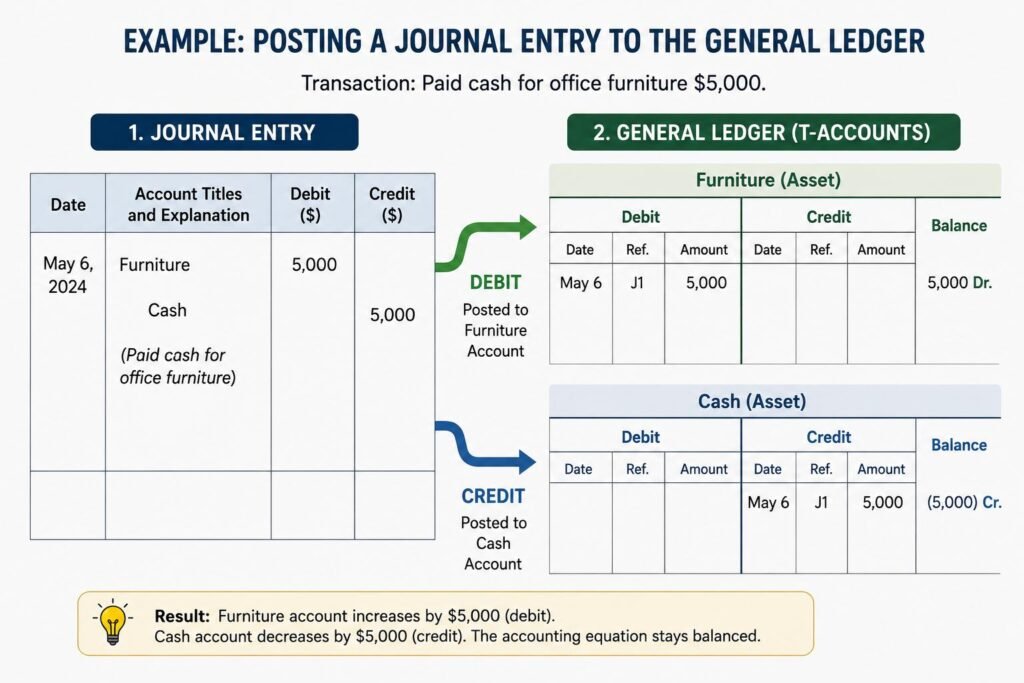
Suppose that a business pays cash for office furniture for $5,000.
The entry into the journal would be in this way:
Debit: Furniture $5,000
Credit: Cash $5,000
Posting the entry will debit the Furniture account for $5,000, making its balance larger since furniture is an asset. A $5,000 Credit is posted to the Cash ledger account, which causes its balance to decrease since cash is a liability. The transaction is now reflected independently on both of the ledger accounts and the balance is now set up on the journal entry. This is a very simple example to illustrate that one journal entry can create more than one account, but the accounting equation (A=L+E) does not change.
How to Balance Ledger Accounts
A ledger account is a record of all the transactions that have been made in the account, and balancing a ledger account involves calculating the difference between the total debits and credits to determine the end of account balance.
All the debits are summed up at the end of an accounting period and the same is the case for the credits. The smaller side is then deducted from the larger side to find out the balance. Typically, asset and expense accounts have debit balances. The typical credit balance of the accounts is found in liability, equity and revenue accounts. Accountants will be better equipped to recognize transactions that may be unusual or suspicious, and thus could be potential posting errors or record-keeping errors, due to knowing these normal balances. After balancing all ledger accounts, the balances will serve as the basis in preparing the trial balance and the financial statements as well.
Some Common Mistakes in Posting Ledger Entries
Even seasoned bookkeepers make posting errors every once in a while. However, some of the common mistakes that can impact on financial accuracy can be particularly prevalent among beginners.
A common error is that the debit or credit is posted in the wrong account. The other frequent mistake is when the right in the right amount is written in the wrong ledger account. There are some bookkeepers who end up missing out on transactions or double-keying a single transaction. A wrong date, lack of referrals and mathematical mistakes when working out running balances also affect the accuracy of the ledgers. Thankfully, these issues can be normally identified during preparing a trial balance or account reconciliation. It’s best to review each and every journal entry before posting it, and then review each and every ledger balance after posting them, to minimize these errors!
Suggestions: Accurate Ledger Accounts can be Maintained
The key to having a successful ledger is consistency, not quickness. All accounting transactions should be entered into the accounting books in a timely fashion so that no transactions are lost or forgotten. Account names must always be exactly the same as the chart of accounts and supporting documents should be kept for future reference. Imbalances in running balances need to be monitored regularly in order to identify any unusual variations as early as possible before they escalate into larger issues. It is also crucial for businesses to reconcile key accounts like Cash, Accounts Receivable and Accounts Payable periodically. While much of the posting process is automated in modern accounting software, having an understanding of the manual process enables accountants to check the output of software, to ensure it is correct and to spot errors that computers may not be able to detect.
The Importance of Ledger Posting in the Accounting Cycle
Ledger posting is the process of translating a transaction into a financial statement, and it is typically a part of the accounting report preparation. As a result of inaccurate posting, all other steps in the accounting cycle are ineffective. The closing of the trial balance could not be balanced, information used to make adjusting entries may be inaccurate, and financial statements may be misleading to the owners, investors, lenders, and taxpayers.
All related transactions are added onto each account, so the general ledger is useful to management for determining business performance. The account balances show spending trends, the increase of income, cash on hand, the amount of debt and the value of assets. These findings help to inform budgeting, forecasting, internal control and decision-making. Thus, posting cannot simply be a bookkeeping activity but an integral part of good accounting practices.
Manual Accounting vs. Accounting Software
Most of the organizations today are depending on accounting software to automate ledger posting. As soon as the journal entry is posted, the software will update all the ledger accounts that are affected by the entry in seconds. This automation minimizes man error, saves time and offers up-to-the-moment financial data.
However, accounting students or new bookkeepers should still have an understanding of manual posting as the software follows the same accounting principles in the background. Understanding the steps in the accounting cycle will allow users to troubleshoot errors, confirm that reports are accurate, and will help users understand financial statements. Manual posting is also applicable in educational centers, where paper records are used in small business operations, and in exam centers where a computer is not available.
Manual Ledger Posting vs. Accounting Software
Once the accounting concept of ledger posting is grasped, many accounting concepts become much easier. Properly maintained ledger accounts are essential for trial balances, adjusting entries, financial statements and account reconciliation. If students have a good understanding of posting, they are likely to do better in more advanced accounting areas, as they realize that each financial report starts with accurate transaction recording, and proper classification.
Posting ledgers is also a skill used in accounting that is acquired during learning that will be used in the future. From bookkeeping to auditing, taxation, financial analysis to corporate finance, the accuracy of ledger balances is a crucial factor in decision making. Practice with this basic accounting skill will build confidence and ready students for more advanced accounting tasks.
Conclusion
One of the most crucial steps in the accounting cycle is the journal entry to the general ledger. It saves the time of organizing chronological journal records into account histories which enable financial reporting. When businesses transfer their entire debit and credit to the right ledger accounts, keep them running and balance the accounts at the end of the accounting period, they are able to build up reliable financial records that can help them to make informed decisions.
In the beginning, journals and ledgers are a source of confusion when it comes to bookkeeping but understanding their relationship takes away some of that confusion. If it takes a little time and patience to get it right, and continually check account balances, ledger posting becomes a common task not a difficult one. This is an important accounting skill that will serve as a foundation for creating trial balances, financial statements and all the other parts of the accounting cycle with a sense of confidence and accuracy.
Get more well researched information about ledger posting here.