Introduction
Journal entries start the trail in a business and every financial transaction has a trail. It may be that a company purchases office supplies or pays an employee’s salary, or receives cash from a customer, or a bank loan account is established, every transaction must first be entered correctly in the general journal and then posted to the ledger. This process helps to keep the financial records accurate, balanced and in accordance to accounting principles. Knowing how to make journal entries is one of the most crucial skills students, entrepreneurs, accountants and bookkeepers need to know.
It is also crucial to be able to understand journal entries as it is the basis of the double entry bookkeeping system. All transactions involve at least two accounts and the debits totaled on all transactions always equal the credits. With a grasp of debits, credits, and account types, journal entries are more of an easy process than a confusing one. When the journal is incorrect, all financial statements thereafter will be reported with errors as well, so it is important to have correct journalizing.
This resource will take you through each step of journal entry with examples of transactions in the business world to help you understand how to make journal entries. At the conclusion of this article you will be familiar with the layout of a journal entry, how to identify which accounts they affect, how to use the rules of debit and credit, and how to avoid some of the common pitfalls involved in making journal entries.
What is a Journal Entry?
The initial documentation of the financial transaction within the accounting cycle is a journal entry. All business transactions with monetary consequences are entered in the journal, before moving on to individual ledger accounts. This timeline allows companies to have a detailed history of all transactions, allowing for easier verification of financial data, reporting and auditing. Since the journal entries are the original documentation of the accounting activities, they are sometimes called “book of original entry.” Every entry records key data on the transaction like the date of the transaction, accounts involved, debits and credits, and a brief description of what the transaction was.
Journal entries are also a link between business activities and financial statements. All transactions that involve a company’s equipment, products, customers paying bills, customer bills being paid, or expenses being paid must be translated to the accounting language of the company using journal entries. If the step wasn’t taken, then businesses would have a hard time keeping their records organized or forming accurate financial reports. A good journal entry maintains the accounting system’s accuracy and will not disrupt the double accounting entry system.
The Double-Entry Principle
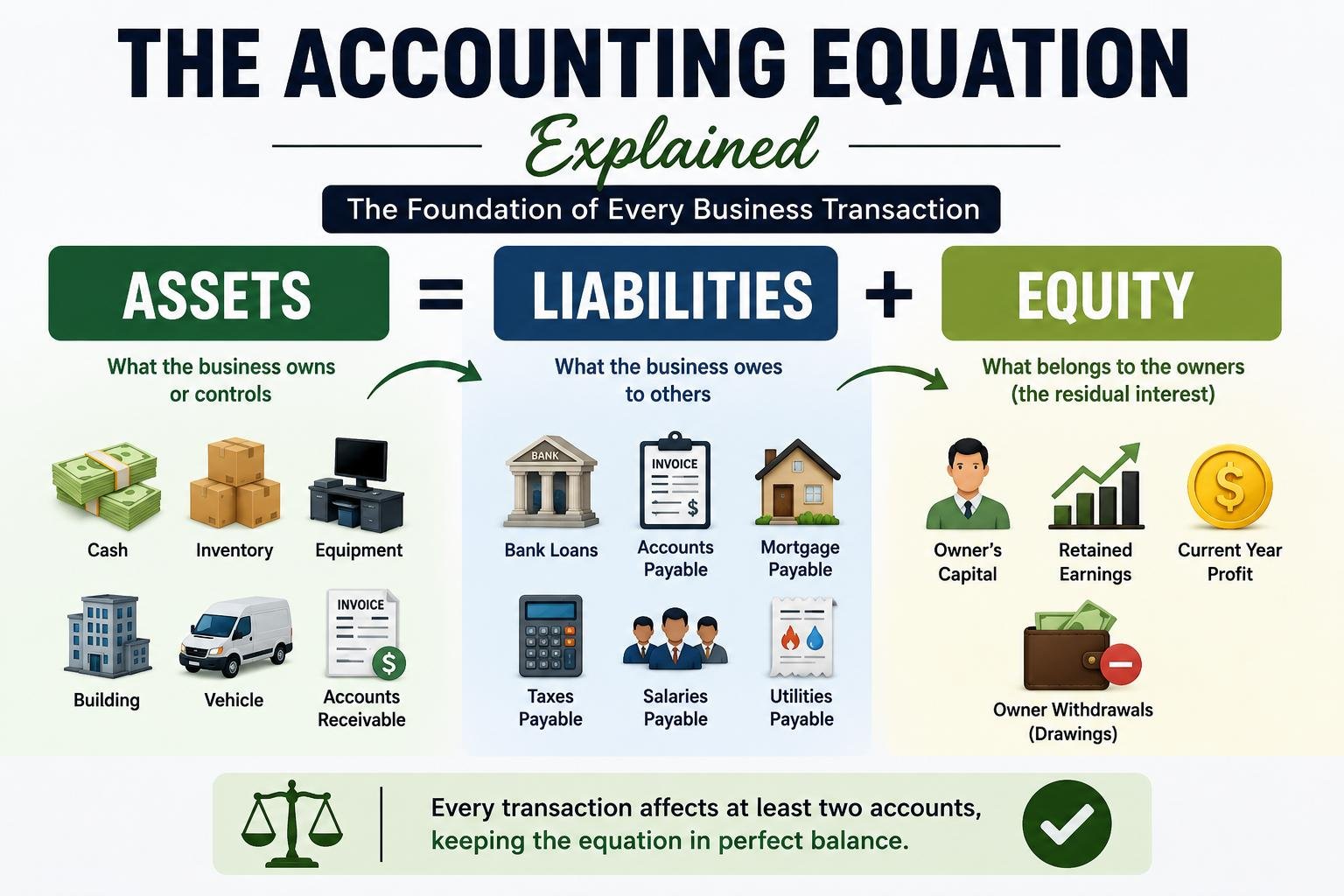
The key element of the double entry bookkeeping system is the following simple but powerful rule: Every financial transaction has at least two accounts of which it is a part. One of these accounts will be debited one, and the other will be credited the other. The total value of debits will always equal the total value of credits. This balance ensures that the accounting equation (Assets = Liabilities + Owner’s Equity) remains in balance after all transactions are made. Record not only the origin, but also the origin and destination of value to provide a complete picture of how business resources are changing over time.
This principle greatly helps ensure that the accounting records are more accurate as errors will be easier to spot if there are times when total debits and total credits do not match. It also helps to avoid the situation where transactions are not recorded correctly, and enables the production of accurate financial statements. Double entry bookkeeping is important to businesses of all sizes, from a sole proprietorship to a large multinational corporation, due to its transparency, accountability and consistency. After reading this chapter and grasping how an account reacts to debits and credits, it will be natural to create journal entries, not something that needs to be memorized.
Parts of a Proper Journal Entry
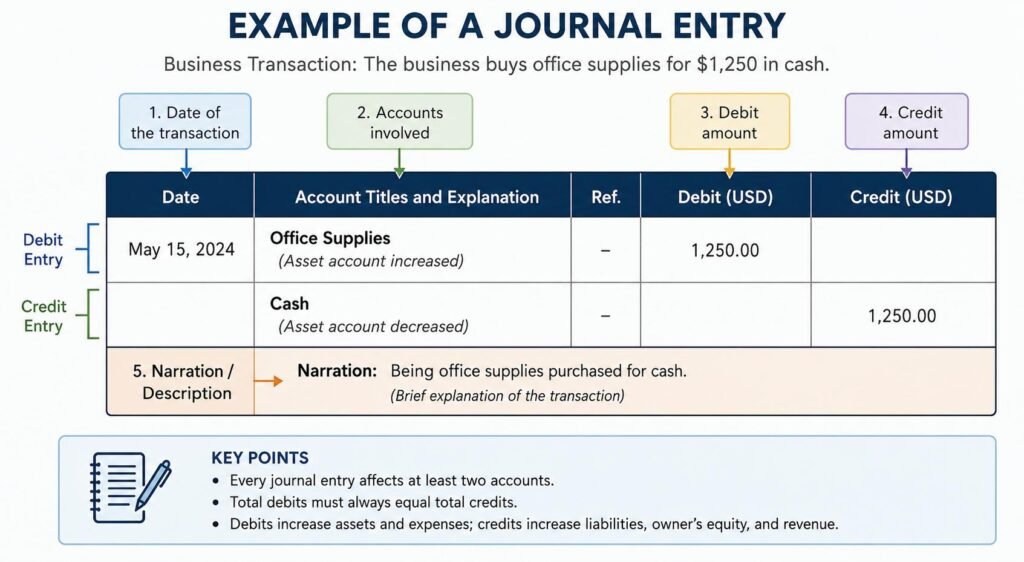
All journal entries are in a standard format that gives clear and complete information about the transactions. The first one is the transaction date which sets the chronological order of financial events. The dates are significant because the accounting records are based on a certain period of time, and the transactions must be given to the right periods, so that the financial statements are accurate. Following the date is the account title that is being debited and then the dollar amount of the debit. Slightly indented below is the credited account as well as the amount due. This formatting instantly displays the ratio of growth and decline of the account following accounting principles.
The last part is the narration or description, succinctly summarizing the reasons for the transaction. Narrations are typically brief, but a good source of context for future reference, audits and error investigations. A good narration will enable anyone looking at the journal to see that the business purpose of the transaction has been documented, without having to look at other supporting documents. These five – Date, Debit Account, Credit Account, Amounts, Narrations – constitute a full journal entry and represent a very precise record of all financial transactions.
Step-by-Step Guide to Recording Journal Entries
Step 1: Determine the Transaction.
Decide on what occurred in the business and then record it. In this lesson, we will start to understand the financial event, as it is the basis for every journal entry. Look at an invoice, receipt or bank statement, purchase order, contracts or payment vouchers to determine what the transaction is. Ask the following questions: “Did the business purchase anything?” Was cash received? Did there have to be an expense? Was money borrowed by the company? Correctly identifying the transaction means there will be no error on the transaction and only valid transactions will be captured in the books. There should be documentation that is reliable to support each valid transaction before it is entered into the journal.
Step 2: Identify Accounts to be impacted
Identify the accounts to be adjusted, after identifying the transaction. At least two accounts are involved in every transaction and sometimes more. For instance, if you buy office furniture with cash, it will impact both the Furniture account and the Cash account. Cash and Rent Expense are impacted by paying rent. Any changes to cash and Accounts Receivable are due to receipt from a customer. It is extremely important to identify all the affected accounts when journalizing as the rest of the steps in journalizing rely on the identification of the affected accounts.
Step 3: Determine which Accounts are Debited or Credited.
Once you’ve found the accounts involved, decide if you are going to debit or credit each account. Debits are used to increase the amount of assets, and credits are used to decrease the amount of assets. When there is a credit there is an increase. A credit increases the values of liabilities, owner’s equity, and revenue. Use of these rules will help to keep the accounting equation in balance. These basic debit and credit principles are the foundation for accountants to decide how each business event will be treated rather than memorizing each transaction.
Step 4: Record the Amounts.
After you’ve determined the debits and credits, write the dollar amounts. Debits must always be equal to the credits. If they don’t, there is something missing or wrong in the journal entry. The balancing requirement provides an inbuilt accuracy check and thereby catches errors before posting the transaction to the ledger. To ensure accurate accounting records, businesses tend to double-check figures multiple times before making journal entries.
Step 5: Write a Clear Narration
Explain the purpose of the transaction in a short description for each journal entry. The narration should include the context of the transaction, but not get bogged down in the detail, like “Being payment of monthly office rent” or “Being cash received from customer for invoice settlement”. Clear narrations enhance the record keeping, ease future review and make audits much easier because they tell the reasoning behind the accounting entry.
Examples of Journal Entries for Common Business Transactions
Example 1: Owner Invests Cash
The owner of a business invests $20,000 in cash to start the business.
Journal Entry
Debit: Cash — $20,000
Credit: Owner’s Capital — $20,000
Narration: Owner’s investment in the business as start-up funds.
When the business receives money, cash increases and when the owner contributes money, owner’s equity increases.
Example 2: Office Equipment bought for cash
The business buys office equipment (5,000$) and pays it at the same time.
Journal Entry
Debit: Office Equipment — $5,000
Credit: Cash — $5,000
Narration: Office machinery bought with cash money.
The asset side of the balance sheet is increased and cash is decreased by the same amount due to the use of the equipment.
Example 3: This is Inventory which was purchased on credit.
A business buys an inventory of $8000 on credit from the supplier.
Journal Entry
Debit: Inventory — $8,000
Credit: Accounts Payable — $8,000
Narrator: The person who tells a story.
An increase in inventory also means that goods have come in, but accounts payable means that they haven’t been paid for yet.
Example 4: Cash Sales
The total amount of cash sales for a business is $3500.
Journal Entry
Debit: Cash — $3,500
Credit: Sales Revenue — $3,500
Narration: Cash received for the goods sold.
Costs go down and revenue is recognized when the product is sold.
Example 5: Receiving payment from the customer.
A customer pays an invoice which is outstanding and has a value of $2000.
Journal Entry
Debit: Cash — $2,000
Credit: Accounts Receivable — $2,000
Narration: Being settlement of customer’s outstanding balance.
The cash will be added to the account and the receivable will be deducted, because the payment has been received by the company.
Example 6: Pay Employee Salaries
The company is paying employees’ salaries of $4000.
Journal Entry
Debit: Salaries Expense — $4,000
Credit: Cash — $4,000
Narration: Being payment of employee salaries, an increase in salary expense and a decrease in cash.
Example 7: The bank loan Received
The business gets a bank loan of $50,000.
Journal Entry
Debit: Cash — $50,000
Credit: Bank Loan Payable — $50,000
Narration: Being proceeds from bank loan.
If cash is received, the cash is increased and if the business owes the bank, the liabilities are increased.
Common Mistakes while Making Journal Entries
A lot of beginners’ error by writing the journal entry without taking the time to study the transaction. A frequent mistake is to use an incorrect account, like office expenses for equipment purchases or accounts payable and receivable mixed up. The other common error is when people transact and reverse debits and credits, giving the transaction the opposite financial impact. Another error is when an accountant leaves out one side of the double entry, or when he or she writes different amounts on the debit and credit side, causing the books to be unbalanced. The lack of narration, the wrong posting dates, and the failure to include a transaction without an accompanying document further decreases the reliability of accounting records and make audits more difficult.
Luckily, there are some ways to avoid these errors by sticking to a journalizing procedure. Before entering any transactions, always be sure to check on the source documents; always be careful to identify each account that is involved; always apply accounting rules to identify the debit and credit accounts; always watch for equal debits and credits; and before posting to the ledger, be sure to review each journal entry. These habits increase accuracy and boost confidence, particularly for novices who are getting to know the ins and outs of bookkeeping.
Some Helpful Tips for Making Journal Entries.
The more they practice, the more easily they will get to learn journal entries. Rather than memorizing each transaction, concentrate on the principles of debit and credit for each account based on the accounting equation. Complete through real business scenarios where purchase/sale, expenses, loans and owner investments have been involved until it becomes familiar. Completed journal entries and the use of a ledger and financial statements also serve as a good reminder of the interdependence of all accounting records. Recognizing transaction patterns over time enables accountants to speed up the process and also avoid guesswork in preparing transactions.
Journalizing has also become easier with accounting software, which eliminates much of the work involved in calculations, but still leaves it to the user to determine the correct accounts. Whether software is used or not, knowledge of accounting for manual entries is still critical, as accounting knowledge cannot be replaced by software. Companies rely on competent individuals who are able to identify unusual transactions, fix mistakes and guarantee that finances are recorded in accordance with accounting guidelines. Learning journal entries therefore will give students a solid basis in all other aspects of accounting.
Conclusion
Journal entries form the basis of a complete accounting of all money matters and are the beginning of each accounting cycle. Businesses can ensure financial accuracy by documenting every business transaction accurately with the correct date, account, debit, credit, and narration information, which can guide them to make informed decisions, maintain regulatory compliance, and report financial status accurately. Each journal entry is structured in the same basic way: Identifying the transaction, determining the accounts involved, deciding which accounts are debited and credited, entering the dollar value for each account and writing a narration. By adhering to these steps, you can maintain balanced and accurate accounting records.
Journal entries can be difficult and intimidating for beginners, but it will become easier with practice. The more of the actual business transactions you can dissect and write down, the more obvious you will make accounting patterns and rules appear to be. Every ledger account, trial balance and financial statement starts with a journal entry and it is one of the most important skills anyone can have when learning accounting. Knowing what a journal entry is crucial, whether you’re a student, entrepreneur or professional bookkeeper, because it will help you keep your books in order and foundationally solid for all of your other accounting responsibilities.
Get more well researched information on How to Record Journal Entries in Double-Entry Bookkeeping here.