Introduction
It takes more than just sales and expenses to run a successful business. All business owners need to know what it really takes to create a product or service. If a company does not have clear and precise cost data, they could be setting incorrect prices, wasting precious resources or losing profits without realizing it. This is where the value of cost accounting as a management tool comes into the picture.
Cost accounting differs from financial accounting in that it is intended for use within the company for internal decisions, as opposed to external users like investors and regulators. It is useful to managers in several ways, including: help identify production costs, assess operational efficiency, minimize waste, and increase profitability. From making business decisions to automobile manufacturing to building a house to food production to consulting services, any company that needs to make any kind of decision can use an understanding of costs for a better decision.
If you have ever asked yourself what cost accounting is, then this in-depth guide will explain all the things you need to know. You will find out what it means, what are its goals, how it works, its types, its significance, pros and cons, and its use in the contemporary business world.
What is Cost Accounting?
Cost accounting is an accounting specialty that measures, categorizes, investigates, aggregates and apportions costs incurred in the generation of goods or services. It is mainly used to assist management to know where their money is going and how its costs can be managed to enhance profitability.
Financial accounting is based on the standardized reporting rules, such as generally accepted accounting principles (GAAP) or international financial reporting standards (IFRS) and cost accounting is more of an internal management tool. Cost accounting systems are not standardized, but set up by organizations in accordance with their needs, not their reporting demands. This flexibility allows companies to produce detailed reports which can help with budgeting, planning, pricing, inventory management and strategic decision making. For a more detailed understanding of the concept, check out this guide on what is cost accounting in detail, which explains cost accounting’s purpose and some of the key principles.
Cost accounting collects data on direct materials, direct labor, manufacturing overhead, administration costs and operation costs. This information helps managers recognize wasteful processes, fix unnecessary expenses, correctly estimate product costs, and ensure the best performance of the business.
Knowing How Cost Accounting Works
Cost accounting is a systematic process of converting the raw financial information into useful information for decision makers. The first step in the process is to list all of the costs that are involved in producing or providing a service. Such costs are divided and grouped into different categories—direct materials, direct labor, manufacturing overhead, etc. Costs are then allocated to products, departments, projects or services in accordance with appropriate costing techniques, once categories have been determined. Once costs have been allocated, management is able to review outcomes and compare costs to budgets or standards. The last step is to create internal reports that identify the cost behavior, profit, efficiency and suggestions for improvement. Cost accounting doesn’t just capture what has happened, it’s a tool that gives businesses the data they need to continually optimize their activities and stay financially viable.
Main Components of Cost Accounting
All cost accounting systems are based on the identification and measurement of various types of business expense. Knowing these cost components enables managers to accurately calculate the actual cost of production and enable them to take informed financial decisions.
Direct Materials
Direct materials are raw materials that are part of the final product. Examples of direct materials include wood for furniture, fabric for garments and steel for automobiles. These expenses can be identified with a certain product.
Direct Labor
Direct Labor: Wages paid to employees who are directly involved in the production of goods or services. Direct labor includes factory workers installing electronics, machine operators making beverages and carpenters building furniture.
Manufacturing Overhead
Manufacturing overhead includes indirect production costs which are not easily identifiable with a given product. These include salaries of supervisors, maintenance costs, insurances, machine depreciation, electricity, and factory rent. These costs are incurred in the production process, but are not specific to any one product and need to be allocated.
Administrative and Selling Costs
In a normal manufacturing cost accounting, administrative and selling costs do not normally form part of the product costs but they do play an important role when considering the overall profitability of a business. These can be office salaries, marketing costs, administrative utilities, etc.
The Goals of Cost Accounting
Cost accounting’s goals are much broader than just calculating production costs. Cost accounting is essential for businesses to enhance their financial performance, optimize operations, and facilitate strategic decision-making.
Cost Ascertainment
The chief purpose of cost accounting is to calculate the actual cost of goods or services being produced. Correct cost determination helps the management to know the cost utilization during the production process and make it easier to measure the profitability of the operation and its performance.
Cost Control
Cost control is the process of controlling the costs so that they do not exceed the planned budgets. Cost accounting allows managers to compare the actual costs to the expected costs, find unfavorable differences, determine the reasons for those differences, and take corrective action before financial difficulties grow out of hand.
Cost Reduction
Cost control is to avoid the unnecessary rise in cost and cost reduction is to reduce the production costs permanently without affecting the quality of the product. Cost accountants investigate workflows, buying processes, production systems and resource usage to find ways to save money over the long term.
Assisting Management Decisions
Managers must constantly make decisions on product pricing, production quantity, outsourcing, equipment purchases, expansion and allocation of resources. Cost accounting can offer the necessary financial information that can aid in making these decisions by presenting accurate cost information and profitability analyses.
Developing prices for goods and services
The lack of knowledge of production costs can cause substantial losses of money. Cost accounting helps firms determine a selling price that will cover costs and provide a reasonable profit margin. Businesses can also size up the competition’s pricing strategy without ever compromising profitability.
Measuring Business Performance
Cost accounting helps management to analyze the efficiency of each department, monitor employees’ productivity, assess operational efficiency and determine what needs to be improved. Measurement of performance helps to improve planning and ongoing organization development.
Types of Cost Accounting
The way to perform cost analysis varies from one organization to another. The following are the major types of cost accounting used by businesses worldwide.
Standard Cost Accounting
In the standard cost accounting, predetermined costs are assigned to materials, work and overhead before production. They are then compared to actual costs to find favorable/ unfavorable variances. Management considers large variations and tries to find the best ways to make things more efficient and better control costs.
Activity-Based Cost Accounting
Activity Based Costing (ABC) allocates overheads based on the activities which create the overhead costs rather than using a general approach. This will give the product cost more accurately, particularly those organizations that make more than one product and have different requirements for each product.
Marginal Cost Accounting
The idea of marginal costing is to concentrate on variable production costs and to ignore fixed costs. Marginal costing is applied in decision making in the short term by management, in setting the price of the product, in planning the production and in assessing the profitability of extra product.
Lean Cost Accounting
Lean cost accounting can help organizations that are following the principles of lean manufacturing by making accounting easier and focusing on value added activities with a minimum of waste. Connects accounting information and continuous improvement efforts.
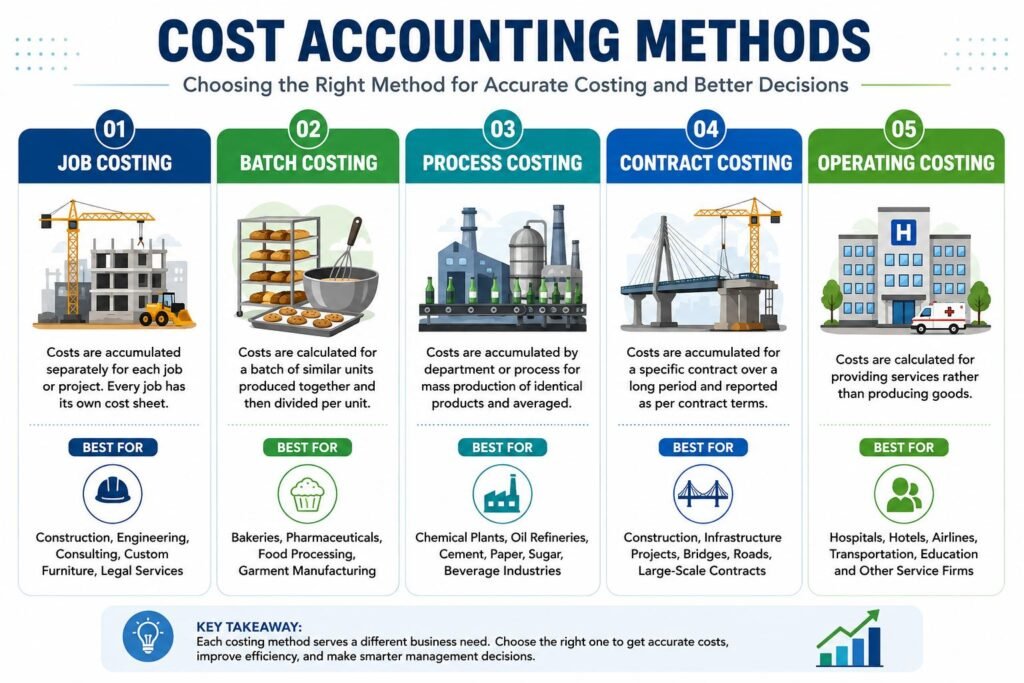
Cost Accounting Methods
The costing method used differs from industry to industry depending on their type of operation. Choosing the right costing system can enhance accuracy and aid in making sound decisions.
Job Costing
If products or services are made to customers’ specified requirements, the job costing is utilized. The costing is done on a per-job basis and the costs are added up. Job costing is used in construction, law, consulting and custom furniture manufacturing, among other industries, because the cost of a job is unique.
Batch Costing
In a batch product, a similar group of products is produced instead of one product. The cost is totaled for the complete batch then divided by the number of units produced. It is often used in the pharmaceutical industry, bakeries, food processors and clothing manufacture.
Process Costing
For industries that make large quantities of identical products, using continuous production methods, process costing will be used. The costs are added to the production department or process and the average cost is calculated. Process costing is used in manufacturing industries like oil refinery, chemical factory, drink factory, cement factory, paper factory and so on.
Contract Costing
Costing is done by contract for large scale, long-term projects like highways, bridges, buildings and infrastructure development. Due to the wide variations in projects in length, materials, labor and complexity, each contract has its own cost records.
Operating Costing
Operating costing is applicable to Service organizations and not manufacturers. This approach is used in industries like airlines, hospitals, hotels, transportation companies and education to calculate the price of providing certain services.
Importance of Cost Accounting to a Business
As cost accounting has an impact on almost all the business decisions, it cannot be ignored. Knowing an organization’s costs gives them an advantage in being competitive, profitable and sustainable.
Cost accounting helps managers to get accurate information for budget planning, forecasting and financial planning. Accurate cost data enables companies to create sensible budgets which account for their operational needs, and anticipate costs. When business conditions do change, management can adjust plans based on the current cost information, instead of assumptions.
One of the other advantages is better pricing decisions. Too low or too high in pricing can affect competitiveness and/or sell below cost. Cost accounting helps to provide detailed cost analysis which helps in balancing the pricing policy that can generate profit and would be attractive to customers.
Another benefit of cost accounting is that it adds to the efficiency of operations. Understanding where the waste is and how to eliminate it, along with idle capacity, excessive material usage and inefficient production processes, will allow an organization to make improvements that will help lower costs without compromising on quality.
Cost accounting is also very important in the process of inventory valuation. Proper stock valuation enhances stock management, tax computations and also money profitability measurement and also decreases mistakes in the stock management.
Cost accounting is also used by managers to assess investment opportunities, to launch new products, to drop unprofitable product lines or to enter a new market. Accurate cost data helps minimize uncertainty and enhances strategic decision-making.
Benefits of Cost Accounting
Those companies that have recognized the value of a good cost accounting system will derive many advantages, contributing to long-term success. One big benefit is that it allows management to better understand production costs, and where there are production savings to be had. An added advantage is better spending control, which helps the organizations to keep a track of spending and discipline them financially. Cost accounting also helps to increase productivity by spotting the unproductive activities and motivates the process to continuously improve. Managers will have reliable financial data and not assume what it is when making decisions, which makes decision-making more accurate. Also, the cost accounting enhances inventory management, helps in realistic pricing, performance evaluation and better financial planning.
Disadvantages of Cost Accounting
While cost accounting has many advantages, it has its drawbacks as well. A full cost accounting system can be costly for businesses due to the need for the software, training employees and hiring accounting professionals. These implementation costs could be a problem for smaller organizations. Cost allocation methods can also include estimates and assumptions, such as in the allocation of indirect costs, and may have an impact on the accuracy. Also, various costing techniques can lead to varied cost figures for the same product and comparisons can be made more difficult. Last but not least, too much cost-cutting can lead to a compromise in the product quality or employee satisfaction, if there’s no other goal for the organization.
Practical Example of cost accounting.
A furniture-making company makes office desks made of wood. Direct materials are items that are directly used in the production of the product such as timber, screws, varnish and packaging materials. Direct labor includes payroll for the carpenters and assembly laborers. Factory rent, electricity, machine depreciation, maintenance, supervisor’s salary are all factory related expenses that are classified under manufacturing overhead.
The company has found that it can make a profit on each desk if the cost of making the desk is $180 using cost accounting. The management determines that it will make a 35% profit, and the selling price is about $243. Reports of costs later show that 12% of the costs in the production have gone up due to the material waste. Management investigates the problem, enhances inventory handling procedures, minimizes waste and production costs without compromising product quality. In this example, it’s shown that cost accounting helps you to price, improve your operations and increase profitability.
Cost Accounting vs Financial Accounting
While both branches can be used to conduct business, they are for various reasons. Financial accounting involves the creation of standardized statements for external users like investors, lenders, regulators and tax authorities. Cost accounting, on the other hand, produces internal accounting reports that are prepared specifically for use in management decision making. While financial accounting is concerned with the historical financial performance and adherence to financial accounting standards, cost accounting is concerned with the analysis of production costs, control of expenses, efficiency and support for future planning. Cost accounting is not a substitute for financial accounting, but rather an additional tool that helps to provide more detailed information about operations that is not provided by financial accounting.
The Implementation of Cost Accounting, Including Best Practices
There are a number of best practices that organizations can use to make cost accounting more effective. The first thing that businesses should do is to define their costs and determine what they can consider a direct cost and what an indirect cost is. Secondly, choosing the most suitable costing system for the functioning of an organization makes it more accurate and useful. Third, frequent cost of production analysis can be used to uncover inefficiencies that are starting to become big issues before they are. Fourth, the integration of cost accounting and budgeting and measuring performance provides a more comprehensive management system. Last, but not least, investing in accounting software and employee training enables better data accuracy, faster reporting and better overall decision making.
Conclusion
Knowing about the concept of cost accounting is crucial for anyone in business management, entrepreneurship or accounting. Cost accounting gives the information to the organizations to help them to understand the cost of production, improve the efficiency of the organization, control expenditure, cut down on waste and allow the organization to come up with a profitable pricing strategy. Cost accounting concentrates solely on aiding management to make better business decisions, while external stakeholders are not its primary concern as they are in financial accounting.
Cost accounting is still gaining significance in the present competitive world in the context of changing customer requirements and cost of production. Businesses use the right costing techniques like job costing, batch costing and process costing to determine actual product costs and overall business performance. Whether you are an accounting student who is learning the basics of accounting or a business owner who is looking to maximize profitability, learning cost accounting will empower you to make better financial decisions, improve cost control, and create a more sustainable and successful business.
Get more well researched information about Cost Accounting here.