Introduction
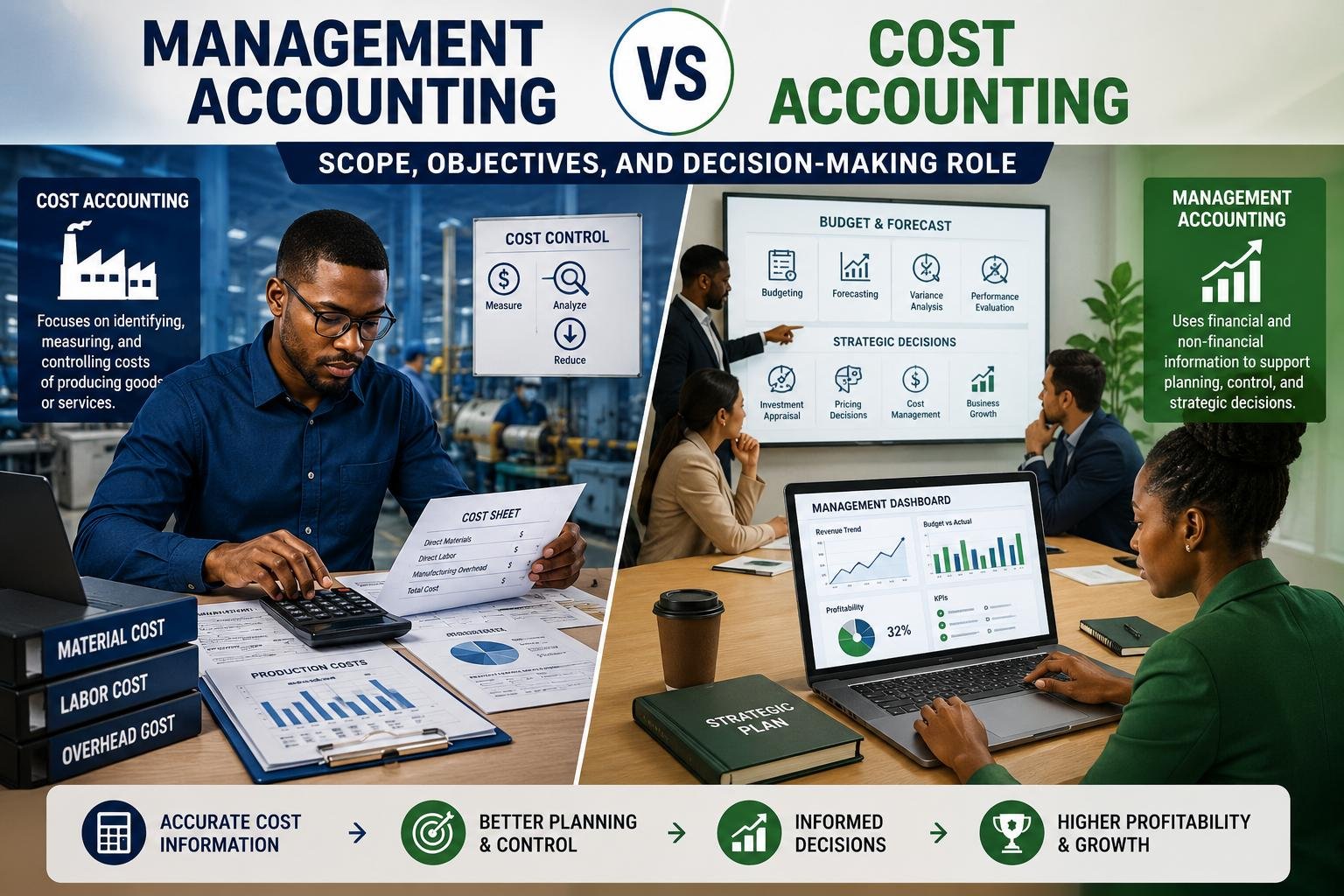
One of the most difficult concepts to grasp for students, business owners and professionals involved in accounting other than the financial reports knows the difference between management accounting vs cost accounting. The function of financial accounting is to prepare financial reports for external users such as investors, lenders and regulators is something many people are already familiar with. But they tend to believe that management accounting and cost accounting are identical, as both are for internal use in the business. These two branches are very similar, but not the same. Cost accounting focuses on the collection, measurement, control and analysis of costs, and management accounting relies on the cost information, in conjunction with financial and non-financial information, to aid in planning, decision making and business strategy. This correlation is vital as it is important for organizations to understand how both disciplines can contribute to profitability, efficient resource allocation and staying competitive in a dynamic market. If a firm accurately measures its costs but is unable to explain them for decision-making, then it will have a hard time being successful in the long run. Similarly, a company that goes through strategic planning without proper cost data will be making poor decisions that will lower profit of a company rather than raising it. This article briefly discusses the scope, objectives and decision role played by both the branches of accounting and demonstrates the contribution by cost accounting to the development of management accounting in providing valuable inputs to the managers for taking decisions.
Cost Accounting as related to Management Accounting.
It is crucial to understand how the two branches of accounting operate before one can consider any differences. Cost accounting is mainly devoted to the problem of finding out the cost of producing goods or rendering services. It tracks the spending of money, determines production costs, evaluates the efficiency of the operations and enables companies to manage unnecessary costs. Cost accounting information becomes one of the highest value input of management accounting. The detailed cost information is then compiled with sales forecasts, market trends, operational performance and customer demand and financial projections to support managers in making informed business decisions, this process is called management accounting. In other words, cost accounting addresses the question of “How much does it cost?” whereas management accounting addresses the question of “What should we do next?” and/or “Which option will maximize profits?” From this relationship it is seen that cost accounting is often regarded to be a branch or a part of management accounting and not a distinct discipline. Managers rely on precise cost information to help them to create budgets, analyze investment possibilities, determine pricing models, and plan expansion.
Management Accounting – Definition
Management accounting involves gathering, analyzing, interpreting, and reporting both financial and operational data which helps in decision making by the management. Management accounting does not prepare financial reports that are used by external parties and governed by accounting rules like IFRS or GAAP, but only for the use of internal parties and management decisions. The reports produced in the framework of management accounting are tailored to the individual needs of the executives, department managers, project managers and business owners. Budgets, cash flow forecasts, variance analysis reports, performance dashboards, investment appraisals, profitability reports and strategic planning documents are examples of reports that could be included. It’s not just about keeping historical transactions; it’s about forecasting future performance and enhancing business operations. Management accounting reports can be prepared on a daily, weekly, monthly (or any other period as needed) basis, rather than on a fixed period schedule because internal managers need information in time. This adaptability enables companies to adjust rapidly to market changes, discover issues before they grow into monetary problems, and make appropriate adjustments before minor concerns turn into major monetary hurdles.
Objectives of Management Accounting
The main role of management accounting is to give useful information to assist the management in taking proper decisions. Reliable information on product returns, risk, costs and revenues is needed for any business decision, including new markets, new employees, new equipment, and new products. Management accounting can make this information clear and understandable. One of the other major goals is planning. Accounting information is utilized by the managers to prepare the operating budget, estimate the future revenues, forecast future expenses and set reasonable budgets for various departments. Management accounting also helps in control of the organization as the actual performance is contrasted with the planned performance using the technique of variance analysis. The comparison assists managers in comprehending why outcomes are not as expected and to take corrective action. Another important goal is performance evaluation as organizations want to know if departments, projects, products or employees are meeting their expected goals. Besides, management accounting helps in strategic planning by analyzing investment opportunities, risk assessment, measuring profitability and long-term business growth. While historical financial records are still a key part of management accounting, it also urges managers to think outside the box and make forward-looking decisions using solid data.
What is Cost accounting?
Cost accounting is one of the specialized areas of accounting that deals with the measurement, recording, classification, allocation and analysis of production costs. It is primarily used to calculate the actual costs of making a product or providing a service and to look for ways of increasing the efficiency and cutting down on unnecessary costs. All businesses have expenses such as Direct Materials, Direct Labor, Manufacturing Overhead, Administrative Expenses, and Operating Expenses. These expenses are carefully monitored by cost accounting to allow managers to understand just what the cost of each product, service, department or project is. This information can be used for setting selling prices, assessing the efficiency of production, finding waste and boosting profitability. Cost accounting is not the same as financial accounting, which is used to report on the overall financial performance of a business, but rather a study of the detailed cost structure of the various business activities. It delivers highly specific information to the manager, which helps in making improvement in the operations and making effective use of resources. From carmakers to food producers, software developers to consultants, it is crucial for businesses to know the reality of running a business to stay competitive and profitable.
Objectives of Cost Accounting
Cost accounting objectives are primarily related to cost determination, cost control and operational efficiency. Correct costing of product/service enables companies to set correct selling prices with acceptable profit margins and in a competitive marketplace. The other purpose of cost accounting is to detect any unnecessary cost, inefficiencies and waste that add to the operating cost without providing any value to the business. Managers can identify resource underutilization in production processes or where costs are going over acceptable limits by analyzing production processes. Another vital goal is to facilitate budgeting and standard costing, that is, setting up the levels of expected costs that can be compared with actual costs. Cost accounting also helps in calculating the value of unfinished goods, finished goods, and raw material that can be used to value their inventory. Cost accounting is particularly significant in the manufacturing industry, where it directly impacts pricing strategies, profitability, and market competitiveness. With constant cost monitoring, organizations can enhance productivity, optimize resource usage, and boost the general monetary efficiency.
The Role of Management Accounting
The role of management accounting is not limited to simply analyzing costs, it’s much more than that. Financial information is analyzed by management accountants, together with the information of other functional areas such as operational, marketing, human resource and economic information, to give a comprehensive picture to managers. They are tasked with creating budgets, making predictions, analyzing investments, analyzing business risks, assessing departmental performance, measuring profitability, and assisting in strategic planning efforts. They also get involved in capital budgeting and pricing decisions, cash flow management, performance measurement, and process improvement in the business. Technology, Business Intelligence systems, predictive analytics and Key Performance Indicators are becoming more commonplace in management accounting and are helping to give decision-makers real-time information to help them make more rapid and effective decisions. Management accounting does not simply focus on cutting costs, it aims to create the most value that an organization can give its customers while taking into account the maximizing of profit, growth, operational efficiency, customer satisfaction and long term sustainability.
The scope of Cost Accounting
The scope of cost accounting is more specific in that it focuses on the identification, measurement, control and analysis of business costs. To aid in the understanding of how costs are being spent, cost accountants categorize costs as a) fixed costs; b) variable costs; c) direct costs; d) indirect costs; e) controllable costs; and f) uncontrollable costs. They create costing systems such as job costing, process costing, activity-based costing and standard costing, depending on the type of an organization’s activities. Other functions of cost accounting include variance analysis, cost control techniques, inventory costing, production cost analysis, break-even analysis and efficiency measurement. These activities enable organizations to gain insight into the use of resources in the production process and the potential for improvements. While cost accounting is not as broad as management accounting, detailed cost information is a key foundation to many other managerial decisions. Managers would be unable to make realistic budgets and/or assess investment opportunities or sell prices without cost measurements.
Management Accounting Supports Cost accounting.
The simplest way to comprehend the connection between such disciplines is to consider cost accounting the information provider and management accounting the decision maker. Cost accounting collects the information about the details of production costs, operating cost, labor efficiency, material consumption, overhead allocation and inventory costs. This information is then used by management accounting, which uses it and other financial and business information to respond to strategic questions that the organization is facing. If the cost accounting shows that the raw material costs are going up considerably, management accounting can be used to determine if the company should raise product prices, bargain with suppliers, redesign products, cut operating costs or look into other materials. In the same way, costing could reveal that one particular manufacturing section does not perform as efficiently as other sections. The information is used by management accounting to suggest process improvements, equipment investments, employee training programs or restructuring operations. Thus, cost accounting gives the details of the facts and management accounting converts the facts into actionable business strategies which enhance the performance of an organization.
The Role of both in Budgeting, Forecasting and Strategic Decision Making
Cost accounting and management accounting are interdependent and budgeting is one of the most evident examples of their interdependence. Cost accounting provides the data for past production costs, labor costs, overhead rates and material usage that are used to create future budgets. These trends are combined with demand for the product in the market, Inflation, Economic outlook, sales forecast and business goals to develop detailed Operating budgets for the management accounting. In forecasting, the role of cost accounting is to give reliable cost information and management accounting is to determine future revenue, profit, cash flow and investment needs. The collaboration between these fields is even more critical to strategic decision making. To expand products, markets, acquisition of equipment, outsourcing products, decision to drop unprofitable products managers need to have an accurate cost information and a wider financial analysis. Cost accounting provides the numbers and management accounting assesses the options, risks, compares returns, and advises on which is best for the organization in the long term. When used together, they provide businesses with the ability to make informed decisions, instead of relying on speculation.
Differences between Management Accounting and Cost Accounting
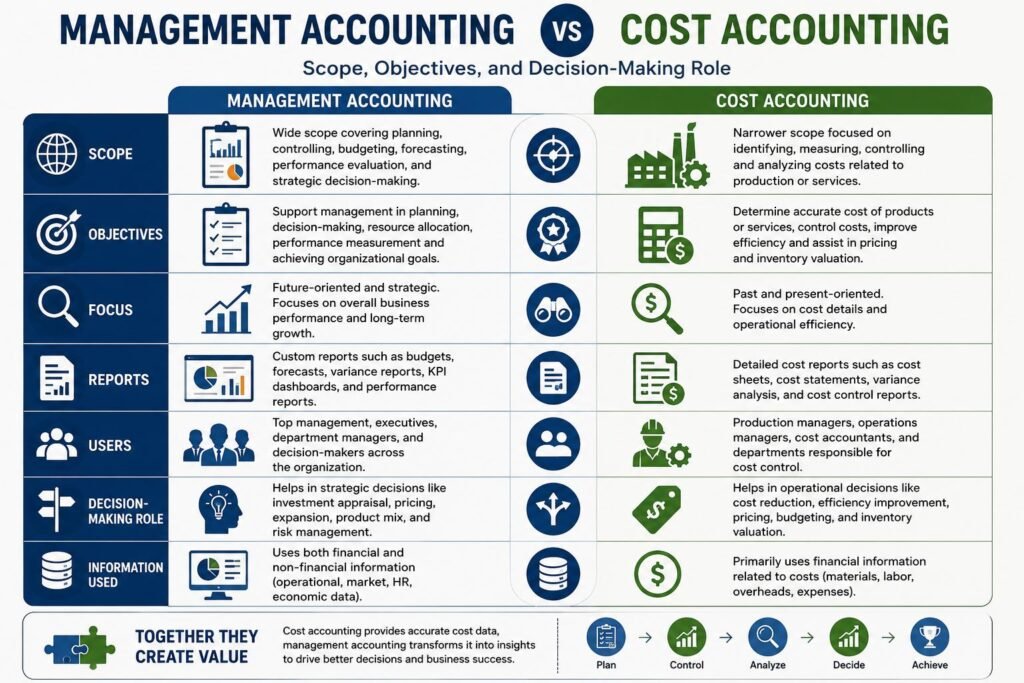
While management accounting and cost accounting have many commonalities, there are some differences between the two. The scope of management accounting is much wider as it aids in all management activities such as planning, controlling, forecasting, budgeting, performance evaluation and strategic decision making. On the other hand, the cost accounting is aimed at the identification, measurement, control and analysis of the cost arising from the operations of a business. Management accounting employs both financial and non-financial information while cost accounting focuses primarily on financial information related to cost. The audience also varies, since management accounting is mainly used by the executives, senior management and decision makers throughout the organization, cost accounting is more useful to the production managers, operations managers and departments tasked with cost control. The other difference has to do with reporting. Management accounting generates tailor-made reports for managerial needs and cost accounting generates detailed cost reports that explain the cost of production, cost of inventory and operational efficiency. Although there are these differences, both branches complement one another and when embedded in a single management information system, organizations can reap the best benefits.
Business Companies Need both Types of Accounting.
Companies that use only cost accounting might have a good idea of the cost of products, but not necessarily a good guide to strategic decisions for future growth, investment or market expansion. However, companies that focus on management accounting without proper cost data may make decisions on incomplete or inaccurate data. Companies are thus successful if they bring together both of these disciplines and use them as part of their decision making process. Cost accounting helps managers understand how efficient operations are, how profitable their products are and how costs behave; management accounting provides the information in a way that enables managers to plan how the organization will perform better. When combined, they can aid in pricing strategies, budgeting, forecasting, investment analysis, resource allocation, performance evaluation, cost control, and long term business sustainability. With the emergence of a more competitive environment and the growing complexity of business life, the capacity to have cost information that is both accurate and relevant to strategic analysis is a growing competitive edge.
Conclusion
Management accounting system and cost accounting system both are closely related but have different purposes in the organization. Cost accounting is used to identify measure and control costs, with specific information on the use of resources during the process of the business. Building on this, management accounting incorporates cost data and financial analysis, financial forecasts, operational data and strategic planning tools to assist managers in decision making. These accounting fields do not necessarily compete with each other; in fact, they all work harmoniously to transform correct accounting information into information that helps with business decisions. Companies with a grasp of this correlation are better positioned to set up sensible budgets, maximize operational efficiency, assess investment opportunities, design lucrative pricing strategies, and foster sustainable growth. If people are already familiar with financial accounting and the fact that it is for external stakeholders, understanding how cost accounting processes information for management accounting will open the door to understanding how decision making in modern businesses, and effective business management, works.
Get more well researched information about Management Accounting vs Cost Accounting here.