Introduction
Being a small business owner is more than a product or service salesperson. A profitable business always has a dependable bookkeeping system that maintains the books and records organized, accurate and current. Business opportunities are lost, tax penalties are incurred, financial reports may be inaccurate, and cash flow problems occur, but many entrepreneurs don’t realize that these issues are financial problems created by inadequate bookkeeping.
Bookkeeping is a task of recording, organizing and keeping a record of the financial activities of a business. It gives the financial backbone that enables business owners to know where they are getting their money from, where it’s going and if they’re making a profit or not. Lack of proper bookkeeping can make it hard to create or support decisions or prove financial strength to investors, lenders or tax authorities.
The first step to a healthy financial system is the development of good basic bookkeeping practices. Such habits make financial management easier, cash flow more efficient, avoid costly mistakes, and make tax preparation a lot easier. From starting a new business to running a successful small company, maintaining regular bookkeeping can ultimately be beneficial for businesses both in terms of time and money.
The Importance of Good Bookkeeping
Small business owners aren’t aware of the significance of bookkeeping until the financial issues start to show up. Some only update their records once a year, during tax season, and others just don’t have proper records, or they rely on their memory to get things right. Unfortunately, the lack of consistency in bookkeeping can result in lost receipts, unpaid invoices, triple-doubled expenses, inaccurate tax returns and bad financial choices. These problems can easily escalate into bigger problems that can jeopardize the stability and profitability of the business.
A company’s financial health is clear when it is properly maintained by good bookkeeping. Good record keeping information keeps the business owner informed of income, manages costs, pinpoints products and/or services that are profitable, can help create a realistic budget, and can help in planning future investments. Good bookkeeping is key to financial statements like the income statement, balance sheet, and cash flow. Having complete and organized records will give business owners the confidence to make strategic decisions based on reliable, accurate financial information and not assumptions or estimates.
1. Keep Personal and Business Finances Separate.
It is one of the most essential bookkeeping tips that every entrepreneur must follow and that is to separate out their personal and business money. When personal and business transactions are intertwined, it can cause confusion and make bookkeeping harder and more likely to be done incorrectly. It can also make tax season difficult since business and personal expenses can be in the same bank account and/or left on the same credit card statement making it difficult to distinguish.
One of the easiest methods to achieve financial separation is to open up a business bank account. It is also advised that business owners get a different business debit or credit card for business transactions and instead of paying business expenses with personal funds. Any expenses that are paid out of the owner’s pocket for business use should be documented as owner contributions or reimbursements. Keeping this separation creates financial transparency, enhances internal controls and helps defend the legal separation between the business and the owner, particularly for registered business entities.
2. Record Every Financial Transaction Promptly
Consistency is crucial to successful bookkeeping. Many people wait to the end of the month or the end of the quarter prior to making the transaction record on the books, which can lead to forgotten expenses, misplaced receipts, and inaccurate records. Transacting as things happen means keeping information current in financial records and substantially lightening month end / year end closing loads. Regular bookkeeping is also more useful for small business owners to track cash flow and to notice when their spending is becoming irregular.
All transactions should be recorded, such as sales, payments received from customers, bills received from suppliers, costs, wages, loans repaid, bank charges and owner’s investments. This can be largely automated using modern bookkeeping software that can be linked with the business bank account and automatically pull in transactions. But, don’t forget to also review regularly, however. Business owners should always confirm that all transactions are classified properly, so that the business can be reported accurately and gain reliable business insights.
3. Track and Organize Every Receipt
Each expense that is recorded is supported by the receipt. When audited by the taxman, businesses might have a hard time supporting deductions without receipts and also confirm the validity of purchases. The absence of receipts can cause tax deductions to be denied, expense reporting errors, and missing financial records. An organized receipt management system is therefore one of the easiest, yet most beneficial bookkeeping practices any entrepreneur can employ.
Mobile scanning applications or accounting software that could store receipts electronically should be the option used to digitize receipts in lieu of putting them in random folders or drawers. Receipts must be sorted by Expense Type, Supplier and Date of Transactions for quick retrieval. Having organized digital records will not only help to minimize your physical storage space needs but, if you need to provide financial documentation in support of a financial report, audit, loan application, or tax filing, and then it will also be easily accessible.
4. Reconcile Bank Accounts Regularly
Bank reconciliation is accounting checks and balances to bank statements in order to make sure that the financial information in both records is the same. This practice will help to catch any mistakes that may have been made in the recording of transactions, duplicate transactions, unauthorized withdrawals, deposits that may have been lost, and errors made by banks. Monthly reconciliation offers a much more accurate and confident financial reconciliation than many businesses will reconcile at year-end.
A regular reconciliation with the bank also makes fraud more difficult to get away with and helps to enhance internal financial control. Discrepancies between the bank statement and the accounting records can be investigated immediately if the payment is listed on the bank statement. Similarly, the absence of deposits or incorrect charges becomes apparent and supporting documentation will be available. By maintaining consistent reconciliation, business owners will have the correct cash balances in their businesses, and can make sound decisions about spending and investing, without the need for incorrect account balances.
5. Be Mindful and Aware of Accounts Receivable.
Accounts receivables are the amount of money owed by customers for products and/or services that have been provided. Making sales is critical, collecting on them in a timely manner is equally critical. Financial problems can plague many profitable businesses simply because customers don’t pay on time. Good bookkeeping also means that outstanding invoices are monitored and any customers who are late with their payments are followed up regularly.
Invoices should be sent out immediately after finishing the job, payment terms should be clearly explained and records of the customers should be kept up-to-date. Aging reports group outstanding invoices by the number of days they have been overdue, which assists business owners in concentrating on the collection efforts for outstanding balances before it becomes a bad debt. Collection rates can be increased and, with a little extra effort from staff, business relationships will remain positive by sending polite payment reminders, offering convenient payment options and communicating professionally with customers.
6. Stay on Top of Accounts Payable
An accounts payable account is the one that you need to pay to suppliers, contractors, utility companies and other creditors. Their management can ensure positive supplier relations, avoid late payment penalties and negative credit ratings and ensure that no extra interest charges are incurred due to the late payment. Another potential problem with AP is that multiple bills may be due at once, if not planned for, which can create a cash flow issue.
There is a system for bookkeeping which keeps a record of all supplier’s invoices from the time they are received and until they are paid. Keeping track of the payment deadlines, smart planning of payments and regular auditing of the remaining payments make a business capable of avoiding delays and make good use of cash. Additionally, some suppliers provide early payment discounts so that, the firms can cut their working expenses by paying the bill earlier. With proper accounts payable management, therefore, there is a direct contribution towards enhancing the financial strength and trust of the suppliers.
7. Ensure that the Expense Categories are Accurate.
One of the most crucial tasks in managing expenses is identifying them correctly. Correct expense classification is key to creating helpful financial reviews and streamlining tax filings. Each expense item should be a part of the proper account (office supplies, rent, utilities, advertising, travel, insurance, professional services, equipment maintenance, employee wages, etc.). Proper classification enables business owners to know and understand where their money is going and what they can do to cut down on unneeded expenses.
Filing incorrect expenses can make for a confusing tax return and mess with the numbers. An example of this is if the recording equipment is treated as an ordinary operating expense rather than an asset, then the depreciation calculation and reporting could be affected. Having expenses carefully sorted also allows enterprises to compare the financial activities of the various months or years and this process will be of great help in making the budgeting and forecasting accurate.
8. Check up on Financial Reports Regularly.
Bookkeeping is more than entering financial data in accounting software. It is the reports that are created from those logs that really matter. Financial statements should be reviewed on a regular basis to ensure that the business is profitable, that there is a positive cash flow, that operating costs are kept under control, that liabilities are not excessive, and generally to see how the business is doing. However, reviewing financial reports during tax season can leave many problems undiagnosed, since by then it may be too late to make changes that would have avoided the issues.
The monthly review of the income statement, the balance sheet and the cash flow statement will offer valuable insights to business performance. These reports indicate if revenue is growing, expenses are controlled, if customers are paying timely, and if there is enough cash to meet upcoming obligations. Financial analysis is conducted regularly to make improved pricing decisions, inventory management decisions, hiring plans, and investment decisions and for an entrepreneur to react in time to changing business conditions.
9. Use Reliable Bookkeeping Software
Technology has revolutionized bookkeeping and made keeping financial records quick, efficient and less cumbersome. Today, all bookkeeping software can perform repetitive tasks including transaction imports, invoice generation, tracking expenses, reconciling bank accounts and reporting on finances. These help to minimize the chance of human error, and provide business owners with real-time access to essential financial data, from anywhere.
Business size, transaction volume, reporting requirements, and business plans for the future should be the key factors used to choose bookkeeping software. Whether or not they select a platform, the important thing is to stick with it. Regular software upgrades are necessary, financial information should be securely backed up, and access to sensitive financial information should be carefully managed and monitored. Despite the advanced automation, it is best for business owners to regularly review the records to help them keep accurate records and ensure that records are complete.
10. Get Ready for Tax Season all Year Long
The tax season can be stressful for many entrepreneurs because their financial records have not been kept up to date. Tax preparation should not be a project, it should be a regular component of the bookkeeping process for businesses. Having financial paperwork in order all year long decreases the odds of missing deductions, false tax filing and searching for documents at the last minute.
Bookkeeping files should be well-organized, and include an organized file of receipts, payroll records, bank reconciliation documents, invoices, expense reports, depreciation schedules, and tax related documents. It’s also important for businesses to take proactive measures and put aside money regularly to pay future taxes on time, rather than waiting until deadlines. Compliance can be enhanced even more by working with a qualified accountant or tax professional throughout the year, while uncovering tax saving strategies that haven’t been considered.
11. Develop a Regular Bookkeeping Schedule
One of the most important bookkeeping tips is that you should be consistent. With the best accounting software or financial advisor, it’s not enough to make up for poor financial paperwork. It is important to bookkeepers to have a specific time devoted to updating books, reconciling accounts, organizing receipts, reviewing invoices and analyzing financial reports weekly, so that the bookkeeping tasks are not overwhelming. Small, regular work makes a big difference compared to trying to do all the bookkeeping in a month’s time.
A weekly bookkeeping schedule promotes financial discipline and helps business owners see the issues before they get out of hand. The regular reviews increase the confidence in financial reports, enhance decision making and decrease administrative headaches throughout the year. As the business grows, these practices become a vital part of its operations and provide a solid financial base for a sustainable future and long-term business success.
Conclusion
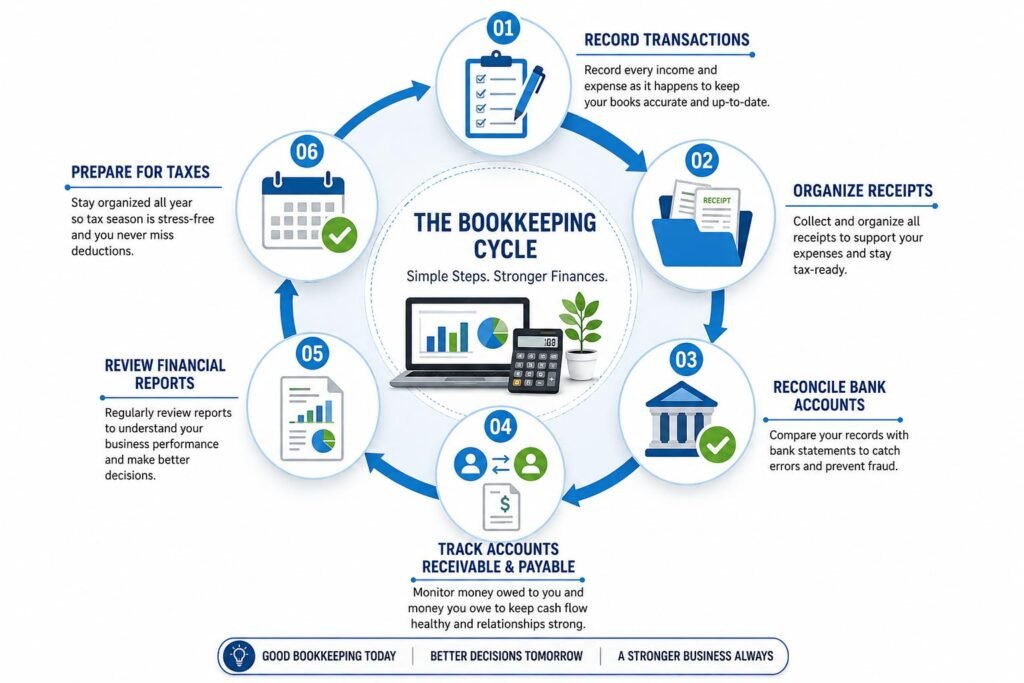
Good bookkeeping can be implemented by any business, whether it’s a large corporation or an accountant. There are strategic habits every small business owner can foster that will help them be better organized, more effective at managing cash flow and be less stressed when it comes to taxes. Having separate personal and business accounts, keeping receipts up to date, organizing receipts, reconciling your bank accounts, tracking receivables and payables, checking financial reports and keeping an even bookkeeping schedule all help to promote healthier financial management.
Bookkeeping is just about seeing the monetary tale of a business. Precise records will give you the data you need to make more informed decisions, get financing, meet tax requirements, and confidently plan for future expansion. Those who practice diligent bookkeeping practices set their businesses up for a more stable, profitable and successful future in a competitive market.
Get more well researched information about Essential bookkeeping practices for small business owners here.