Introduction
It is important to have the right financial information to make decisions, gain investor interest, meet tax requirements and evaluate performance, all successful businesses have these. The accounting cycle is a set of steps behind every balance sheet, income statement and cash flow statement. The accounting cycle refers to the sequence of accounting tasks that accountants perform in an accounting period to record, classify, summaries and report the transactions. It is one of the most significant steps for accounting students and future accountants to grasp this process, as it affords them insight into how daily business transactions become useful financial data. Learners do not just learn about journal entries, ledgers and trial balances, they learn how each stage is interdependent and how it helps to ensure accurate financial statements. The accounting cycle also helps minimize the chance of errors, increases the accuracy of financial data and increases confidence in the financial statements of businesses of all sizes.
Understand the Accounting Cycle.
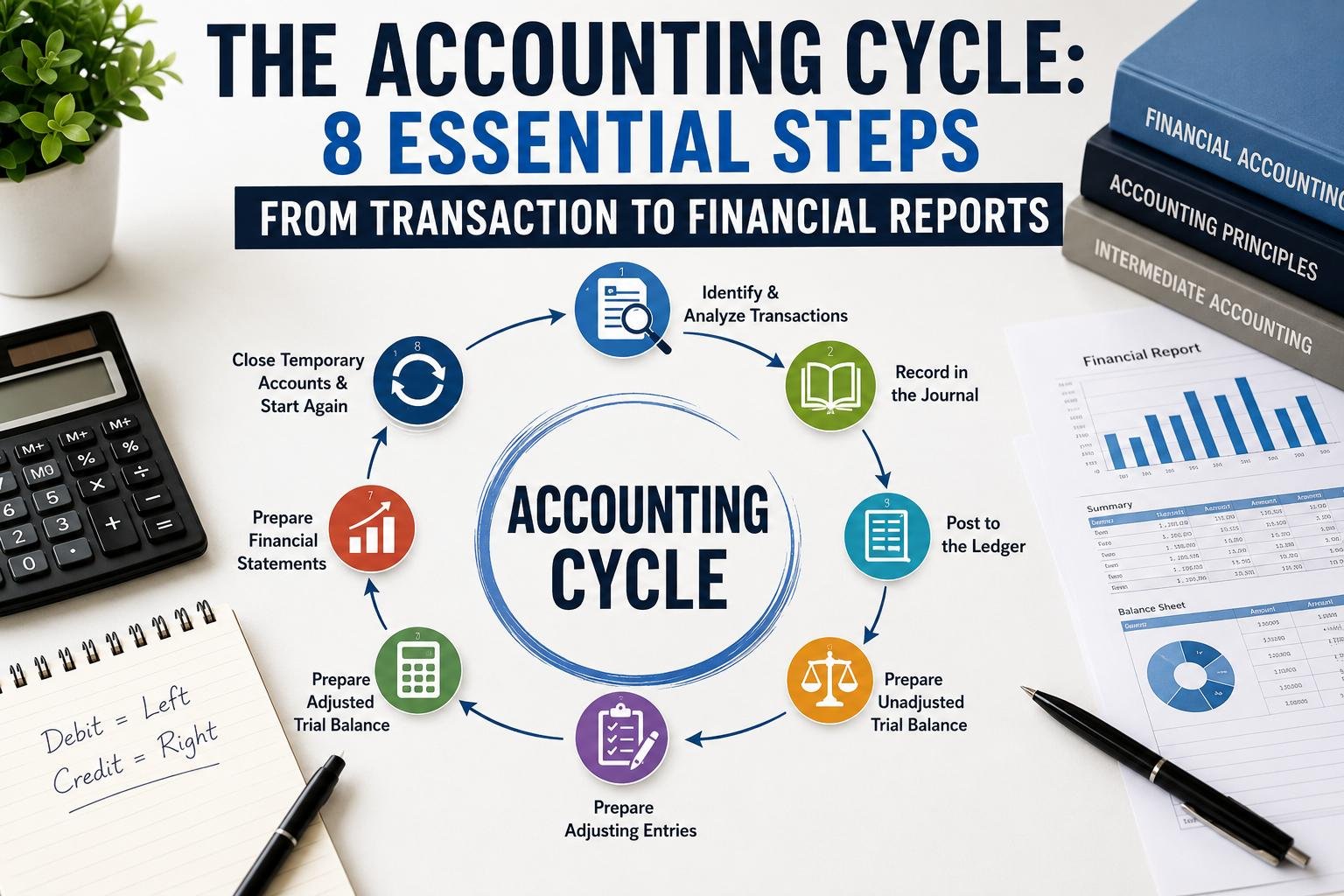
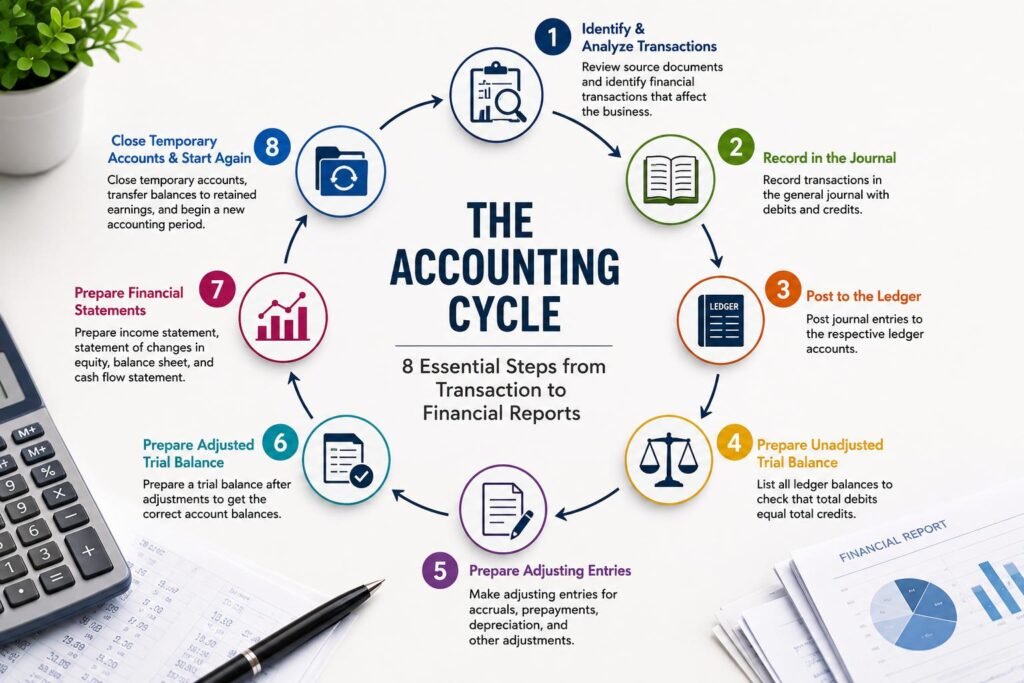
The accounting cycle is the entire sequence of steps used to determine the amount of business transactions, to record them in the accounting records, to adjust the balances (if needed), and to prepare financial statements for those users of accounting information. It starts from the time a financial transaction takes place and ends when temporary accounts are closed when preparing for a new accounting period. While today most of these tasks are done automatically by accounting software, today’s accountants are still required to have an understanding of the process to identify errors, to interpret the financial information properly, and to ensure it is in compliance with accounting standards. Failing to follow one or more of the accounting cycle steps may lead a business to prepare an inaccurate financial statement that can cause managers, investors, and creditors, as well as taxing authorities, to be misled. Because it shows all the steps in the accounting cycle from source documents to final reports, the full accounting cycle is a good foundation for all accounting students.
Why is it that the Accounting Cycle is Important?
The accounting cycle is significant because it is a process that makes the financial reporting procedure consistent and accurate. There are hundreds or thousands of transactions per month that a business will have to go through and if it’s not a system, important information may not be recorded, duplicated or completely lost. The accounting cycle provides a process that captures, categorizes and records all transactions in the company’s financial statements. This uniformity can be used to measure performance across time periods and make decisions on budgeting, investments, and operations. It also serves external parties like banks, investors and governments with reliable information on the financial status of the organization. When accounting students learn the cycle, they grasp the logic of how each accounting topic (journal entries, adjusting entries, financial statements) relates to the other and much more easily see the big picture of each topic as part of a whole.
Step 1: Identify and Analyze Transactions
The first step in the accounting cycle is to identify and analyze financial transactions that have an impact on the business. Not all events are considered accounting transactions. For instance, when a new employee joins the company, this is an important moment, but is not registered until the moment it impacts the company’s money with salary payments or other costs. The types of transactions recorded are: sales, purchases, payments, borrowing of money, receipt of cash from customers and acquisition of assets. To identify the type of each transaction, accountants review source documents like invoices, receipts, bank statements, purchase orders, and payroll records. In this phase, accountants determine which accounts are involved and determine if each of these accounts should be debited or credited. Important analysis takes place at this stage as mistakes here can be carried over the rest of the accounting cycle and has an impact on the reliability of the financial statements.
Step 2: Record Transactions in the Journal
Journal entries are used to record transactions in the general journal after they are analyzed. This is referred to as the “journalizing” step. The book of original entry is general journal because the transactions are first recorded here, and then posted to other books. The date, accounts affected, debit and credit amounts and a brief explanation of the transaction are written into each journal entry. Assume that a company buys $500 of office supplies for cash. The Office Supplies account would be debited (asset would increase) and Cash would be credited (asset would decrease). Journal entries are made in chronological order to easily verify transactions from their source documents in the event of any future queries. The reason for this is that every transaction will impact on two or more accounts and that debits always equals credits in this stage of the double entry bookkeeping system.
Step 3: Post Journal Entries to the Ledger
Once transactions have been posted in the journal they are then posted in the ledger accounts. The general ledger has the assets, liabilities, equity, revenue and expenses accounts each with their own separate account that can be viewed individually by the accountant. The ledger is organized by account type, whereas the journal records transactions in chronological order, it makes it easier to analyze account balances and make reports. All cash related transactions are recorded in Cash account, for instance, and all sales transactions are recorded in Sales Revenue account. Posting enables the accountant to see the cash at hand, the amount that customers owe the business and the amount of business expenses that have been settled. If the ledger wasn’t there, the bookkeeper would have to do a lot of work to make the financial statements, reviewing dozens or hundreds of journal entries one by one, which would be inefficient, and prone to error.
Step 4: Prepare the Unadjusted Trial Balance
After all the transactions are posted to the books, then accountants create an unadjusted trial balance. The trial balance is used to ensure that all debits have been matched with all credits following the completion of all transactions. The trial balance is a list of all ledger accounts with the total debit or credit balances shown on the right-hand side and is used to separate the debit balances from the credit balances. If the totals are not equal, the totals must be corrected first because there is some error in the accounting records. Errors may still exist, though, even if the total debits and total credits are equal, as some errors will not affect the equality of debits and credits. Such as entering the number incorrectly in both accounts or entering a transaction in the wrong account category. Despite the restrictions it contains, the trial balance is still a significant part of internal control for the accountant as it can help identify and rectify errors before financial statements are produced.
Step 5: Prepare Adjusting Entries
Some transactions may need adjusting at the end of an accounting period as they may have taken place but not been fully recorded. Adjusting entries are used to ensure that the revenue and expenses are recorded when earned or incurred, and that the matching principle is followed, in accordance with the accrual basis of accounting. Examples are depreciation expenses, accrued salaries, prepaid insurance, and unearned revenue. Let’s assume a company pays its insurance premiums once a year in advance. Some of the prepaid insurance needs to be adjusted during the month to recognize as an expense. Likewise, staff could have been paid salaries that will not be payable until the next month, and thus accrued salary costs have to be posted. The adjustments enable the financial statements to be more accurate than financial statements would otherwise be, in that they would simply show the changes in cash in and out of the account for the period.
Step 6: Prepare the Adjusted Trial Balance
Once all the adjusting entries have been made to the ledger, accountants create an adjusted trial balance. This is like the unadjusted trial balance except that it has been adjusted for all adjustments at the end of the accounting period. The adjusted trial balance is the final account balances to be used for the financial statements. Adjusting entries may have an impact on the accounts of revenues and expense, so this statement helps that the amounts of revenues and assets are correct before financial statements are prepared. Once the debit and credit balances are equal, after making adjustments, accountants can continue to the next step in the accounting cycle with a great deal of confidence. Though it is an important step that many accounting students do not realize the importance of, it serves as a last check before the financial statements are created and shared with users that are using them to make decisions.
Step 7: Preparation of Financial Statements
The adjusted trial balance is the basis for making financial statements. Typically, the first statement to be prepared is the income statement, which presents the revenues, expenses and net profit/loss for the period. The net income is then added to the statement of changes in equity or retained earnings statement in which the effect of profits, losses, and owner withdrawals are shown. Then, the accountants compile the balance sheet that presents the company’s assets, liabilities and equity on a particular date. Lastly, many businesses would create cash flow statement to illustrate cash flows from operating, investing and financing activities. The financial reports are of great value to managers, investors, creditors, employees and regulators. They convert thousands of transactions into usable information that shows the financial position and performance of the organization.
Step 8: Close Temporary Accounts and Start Again
The last stage in the accounting cycle is to close temporary accounts for the next period of accounting. Revenue, expenses, drawings/dividends are all temporary accounts since they are limited to one accounting period. These accounts are closed when their balances are transferred to the owner’s capital account or retained earnings. Revenue and expense accounts are closed by bringing their balances to zero and then expense accounts are reset to zero after they have been transferred. The accounting period will be opened with zero balances and it will enable businesses to compare their performance from one accounting period to another. Those accounts not closed because the amount of the account will carry over to future periods are referred to as permanent accounts. After closing of the accounts, accountants can generate a post-closing trial balance to verify that only permanent accounts are open.
Common Errors That Occur During the Accounting Cycle
Errors may be made at any point in the accounting cycle but they are a logical sequence. It is possible for transactions to be entered twice, for amounts to be posted to the wrong accounts, or for amounts to be incorrect. Accountants might also neglect to make adjusting entries, which results in the wrong time of reporting of expenses or revenues. Errors in the calculations may also impact on the financial statements and result in poor decision making. Making reconciliations, independent reviews and using accounting software that has built-in controls are the best ways to minimize errors. But some things can’t be done by technology: mistakes can still be made if software requires accurate information to be entered by users. The accounting cycle helps accountants’ spot unusual balances and investigates them before they are included in the financial reports and shared with stakeholders.
How Accounting Software Has Changed the Accounting Cycle
Today’s accounting software has taken the accounting cycle much further, and the number of manual tasks accountants must perform is much smaller. You can import transactions directly from bank accounts, create invoices automatically and generate financial statements in seconds. Although technological improvements have been made, the principles or aspects of the accounting cycle have not changed. The process for software is the same as follows: Identification of transactions, recording of entries, posting to the ledgers, making adjustments, and reporting. Therefore, it is important that accounting students learn about the manual process first otherwise they will not be able to use technology to perform the calculations. Employers still prefer people who know the advantage that a system offers and not just take software out of the box and accept it. Having a solid grounding in accounting principles helps to understand and work with accounting technology more effectively and resolves issues when they arise.
Conclusion
The accounting cycle gives a clear path to follow and helps to convert each business transaction into a dependable financial report. Each of these transactions is important in helping to ensure the accuracy and integrity of accounting records, from transaction analysis all the way to the closing entries. Students with knowledge of the accounting cycle will be able to better appreciate the relationship of the various parts of the accounting cycle, journal entries, ledgers, trial balance, adjusting entries, and financial statements. They don’t see accounting topics as distinct pieces of information to memorize, but as steps in a logical process for which each has a certain meaning. Whether records are kept in a pencil and paper system or in a complex computer system, the accounting cycle is the basis upon which financial reports are prepared and one of the most important concepts that all aspiring accountants must learn.
Get more well researched information about Accounting Cycle here.