Introduction: Understanding the Importance of VPN Technology in the Digital Age
VPN technology is crucial in the digital age because it offers a wide range of benefits.VPN technology is an essential component in the digital age because of the myriad of benefits it provides.
The Internet has revolutionized the way people communicate, communicate with others, work, learn, shop and obtain information, and it has created additional privacy and security issues. All users of a computer have been exchanging information with websites, applications and online services every time they connect to the internet. This exchange could include browsing information, approximate location, and even network information. Personal information can be vulnerable on an unsecured network, particularly a public Wi-Fi hotspot at an airport, hotel, café or library. VPNs, otherwise known as virtual private networks, are technologies that form a more secure and private relationship between a user and the internet. VPNs establish a secure relationship, disguise the user’s true IP address, and safeguard their private data from unauthorized access, making them vital for those seeking more control over their online privacy, whether individual, corporate, or working remotely.
A VPN secures a user’s connection between their device and VPN server before they log into the outside network. The process alters the way online traffic moves, and makes it difficult for an outside observer to easily track the information being sent. If you are looking to fully understand how VPNs work, it is important to understand the connection between encryption, tunneling, IP masking, and VPN protocols because this technology does not make you completely invisible online, but it does provide an extra layer of security that can allow you to decrease your vulnerability to tracking, data interception, and specific online dangers. With the increasing prevalence of the Internet in both personal and professional lives, understanding how VPNs work empowers individuals to make informed choices about safeguarding their online identities.
Virtual Private Network (VPN) – What is it?
A Virtual Private Network is a service that creates a secure network connection through a public or shared network, like the Internet. In normal circumstances, if a user accesses a website without using a VPN, their device will directly link to the website’s server. In the course of this process, Internet service providers, network administrators and other third parties may be able to monitor some information regarding the connection. With VPN, this process is altered by sending internet traffic via a safe VPN server. The user’s device will first communicate with the VPN provider’s server, and then the VPN provider’s server will communicate with the internet. This introduces an extra hurdle between the user and the websites he or she visits.
A main function of the VPN is to increase privacy and security by securing data as it travels throughout the networks. VPNs are widely used by people seeking to ensure their online activities are secure, businesses to protect their communications, and remote workers to access systems safely. VPN technology was created primarily for businesses to link their own employees and offices securely, but has been readily accessible for everyday users. Today, every VPN service offers applications for computers, smartphones, tablets, and various other internet-connected devices, allowing secure VPN connections to be available to more people.
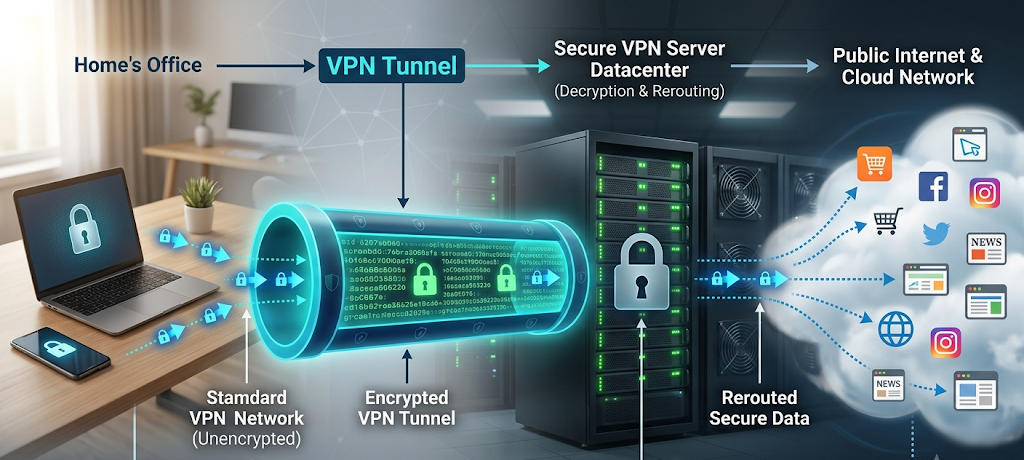
Understanding the basics of VPN connections and how they work.
VPN Tunneling: Building a Secure Tunnel for Data.
Tunneling is one of the most crucial ideas of VPN technology. The concept of VPN tunneling is the creation of a private pathway through which the internet data flows between a user’s device and a VPN server. The link remains on the public internet network but the data is placed within a secure tunnel which excludes it from regular internet traffic. This tunnel functions as a secure channel through which information can flow safely and securely, without the possibility of unauthorized access or manipulation. The tunnel is not a real tunnel, it is a concept of software techniques that organise and safeguard digital communication.
The user logs into a VPN and the VPN application communicates with a user selected VPN server. When the user’s data is sent through the tunnel, it is then encapsulated in encrypted packets. The information is then decrypted and transmitted to its final destination on the internet when it arrives at the VPN server. Site responses are processed in reverse, passing through the secure tunnel and VPN server until they reach the user’s device. In this way, this process prevents attackers on the same network from getting access to the sensitive data like login information, message content, or financial data.
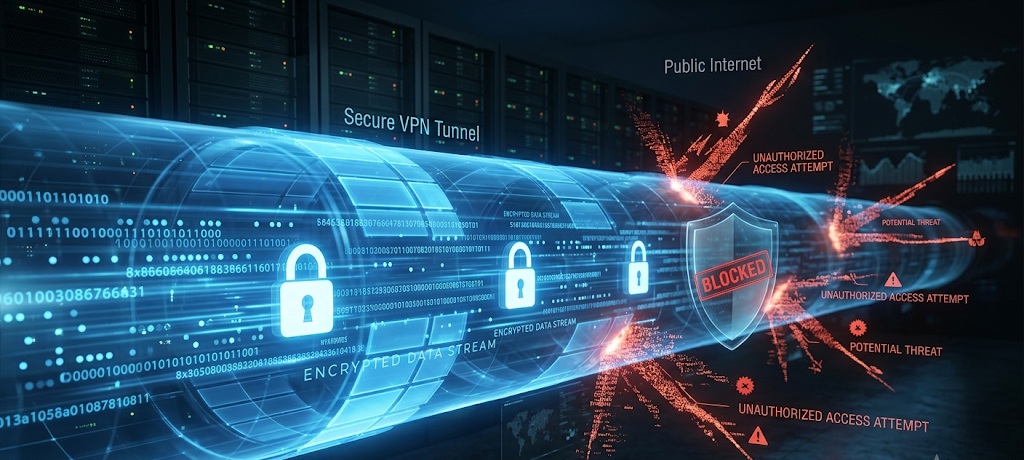
Principle of encryption and how to prevent unauthorized access to data.
VPNs also have a number of important features that help ensure that information on the internet is secure, such as encryption. Encryption is the transformation of readable information into unreadable information with mathematical methods. Information can only be deciphered and made intelligible by those who have the proper cryptographic keys. The data transmitted over networks might be accessible to the wrong users if it is not encrypted, particularly with public networks where numerous devices are connected.
The best VPN services use high-quality encryption to ensure a high level of security yet have good performance. Encryption secures data like browsing history, emails, business files, and device-to-device communications. A VPN, for instance, encrypts the data that passes between the user’s computer and the Internet, making it much more difficult for other users of the same network to access. But encryption won’t guard users from all online dangers. A VPN doesn’t stop them from getting scammed, being targeted by Phishing attacks, downloading malicious files or entering private information with a dangerous site.
IP Masking: Hiding Your Digital Location
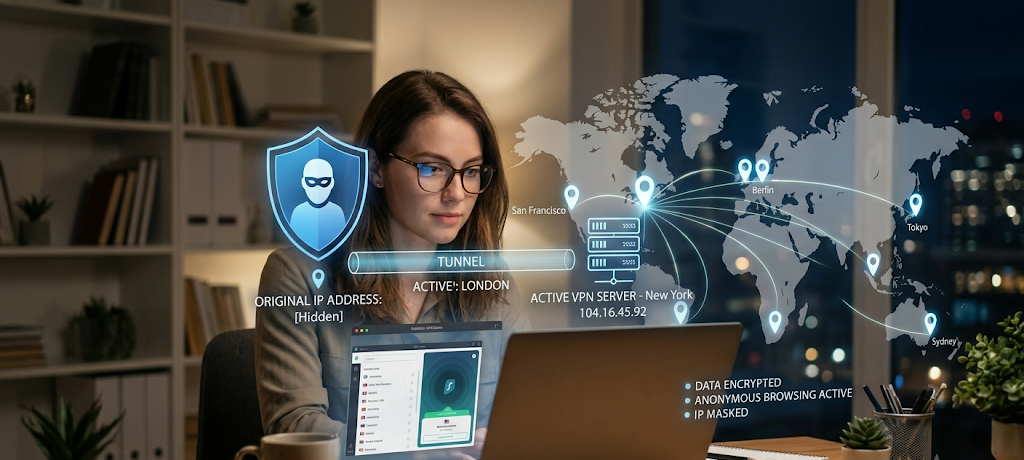
One more vital purpose of a VPN is IP masking. There is an assigned IP address for every device which is on the internet and functions as a digital identifier to make it easier for online services to determine the origin of requests. An IP address can identify things like a user’s general location and Internet service provider. With a VPN on, websites and online services will recognize the IP address of the VPN server rather than the user’s IP address.
This process affords increased privacy by making it harder for sites, advertisers and other entities to link online behavior with a user’s actual network location. For instance, a person from one country accesses a VPN server from another country, and websites assume that the VPN server is the other country. But, online tracking isn’t completely removed by IP masking. Cookies and other means of tracking, such as account activity, can still be used to gather information from websites.
Types of VPN protocols
OpenVPN
OpenVPN is among the most popular VPNs due to its combination of security, flexibility, and reliability. It’s a protocol that has been developed, tested, and refined by security people and developers over many years and is open source. OpenVPN can be used on various kinds of networks, including the strong encryption methods, which makes it both personal and business friendly. Many VPN providers use OpenVPN because it provides robust protection, and it can be customized to set VPN connection options.
Another benefit of OpenVPN is that it is able to operate on various ports, assisting it to keep working well on networks that may have restrictions. OpenVPN, however, may need more CPU power, due to its high level of security. Older devices may see slightly lower speeds with this protocol.
WireGuard
WireGuard is a relatively new VPN protocol that is built to be high-performance and more efficient and simpler in architecture. WireGuard’s design is smaller than older protocols, which have a lot of complex code. It’s easy to build and it offers high-performance connection speeds, yet it also offers high levels of security.
Many current VPN suppliers have embraced WireGuard since it is efficient on cell phones and networks with fluctuating connection quality. It can seamlessly switch between Wi-Fi and mobile data connections. Older protocols may still be in use by some organizations because they have undergone testing for longer durations of time than the newer protocol, WireGuard.
IKEv2/IPSec
Another popular VPN protocol is Internet Key Exchange version 2 (IKEv2) along with IPSec, particularly in the case of smartphones. It is cited for its connection stability when users switch from one network to another. For instance, when someone is on a phone and they switch to Wi-Fi, they don’t lose the VPN connection.
IKEv2/IPSec is secure and efficient, thus it is a favourite choice for mobile VPN applications. But it may vary according to the VPN company and functioning system. Users may also like other protocols over this as they provide them more flexibility and compatibility with different devices.
Advantages of Using a VPN.
Enhancing Privacy on Public Wi-Fi Networks
Public Wi-Fi networks offer easy access to the internet, but they can introduce security concerns as numerous devices from unknown sources may be linked to the network. While some networks are secure, others may not be. Sometimes, cybercriminals are able to gain information from users who do not realize that they are on an unsecured network. A VPN helps to mitigate these risks by providing encrypted Internet traffic and a secure tunnel between users and the VPN server.
When accessing work platforms, online banking services, personal files, and email accounts, travelers, students, remote workers and anyone who logs in to a public Wi-Fi network often need an added layer of security to prevent these services from being compromised, which is where VPNs can help. While users should remain good internet surfers, a VPN is a useful security barrier when using a shared internet connection.
Access to content and overcome geo-restrictions.
There are plenty of online services that offer different material to users depending on their geographical location. These may be in place due to licensing, regional policies or business choices. VPNs can also connect users across servers in other regions, thus making it look as if the user is browsing from another region.
This feature is typically employed by tourists who desire to receive services of their home country while traveling or by users who require access to information which may not be available in their current location. Users should note, however, that certain platforms do not allow VPNs and using the VPN to access restricted content could be in violation of some service agreements.
Improving security for remote working
There has been a rise in remote working and organisations need to ensure that information used within their systems is protected when users are working remotely from the office environment. VPNs can be used to secure remote workers’ connections to the workplace network. Employees can connect to the internet through secure channels of communication known as VPN channels, as opposed to sending sensitive company data through unsecured Internet connections.
Companies may opt for specialized corporate VPN solutions that incorporate extra security measures like access controls, user authentication, and monitoring tools. These systems ensure that only authorized persons can be granted access to the resources of the company. When using a VPN, it should be a crucial measure for those who work remotely and have confidential data to handle.
VPN Services Restrictions
VPNs are great and have a lot of benefits but not a perfect security solution. A drawback is that VPNs can slow down Internet speeds as information passes through an extra server and must be encrypted and decrypted. The impact will rely on the requirements of the VPN service provider, server distance, internet connection speed, and decided protocol.
The other drawback is that the VPN providers may be able to monitor the activity of their users since the internet traffic runs through their servers. This is why it is crucial to select a reliable VPN service. Some free VPNs may have poorer security measures, advertise, and may gather user information. Before selecting a VPN service, users need to thoroughly investigate VPN providers and privacy policies.
A VPN is not a 100% anonymizer either. Even without any online information people have provided, including their account details and personal information they give, it is possible to identify them through the use of tracking technologies in the browser. VPN should be used in conjunction with other privacy measures, such as using strong passwords, staying up-to-date with security updates, being mindful of online activities, and knowing how to protect yourself from online threats.
Selecting a dependable VPN service
There are a few key factors that should be taken into account when choosing a VPN service. Security features should be a priority, such as robust encryption security, modern protocols, and reliable practices with privacy. A reputable provider should be transparent about how they secure user information and if they are able to log connections and activity.
Availability of the server and speed are also important. The more locations a VPN has, the more its performance and options for connection will be great. In addition, users need to determine if the VPN service is compatible with their devices, such as computers, smartphones and tablets. If there are added features like automatic connection protection, customer support, and malware protection tools, they can also enhance the overall experience.
Price shouldn’t be the only criterion to choose a VPN. Low cost or free services can be inadequate in terms of privacy, as they can be collecting user data or offering only minimal protection. A trustworthy VPN will spend on security framework, normal updates, and clear privacy policies.

Conclusion
VPNs have grown to be instrumental for the protection of digital privacy and enhancing online protection. They establish safer connections with tunneling, encryption, IP masking, and advanced VPN protocols, ensuring that users can better safeguard their data from intrusions. Using a VPN can be helpful in many different situations, such as accessing public Wi-Fi networks, working remotely, travelling abroad, or simply wanting to enjoy a bit of privacy online.
It’s important to note, though, that VPNs aren’t a panacea for all cybersecurity issues. It is most effective when used in conjunction with other security measures like robust passwords, multi-factor authentication, software updates and exercising prudence when using the internet. Finally, acquaint yourself with the function of VPN technology and pick a reliable provider carefully to make better choices for securing your info in a more connected electronic digital globe.