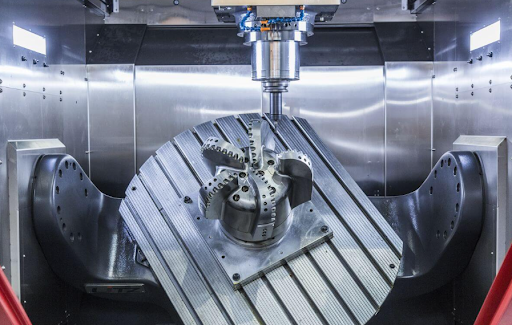
A single block of metal becomes a turbine blade, or a surgical implant with curves that look almost impossible to cut by hand — this is usually the work of 5 axis CNC machining. The idea, put simply, is that the cutting tool travels along five directions at the same time, not just the usual three. With two extra rotational movements, the tool can tilt and swivel around the part, reaching angles a standard machine could never get close to. For precision manufacturers, parts that need tight tolerances and complicated shapes almost always go through this process, and once the logic behind it is understood, it stops feeling like a mystery.
What Makes It Different From Standard Machining
In most people’s minds, CNC machining means a tool sliding up, down, and side to side — the X, Y, and Z axes — and for flat or boxy parts, that is enough. But not every part in the real world is flat. Curved housings, angled brackets, undercuts, shapes like these often force a part to be flipped and repositioned several times when only a basic machine is used.
Once two rotational axes are added, commonly labelled A and B, or A and C, the spindle or the table gains the ability to pivot on its own. From nearly any direction, the tool can now reach the workpiece without a hand ever touching it in between. That, really, is the entire point. A single setup, one uninterrupted process, and far less room for anything to go sideways.
Fewer Setups Means Fewer Errors
Something many people never stop to consider: each time a part is unclamped and put back into position, a small window opens for error to creep in. Half a millimeter off, maybe, which sounds trivial until it isn’t — in aerospace or medical fields, a gap that small can decide whether a part fits properly or gets thrown away entirely.
With five axis machines, the workpiece stays fixed while the tool handles all the movement, so that risk is nearly eliminated. This is exactly why industries with no tolerance for error whatsoever — aircraft components, or implants shaped precisely around a patient’s anatomy, for instance — depend so heavily on this approach.
Where You’ll Actually See This Technology in Use
This shows up in more places than most people would guess. Turbine blades and impellers, both in aerospace and automotive work, call for smooth, aerodynamic curves that would be nearly brutal to produce through any other method. Engine housings sit in much the same category.
Within medicine, the same technology is used for implants, prosthetics, and surgical tools that must match shapes that are often intricate and sometimes built for one specific patient. Mold and die makers rely on it too, particularly for tooling with deep cavities or steep internal walls, features that would otherwise demand several separate operations just to finish.
Simultaneous Machining vs 3+2 Machining
Five axis work isn’t a single, uniform process, and this is where confusion tends to creep in. Broadly, two approaches exist. In simultaneous machining, all five axes move together throughout the entire cut, and this is what produces those flowing, organic, sculpted surfaces people associate with the process.
Positional machining, or 3+2 as it’s often called, works differently. First, the two rotational axes tilt the part into a fixed position and lock it there; only then does the machine cut using the standard three axes. Somewhat simpler in nature, this method tends to suit parts that only need several flat or angled faces machined with precision, without taking on the added complexity that continuous rotation brings along.
Why Programming Matters More Than People Realize
Without solid programming behind it, none of this functions at all. Exactly how the tool should move, angle by angle, pass by pass, avoiding a crash into the part or its fixtures, is mapped out through CAM software. Because the tool can approach from so many directions, considerably more planning is required compared to basic 3 axis work. Tool length, clearance, the sequencing of passes, getting even one of these wrong risks ruining a piece of material that isn’t cheap. What actually separates a clean, accurate part from a costly mistake is, in the end, good programming.
Why Demand for This Keeps Growing
Parts continue growing more complicated, and tolerances keep tightening — this is simply the direction manufacturing has taken. A level of design freedom that older methods could never offer is what five axis systems give engineers, whether the job is a one-off prototype or a full production run. It wouldn’t be an exaggeration to say that shapes once considered impractical, or even impossible, only a couple of decades ago, have been made achievable through this technology.