Introduction
Entrepreneurs who are starting a small business know that it is one of the most fulfilling yet difficult objectives to pursue. Passion, determination and creativity are often all that’s needed to start a business, but strategy, discipline and adaptability are needed to sustain and grow a business over time. It’s not that many goods or services that fail, its many businesses that have difficulty managing their growth. Fast growth, if not planned, can lead to financial stresses and slow growth can lead to reduced competitive ability in increasingly saturated markets. Growth and sustainability go hand in hand for a business; it is important to not only think big but work with the idea of long term sustainability.
If you are a business owner who wants to achieve long-term success in your business, then you should build a solid foundation first and then then try to grow your business aggressively. This involves knowing the requirements of customers, enhancing operational effectiveness, adopting technology, and funding marketing campaigns that deliver tangible outcomes. Growth does not just mean an increase in sales, it should be accompanied by better efficiency, better customer relationships, more profits and greater ability to adapt to market changes. Strategically managing growth is a key factor in navigating economic uncertainty and industry disruption, and enabling growth-minded entrepreneurs to keep thriving.
The best way to ensure sustainable growth is to adhere to some viable business plan strategies, which would suit the business goals, resources and market situation. Rather than following fads, enterprises can develop a strategic plan for long-term success and stay competitive in their field.
1. Develop a clear vision for Sustainable Business Growth.
Sustainable business growth is the growth of revenue, customers, market share and capacity without sacrificing quality, customer satisfaction, or financial stability. Growth is often perceived as simply being the increase in sales of products or opening new stores, a misconception made by many entrepreneurs. But real growth is much wider and exists in the establishment of systems which enhance growth without sacrificing consistency and profitability. When a company expands rapidly without adequate systems, they can face issues like cash flow problems, falling product standards, workers’ fatigue, and customer dissatisfaction.
The first step to a sustainable growth strategy is to establish realistic goals and determine the resources needed to attain the goals. In order to improve, or evaluate, a business’s strengths and weaknesses before a business introduces new products, enters new markets or extends production capacity. Growth should be aligned with the business mission and values, customer needs and market opportunities. Entrepreneurs can minimize risk and build a more robust base for continued growth by thinking strategically about expanding.
Moreover, there is a need for ongoing learning and adaptation for sustainable growth. Consumer tastes change, new products are offered, and innovations and changes in technology alter industries. Facing the changing environment with flexibility and responsiveness, the businesses have more chances to sustain the momentum and stay competitive in the long run.
2. Increasing the Number of Products and Services Offered.
Knowing what customers need and what the market requires.
One of the best ways to boost revenue and new customers is to diversify the products and/or services. The existing customer base can be the lowest-hanging fruit when it comes to new products, as they are already accustomed to, and value, your brand. Businesses can gain insights from customer feedback, purchasing behavior, and market trends to determine the potential for new products or services that align with changing customer demands.
For instance, a bakery might start out making cakes before moving onto pastries, desserts, catering or baking classes. In the same way, a clothing company could launch accessories or shoes or even tailor-made clothing. The trick is to make sure that new products are in line with the business’s knowledge and branding, and not in some new niche that customers don’t know about and that represents an unnecessary expansion of the business.
Entrepreneurs need to do market research before introducing new products to see how much demand there is, pricing the product and other competition. Conducting testing on a smaller scale like a small-scale pilot or limited release may give product information with less risk of financial loss. Strategic Growth will help businesses improve customer loyalty and boost average customer spend.
3. Improving Customer Retention
For example, building Long-Term Relationships with Customers, It is much more expensive to acquire new business than to retain existing business. Therefore, the retention of customers should be a key point to focus on by any company aiming for sustained growth. Customers that return purchase items again and again not only make repeat sales, but they are also brand ambassadors for their colleagues, friends and family. If they are able to refer them, they can be a valuable asset for new business opportunities and can be inexpensive to maintain.
But the first step in boosting customer retention is providing a remarkable customer experience along the customer journey. Product quality, timely delivery, good communication and appropriate problem solving are important aspects that businesses should focus on. Customers feel that they are cared for and appreciated, so they are more likely to remain with the company despite its competitors’ lower price or promotion. Personalization can go one step further in building relationships, by making customers feel understood and recognized.
Repeat purchases can be stimulated and customer engagement boosted with loyalty programs, exclusive offers and customized rewards. By keeping in touch with the audience and using newsletters, social media updates, and follow-up messaging, businesses can maintain brand awareness and stay connected with their audience. Customer satisfaction and relationship management can help businesses build a solid revenue foundation that will enable them to pursue other growth strategies in the future.
4. Increasing Operational Efficiency
Make processes more efficient in order to perform them better.
Business growth is influenced by operational efficiency as it enables the companies to generate more value with the involvement of less resource. Inefficient processes lead to cost, inefficiency and restrict the organization’s ability to scale efficiently. A company can optimize its operations to boost its profit and quality service in a high standard.
The first step towards increasing efficiency is the identification of the points where there is inefficiency and there is waste in the existing process. This can include examining production processes, stock control, communication and administration procedures, etc. These repetitive tasks, including inventory management, payroll processing, and invoicing, can be automated, freeing up time and minimizing human error, which will allow staff to redirect their attention to more value-creating tasks.
Training and development of employees also is a major component of operational efficiency. Competent, high performing workers are more productive, flexible and self-reliant in problem-solving. By fostering a collaborative and continuous improvement mindset, employees are motivated to find opportunities to improve and eliminate inefficiencies. Companies that are operationally efficient are better equipped to deal with the surge in demand and expansion opportunities.
5. Use of Technologies for Development
Improving competitiveness through the use of Digital Tools
Technology has changed the business landscape in the way they operate, communicate and serve their customers. By leveraging digital solutions, small businesses can be more effective, cost- and resource-efficient, and provide better customer experience, a feat they may never have been able to achieve when competing with larger firms. Don’t see technology as an expense, think of it as an investment that will help your company grow.
The customer relationship management systems assist businesses in knowing the customers, acknowledging the key customers and enhancing the communication. Accounting software makes financial management easier and provides up-to-the-minute information on cash flow and profitability. The growth of e-commerce has given businesses access to customers beyond their local community and digital payments have made payments more convenient and secure.
Additionally, the use of cloud computing, data analytics, and automation tools contributes to the capabilities of businesses by supplying them with valuable information for decision-making and decreasing manual workloads. Business can leverage analytics to gain insights into customer behaviour, assess the effectiveness of marketing efforts and discover new trends. The strategic use of technology can help entrepreneurs become more agile, productive, and create a more scalable business model.
6. Forming Strategic Partnerships
Creating strategic partnerships can offer businesses the chance to expand their reach into new markets, share resources and achieve greater credibility without having to take on the entire burden of the expansion themselves. Relationships can be formed through a partnership with suppliers, joint ventures, referral agreements or co-marketing. By leveraging the right relationship, value can be created for both parties and strengthening the competitive position at the same time.
A fitness center might be involved with a nutrition consultant in providing complete wellness packages, or perhaps a neighborhood restaurant could work with food delivery services to get to a wider customer base. These partnerships offer the opportunity for businesses to add value for its customers, and gain from the knowledge and customer base of its partners.
Communication, collaboration and mutual benefits are key ingredients to successful partnerships. It is important for businesses to take the time to assess the suitability of a partner based on value, reputation and business objectives. With proper management, these partnerships can foster increased growth and a lowered risk, and opportunities that could not be reached on their own.
7. Scaling Marketing Efforts
Marketing plays an important role in the growth of business since even the best product and services can’t succeed if potential customers are not aware. With the expansion of a business, its marketing approach has to expand to extend the reach of its message to a wider audience, while retaining the message’s consistency and effectiveness. Scaling Marketing involves growing your marketing efforts while avoiding compromising on quality and budget constraints.
Expansion is possible through the digital marketing channels which are cost-effective. SEO enhances the online presence of businesses by making them visible in the right search results. Content marketing establishes authority and trust through valuable information that will answer customer questions and concerns. Social media marketing offers businesses the opportunity to connect with their audiences directly and build relationships with them.
One reason why email marketing is one of the highest return marketing campaigns is that it allows communicating with existing and prospective customers on a personal level. Additional growth can be achieved through paid advertising campaigns that can be directed towards particular demographics and interests. It is crucial that businesses constantly evaluate the performance of their campaigns, and make changes to their approach as needed in order to ensure that they get the best return on the investment and are as efficient as possible.
8. Establishing a Good Team and Leadership Framework
Growing a business can involve making the transition for the entrepreneur to delegate tasks and empower employees. Effective leadership and delegation are vital to keeping things running smoothly and allowing of growth. If a business owner tries to deal with all the aspects of business on his own, he can get into a lot of trouble and may not be able to achieve the potential of his organization.
Applying knowledge and skills of the employees and investing in their training, strengthens the workforce, which helps them achieve growth goals. The roles, expectations and communication are clear, resulting in increased accountability and teamwork. Leadership development programs can help managers get ready for an expanded role in the organization and ensure continuity for growth.
Positive workplace culture is one of the key elements of long-term success as well. Valued and supported employees are more likely to stay, be productive and involved in the company’s objectives. In building up robust teams and cultivating leadership at every level, companies lay the groundwork for continued growth.
9. Using KPIs to Measure Growth
Data Collection to track progress and making data-driven decisions. Business growth should be based on the objective, not on the assumption or intuition. Key Performance Indicators (KPIs) offer useful information about performance and can be used to see strengths, weaknesses and areas for improvement for business owners. By tracking these indicators regularly, businesses can make informed decisions and adapt their strategies as needed.
One of the most frequent KPIs is revenue growth – this is the measure of how well the company is able to boost sales over time. Profit margins are a way to gauge a company’s financial health by calculating what portions of profits are left over after costs have been subtracted. Customer acquisition cost will give a business insight into the efficiency of its marketing strategies and CLCV will give the business insight into the revenue a business will generate from a customer during their lifetime.
Other key metrics that can be tracked are customer retention rates, employee productivity, inventory turnover, website traffic and conversion rates. By monitoring these metrics, businesses can gain insights into what is happening, track progress toward their objectives, and make better-informed decisions about how to allocate resources. Making decisions based on data will take out the guesswork and increase your chances of successful sustainable growth.
Challenges to Overcome in the Process of Expansion
As an organism grows, new challenges arise and need careful management and planning. As the need for more resources grows, it can lead to increased strain; as teams grow, communication challenges and operational complexities can result. Businesses may face financial strain because of equipment, employee and marketing expenses that help expand the business.
By keeping a close eye on their finances, businesses can address these issues, ensuring that their performance is continuously monitored and effective measures are taken to adapt to changing demands. Communicating and planning in advance can help organizations overcome issues before they become large-scale challenges. Entrepreneurs should also be open to customer, employee and industry input which can offer insights at a time of transition.
Businesses must be flexible and resilient when they’re on the path of growth. It’s important to note that markets change quickly, and what worked in the past might need to be altered depending on the situation. Those companies that continue to be agile and focused on constant improvement are more likely to be able to handle setbacks and stay on the road in the long run.
Conclusion
Building a small business isn’t all about dedication and drive. Successful results are only possible through strategic planning, operational excellence, customer loyalty and adapting to market changes over time. Entrepreneurs who prioritize sustainable growth over quick expansion will be more successful in creating resilient companies that will be able to thrive in competitive environments.
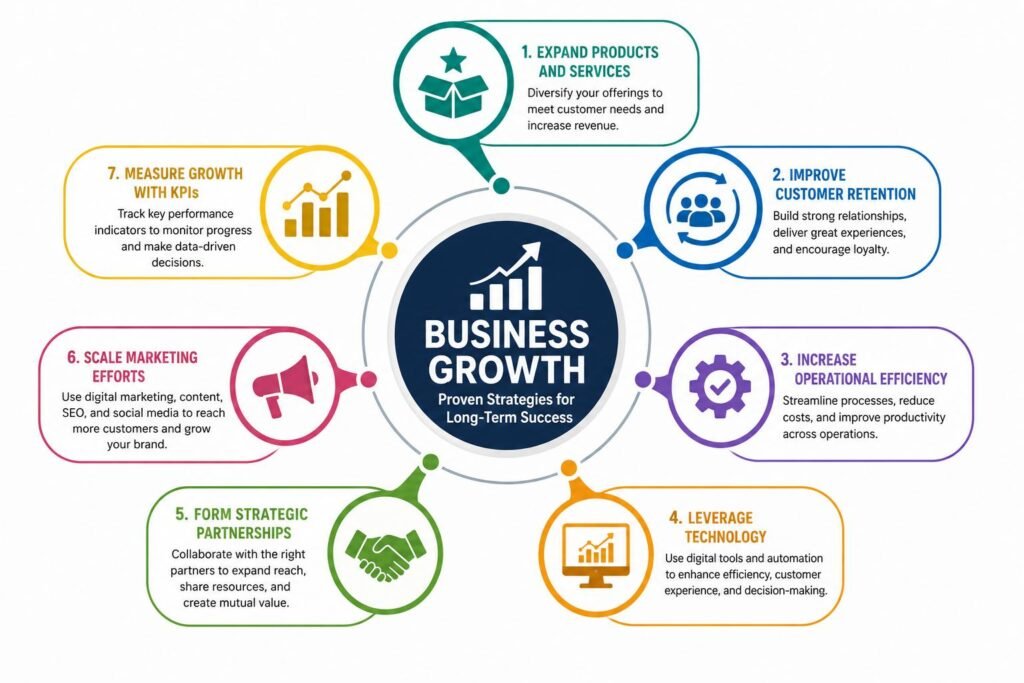
Some of the best ways to sustain growth are to expand product lines, enhance customer retention, improve operational efficiency, utilize technology, establish strategic partnerships, and scale marketing efforts. Furthermore, having the capacity to track progress through key performance indicators that give actionable insights and support decision-making is crucial.
In short, it’s not just a single accomplishment but a continuous journey of business growth. Entrepreneurs who embrace innovation, learning, and strategic action will have businesses that can endure long-term success and thrive for years to come. Investing in robust foundations now will help companies be better able to capitalize on opportunity in the future and sustain success in a dynamic business environment.
Get more well researched information about How to Grow a Small Business here.