Introduction
Running a small business is a do it all role. One day you are fielding customer questions, the next you are tracking expenses, managing inventory, creating marketing materials, and scheduling appointments. Although many software solutions put out there to solve these issues what they don’t tell you is how quickly that which may work for a large company’s budget will break a small business or startup’s bank.
Fortunately it is easy to find very good free tools which business owners may use to automate repeatable tasks, improve in organization, and at the same time see an increase in productivity which in turn does not break the bank. We have a wide range of solutions which cover the basic business needs for accounting, inventory management, graphic design, appointment setting, customer communication, project management and document storage.
Many business owners think they require large scale software solutions to properly run their companies. In fact we see that today’s free software platforms which are very powerful in what they do can in fact replace manual spreadsheet use, paper based record keeping, and very time intensive admin tasks. What is key is in which tools you invest your time in that will add the most value for your business and how you go about putting them into practice.
If you are in search of solid free software solutions we have a guide which details twelve practical options for you. We go into each tool’s setup, benefits, and tradeoffs and also provide integration tips to get you up and running successfully.
Why Free Business Tools Matter
Small out of large resources which is an issue for small businesses. At start of growth hiring more staff or going in for costly software is not an option. Thus often owners do it themselves which in turn takes up hours which could be used for customer service or revenue generation.
Free open source software which does away with these issues by automation of routine tasks. Instead of manual invoice creation, keeping track of stock on paper, using the phone for appointment setting, or designing promotions from scratch, companies may use special tools which simplify what they do. Which results in better accuracy, superior customer service, and greater productivity.
Another key benefit we see in free platforms is that they offer upgrade options which in turn allow businesses to take on advanced features as they go along. What we are to see is that it is easy for a business to get in without software cost at all to start with and they should only pay for premium plans as and when business growth supports that investment. By using free tools in the beginning what companies do is put in place organized systems which in fact support that long term growth.
1. Wave-Free Accounting and Invoicing
What It Does
Wave is at the top of the list of free accounting solutions which small businesses use. We see that it includes features like tracking income and expenses, issue invoices, watch cash flow, and produce financial reports. Also instead of going to the trouble of recording transactions in notebooks or spreadsheets is what many business owners did in the past they may now put all their financial records in one place.
The software which is for independent workers, consultants, service providers and small retail businesses that require basic bookkeeping features we put at that.
Setup Steps
Create a free account, fill out your business info, connect your bank account if you have it, and we also will walk you through customizing invoice templates. Once everything is set up you can start logging in transactions, and sorting your expenses which will keep your finance records in good order.
Limitations
In large enterprise scale systems’ advanced accounting features may not be included. Also some payment processing services may charge transaction fees.
Integration Tips
Integrate Wave with Google Drive for secure storage of financial docs and receipts. Also, with regular reconciliation you improve record accuracy and simplify tax prep.
2. Zoho Free Inventory Plan.
What It Does
As businesses grow inventory management becomes a more complex issue. At Zoho we have designed a solution to that in which we track stock levels, monitor product movement, manage purchase orders, and also which reports out on stock outages. Also for the very large set of companies that sell physical products we see great benefit from automated inventory tracking.
Instead of the traditional method of keeping handwritten stock records which is subject to errors, businesses can now access real time inventory reports and in turn make better purchase decisions.
Setup Steps
Create an account, add products to it, report current stock levels, and set up warehouse and storage locations. Once finished inventory updates automatically as products are sold or received.
Limitations
In many cases the free version supports few orders and users which is which makes it more so for small scale use.
Integration Tips
Integrate our systems with your accounting software and e-commerce platforms to automate inventory and sales data.
3. Canva-Easy Graphic Design.
What It Does
Professional design is a must for marketing, however hiring a designer for each project breaks the bank. Canva has access to a large selection of templates for social media posts, flyers, business cards, presentations, brochures, and promotional graphics.
Even those without design experience may create attractive marketing materials quickly. This also reduces our dependence on outsource design services while at the same time we maintain a professional brand image.
Setup Steps
Register for our free service, pick a template, add your logo, change out colors and fonts, and we’ll get your designs for you.
Limitations
Some of the premium templates, stock photos, and advanced features are available with a paid subscription.
Integration Tips
Integrate Canva with social media and cloud storage to improve content flow.
4. Google’s free tools in Workspace.
What It Does
Google has a suite of free productivity tools for business. Docs, Sheets, Slides, Forms, and Drive which enables collaboration, document management, and data organization.
Instead of sending out different versions of files via email which is a common practice, teams may work at the same time on the same document. This in turn improves efficiency and reduces confusion.
Setup Steps
Create a Google account, set up your Drive folders, and start storing docs in the cloud. Share out files as you need to your team and collaborators.
Limitations
Free plans have storage limits.
Integration Tips
Integrate Google Sheets with reporting tools, inventory systems, and scheduling software for a single source of truth.
5. Trello-for Project and Task Management.
What It Does
Trello is used by businesses to organize projects visually through boards, lists, and cards. We see improved visibility and accountability in that which they use it for from handling customer orders to running marketing campaigns, managing employee tasks, or improving operational workflows.
Business owners which are to say often find they forget important tasks when it comes to memory alone. Trello we see to present a very organized atmosphere which has those deadlines and tasks which at all times remain visible.
Setup Steps
Create a system of boards, set up workflow stages, assign tasks and put in due dates. Employees will be sent out notifications when responsibilities change.
Limitations
Complex project management needs at times may bring in premium features.
Integration Tips
Integrate Trello with Google Drive, Slack, and email automation tools for smooth workflow management.
6. Calendarist- Appointment Scheduling.
What It Does
Scheduling out the calendar time is more often than not a task that takes up a large amount of time. Calendly out does back and forth communication by which clients book in to available time slots directly.
This is true for consultants, tutors, coaches, health care providers, and service based businesses that use appointments.
Setup Steps
Create a profile, set your availability, connect your calendar, and share the booking link with customers.
Limitations
Advanced automated options are included in paid plans.
Integration Tips
Integrate Calendly with Zoom, Google Calendar, and email platforms for seamless meeting management.
7. HubSpot’s free CRM version.
What It Does
Customer relationship management is key to business growth. HubSpot CRM which is a tool for the job helps businesses track leads, manage customer interactions, store contact info, and monitor sales pipelines.
Instead of having customer info in separate notebooks and spreadsheets, we see businesses create a central customer database.
Setup Steps
Import your contacts, tailor sales stages to your needs, and start tracking customer interactions.
Limitations
Some of the more advanced sales and marketing features are included in premium plans.
Integration Tips
Integrate our systems with email platforms, forms, and customer support tools to present a unified customer management solution.
8. Facebook for Business version of WhatsApp.
What It Does
Customer interaction plays into satisfaction and sales. With WhatsApp Business companies are able to put out professional profiles for themselves, send out automatic greetings, organize conversations and display product catalogs.
For small business which is what many are, WhatsApp is their main customer service and sales platform.
Setup Steps
Download the app, create your business profile, add in your hours of operation, upload product pictures, and set up auto responses.
Limitations
For large scale customer support we may require additional communication channels.
Integration Tips
Integrate WhatsApp with CRM and customer databases to improve communication tracking.
9. Free plan on Mailchimp.
What It Does
Email marketing is a very affordable method for customer retention. Mailchimp helps companies to grow their subscriber base, run campaigns, and see email performance.
Instead of reaching out to each customer individually with promotions, businesses can use automation to improve engagement.
Setup Steps
Create a business account, import your contacts, design email templates, and schedule campaigns.
Limitations
Free plans are subject to email and monthly limits.
Integration Tips
Integrate with web sites, online stores, and CRM systems to automate subscriber collection.
10. Bitrix24
What It Does
Bitrix24 is a platform that brings together project management, CRM features, communication tools, and collaboration tools. Small businesses are able to handle many operational tasks from within a single application.
This centralization increases productivity and reduces software complexity.
Setup Steps
Create a profile, bring in your team, set up departments, and put in place workflows.
Limitations
The large number of features may require time to master.
Integration Tips
Connect into email systems and communication tools to improve operational efficiency.
11. Loom
What It Does
Explating processes over and over are a waste of time. Loom which allows users to record screen share videos that go over tasks, answer to customer questions, or train employees.
Instead of long written out instructions which can be confusing, we see that visuals are a better solution.
Setup Steps
Install the add-on, record videos, and share out the links to your audience.
Limitations
Free plans have recording time limits.
Integration Tips
In onboarding, in customer support, and in training we use Loom.
12. Google My Business Profile.
What It Does
Local presence is key for small businesses. Google Business Profile which displays info on local search results, posts operating hours, collects reviews and gives out directions.
Businesses not engaging in local search optim and which as a result lose out on local customers that are at that very moment looking for what those businesses have to offer.
Setup Steps
Claim your business profile, verify your info, add in business details, upload some photos, and ask customers to review.
Limitations
Results are a function of profile completeness and customer engagement.
Integration Tips
Connect your site, social media pages, and review strategies to improve online presence.
Best Practices for Integrating Free Tools
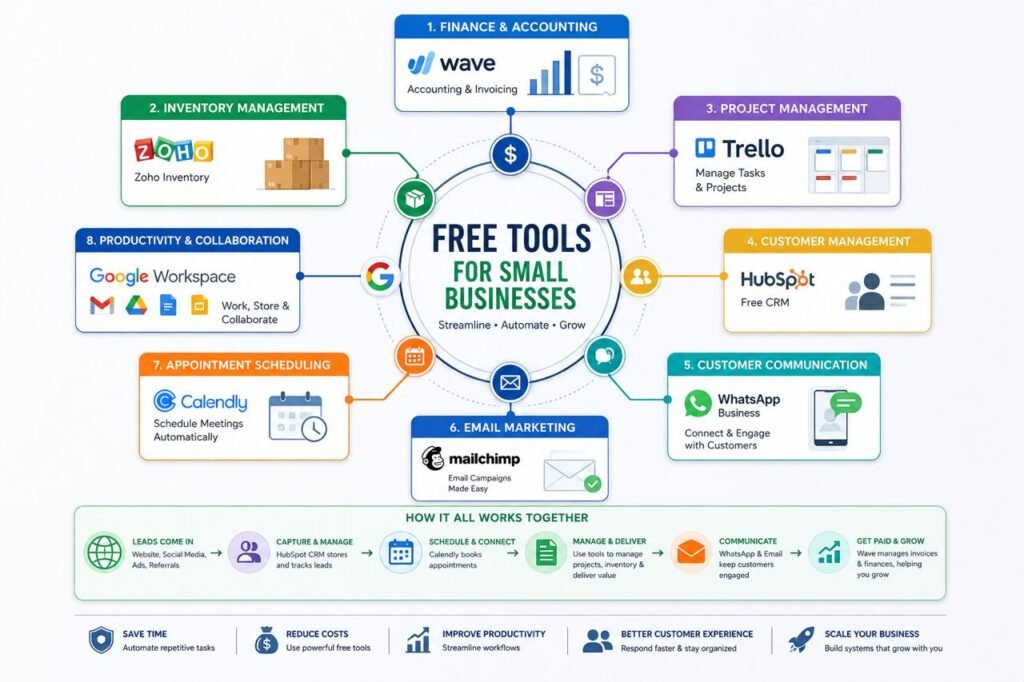
Using many separate tools may still present issues of data isolation. What we see in very successful small businesses is they have put in place simple workflows which allow info to flow easily between systems. For example we see leads that come in via the website go straight into the CRM, scheduled appointments pop up on the calendar, invoices are generated through the accounting software, and customer interactions are noted for future reference.
Before we implement new software we should identify which processes are the biggest time consumers. For sure include in that first go at it tasks like bookkeeping, customer communication, scheduling, and inventory management as these tend to see the best results. Once we see those systems run well we can roll out other tools to support marketing, collaboration, and analytics.
Regular which out to regular staff training. We see that which great software has limited value if employees do not know how to use it right. Put in place clear procedures, provide documentation, and at regular intervals review workflows to make sure all follow the same practices.
Common Mistakes to Avoid
Many business owners will download a large number of apps without a clear plan which in turn often causes us to do the same task more than once, have different sets of data that don’t match up, and introduce too much complication into what we are doing. What they should do instead is to target which specific issues in the business’ operations that they will address with the technology they choose.
Another issue is that people ignore data backup and security issues. Free software still has very important business info which includes customer details and financial records. Use of strong passwords, user permissions, and regular backups is key to data protection.
Businesses can also do away with total dependence on manual processes once software is rolled out. The point of this software is to take over repeatable tasks and improve efficiency. Also as you go along review processes to find out more chances for automation and integration.
Conclusion
Small businesses no longer require large software investments in order to operate effectively. We have free tools which include for account services, inventory tracking, graphic design, scheduling, customer outreach, project management, email marketing, and local search which in turn present great alternatives to manual processes. By choosing the which platforms to use and how to integrate them which is the strategic part, entrepreneurs are able to save time, reduce costs, see better accuracy in what they do and in the process put more energy into serving customers and growing revenue.
The focus should be on the issues which present the greatest operational challenges and we may as well take a gradual approach to it. We put in these 12 free tools thoughtfully and consistently which in turn will form the base of a lean, organized and scalable business which also stays competitive without breaking the bank.
Get more well researched information about Free Tools for Small Businesses here.