Monitoring Microservices Without Breaking the Budget
Kubernetes changed how teams deploy software, but it also changed how observability breaks down. Pods are ephemeral – they spin up, crash, reschedule, and scale across nodes in minutes. Services talk to each other through layers of mesh, ingress, and DNS that traditional host-based monitoring was never designed to handle. The result: engineering teams are generating more telemetry than ever, and the tools they use to make sense of it are often the largest line item in their cloud budget.
The core challenge is structural. Per-host and per-pod pricing models penalize the very elasticity that makes Kubernetes valuable. A cluster that auto-scales from 50 to 200 nodes during a traffic spike should not triple your observability bill in the process. Teams need tools that charge on data volume, not infrastructure count – and that can auto-discover services as they appear without manual configuration.
This guide compares seven APM tools suited for Kubernetes-native environments in 2026: CubeAPM, Datadog, Dynatrace, Grafana Cloud, Elastic APM, Splunk, and New Relic. Each is assessed on pricing, OpenTelemetry support, Kubernetes depth, deployment model, and how well it handles the realities of dynamic container orchestration.
What to Look for in an APM Tool
- Pricing model that does not penalize auto-scaling: Per-host and per-pod pricing creates unpredictable bills in Kubernetes environments. Ingestion-based models decouple cost from infrastructure count, which makes budgeting possible when clusters scale dynamically.
- Automatic service discovery: Kubernetes workloads are ephemeral by design. The APM tool must detect new pods, services, and deployments automatically without requiring manual registration or dashboard updates.
- OpenTelemetry-native instrumentation: OTel is the standard for Kubernetes observability. Platforms built natively on OTel ingest OTLP data without transformation penalties. Platforms that bolt OTel onto proprietary agents often require workarounds or incur custom metrics charges.
- Deployment model – SaaS vs self-hosted: For teams running Kubernetes in regulated environments or with data residency requirements, a self-hosted APM inside the same VPC eliminates both compliance risk and cloud egress cost.
- Pod-level and namespace-level visibility: Cluster-level dashboards are table stakes. What separates tools is the ability to trace requests through specific pods, correlate with container resource metrics, and surface issues at the namespace and deployment level.
- Cloud egress cost: Sending telemetry from your Kubernetes cluster to any external SaaS platform costs approximately $0.10/GB in cloud data-out fees. At 30TB/month, that is $3,000/month, which does not appear on your observability invoice. Self-hosted platforms inside your VPC avoid this entirely.
Pricing Methodology
| Assumption | Value |
|---|---|
| Monthly ingestion | 30TB (~20TB logs, 7TB traces, 3TB metrics) |
| Retention | 30 days, all signals |
| Log indexing | 30% indexed, 70% archive |
| Hosts | 100 |
| Users | 20 full-platform |
| Metric series | 500,000 active |
| Scope | Core observability only |
Estimates are directional, based on public rate cards as of early 2026. Vendor discounts can reduce SaaS costs significantly.
Cost and Feature Comparison
| Tool | Est. Cost @ 30TB/mo | Pricing Model | OTel Native | Data Residency | Self-Hosted |
|---|---|---|---|---|---|
| CubeAPM | ~$5,100/mo all-in | $0.15/GB ingestion-based | Native | Always (in-VPC) | Yes (vendor-managed) |
| Datadog | ~$30K-$45K+ | Host + feature-based | Partial* | SaaS only | No |
| Dynatrace | ~$20K-$35K+ | GiB-hour + commit | Partial | Managed option | Managed |
| Grafana Cloud | ~$15K-$20K+ | Usage-based | Native | If self-hosted | Yes (OSS) |
| Elastic APM | ~$8K-$15K | Deployment-based | Partial | If self-hosted | Yes (SSPL) |
| Splunk | ~$35K-$60K+ | Host + enterprise | Partial | Managed option | On-prem |
| New Relic | ~$20K-$25K+ | Ingest + per-user | Partial | SaaS only | No |
* Datadog OTel metrics are often billed as custom metrics. All estimates based on 30TB/month, 100 hosts, 20 users, 30-day retention. Vendor discounts and EDP commitments can significantly reduce SaaS costs.
1. CubeAPM
Best for: DevOps and platform teams that want full-stack observability inside their own cloud without SaaS data egress, pricing sprawl, or DIY self-hosting overhead
CubeAPM is a self-hosted, OpenTelemetry-native, full-stack observability platform covering APM, logs, infrastructure, Kubernetes, Kafka monitoring, RUM, synthetic monitoring, and error tracking. It can be deployed inside your AWS, GCP, or Azure VPC – telemetry never leaves your infrastructure boundary. For Kubernetes teams, this means all pod, service, and cluster telemetry stays within the same network, with zero egress cost regardless of cluster size or scaling behavior.
Ranked in the top 10 APM platforms in G2’s Spring 2026 APM Grid Report and #4 easiest-to-use APM tools on G2. Capterra 5/5, G2 5/5. Used by Policybazaar (insurance), Delhivery ($3.5B logistics – 75% savings after replacing three separate monitoring tools), Mamaearth ($1.2B), world’s largest bus aggregator – redBus (part of MakeMyTrip Limited (NASDAQ: MMYT), 8+ countries), Ola, and Practo (healthcare). SOC 2 Type II and ISO 27001 certified.
Key Features
- OpenTelemetry-native: Built from the ground up on OTel. Compatible with OpenTelemetry, Datadog, New Relic, Elastic, and Prometheus agents for incremental migration
- Self-hosted, vendor-managed: Runs in your VPC with zero cloud egress cost. Your monitoring stays up even if the internet doesn’t
- Kubernetes-native monitoring: Auto-discovers pods, deployments, and namespaces. Correlates application traces with container resource metrics
- AI-based Smart Sampling: Retains traces that matter while reducing storage overhead
- MCP server: CubeAPM provides an MCP server that customers can use to query CubeAPM in natural language
- 800+ integrations: Kubernetes, synthetic monitoring, RUM, and error tracking included
- Unlimited retention and unlimited users: Included in pricing – no separate charges
Pricing
Predictable pricing – $0.15/GB of data ingested. No per-user fees, no per-host charges, no custom metrics surcharges. Single billing dimension. Clusters that auto-scale from 50 to 200 nodes do not change the pricing model – you pay for the data, not the infrastructure count.
At 30TB/month: ~$5,100/month all-in ($4,500 license + ~$600 infra)
Delhivery: 75% savings after replacing three separate monitoring tools. Mamaearth: ~70% savings, migrated in under an hour. redBus: 4x faster dashboards, 50% faster MTTR.
Pros
- 70-75% lower cost than enterprise APM at scale
- Pricing decoupled from host/pod count; auto-scaling does not affect the bill
- Complete data ownership; telemetry never leaves your VPC
- Single billing dimension with no hidden cost axes
- Zero cloud egress cost
Cons
- Requires self-hosted deployment in cloud or on-prem; may not suit teams looking for a SaaS-only model
- AI/ML anomaly detection is growing, but not as mature as Dynatrace Davis AI.
2. Datadog
Best for: Broad SaaS ecosystem coverage with the budget to manage billing complexity
Datadog is the largest commercial observability platform, with 900+ integrations covering APM, logs, security, RUM, synthetics, and network monitoring. Its Kubernetes Explorer provides pod-level visibility, deployment tracking, and resource monitoring across clusters. The trade-off is cost: host-based pricing compounds in Kubernetes environments where node counts fluctuate, and custom metrics charges are a persistent source of bill shock. OpenTelemetry metrics sent through Datadog are often billed as custom metrics.
Key Features
- Kubernetes Explorer with pod, deployment, node, and resource visibility
- Unified observability: metrics, logs, APM, RUM, synthetics, security, database monitoring
- 900+ integrations; one of the largest ecosystems in the category
- Watchdog AI proactively surfaces anomalies
- Live Container view and Kubernetes audit log monitoring
Pricing
Multi-dimensional billing: hosts ($15-$18/host/month infra, $31/host APM) + custom metrics + log ingestion ($0.10/GB) + log indexing (~$1.70/million events) + APM spans + RUM sessions.
At 30TB/month: ~$30,000-$45,000+/month
Pros
- Best-in-class integration ecosystem and product breadth
- Strong Kubernetes monitoring with deep cluster and container visibility
- Mature CI/CD and deployment tracking
Cons
- Host-based pricing penalizes auto-scaling Kubernetes clusters;cost grows with node count, not data volume.
- OTel metrics billed as custom metrics; adds cost for teams adopting open standards
- Mostly SaaS; SaaS models are not suitable for data residency requirements; teams needing in-VPC deployment should evaluate self-hosted alternatives.
- Total cost at scale significantly exceeds platforms with simpler pricing models.
3. Dynatrace
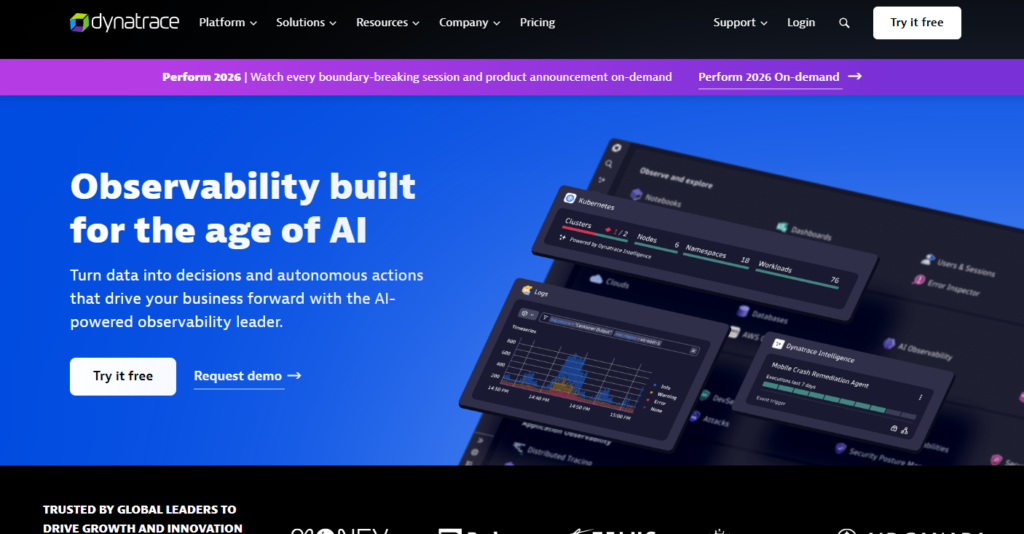
Best for: Large enterprises that need AI-automated root cause analysis across complex Kubernetes environments
Dynatrace differentiates with its Davis AI engine, which automatically maps service dependencies and performs causal root-cause analysis – reducing alert fatigue in complex microservice environments. Its OneAgent auto-discovers Kubernetes workloads and injects itself into containers automatically via the Dynatrace Operator. Gartner ranks Dynatrace highest in “Ability to Execute” among observability vendors. The platform targets large enterprises with deep automation requirements.
Key Features
- Davis AI: Automatic baselining, anomaly detection, and probable-cause analysis across Kubernetes services
- Full-stack monitoring via OneAgent with automatic service and pod discovery
- Dynatrace Operator for flexible Kubernetes deployment (cloud-native full-stack, classic full-stack, application-only)
- OpenTelemetry support via OTLP API, OTel Collector, and Dynatrace Collector
- Log management with separate ingest, processing, and retention pricing
Pricing
Usage-based with separate rate-card units. Full-Stack Monitoring at $0.01/memory-GiB-hour, Log Management ingest at $0.20/GiB, retain at $0.0007/GiB-day. Mandatory annual commitment.
At 30TB/month: ~$20,000-$35,000+/month
Pros
- Best automated root cause analysis in the market
- Automatic Kubernetes workload discovery via Operator; minimal manual configuration
- Managed deployment option for data residency (Dynatrace Managed)
- Strong compliance and enterprise security features
Cons
- Proprietary OneAgent creates vendor lock-in; harder to switch once embedded in every pod.
- Memory-GiB-hour pricing is harder to estimate than simple per-GB models. Teams that prefer a single billing dimension may find ingestion-based alternatives easier to forecast.
- 4 GiB minimum billing per small host penalizes lightweight Kubernetes nodes and sidecars.
- Davis AI requires a baselining period; new deployments and freshly scaled pods do not get full value immediately.
4. Grafana Cloud (LGTM Stack)
Best for: OTel-first teams that want flexible dashboards, open-source foundations, and deep Prometheus integration
Grafana Labs built the LGTM stack – Loki (logs), Grafana (dashboards), Tempo (traces), Mimir (metrics) – into a managed observability platform. For Kubernetes teams already using Prometheus for cluster metrics, Grafana Cloud is a natural extension: Mimir provides long-term Prometheus storage, Grafana Alloy (an OTel Collector distribution) routes signals to the right backend, and the dashboarding layer is the most flexible in the market.
Key Features
- LGTM stack: Mimir for metrics, Loki for logs, Tempo for traces
- Grafana Alloy: OTel Collector distribution with built-in Prometheus pipelines
- Strongest dashboarding and visualization across multiple telemetry sources
- k6 performance testing integrated into the observability ecosystem
- Kubernetes Monitoring app with cluster, namespace, and workload views
Pricing
Usage-based across telemetry types. Logs: $0.05/GB process + $0.40/GB write + $0.10/GB retain. Traces: same structure. Metrics: $6.50/1k active series. Platform fee: $19/month.
At 30TB/month (managed cloud): ~$15,000-$20,000+/month
Pros
- Fully OTel-native; no custom metrics penalty
- Strongest Prometheus integration for teams already using it for Kubernetes metrics
- Adaptive Metrics/Logs actively help reduce billing
- Self-hosted path available for cost-driven teams with operational capacity
Cons
- No native APM out-of-the-box; requires significant configuration for application-level tracing
- Self-hosting the LGTM stack at scale requires dedicated SRE expertise.
- Usage-based pricing still grows with volume on managed cloud.
- LGTM stack has a steep learning curve for teams new to Grafana.
5. Elastic APM
Best for: Teams already on the ELK stack who want to add APM without a new vendor
Elastic APM is the distributed tracing and application monitoring component of the Elastic Stack. For teams already indexing logs in Elasticsearch and visualizing in Kibana, adding APM is a natural extension. It provides distributed tracing, service maps, error tracking, and MELT correlation. Elastic’s Kubernetes monitoring covers pod health, node resource usage, and container metrics via Elastic Agent, which deploys as a DaemonSet.
Key Features
- Native Elasticsearch integration: APM data correlates directly with log indices
- OpenTelemetry compatible across serverless, self-managed, and hybrid deployments
- Machine learning-based anomaly detection via Elastic ML
- Kubernetes monitoring via Elastic Agent DaemonSet with container and pod metrics
- Available self-hosted (SSPL license) or Elastic Cloud
Pricing
Self-hosted is free; you cover infrastructure. Elastic Cloud: consumption-based. Serverless Observability: Logs Essentials from $0.07/GB ingested + $0.017/GB retained/month.
At 30TB/month (Elastic Cloud): ~$8,000-$15,000/month
Pros
- Zero incremental cost if already running Elastic for logs
- Strong log + trace correlation in the same query interface
- Self-hosted option keeps data on your infrastructure
- ML-based anomaly detection included
Cons
- Significant operational overhead to run self-hosted at scale; vendor-managed self-hosted platforms reduce this burden.
- Kibana Query Language (KQL) is less developer-friendly than SQL or PromQL.
- 2021 SSPL licensing change; review for open-source compliance.
- APM experience is less polished than purpose-built APM tools.
6. Splunk Observability Cloud
Best for: Enterprises with existing Splunk SIEM investment that want unified observability and security
Splunk Observability Cloud provides full-fidelity distributed tracing with no default sampling – every trace is captured, which is valuable for debugging intermittent issues in high-throughput Kubernetes environments. The platform integrates deeply with Splunk’s SIEM and log analytics products, making it a natural choice for organizations already committed to the Splunk ecosystem. Kubernetes monitoring covers cluster health, pod scheduling, and container resource utilization.
Key Features
- Full-fidelity tracing: Captures every trace without default sampling
- Deep integration with Splunk SIEM for unified observability and security
- Kubernetes Navigator for cluster, node, pod, and container visibility
- OpenTelemetry support via the OTel Collector (Splunk distribution)
- Tag Spotlight for rapid service-level debugging
Pricing
Host-based: $15/host/month base for infrastructure monitoring. APM, log management, and real user monitoring are priced separately via enterprise contracts.
At 30TB/month: ~$35,000-$60,000+/month
Pros
- Full-fidelity tracing captures every transaction; no sampling gaps
- Strongest SIEM integration for teams that need observability + security correlation
- Kubernetes Navigator provides clear cluster topology views
Cons
- Most expensive option in this comparison – cost is difficult to justify without existing Splunk investment.
- Host-based pricing penalizes dynamic Kubernetes environments where node counts fluctuate.
- Deployment and configuration effort is significant.
- Teams without existing Splunk investment face high switching costs and limited standalone value.
7. New Relic
Best for: Teams that want a broad commercial observability platform with a generous free tier
New Relic provides full-stack observability with a unified telemetry data platform (NRDB) and its own query language (NRQL). The free tier – 100GB/month and one full platform user – makes it accessible for small teams and side projects. Kubernetes monitoring covers cluster explorer views, pod health, and container metrics. New Relic accepts OTLP data, which simplifies instrumentation for teams already on OpenTelemetry.
Key Features
- NRDB unified telemetry store with NRQL query language
- Free tier: 100GB/month + 1 full platform user
- Kubernetes cluster explorer with pod and node views
- OpenTelemetry support via OTLP ingest
- AI-assisted observability with alert-coverage recommendations
Pricing
Dual cost axis: $0.40/GB ingest + user fees (Core $49/user; Full $99-$349/user per month for full platform access). Data Plus for 90-day retention: $0.60/GB.
At 30TB/month: ~$20,000-$25,000+/month
Pros
- Generous free tier for small teams and evaluation
- Broad full-stack coverage in a single platform
- OTLP ingest simplifies OTel adoption
- Strong synthetic monitoring with scripted browser and API tests
Cons
- Dual cost axis (data + users) creates compounding costs as teams and data volumes grow.
- 8-day default retention is short – 90-day retention requires Data Plus at $0.60/GB.
- NRQL is a proprietary query language – dashboards and alerts do not port to other platforms.
- SaaS-only; no self-hosted path for data residency or egress-sensitive environments.
How to Choose the Right APM Tool for Your Kubernetes Stack
- Choose CubeAPM if cost predictability and data sovereignty matter. Ingestion-based pricing of $0.15/GB does not change when clusters auto-scale, and self-hosted deployment keeps telemetry in your VPC.
- Choose Datadog if you need the broadest integration ecosystem and can manage host-based billing across dynamic clusters. Model custom metrics costs before committing.
- Choose Dynatrace if AI-automated root cause analysis across complex microservice topologies is your primary need. Factor in the annual commitment and 4 GiB host minimum.
- Choose Grafana Cloud if you are already running Prometheus for Kubernetes metrics and want to extend to full observability with OTel-native instrumentation.
- Choose Elastic APM if your team already runs the ELK stack and wants to add distributed tracing without introducing another vendor.
- Choose Splunk if you need full-fidelity tracing and have an existing Splunk SIEM investment that justifies the cost.
- Choose New Relic if the free tier (100GB/month) covers your needs or you want a broad SaaS platform with OTLP ingest.
Final Thoughts
Kubernetes monitoring is not a feature checkbox – it is a pricing and architecture question. Per-host billing models were designed for static infrastructure, and they create unpredictable costs in environments where pod and node counts change by the hour. Teams running dynamic workloads should model their observability bill at peak cluster size, not average.
For teams where data residency or compliance is a hard requirement, self-hosted platforms are the only viable path – sending telemetry to an external SaaS provider introduces both regulatory risk and cloud egress cost that does not appear on the observability invoice. If AI-driven automation is the priority, enterprise platforms with mature causal analysis justify their premium in large, complex environments. If open-source flexibility and Prometheus compatibility matter, the LGTM stack provides the most customizable foundation.
The right tool depends on what your Kubernetes environment actually looks like: how many clusters, how dynamic the scaling, how sensitive the data, and how much operational overhead your team can absorb. Compare your top two options against your actual telemetry volume and cluster behavior before committing. The numbers at your scale will make the decision clearer than any feature comparison.
Keywords: APM tools Kubernetes 2026, Kubernetes monitoring, container monitoring APM, Kubernetes observability, OpenTelemetry Kubernetes, self-hosted APM, CubeAPM, Datadog Kubernetes, Dynatrace Kubernetes, observability cost Kubernetes