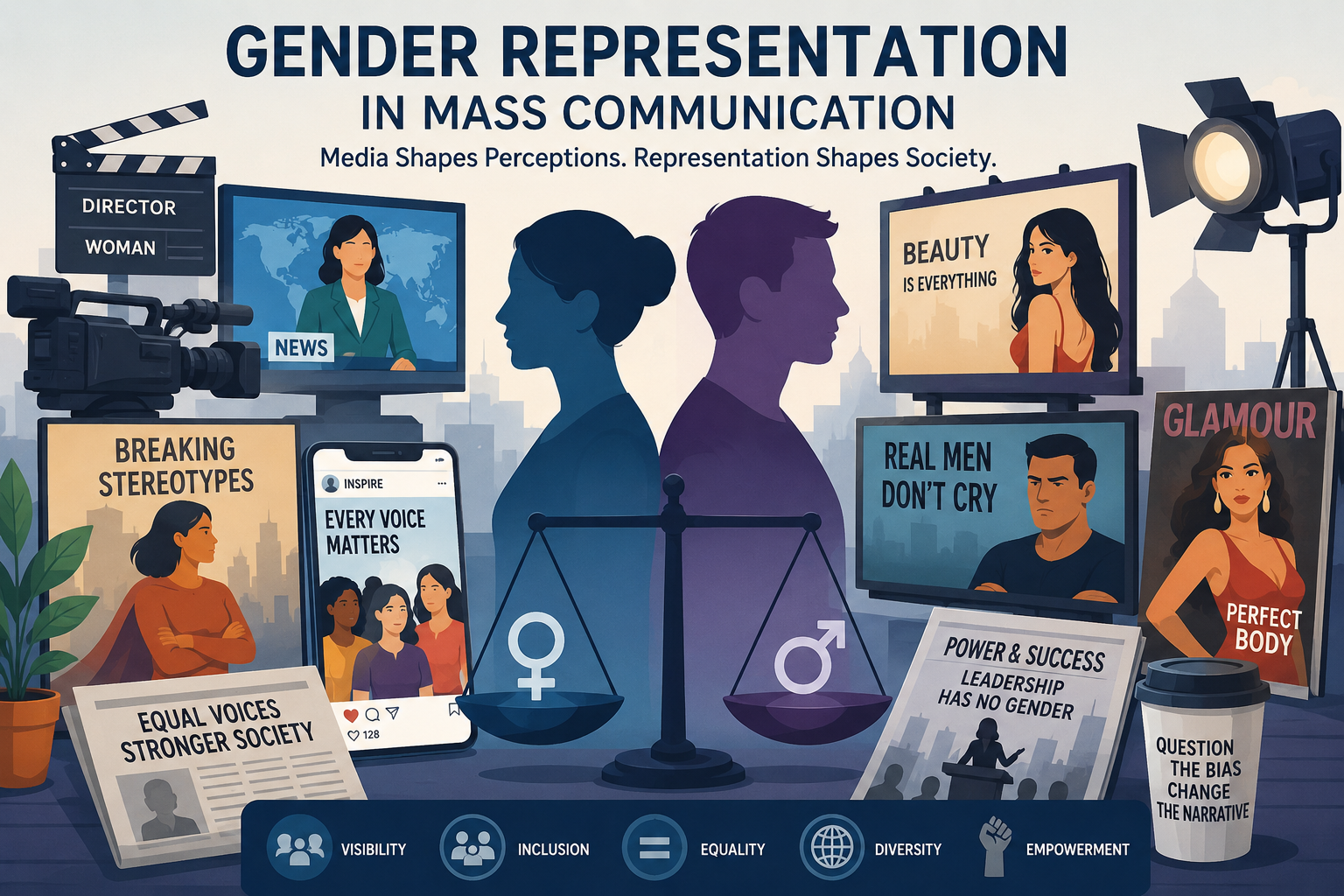
The significance of mass communication in society is crucial when it comes to forming a belief, a culture and even a personal identity of the people in the society. These are constantly inundated with messages in the newspapers, on television, in films, magazines, advertisements, on the radio and online, all of which affect identity and the views of others.
There are various kinds of messages sent through the media, gender representation is one of the most important as it influences the understanding of society about the gender. All pictures, plot lines, interviews and commercials contain strong and explicit messages about the way men and women are supposed to act, what they are supposed to do and what values they are supposed to have.
The knowledge of these patterns can empower viewers to be more critical consumers of media and identify biases in communication.
Gender Representation in Mass Communication: What Is It?
Gender representation is the portrayal of men and women through a media (that is the roles, behaviors, personalities and social expectations attributed to their gender).
In Mass Communication, gender representation has a bearing on all aspects of production of mass communication content. It decides who is going to be a Leader, an Expert, a Caregiver, a Hero or a Victim. From casting to dialogue writing, all of the choices that a media producer makes towards the film shape a larger cultural perception of gender. Media can foster equality and empathy with the balanced and inclusive representation of these portrayals. If they are based on stereotypes or exclusion, they can commit to discrimination and social division.
Key Components of Gender Representation
The following are elements that influence portrayal of gender:
- Visibility and Inclusion: How and what genders are represented and how often.
- Role Distribution: Roles played by characters, if authority, support, dependence etc.
- Language and Tone: Description/Address of people.
- Visual Presentation: Clothing, body images, facial expressions and gestures.
All of these aspects play a role in the perception of gender norms and expectations by audiences.
Historical Development of Gender Representation in Media
The representation of gender in mass communication has changed a great deal over the years, which has mirrored other political, social and cultural changes. Gender roles were often portrayed in a traditional, rigid fashion in the first-generation media. Men were portrayed as public decision makers, political leaders, economic providers and women were portrayed as homemakers, mothers and emotional supporters, which was shown in newspapers and early films. Such roles perpetuated the socialization of women into roles which restricted their opportunities and accepted the unequal power relationships.
The representation of women in the media started to change during the twentieth century as social movements for women’s rights and gender equality began to occur. The female character has started to be more of a professional, political activist and independent thinker. The portrayal of women became more complex in the media of television, cinema, and journalism, with the latter starting to explore topics including gender discrimination and the lack of gender equality in the workplace. Progress was, however, not always smooth going. Where women were afforded more overt roles, they were still often evaluated on a standard of beauty or based on a stereotype of emotions.
Media has started to recognize gender diversity that goes beyond the binary and gendered nature of human persons in recent decades. Language, terminology, and representation are now being used in mainstream communication that includes a discussion about non-binary identities and transgender. These conversations have been sped up with the help of social media, which gives voice to those that are marginalised. Although these progressions have been made, there are still challenges to be faced. The issue of stereotypes, underrepresentation and subtle biases remains in the media and the need to critically analyze the media is more relevant than ever.
Common Gender Stereotypes in Mass Communication
Gender stereotypes are too-easy assumptions about behaviours which are attributed to men or women. Media frequently reenacts these stereotypes in the form of common storylines, visuals and main characters. Stereotypes can be innocuous, or even funny, but when they are repeated they can have an impact on public attitudes and result in entrenched expectations.
Female Stereotypes in Media
Women tend to be stereotyped as only capable of being in one role that is more limited, emotional or dependent. Common stereotypes include:
- The Caregiver: Is the one who cares for the family and provides emotional support to others.
- The Beauty Ideal: Desirable for beauty, usually in reference to physical appearance.
- The Emotional Woman: Represented as feeling too much or too emotional, too sensitive, too irrational.
- The Supporting Character: This is a character who does not have much to do but to help the main characters.
- The Victim: Who is most often portrayed as weak and/or helpless.
The representation can harm women’s presence in the workplace, educational and social spaces. They can also be a factor in building self-esteem and career goals for youth.
Male Stereotypes in Media
The stereotypical roles men have to fit into are also limiting, such as those that focus on power, invulnerability, and suppression of emotions. Common examples include:
- The Strong Protector: Is expected to be a defender and leader of others.
- The Emotionless Hero: Discouraged from expressing their emotions.
- The Aggressive Competitor: Is associated with winning and dominance.
- The Financial Provider: Defined by his/her professional accomplishment.
- The Authority Figure: Natural leader/man of authority.
These images may lead to issues with mental health, emotional repression and skewed ideas about manhood.
The Different Media Platforms and Their Role in the Representation of Gender
Mass communication can be done on various platforms. Each medium has an impact on different levels in the construction of gender stories and audience perceptions.
Television and Film
Media like television and film can be effective for gender representation due to the mix of visual representation, emotional connection and repetition. Characters turn into social icons, which form expectations regarding relationships, jobs, and identity. Casting, costume and lines are all examples of how gender stereotypes tend to be created. In recent productions, the roles played by characters are more varied and empowered, but many of the programs still adhere to old gender norms.
Advertising and Marketing
The space of advertising is characterized by short and convincing messages that aim to manipulate consumer behaviour to certain ends, sometimes through the use of symbols of gender. Examples are home cleaning products targeted at women, and luxury cars advertised with male imagery. Media advertisements often perpetuate slim body ideals for women and muscularity, control and dominance for men. Advertising is regularly repeated and, over time, can therefore have a strong effect in reinforcing gender expectations.
Newspaper and Journalism
The news media influences the public perception of authority and expertise. Gender bias can manifest in the selection of interviewees, portrayal of political leaders or in the use of language when describing public figures. Appearance or family roles may be taken into consideration more seriously for women than for men; men are often presumed to have authority or competence. A balanced journalist needs to be aware of these nuances of communication.
Social Media and Digital Platforms
Representation of gender is radically changed in the context of social media, as it enables people to invent and tell their own stories. Stereotypes can be challenged, and marginalized communities can be represented and advocated for by influencers, activists and others. But, digital platforms also induce appearance, popularity and identity-performance pressures. The pursuit of unrealistic beauty ideals, online harassment and visibility algorithms can make it challenging to achieve authentic representation.
Understanding Gender Representation in Mass Communication
Women are underrepresented in media because of its influence in forming social attitudes and personal identity. Positive and authentic portrayal in media leads individuals to feel validated, empowered and included. Representing in an inclusive way expands peoples’ awareness of the human experience and fosters empathy among social groups.
Positive media portrayal can:
- Develop a greater sense of self-confidence and self-worth.
- Expand career and lifestyle aspirations.
- Accept and embrace difference and inclusion.
- Minimize discrimination and social bias.
- Discuss and reinforce healthy relationships and communication.
Conversely, if representations are not adequately representative or are biased, this can reduce the opportunities and perpetuate discrimination. People who don’t see themselves in the media often think they’re invisible or overlooked by others, and those who see negative stereotypes could take those beliefs as their own. Media thus plays an important role in social responsibility, in shaping perceptions and promoting equality.
Knowledge of Biases in Communication Through Representation of Gender
Communication biases are the result of assumptions, stereotypes or unequal power behind the process of how messages are developed and understood. Gender bias can also be a hidden bias, so it may not be apparent without careful examination. These biases impact the media production as well as the interpretation of media and the social interaction in people’s daily life.
Communication Bias Examples in Media (With Explanations)
Common examples include:
- Men were more likely to be quoted in newspapers and other news reports as experts.
- Women spoke about their appearance using words that were related to it.
- Leadership that is traditionally regarded as male.
- Emotional behavior judged differently by gender.
- Men and women whose gender expression falls outside the norm are marginalized.
These patterns can be directly linked to biases of communication which inform public perceptions of competence, authority and identity. These biases can hurt working environments, educational opportunities and political engagement over time.
How to Identify Hidden Bias
Communication bias is detectable by critical media consumers by asking:
- Who’s there and who’s gone?
- What are the stereotypical roles that are being reinforced?
- Who is the one who has authority in the story?
- How does language influence people’s perception of the audience?
- Are a variety of identities represented in a realistic fashion?
They draw attention to issues and promote the active rejection of biased messages.
New Strategies That Can Enhance Gender Representation
Collective effort by the media, teachers and viewers is essential to ensuring gender equality is reflected in the content.
What Can Media Producers Do?
Content creators who are responsible can:
- Use a variety of editorial and creative teams to hire.
- Talk to experts and organisations on Gender and the Advocacy group.
- Explicitly question and counter stereotypical assumptions.
What Audiences Can Do
Consumers can also be very effective in their role by:
- Support inclusive films, books and journalism (print, radio and TV).
- Interpret and critically evaluate media messages.
- Draw attention to negative roles and images.
- Provide literacy competencies in the media.
- Promote open discussion around representation.
Audiences typically call for authenticity and accountability, which often kick off media change.
Conclusion
The representation of gender in mass communication affects the perceptions of social role, equality and identity in society. Media can be reinforcing of negative stereotypes, but also can be challenging them through considering an inclusive approach to storytelling.
While there is significant improvement, many of the traditional assumptions and biases in communication have yet to be overcome in the content creation of the media. But audiences can be better informed and empowered consumers of media culture by critically examining images of gender in TV, advertising, the press and digital media.
By promoting balanced and authentic representation, everyone benefits from empathy, opportunity and an equitable society is created.
Common Questions and Answers (FAQs)
What does representation of gender in mass communication mean?
Any images, representations of people and their roles, behaviors, identities and social expectations associated with gender.
Why is it important to have gender representation in the media?
It affects attitudes of the public, one’s self-image and the social norms, all affecting the way people think and act about themselves and others.
What are some of the mainstream gender stereotypes present in the media?
Women have traditionally been depicted as both caregivers and pretty, and men as strong and impassive leaders.
In what ways does the media cause communication bias?
The media perpetuates prejudices and stereotypes which influence the interpretation and interaction with others.
How to get better gender representation?
By using inclusive narratives, diverse recruitment, viewers’ awareness and a critical viewpoint in media literacy.