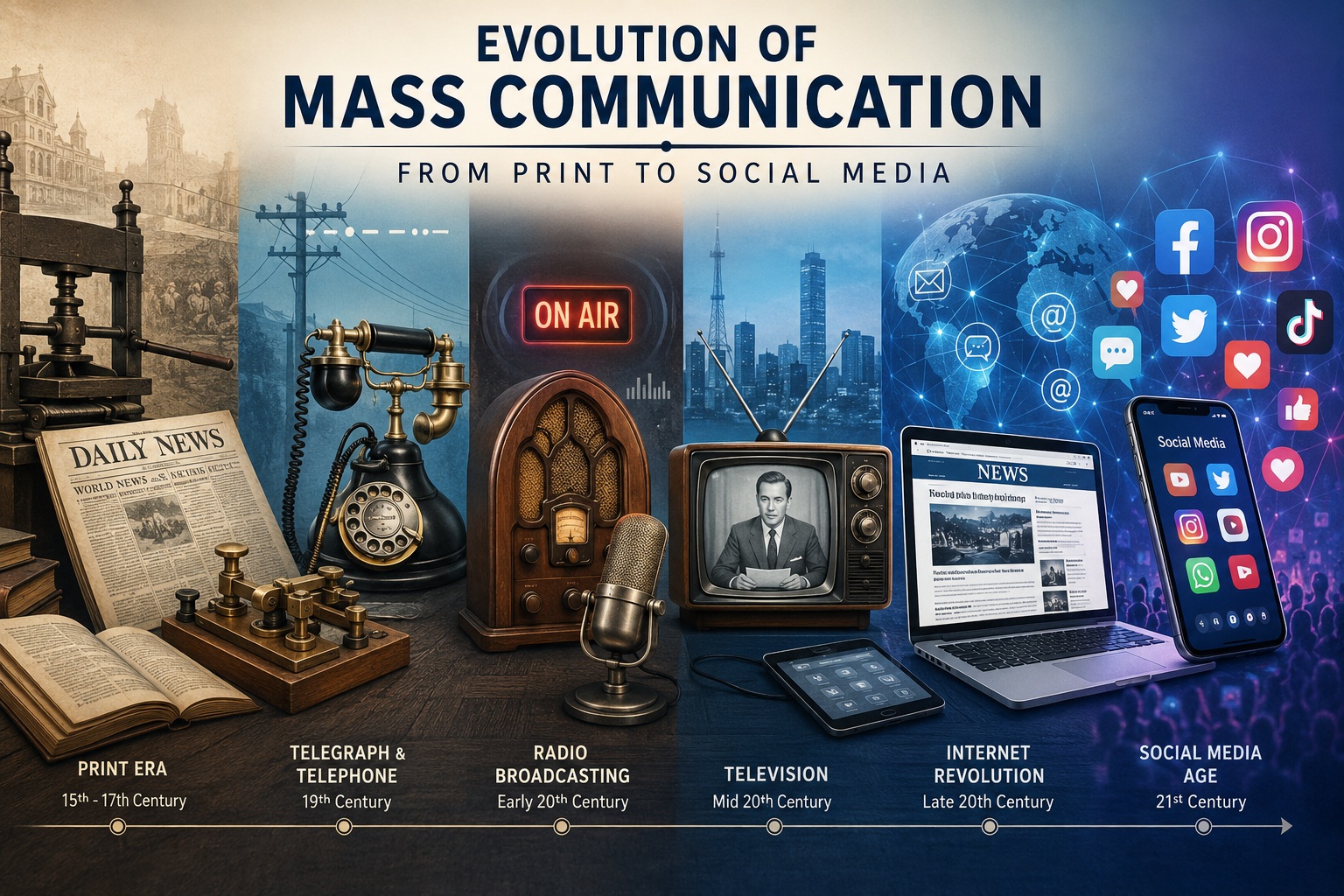
The evolution of mass communication has affected human civilization by shaping how information is created, shared, and understood in society. As technology evolved, the nature of communication has changed. The appearance of the first printed newspapers played a major role in politics, industry, culture, and social behavior. The ability to communicate with many changed the social system, making knowledge more readily available and distance less of a constraint.
Through the study of the historical development of mass communication, we gain knowledge of the development of mass communication and how it influenced the public’s interaction with communication over a period of time.
Mass communication is not just the passing on of information; it is a process of collective understanding which must be moulded. Each period had a new form of communication, which accelerated, expanded, and made communication more accessible. Each of these stages is a sign of some technological advancement, from print to radio, television to the internet and then social media. This is how it’s evolved and is an important reason why communication is still one of the most powerful factors in today’s world.
The Print Era: Mass Communication’s Foundation
The era of mass communication started with the printing technology and the invention of the printing press in the 15th century. Before this, a book was a luxury and very expensive; communication was done by hand-copying manuscripts by scribes. Most of the information was in the hands of religious institutions and scholars, and people had little access to written information. The invention of the printing press by Johannes Gutenberg revolutionised this system by allowing the use of movable type to write books in large quantities on speedy printing presses.
This innovation revolutionized education, religion, and politics by making it easy for people to access information. It made books more affordable and accessible, which helped to spread ideas and knowledge and, therefore, literacy. The printing press laid the groundwork for mass communication as it was a method of spreading information to a larger population than ever before in human history. The advent of newspapers led to an increase in print communication. In the 17th century, newspapers were gradually issued and started to report on politics, trade, and social affairs. Books were written, newspapers became more interested in current issues, promoting a culture of timely information sharing.
Later, the Industrial Revolution helped to make newspaper printing cheaper and quicker. This ushered in mass circulation, and journalism became a professional industry. For centuries from then on, print media took over as the primary means of communication and started influencing public opinion on a large scale and informing society about a lot of things.
The Telegraph and Telephone: Fastening the Speed of Communication
The Telegraph Revolution
The invention of the telegraph was one of the most important innovations in communication in the nineteenth century. Before the telegraph, messages were transmitted physically by letters or messengers — a process that could take days or weeks. It changed because Samuel Morse invented the telegraph, which sent people’s messages through electrical signals over great distances in minutes. This changed the nature of communication by adding speed as a criterion.
Governments used the telegraph for official communications, businesses for trading, and news agencies for reporting news in the shortest possible time. The telegraph paved the way for the world to become more useful and practical, and connected faraway regions for the first time. It was the first electronic communication and the forerunner of today’s communication systems.
Journalism was greatly affected by the telegraph because it enabled news agencies to collect and disseminate information more quickly. This established a new trend in the expectation of instant reporting of news. People could get up-to-the-minute information on significant happenings, altering the way society received information.
The Rise of the Telephone in Evolution of Mass Communication
The telephone was the next development from the telegraph, with the addition of real-time voice communication. Alexander Graham Bell invented the telephone in 1876 and made the first use of the instrument to establish a direct link between two people over a distance — communication became much more personal and interactive.
Telephones replaced telegraphs for natural conversation, which had required coded messages. Within a few years, the telephone was adopted in business and began to be used to improve coordination, and within the family, people began to use it to maintain communication between family members. The telephone was not like a newspaper, a mass medium, but it did make a large contribution to the communications infrastructure that facilitated later media systems. It accentuated the need for instant communication and society’s quick communication culture that ensued.
Radio Broadcasting: The Voice of the Masses
Radio was the first truly electronic mass medium of the 20th century. Radio did not require literacy and, therefore, was accessible to a much wider audience than print. It was a novel type of news, music, sports, and educational programming that consumers were able to hear first-hand in their own homes and create a new relationship between the media and the audience.
Radio changed the world of communication by broadcasting information to millions of people at once. For the first time, the idea of simultaneous mass communication was introduced; that is, the same message could be given to the entire population simultaneously. Governments made announcements and communicated during war, while businesses advertised and promoted brands.
Radio also transformed journalism by allowing live reporting. Now, something significant, such as a war, an election, or speech, could be broadcast live, creating a stronger emotional connection with the audience. Radio became a main feature of family life and culture; often, family members listened together. Radio’s information and entertainment mix resulted in one of the most powerful communication media ever created. The fact that radio still enjoys high audience ratings and remains flexible in adapting to new technology is evidenced by the digital streaming and podcasting capabilities it offers today.
TV: An Icon That Revolutionized Viewing
Combination of Sound and Image
In the evolution of mass communication, television was a new medium and, with its advent, ushered in a new era where sound and visuals could be combined. While radio was used for narration, TV used audio and visual elements and allowed the audience to see what was going on. This made the emotional impact even greater and presented the audience with more engagement in communication. Television became popular after World War II and was soon the most important medium for news, entertainment, and advertising. It revolutionized the consumption of information by families — information was now set to images and sound.
TV had a tremendous impact on politics due to the fact that political leaders came into the view of the people. Television was used for speeches, debates, and campaigns, influencing voters’ minds both word-for-word and through visual images. Historical events were transmitted live and consequently became shared national and global experiences, such as space missions, international wars, and cultural events. With television, communication became more immediate and emotional than with print or radio.
Television and Global Culture
International events were broadcast on television, thus facilitating the interconnection of cultures. It introduced the idea of a globalized world in which people could see the same things anywhere they went. Television also revolutionized advertising by using visual storytelling techniques to impact consumer behavior.
Television became one of the most powerful marketing tools of the 20th century, allowing brands to target audiences personally. It continues to have an impact on culture, politics, and entertainment today, even in the digital age.
The Internet Revolution: Communication Revolution
The internet has revolutionized mass communication more than any technology ever has. It combined text, audio, images, and video in a single application, making communication more interactive, cheaper, and faster. The internet eliminated many obstacles to publishing compared to traditional media. There was no longer a need for printing houses, radio stations, or TV stations to communicate information among people. Websites, blogs, and online content creators could create content for audiences around the world. This shifted communication power from institutions to individuals, making communication more democratic.
Journalism was also changed by the Internet. Many people abandoned newspapers for online news platforms because they provided instant news. Search engines made information more accessible, and multimedia journalism introduced video, live coverage, and interaction. Companies adopted e-marketing, governments adopted electronic communication networks, and education adopted e-learning. Communication became permanent, and information became available anytime. Despite this, however, the internet has had its difficulties, such as misinformation, fake news, and information overload. Communication became faster, but so did the need for scrutiny of information.
The Interactive Communication Age: Social Media
From Passive Audience to Active Participation
Social media has made communication more active for audiences and changed mass communication. The process of communication in traditional media was one-way because communication flowed from the media to the audience only. But with social media’s real-time creation, sharing, and reaction to content, this changed completely. This led to the emergence of two-way communication, making media more interactive and personal. Ordinary citizens gained the power to post content and influence public discourse on social networking sites.
Social media has become part of journalism’s paradigm shift, and news stories frequently make headlines on social media before traditional media outlets report them. It also revolutionized marketing by enabling brands to connect with customers directly. New communication figures arose — influencers — who shared opinions and influenced consumer decisions. Social media gave people a stronger public voice.
The Power of Virality
Virality is one of the most important aspects of social media. Information spreads quickly on social media; sharing posts and information through likes, comments, and reposts can reach the entire world in a matter of minutes. This creates space for community engagement, activism, and awareness.
Social media has been used as a platform for social movements to mobilize crowds and spread awareness about causes people care about. However, the same speed that can spread useful information may also spread false information. This creates problems with credibility and trust in the media.
Conclusion: Evolution of Mass Communication
From print to social media, and from physical to digital communication, humanity has relentlessly worked to increase the efficiency of conveying information over many years. Each major technological development — whether the printing press, telegraph, telephone, radio, television, internet, or social media — has advanced, enhanced, and expanded the speed, power, and reach of communication.
These changes impacted learning, socialization, and involvement in society. Slow, physical systems were replaced by communication that takes place in fleeting moments between millions or even billions of people.