Introduction
Programming is supposed to be a very technical and expert only field. However, programming is actually a logical and structured process, and any person could understand it, if given the proper supervision. Every software application, website, mobile application or computer system begins with a number of very intentional steps that lead a programmer to a functioning solution. The stages of programming are very valuable to people who are studying, building or interested in tech, as it illuminates the process of software development, structured and efficient.
Programming is more than just writing code. Also, it’s identifying problems, creating solutions, designing algorithms, verifying solutions, and fixing errors before the implementation process begins. If you don’t follow proper process software projects may break down, become hard to maintain, or present incorrect results. This is why professional programmers employ a systematic approach to ensure quality and reliability in their programming
In this article we will examine the entire programming process from problem definition to implementation and maintenance. We see how it can help us achieve the overall purpose of creating improved and more efficient software solutions at each step.
Understanding Programming as a Process
Programming is a field which is related to the creation of instructions that tell a computer what to do in very precise terms. We write these instructions in what we call programming languages like Python, Java, C+, or JavaScript. Although coding is a key element of programming, it is but one piece of the puzzle which is software development. Instead what also is important is the structured approach which includes design, planning, testing and maintenance.
Stages of programming is what developers use to break down complex tasks into manageable stages. Also it presents problems in a clear light before going into solution design. Also at which point they may test and improve their work constantly.
In the stages of programming there is a progression through stages which feed into each other. To skip any step is to risk confusion, software errors, or system failure. Thus it is essential that programmers pay attention to the process which in turn will produce reliable and user friendly applications.
Major Stages of Programming
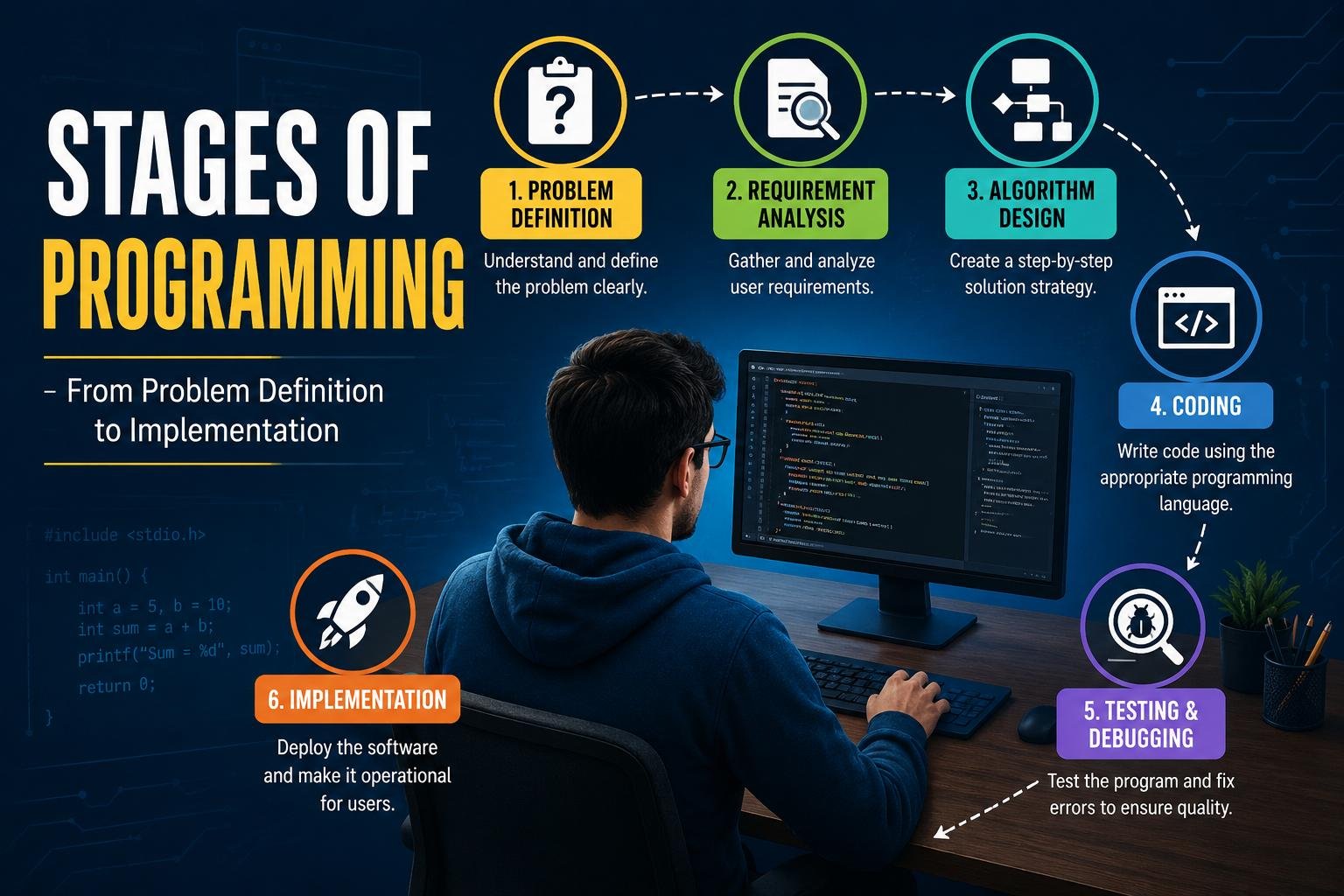
Programming process typically includes the following stages:
- Problem Definition
- Requirement Analysis
- Development of Algorithms.
- Flowchart and Program Design
- Coding
- Testing and Debugging
- Documentation
- Implementation and Maintenance
Each of these stages plays a role in the success of software development.

1. Problem specification
In the beginning, is the problem definition which is also perhaps the most important stage in programming. Before putting pen to paper or finger to keyboard programmers must clearly see the problem at hand. Poor problem definition is a sure path to poor quality software solutions.
At this stage, programmers identify:
- The purpose of the program
- The expected output
- The users of the system
- The limitations and constraints
- The data required for processing
For instance a programmer which is in the process of developing a school management system must first determine what the school requires. What does the school want in terms of student registration, attendance tracking, exam results, or fee management? Identifying these at the start will help to avoid confusion down the road.
A well-defined problem is the base for the success of a programming project. It makes sure that developers are put forward the right issue at hand which in turn prevents them from adding in unnecessary features.
Importance of Problem Definition
Problem definition is important because it:
- Prevents misunderstanding
- Saves development time
- Reduces errors
- Improves planning
- Ensures accurate solutions
In many cases programmers report to put in great effort in software which in the end does not address user requirements.
2. Requirements Assessment.
After we define the issue at hand the next step is to analyze the requirements. Requirement analysis in this stage is to obtain in depth information of what the program is to do.
At this stage we see interaction between developers, clients, users and stakeholders. Programmers put forth questions to clarify expectations.
Requirements are for the most part in two categories:
Functional Requirements
These are the actions which the system is to take out. For example:
- User login functionality
- Data storage
- Report generation
- Payment processing
Non-Functional Requirements
These present what the system is to do. For example:
- Security
- Speed
- Reliability
- User friendliness
Requirement analysis is what which enables programmers to develop software that at the same time meets technical and user needs.
Challenges in Requirement Analysis
Some common challenges include:
- Incomplete information
- Changing client needs
- Communication gaps
- Unrealistic expectations
To that end developers put together requirement documents and also have regular meetings with stakeholders.
3. Development of Algorithms
Once the issue and requirements are grasped programmers begin to put together a solution with algorithms.
An algorithm is a set of steps used for problem solving which is done in a logical way. It details out the precisely which actions should be taken to produce a desired output.
Algorithms are critical as they enable programmers to work out the logic of a program prior to code.
Characteristics of a Good Algorithm
A good algorithm should be:
- Clear
- Simple
- Efficient
- Accurate
- Finite
For instance, a program to determine student grades may include the steps of:
- Start
- Input of student grades.
- Determine total score
- Calculate average.
- Assign marks according to average performance.
- Display result
- Stop
This order of steps which helps programmers structures their thoughts prior to implementation.
Benefits of Algorithm Development
Developing algorithms provides several advantages: Developing output algorithms which perform certain tasks to the best of their ability.
- Simplifies problem solving
- Reduces coding errors
- Improves efficiency
- Makes debugging easier
- Enhances program design
Algorithms are the structure which programmers follow in the software development process.
4. Flow diagram and Programming design.
After developing algorithms programmers also use flowcharts and design tools for program structure visualization.
A flowchart is a visual presentation of an algorithm which uses symbols and arrows. It also helps programmers to see how data moves through a system.
Common Flowchart Symbols
Some commonly used flowchart symbols include: Some frequently used flowchart symbols include:.
- Oval: Begin or Stop.
- Rectangle: Process.
- Diamond: Determination.
- Parallelogram: Input/output
- Arrow: Flow direction.
Flow diagrams present complex processes in an easy to understand and intuitive way.
Program Design
Program design is in the stage of which out you will lay out the pieces of your program and how they interact. This includes:
- Data structures
- User interfaces
- Database design
- Program module
- File organization
Design that is good improves software efficiency, readability, and maintainability.
Importance of Program Design
Effective design helps:
- Reduce development problems
- Improve performance
- Simplify maintenance
- Enhance scalability
- Support teamwork
Professional software projects depend greatly on good design before development starts.
5. Coding
Programming is the stage at which developers turn algorithms and designs into code. This is very much what the public thinks of as programming.
Programmers use languages such as:
- Python
- Java
- C++
- JavaScript
- PHP
- C#
Language choice is determined by the type of software we are developing.
Coding Best Practices
Good programmers also adhere to coding best practices which in turn produce clean and efficient code. These practices consist of:
Writing Readable Code
Readable code is easy to go through and maintain. Programmers use proper indentation, space, and meaningful variable names.
Example:
Student-score = 85
This is clearer than:
x = 85
Using Comments
Comments in code are used to explain what is happening and help other developers to understand the code.
Avoiding Repetition
Programmers use of functions and loops which is to minimize repetition of code.
Following Standards
Coding practices in turn improve consistency within development teams.
Importance of Coding
Coding is what turns out ideas and designs into functional software. In which there is no code that is a theoretical algorithm or design.
Also at it goes that writing code is not enough for success. Programs also have to be tested through and through for correctness.
6. Testing and Debugging
In the stages of programming testing and debugging are a large component of the programming which we do. Also even very experienced programmers will make mistakes and so software should be put through a thorough test cycle before it is released.
1. Testing
Testing is out to see if a program does what it is supposed to do.
Types of Testing
Unit Testing
This is a breakdown of the program into its components.
Integration Testing
This is to see how different modules perform together.
System Testing
This is a full system evaluation.
User Acceptance Testing
Users try out the software to see if it fulfills their requirements.
2. Debugging
Debugging is the process of error detection and correction in a program.
Programming issues are divided into three categories:
Syntax Errors
These happen when code breaks programming language rules.
Example:
print(“Hello
The quotation mark is incomplete.
Runtime Errors
This occurs while the program running.
Example: Sure, what is the text you would like me to paraphrase?
- Dividing by zero
- Accessing invalid files
Logical Errors
During which the program runs but reports wrong results.
Logical defects are the most hard to find out as the program seems to work.
Importance of Testing and Debugging
Testing and debugging help:
- Improve software quality
- Detect errors early
- Enhance reliability
- Increase security
- Improve user satisfaction
Without that proper testing done first software may see to break in ways we don’t expect which in turn damages user trust.
7. Documentation material
Documentation is the process of putting down info related to the program and its development. Many new programmers ignore this but it is very important.
Documentation is for developers and users to understand how the software works.
Types of Documentation
Technical Documentation
This includes program structure, algorithms, databases, and code organization.
User Documentation
We provide guides for using the software.
Examples include:
- User manuals
- Installation guides
- Help files
Benefits of Documentation
Good documentation:
- Simplifies maintenance
- Supports teamwork
- Helps future developers
- Improves user experience
- Reduces confusion
In large scale software projects we see many developers involved which is why documentation is key for communication and success.
8. Deployment and Management.
Introduction of the final software to users at this stage is also about installation, configuration and making the program operational.
Implementation Activities
Implementation may involve:
- Installing software
- Migrating data
- Training users
- Configuring systems
- Monitoring performance
Implementation success is a result of good planning and testing.
Maintenance
Software development is an ongoing process which does not stop after the implementation. We do see changes, improvements and corrections to the programs as they grow older.
Maintenance includes:
- Corrective Maintenance: Fixing discovered errors.
- Adaptive Maintenance: Bringing software up to date with new technology
- Perfective Maintenance: Improving features and performance
- Preventive Maintenance: Reducing future risks and potential problems
Importance of Maintenance
Maintenance ensures software remains:
- Functional
- Secure
- Efficient
- Relevant
- Compatible with modern systems
Many software systems see updates to their codebase for years post release.
The Role of Teamwork in Programming
Modern programming projects are almost always a team effort. In large scale systems we see:
- Programmers
- Designers
- Testers
- Project managers
- Database administrators
- Security specialists
Teamwork increases productivity and also has specialists put forward their expertise.
Communication is of great importance in the programming process. Developers put forth ideas, talk through issues, and coordinate tasks.
Common Challenges in the Programming Process
Programming projects may present with a number of issues which include:
Changing Requirements
Clients may change what they need at any point in development which in turn causes programmers to revise present plans.
Time Constraints
Deadlines stress out developers and increase error rate.
Technical Complexity
Some projects are of complex technical and logical design.
Security Risks
Programs need to protect against cyber threats and.
Lack of Planning
Poor preparation often results in project failure.
Developers overcome these issues through organization, team work, testing, and continuous learning.
Why Understanding the Programming Process Matters
Grasping the stages of programming benefits at all levels of experience from beginner to professional also it presents programming as a logical exercise which is not so secret.
Knowledge of the programming process also:
- Improves problem-solving abilities
- Encourages structured thinking
- Enhances software quality
- Reduces development costs
- Supports career growth in technology
Even non-programmers may gain from study of the development and care of computer systems.
Conclusion
Programming goes beyond just writing out lines of code. It is a structured and logical process which turns ideas into practical software solutions. From the definition of problems and analysis of requirements to the design of algorithms, code write up, testing, and maintenance, each stage plays a role in the development of effective and reliable programs.
Understanding the stages of programming brings to light the fact that software development is a very human process which at the same time is very methodical. By using a structured approach developers are able to produce software that is at the same time efficient, secure, and easy for the end user and which also is a solution to real world problems.
As technology is ever changing the programming process will be at the root of software development. In the creation of a basic calculator or a large scale enterprise system programmers use these stages which transform ideas into functional digital solutions.
Get more well researched information about the stages of programming here.