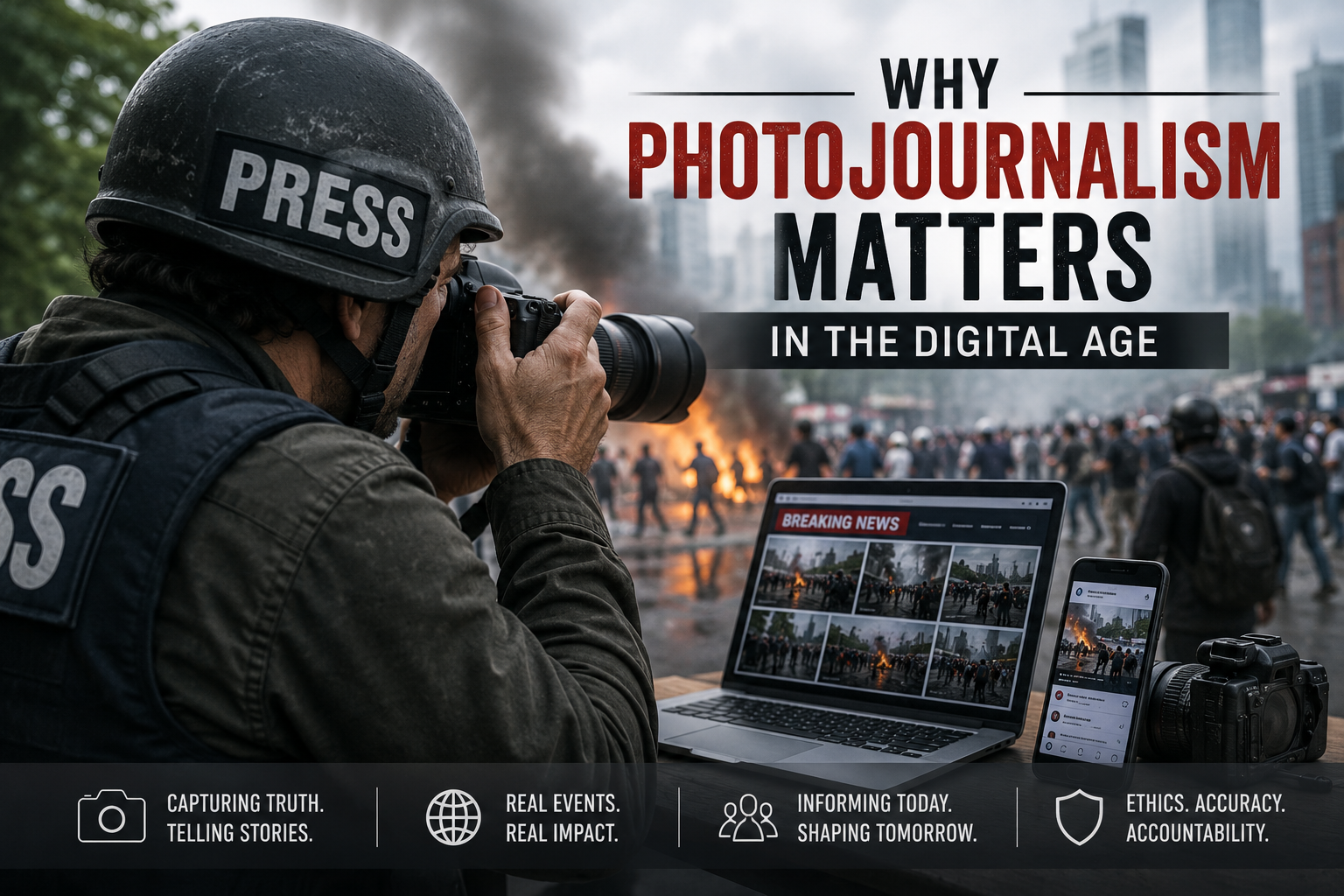
With the current fast-paced digital landscape, a massive shift in how people receive news has greatly changed from traditional formats to highly visual formats that are real-time news. The culture of smartphones, social media, and 24-hour news cycles has led to the creation of a culture where images are the first form of communication (and are sometimes the most effective form of communication). In this context, photojournalism in modern media has become a critical pillar of narratives, which makes audiences comprehend the events happening around the globe.
Photojournalism is not simply about taking pictures but about capturing the truth, emotion, and context in one frame. A strong photo can capture history, shape the opinion of the people, and elicit meaningful discussions. In the digital era, where information is disseminated in real time, credibility and ethicality of visual reporting have increased to an extent that it can no longer be ignored. Though anyone can capture and share images with a smartphone, there is a level of expertise, responsibility, and storytelling that is the distinction of the work of a professional photojournalist.
Meanwhile, there are new challenges in the digital realm. The fake news spreading so fast, the appearance of manipulated images, and the excessive number of sources that can be found online made it more difficult to help the audience locate credible sources. Nevertheless, despite all these obstacles, photojournalism continues to be an important means of recording reality and keeping the power in check. This article deals with the development, relevance, and future of photojournalism, with a particular focus on the reasons as to why photojournalism remains relevant in the current media environment.
The Evolution of Photojournalism in the Digital Age
The transformation of photojournalism has been an amazing transformation that has occurred over the last 100 years. During its infancy, photographs were largely employed in newspapers and magazines as a complement to the written stories. Capturing, developing, and publishing images used to be time-consuming and demanded a technical approach and close editorial supervision. Nevertheless, the shift to digital technology has changed all aspects of the field.
The digital cameras and cell phones currently enable photojournalists to not only take good quality pictures but also instantly transfer them to newsrooms in seconds. It is this immediacy that has been created in the contemporary media, more dynamic and responsive than ever before in the history of photojournalism. Viewers do not need to wait until the next day to see pictures of key events; they are now able to be updated on events in real time.
Significant Digital Era Changes
- Film to Digital: The transition to digital photography, as opposed to analog, has made it more efficient and accessible.
- Real-Time Reporting: It is now possible to share images in real time and across a variety of platforms.
- Universal Access: Digital media enables the photographs to be accessed by people all over the world within a few seconds.
- Interactive Content: Photojournalism, in most cases, is integrated with videos, graphics, and live updates.
Nevertheless, photojournalism has not lost its essence, as the main task of a photojournalist is to capture reality on the ground and present the visual evidence of the events. The tools might have changed; however, the dedication to accuracy and storytelling remains to define the profession.
The Power of Visual Storytelling
One of the most interesting phenomena of photojournalism is visual storytelling. Images can convey complicated concepts within the shortest and most efficient time, thus making them an indispensable tool in the computer age. One photo can be able to capture a moment that limited words may not be in a position to describe, and this gives the audience an immediate and emotional attachment to a story.
Most of the time, photographs are used as historical documents which conserve the moments that characterize societies and cultures. As an example, pictures of social movements, environmental disasters, or humanitarian crises may become iconic images of the bigger picture. Not only informative but also inspiring, action and empathy are these images.
The Reason Why Visual Storytelling is So Effective
- Emotional Connection: Pictures evoke emotions which attract viewers to the narrative.
- Instant Communication: Visuals are a fast means of conveying information and do not need a lengthy explanation.
- Cross-Cultural Understanding: Photographs will not be restricted by language boundaries, making them globally accessible.
- Memorable Impact: The striking images will not be forgotten by the general population, even long after their initial observation.
The success of visual storytelling, however, will be dependent on context. Images do not always have adequate explanation, thus they can be misconstrued or serve to back up misleading narratives. This underlines the need to use captions, background information, and ethical reporting.
Impact of Social Media on Photojournalism
Social media has redefined the very dynamics of the distribution and consumption of photojournalism. Visual content is a priority of such platforms as Instagram, Facebook, and Twitter, so photographs are one of the main aspects of digital communication. These sites allow photojournalists to distribute their work to the world at large in real time, enhancing the range as well as impact.
Citizen journalism has also made a big contribution to the development of modern photojournalism. Citizen journalists are in a position to take pictures and distribute them of breaking news stories, and the first pictures of a significant event may be provided by an ordinary citizen with a camera. While this has democratized the field, on the other hand, it has brought challenges that have to do with credibility and accuracy.
The Benefits of Social Media
- Immediate Visibility: Photos can be distributed among millions of users in a few minutes.
- Broader Viewpoints: Citizen journalists can offer a variety of perspectives.
- Direct Interaction: Audiences have the opportunity to interact with the content by commenting and sharing it.
Social Media Issues
- Misinformation: Unproven pictures can become viral and misguide the audience.
- Loss of Context: Photos can be distributed without proper descriptions.
- Saturation of Contents: The extremely large quantity of images makes it challenging to distinguish plausible sources.
Photojournalists are professionals whose services are very important in ensuring that the standards of accuracy and reliability are adhered to. Their training has been such that not only are pictures visually appealing, but they are also true and well contextualized.
Ethical Accountability in the Online Space
Photojournalism is all about ethics, and its significance has been heightened with the advent of the digital era. Editing and manipulatory features of images have contributed to lowering the authenticity and trust levels because it is now easy to distort reality. To uphold the credibility of photojournalists, a set of strict ethical guidelines has to be followed.
Among the most important ethical issues is the need to make sure that the pictures are a true reflection of reality. These involve not staging scenes, falsely editing, or editing in such a way that the meaning of a photograph is changed. Photojournalists should also take into consideration the effects of their work on those they are taking photographs of, especially in sensitive scenarios.
Core Ethical Principles
- Precision: Pictures should not be distorted to depict real situations.
- Integrity: Journalists are not supposed to be manipulated or act up.
- Respect: Dignity and sensitivity towards the subjects should be shown.
- Transparency: All the required amendments must be made known.
With the emergence of deepfakes and AI-generated images, the situation has become even more complicated. With technology constantly changing, it is going to be necessary to not only practice ethics in visual media but also to enhance the media literacy of the audience.
Photojournalism and Its Influence on the Formation of Opinion Among People
Photojournalism has been a potent tool in influencing the opinion of the people. The iconic pictures have significantly shaped the perception of occurrences by the people, becoming, in most cases, the symbol of social and political movements. The influence of photojournalism is multiplied in this digital era due to the speed and coverage of the internet.
One photo can instigate conversations around the globe, increase awareness, and prompt action. Photographs of demonstrations, humanitarian emergencies, or natural disasters can often be evocative of the audience, as it tends to prompt audiences to pay attention to critical issues.
The Role Played by Photojournalism in Shaping Society
- Creates Awareness: Brings to the fore issues that would otherwise not have been realized.
- Fosters Engagement: Fosters discussion and exchange of ideas.
- Motivates Change: Has the ability to affect the general opinion and political choices.
But this power is accompanied by responsibility as well. The harmful effects of misleading or out-of-context images can negatively influence people’s opinions. This goes further to affirm the importance of ethical and correct reporting.
The Issues That Are Affecting Photojournalism Today
Although photojournalism is still a necessity, there are many challenges that it is facing in the digital world. The high rate of news production, coupled with the emergence of social media, has made it a highly competitive environment in which accuracy can be compromised at times.
Key Challenges
- Misinformation and Fake Images: With images being manipulated or fake, trust is destroyed.
- Economic Pressures: The shrinking revenues in traditional media have an impact on funding photojournalism.
- Safety Hazards: Photojournalists are usually exposed to hazardous conditions.
- Saturated Content: Multiple images cause it to be hard to distinguish good work from all the images.
To overcome these challenges, there is a need to collectively work on them through the collaboration of journalists, media organizations, and audiences. With accuracy and ethical practices being the priorities of the industry, it is possible to ensure that the credibility of the industry can be preserved.
Future of Photojournalism in Modern Media
Technological innovation and evolving demands of the audience will result in the future of photojournalism. The new possibilities in storytelling are growing with the use of new tools like drones, virtual reality, and artificial intelligence.
Emerging Trends
- Drone Photography: Photographs of exclusive aerial views.
- Virtual Reality (VR): Provides an immersive storytelling experience.
- Artificial Intelligence: Helps to sort out and analyze visual information.
- Mobile Journalism: Facilitates real-time news coverage with smartphones.
Nevertheless, in spite of these developments, the fundamental tenets of photojournalism, which include accuracy, integrity, and storytelling, will still be vital. With the advancement of technology, photojournalists will have to adjust to these values, but not neglect them.
Conclusion
In contemporary media, photojournalism remains a critical element, as it offers the audience relevant and striking visual stories. The multifaceted nature of the technological, narrative, and moral aspects of modern media is reflected in the concept of photojournalism. The desire to have credible and trustworthy reporting of visuals has never been greater than in a world that is overwhelmed with images.
As professional photojournalists, they are the key to telling stories, capturing the events that happen in the life of any community, and providing the context which helps to interpret complex issues. Not only does their work inform, but it also evokes a feeling of empathy and engagement.
With the ever-changing digital world, photojournalism will come to familiarize itself with new technologies and platforms. It can continue to be a potent instrument in the formation of the opinion of the people, and even in the preservation of the visual history of our age, by upholding ethical principles and being innovative.
Frequently Asked Questions (FAQs)
1. What is photojournalism in contemporary media?
Modern photojournalism in the digital age implies that photography is used to report news and tell stories in the digital age and is a combination of visual storytelling and journalistic principles.
2. Why is photojournalism important in the digital age?
The instant, dramatic communication that it provides makes audiences comprehend complex events in the shortest time and creates emotional resonance.
3. How has social media transformed photojournalism?
Social media has now made photojournalism quicker and more reachable but has also presented issues like misinformation and lack of context.
4. What are the ethics of photojournalism?
Some of the main principles are accuracy, integrity, respect for subjects, and report transparency.
5. What is the future of the photojournalist?
The future will be associated with new technologies such as drones and virtual reality, preserving the main values of truth and narrative.