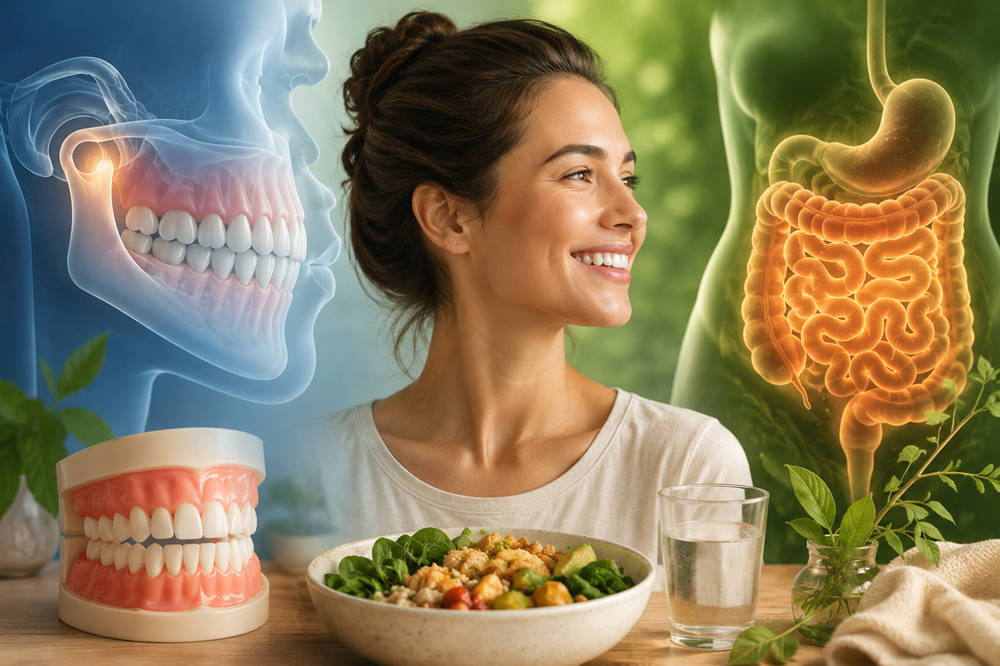
Most people think of digestion as something that happens in the stomach. It doesn’t. It starts the moment your teeth make contact with food. The mechanical breakdown that happens during chewing – what physiologists call mastication – is what makes the rest of the process work. When the bite is compromised, everything downstream pays for it.
What Chewing Actually Does
Teeth have a much more important role than just breaking food into manageable parts. They also prepare food for digestion by the stomach and intestines. This is done by increasing the food’s contact with digestive enzymes in the saliva. The more the food is broken up in the mouth and exposure to the salivary amylase, the more completely and quickly this process occurs.
Poorly masticated food forces the rest of the digestive system to work hard. The stomach may over-produce acid in an attempt to dissolve the food mass in its entirety. This can lead to indigestion and other acid-related disorders. If you are unable to extract the proper nutrients out of your food, you are also likely to put stresses and strains on your tissues and organs.
The Nutritional Shift No One Talks About
When teeth deteriorate and are not properly taken care of, people change their eating habits by avoiding hard and healthy foods that are difficult to chew, as a way to avoid pain. This leads them to consume more processed, easier to eat foods, which are usually high in sugar and low in essential nutrients. This is not about self-control, but about the limitations caused by dental problems.
Studies have shown that people with fewer natural teeth or badly fitting dentures have a significantly lower intake of fiber, magnesium, and calcium than those with a healthy dental situation. This lower nutrient intake is a direct result of poor dental health because people are forced to avoid nutritious but hard-to-chew foods.
So, taking care of your teeth is not just about having a pretty smile, it’s about making sure you can eat the foods that will keep you healthy in the long run.
Long-Term Solutions That Actually Address The Cause
Removable dentures can restore some function, but they don’t solve the bone problem. Because they sit on top of the gum tissue rather than anchoring into the jaw, they don’t transmit the mechanical forces needed to maintain bone density. Over time, the ridge continues to resorb underneath them, which is why dentures need refitting and eventually stop working well regardless of how carefully they’re maintained.
Dental implants work differently. A titanium post is placed directly into the jawbone, where it undergoes osseointegration – a biological bonding process where the post fuses with the surrounding bone tissue. The result is a tooth replacement that behaves like a natural root, transmitting chewing forces into the bone and preventing the resorption cycle from continuing. Bite force is restored to a level that lets people eat the full range of foods they’d otherwise have to avoid.
This matters for the long haul. A restored bite isn’t just about comfort or appearance. It’s the mechanical prerequisite for eating the diet that supports gut health, bone density, immune function, and metabolic stability.
What Happens To The Jaw When Teeth Go Missing
Bones are not inactive parts of our body. For instance, the alveolar bone – that is found in the jaws and surrounds and supports teeth – is kept dense because the roots of our teeth transmit force to it as we chew, and this, in turn, sends a signal that helps the bone to maintain itself healthy. However, when a tooth is lost this signal stops, and the bone begins to reabsorb.
But this is not only an aesthetic issue. As the ridge of the tooth begins to shrink, the adjacent teeth lose support and start to move or become loose. Also, an incorrect bite will put unnecessary strain on the temporomandibular joint which connects our jaw to the skull. These problems will in turn result in headaches, pain in the jaw, and still more problems when chewing.
The loss of one tooth will increase the risk of losing more! And the worst part is that this degradation will happen faster than we imagine.
Restorative Dentistry As Preventive Medicine
Considering “dental health” and “physical health” as separate things is a bit of a myth. The mouth is where the digestive tract begins, after all, and what happens there determines what the rest of the body has to work with. Periodontitis contributes to overall body inflammation. Having a compromised bite leads to a shortage of nutrients. Bone loss in the jaw leads to a snowball of problems which certainly won’t remain in the jaw.
Treating tooth loss early, with solutions that preserve bone and restore full function, is one of the more straightforward interventions available for long-term physical health. It just sadly doesn’t often get the attention that it should.