Introduction
In present day corporate settings we see that companies are dealing with very complex operational structures which in turn require more than what traditional cost systems can offer. In the industries of construction, infrastructure development and multi-location retail we see specific issues that stand out which may not be properly addressed by standard cost methods. That is when we see the value of special costing methods like contract and branch costing.
These we have designed for particular business models. In the case of contract costing we look at large scale projects which are usually in the construction or engineering sectors, and we have branch costing which is for businesses that operate in many different locations. By this means we enable managers to do better financial planning, improve cost control, and increase profitability.
In this piece we will look at the issues related to contract costing and branch costing. At the finish you will see how these special cost accounting methods address unique business issues.
To find out more about what we put in to business’ financial strategies see this in depth guide which covers contract costing and branch costing and how they play a role in decision making.
Understanding Contract Costing
What is Contract Costing?
Contract costing is a type of job costing that is used for large scale, long term projects. It is also a practice in the construction, shipbuilding, road development, and engineering projects. Each project is put out as a separate cost unit and costs are tracked individually per contract.
For small tasks we may not see the value in detailed cost tracking but with large scale contracts which span months or even years and require great investment we must pay close attention to cost tracking.
Key Features of Contract Costing
- Large-Scale Projects Large scale projects: Contracts include large sums of money and long time frames.
- Site-Based Work Site Based Work: Most of the action of these contracts is located at certain places beyond the factory setting.
- Separate Cost Units Delineate Cost Units: Each contract stands alone in terms of cost accumulation and analysis.
- Direct Cost Allocation Direct Cost Assignment: Costs associated with materials, labor, and direct expenses are put into the contract.
- Progress Payments Progressive Payments: Payments are made in installments for work completed which is called certified work.
Components of Contract Costing
- Direct Materials: Contract specific raw materials.
- Direct Labor: Wages of workers on the project.
- Direct Expenses: Expenses of equipment hire or subcontracting.
- Overheads: Indirect expenses assigned to the contract.
- Work Certified and Uncertified: Work that has been signed off by the client versus work which is still in progress or outstanding.
Profit Recognition in Contract Costing
Since we have long term contracts profit is not recognized at the time of completion. Instead we report partial profits as we progress through each stage of completion. This also does:.
- Providing realistic financial reporting
- Avoiding sudden profit fluctuations
- Supporting better financial planning
Applications of Contract Costing
Contract cost analysis is used in:
- Construction companies that are at work on roads, bridges, and buildings.
- Engineering firms that work on large scale infrastructure projects.
- Shipbuilding and aerospace industries
- Government contract projects
Advantages of Contract Costing
- Accurate Cost Tracking: Each contract is reviewed separately.
- Better Budget Control: Managers may review actual costs against estimates.
- Performance Evaluation: Improves project performance and profitably.
- Improved Cash Flow Management: Progressive payments produce steady income.
Challenges of Contract Costing
- Complex Record-Keeping
- Uncertainty in Cost Estimation
- Risk of Cost Overruns
- Difficulty in Profit Calculation
Despite these issues, contract costing is still a key element in the world of large scale and custom made projects.
Understanding Branch Costing
What is Branch Costing?
Branch performance analysis is a practice which businesses that have many branches or outlets use. It includes the tracking and evaluation of each branch’s financial performance to improve efficiency and profitability.
Branches may differ in terms of size, function and autonomy. Some work independently while others look to the head office for supplies and decision making.
Objectives of Branch Costing
Determine the profit of each branch which is the most profitable what, the bottom line for each branch is:
- Maintain tight control of branch operations.
- Ensure proper allocation of resources
- Detect inefficiencies and prevent fraud
- Support strategic decision-making
Types of Branches
1. Dependent Branches
- At the behest of head office’s control.
- Do not keep full accounting books.
- Receive products and procedures from headquarters.
2. Independent Branches
- Maintain their own accounting systems
- Run more autonomously.
- Prepare separate financial statements
3. Foreign Branches
- Operate in different countries
- Require that which is related to currency conversion and local regulations.
Methods of Branch Costing
1. Debtors System
- Used for dependent branches
- Tracks shipments, sales, expenses, and returns.
2. Inventory and Debtors System.
- Keeps track of stock movement.
- Helps in better inventory control
3. Final Accounts System
- Branch prepares full financial statements
- Suitable for independent branches
4. Wholesale Branch System
- Goods are charged out to branches at a markup.
- Helps out with price and profit.
Key Components of Branch Costing
- Goods Sent to Branch
- Branch Sales (Cash and Credit)
- Branch Expenses
- Stock Management
- Debtors and Creditors
Applications of Branch Costing
Branch costing is commonly used in:
- Retail chains and supermarkets
- Banks and financial institutions
- Restaurants and hospitality businesses
- Distribution companies
- Franchise-based businesses
Advantages of Branch Costing
- Performance Measurement: Evaluates each branch separately.
- Improved Control: Improves operational performance.
- Better Decision-Making: Identifies successful and unsuccessful branches.
- Fraud Prevention: Regular review of finances.
Challenges of Branch Costing
Head office is in close touch with branches.
- Data Inconsistency across locations
- Currency Issues in foreign branches
- High Administrative Costs
Key Differences of Contract vs. Branch Costing
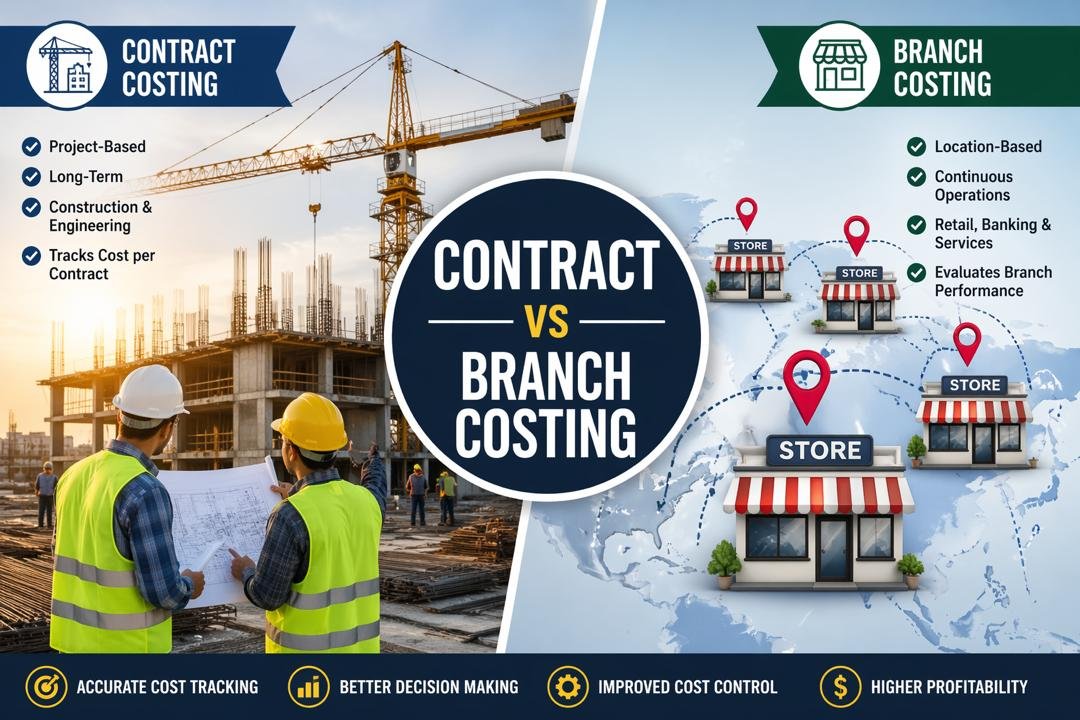
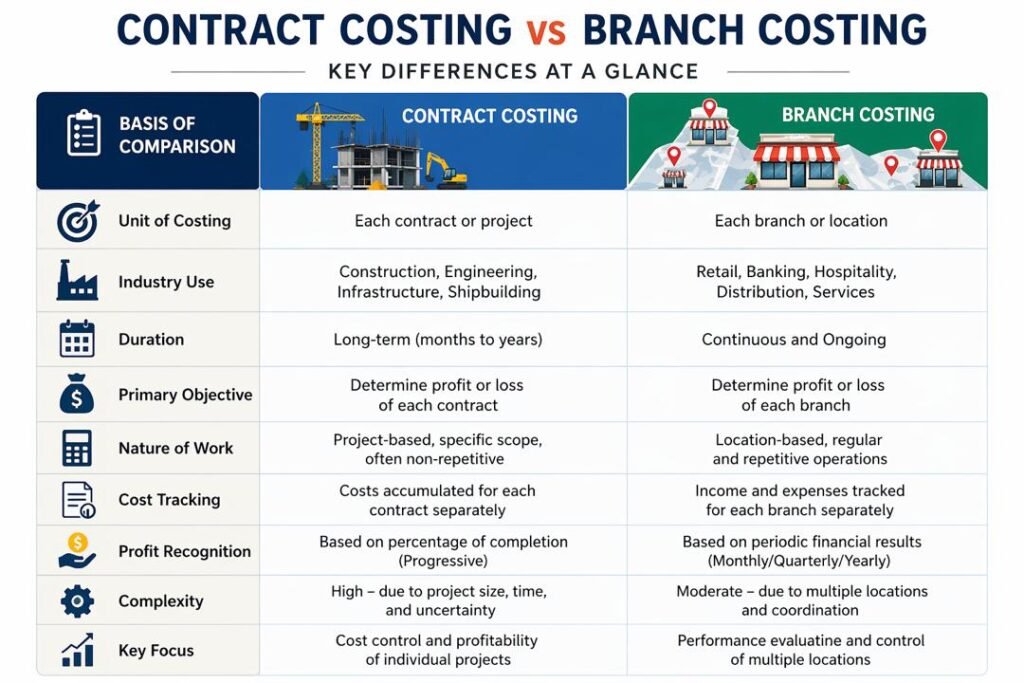
Contract costing and branch costing vary greatly in which they put their focus and how they are used.
Contract cost structure is a per project basis which means each contract stands alone for cost tracking. This is common in the construction and engineering industries which have large scale and long term projects. We mainly determine the profit of each individual project and may see these contracts go on for months to even years.
In other words, we see branch costing as a location based system. Each branch or outlet is put forward as a separate entity for financial review. This practice is common in retail, banking, and service industries which have many different locations. As opposed to contract costing which is for large scale and sometimes one-time events, branch costing is an ongoing process which reports on present performance.
In terms of contract costing, we see great complexity in respect to the project scale and level of uncertainty while in branch costing there is an issue in the control and coordination of multiple locations.
Importance of Specialized Costing Methods
Traditional costing systems do not always work for companies with unique structures. In regard to which we see that specialized costing models such as contract costing and branch costing present:.
- Customized Financial Insights
- Enhanced Cost Control
- Improved Strategic Planning
- Better Resource Allocation
These approaches allow for business flexibility in their everyday operations instead of a one size fits all approach.
Real-World Relevance
In Construction
A construction firm which is into many projects at the same time must track each project separately. In terms of contract costing we have that:
- Costs are allocated correctly
- Profitability is measured accurately
- Delays and overruns are noticed early.
In Multi-Location Businesses
Retailers which have stores in many cities use branch costing to:
- Compare branch performance
- Adjust pricing strategies
- Allocate inventory efficiently
- Decide on expansion or closure
Integrating Technology in Costing Systems
Modern companies are seeing to it that they use digital tools for their cost structures. Software solutions which do:
- Automating data collection
- Reducing human error
- Providing real-time financial insights
- Enhancing reporting accuracy
For contract costing, project management software includes cost tracking which is tied in with timelines. In branch costing we see that which is run through centralized accounting systems out to multiple locations.
Strategic Benefits for Managers
Managers greatly from these costing systems:
- Informed Decision-Making: Precise data leads to better choices.
- Risk Management: Early identification of problems reduces financial risk.
- Performance Optimization: Notes for improvement.
- Financial Transparency: Improves accountability in all areas of operation which includes:.
Common Mistakes to Avoid
- Inadequate Cost Allocation.
- Omitting Overheads.
- Delayed Reporting
- Lack of Standardization
- Ineffective communication between units.
Preventing these errors is what will bring out the best in our contract costing and branch costing systems.
Future Trends in Specialized Costing
As companies grow, so do their cost accounting methods. We see in present time:
- Artificial Intelligence in predictive cost analysis.
- Cloud enabled Accounting Systems for real time access.
- Data analysis for greater financial insight.
- Automation to reduce manual effort
These are also we are seeing greater efficiency in and access to special.
Conclusion
Contract and branch costing are essential for companies which are in complex environments. As to contract costing which is for large scale multiyear projects and in that sense broad in scope, branch costing is that which improves performance and control across many different locations.
Both presents customized solutions for specific operational issues. Through implementation of these systems companies see better cost control, improved decision making, and in turn greater financial performance.
In today’s environment which is very much results and efficiency oriented we see that adoption of special costing methods is a must for sustainable growth and competitiveness.
Get more well researched information about Contract and Branch Costing here.