One of the most significant pillars of the contemporary technology is computer networking. Whenever you send a text, watch a video or visit a web site, a network behind the scenes is busy to achieve it. As such, knowledge of the network functioning will make you make sense of the digital world you are in.
To put it simply, computer network is a system, which links two or more devices together in order to exchange information and resources. Nevertheless, there is more than meets the eye in this definition. To develop practical background literacy in networking, you must know how the devices are connected, how data is transmitted, and why there are various types of networks, including foundational literacy in networking.
In this guide, we shall subdivide networking concepts in an easy and understandable manner. In addition, we will discuss key concepts like the nodes, links, data flow and the type of networks like LAN, MAN and WAN. Consequently, this will give you a powerful mental image of the working of networking.
What is a Computer Network?
A computer network is a collection of devices linked to each other and exchange resources. These gadgets are computers, smartphones, servers, printers, and even smart home gadgets. To illustrate, when you turn on Wi-Fi on your phone, it will be connected to a network.
A network is not however only about connection; it is about communication as well. Devices communicate in orderly manners such that data is sent to the appropriate destination. Moreover, networks have rules called protocols that are used to guarantee smooth communications.
Additionally, networks can be small, comprising of two devices attached to each other or massive such as the whole internet. As such, the magnitude of a network can be very diverse, depending on its intent.
What are the computer networks?
The computer networks are there to facilitate easier, faster and efficient communication and sharing of resources. In the absence of networks, all devices would be self-contained and this would be very ineffective in the current digital world.
E.g. Companies utilize networks to exchange files, administer databases and communicate within the company. On the same note, networks are used in schools to access the Internet and exchange learning materials. Thus networks enhance productivity in a wide variety of settings.
Secondly, networks cut expenses. An organization can have all computers linked to a single printer, as opposed to purchasing individual printers. This leads to centralization of resources and makes them easier to control.
Moreover, networks facilitate communication around the globe. The internet as a large-scale network is a huge interconnected network. As a result, individuals in various nations are able to interact instantly.
The major elements in a computer network.
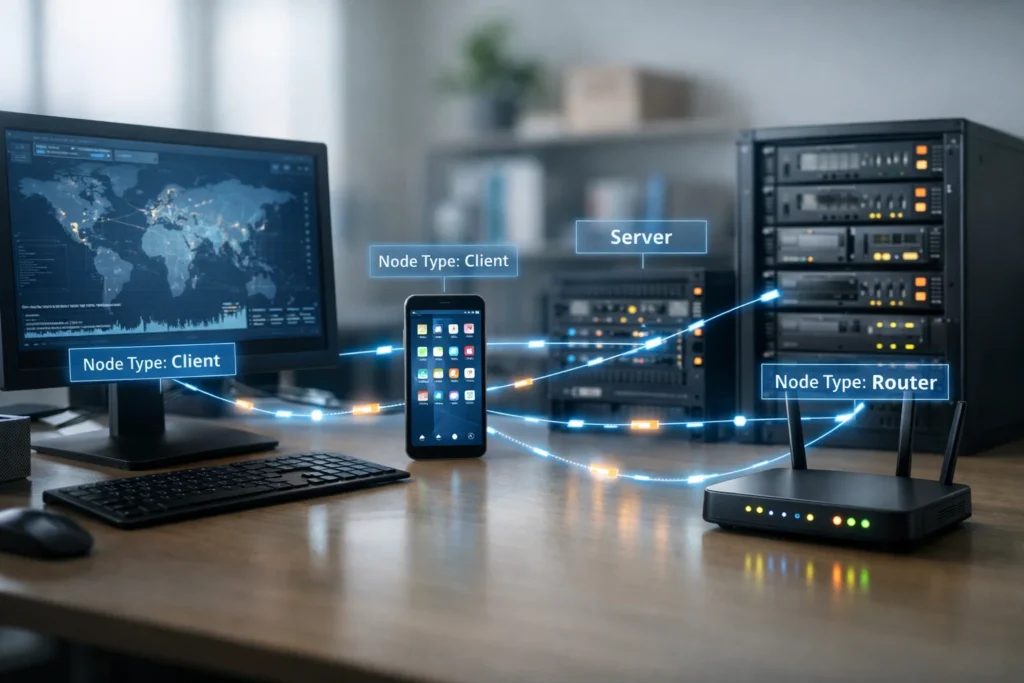
In order to know the functioning of networks, you need first to know the basic components of a network. This consists of nodes, links and data transmission systems.
1. Nodes
- Any device that is being connected to a network is called a node. To illustrate, computers, smartphones, routers and servers are all nodes. Not every node, however, has the same functionality.
- There are some nodes that transmit data and others that receive data. An example is that your laptop requests something when you navigate to a webpage, and a server replies with the data on the web page. Thus, the nodes have various functions in communication.
- In addition, nodes may be either simple or complex in accordance with their purpose. A simple node is a printer which is connected to a network and a complex node is a server which handles thousands of requests.
2. Links
- The connection paths are known as links between nodes. These connections may be either wired or wireless. Indicatively, the Ethernet cables lead to wired connections, whereas Wi-Fi enables wireless connections.
- Moreover, connections will dictate the speed and dependability of communication. Wired connections tend to be more stable and wireless connections tend to be flexible. Thus the performance of the network is influenced by the selection of link.
- Moreover, links carry data in the form of signals. These messages are sent between nodes to their destination.
3. Data Transmission
- Data transmission refers to the process of transmitting information between two devices. First, the data is divided into smaller units called packets. Then these packets move through the network separately. Finally, the receiving device reconstructs them back to the original message.
- In addition, this technique enhances efficiency. Other packets can arrive even if one is delayed. Consequently, communication remains smooth even when the network is congested.
- Moreover, protocols like TCP/IP ensure that information is delivered to the correct destination. As a result, structured systems control how data is transmitted.
Computer Network types.
Computer networks are available in various sizes and categories depending on the size of coverage. They are LAN, MAN and WAN.
1. LAN (Local Area Network)
- A LAN is a network that interconnects devices in a limited space like a home, office or school. An example is that all the computers in a school computer lab can be on the same LAN.
- In addition, LANs are usually quick as the gap among the devices is minimal. Hence they are best suited in environments where there is a need to have high-speed communication.
- Nevertheless, LANs are not able to span over long geographical distances. Consequently, they are only used locally.
2. MAN (Metropolitan Area Network)
- A MAN spans over a wider range than a LAN, e.g. a city or town. As an example, a city administration can use a MAN to integrate various departments.
- Also, MANs are used to enable organizations to share data between different buildings. Thus, they fill in the difference between small-local networks and large-global networks.
- But MANs demand more sophisticated infrastructure as compared to LANs. This makes them more costly in terms of installation and maintenance.
3. WAN (Wide Area Network)
- A WAN is very extensive, and can be a country- or continent-wide. The internet is the most perfect illustration of a WAN.
- In addition, WANs are used to connect LANs and MANs. Thus, they facilitate communication and exchange of data worldwide.
- WANs are however slower in most cases compared to LANs due to increased distance that the data is covered. Moreover, they need complex technologies such as routers and satellites in order to operate successfully.
The flow of Data over a Network.
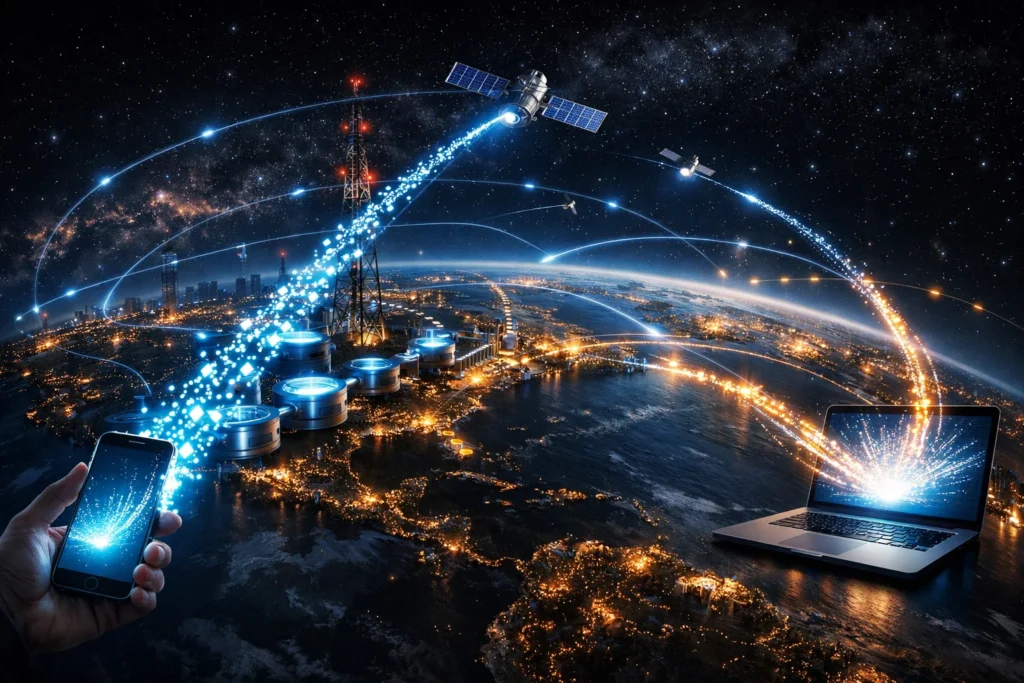
Awareness of the flow of data will enable you to create a more clear networking image.
Each time you send a message or open a webpage, a request is first generated by your device. Then this request is divided into packets. Subsequently, these packets are transmitted in various nodes and links.
In addition, routers are also important to direct these packets. They determine how data should be transmitted to its destination in the most optimal way. Routers therefore serve as traffic controllers of networks.
Moreover, the packets might take different routes. However, they all still reach the same destination. This increases efficiency and reliability.
Finally, the receiving device reassembles the packets into the original message.
Real-life applications of computer networks.
Computer networks are all over the world. Take the case of WhatsApp, the message is sent across several networks before it gets to the receiver. Hence, chat applications depend on network infrastructure.
Online banking systems use encrypted networks to send financial information. Additionally, streaming services such as Netflix and YouTube require fast networks to deliver content without delays.
Moreover, smart devices such as smart speakers and Wi-Fi cameras are products of local networks. This shows how networking is part of everyday life.
The value of Networking Knowledge.
Networking is significant to learn since it builds digital literacy. For example, understanding how networks operate helps you solve internet problems more easily.
Additionally, careers in IT, cybersecurity, and software engineering become more accessible with networking knowledge. Thus, it has strong practical and professional value.
Moreover, with ever-changing technology, networks will become even more important. Therefore, learning this today prepares you for future developments.
Conclusion
The current system of communication is based on computer networking. It links devices, facilitates data exchange and drives the internet. However, the concept of networking begins with the basic concepts such as nodes, links, and transmission of data.
Furthermore, different types of networks like LAN, MAN and WAN explain how connectivity scales from small to global systems. Thus, building a strong foundation in networking helps you understand more advanced topics later.
Finally, networking is not only a technical topic but also a fundamental part of how the digital world operates. Consequently, learning these basics gives you confidence to understand modern technology.