Abstract
PR has become a tactical communication activity that is important in determining the reputation of organizations, stakeholder relations and interaction with society. This paper reviews the extent and services of PR in the corporate, government and non-profit organizations focusing on the transformation of PR in the online era. The paper uses recent literature to discuss some of the major PR functions, including media relations, internal communication, community engagement, and brand positioning. The paper applies a qualitative and literature-based approach to integrate the current research findings. Findings have suggested that PR has moved on to being a communication support tool to a data-led, digital media-led, and stakeholder expectations-led strategic management. The paper concludes that public relations functions and scope play a great role in the transparency, trust building and social responsibility in contemporary society.
Keywords: PR, PR Activities, Media PR, Corporate PR, Stakeholder PR, Online PR, Rep PR.
Introduction: Public Relations Functions and Scope
Public Relations (PR) has been generally accepted as a strategic communication process of establishing mutually beneficial relations between organizations and their publics. The contemporary society has seen PR develop into a key element of organizational management and interaction with society, compared to the past, where it was all about publicity and media liaison.
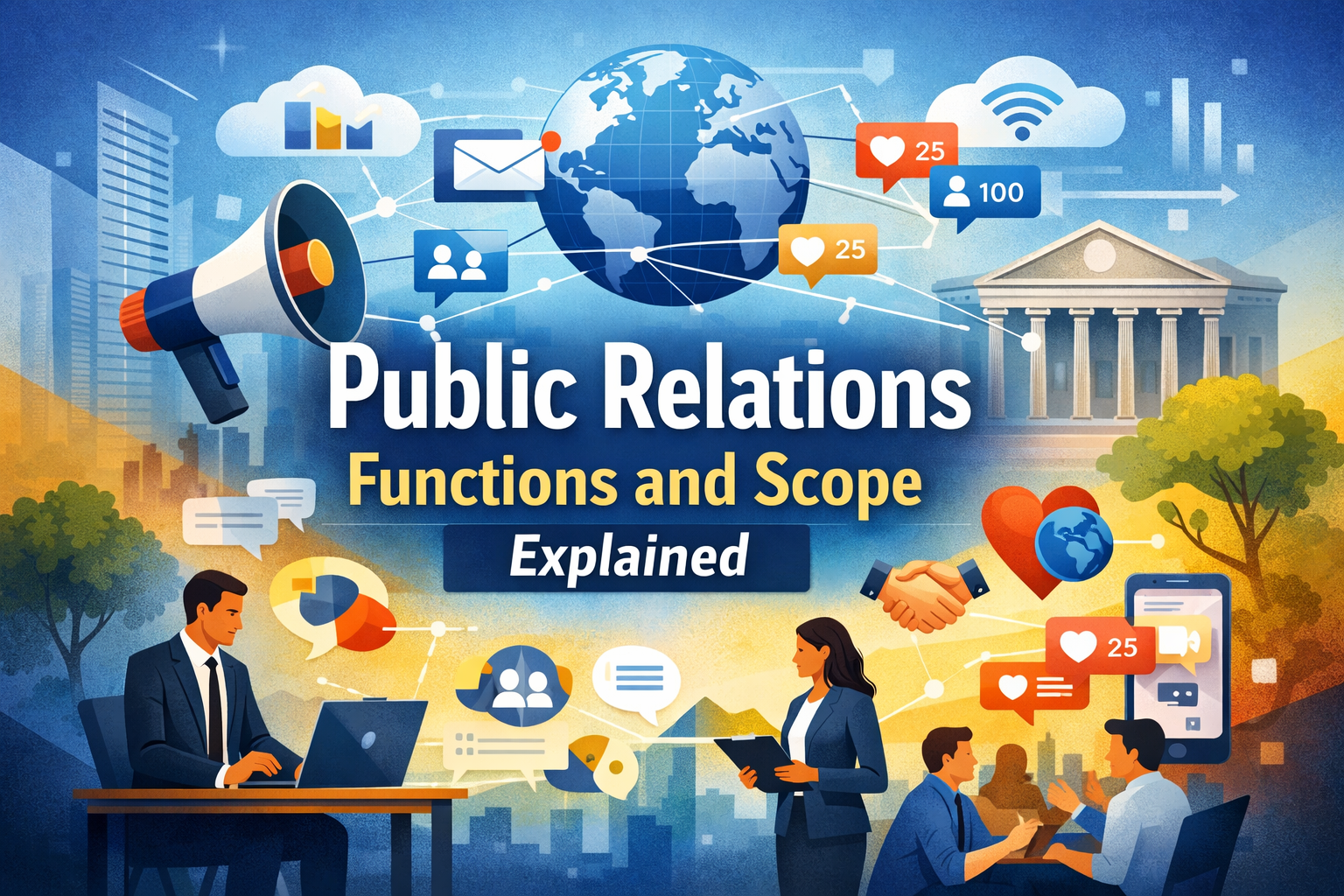
The growing complexity of the communication environments that are brought about by globalization and the digital technologies has enlarged the Scope of PR activities that target reputation management, crisis management, stakeholder engagement and digital content strategies. PR has now become a mediator of relationships between organizations and various stakeholders who include employees, customers, governments and communities.
This paper will explore public relations functions and scope, including boundaries of PR and the roles of PR within the various industries, as well as its increased importance to society.
Literature Review
According to recent scholarly research, the metamorphosis of PR as a multidimensional and strategic field is emphasized. Ibragimovna (2025) includes external and internal communication in the functions of PR, but instead, it is dedicated to preserving trust and orchestrating the opinion of the people.
On the same note, Mashchenko (2024) defines PR as a structured process that entails communication, analysis, and relationship management with a particular focus on how it helps to avoid conflicts and improve the stability of the organization.
Within the framework of the digital transformation, Munif (2025) proposes that PR has become more data-driven, moving away from the passive role of distributing information to the active one, where real-time reactiveness and digital skills are required.
Moreover, the works published in Frontiers in Sociology (2024) state that new media platforms have had a substantial impact on PR activities, especially the content management and audience interaction.
Research on sectoral applications indicates that PR functions are different in organizations. As an example, government PR can be defined as the strategy of paying attention to the communication and transparency of the population, whereas corporate PR is concerned with the image and the credibility of stakeholders.
In general, the current literature supports the fact that public relations functions and scope should not be a fringe activity anymore, but a management strategic functionality that leads to organizational success.
Conceptual Review
Concept of Public Relations
PR can be thought of as a conscious, premeditated and continuing attempt to create and build a mutual understanding between an organization and its stakeholders. It involves a combination of communication, management and relationship-building processes.
Scope of Public Relations
PR activities include a wide variety of activities, such as:
- Media relations and publicity
- Internal communication
- Community engagement
- Crisis communication
- Corporate social responsibility (CSR).
- Online and social media administration.
Such practices are indicative of the growing feature of PR, which is responsive to the evolving communication environments.
Public Relations Functions
The major PR functions are:
- Information Dissemination- Sharing of correct and timely information.
- Relationship Management – Develop trust among the stakeholders.
- Reputation Management – Being good in the eyes of the crowd.
- Crisis Communication – How to deal with and address organizational crises.
- Strategic Advisory Role – Helping the management make decisions.
These roles illustrate how PR is incorporated in organizational planning and management.
Theoretical Review
Excellence Theory
According to the Excellence Theory, which was invented by Grunig and Hunt, PR should be founded on two-way symmetrical communication, whereby organizations would talk to stakeholders. This theory focuses on understanding and ethical communication.
Systems Theory
Systems Theory considers organizations as open systems that are in interaction with their environments. PR is therefore very important in regulating these interactions by enabling communication between the organization and its immediate environment.
Situational Theory of Publics
This theory describes the response of various groups concerning communication according to their level of awareness and participation. This framework helps PR practitioners to communicate with various audiences in a manner that suits them.
Relationship Management Theory
This theory centers on the construction and the sustenance of long-term relations between the organizations and the stakeholders. It puts emphasis on trust, commitment and satisfaction as major signs of effective PR.
Methodology
The present study will apply the qualitative research method using a systematic review of the literature. Peer-reviewed journals, academic publications, and recent research on the topic of public relations were searched and gathered as secondary data.
The method involves:
- The selection of literature of 2023-2026 publications.
- PR functions and scope: Thematic analysis.
- Comparison between industries (corporate, government, non-profit).
In this way, one could get a broad perspective of the contemporary PR practices and trends.
Findings
Expansion of PR Roles
The paper concludes that PR has developed to become an important strategic management role that shapes the way organizations make decisions and perform.
Digital Transformation
Digital media has greatly increased PR operations, real-time communications, audience and data-based approaches.
Sectoral Differences
- Corporate PR is about branding, investor relations and crisis management.
- The PR of the government focuses on information and openness.
- Non-profit PR gives more emphasis on advocacy and connection to society.
- Focus on Stakeholder Engagement.
The one-way communication that has characterized PR is being replaced by relationship building in line with the current communication concepts.
Discussion
The results are indicative of the increased significance of PR in contemporary society. The adoption of digital technologies has made PR interactive and dynamic.
PR practitioners now need to have a variety of skills, such as strategic thinking skills, digital literacy, and data analysis. This conforms to the claims made by Munif (2025) that PR practitioners need to be able to adjust to the ever-evolving communication settings.
Also, the move towards stakeholder engagement indicates the topicality of relationship management and excellence theories. When organizations embrace open and honest communication methods, there are chances of earning trust and being credible.
The paper also highlights the role of PR in society, especially in advancing social responsibility and ensuring organizations and society engage in discussions.
Conclusion
Public Relations functions and scope has evolved into a comprehensive and strategic function that plays a vital role in modern society. Its scope extends across multiple domains, including media relations, internal communication, community engagement, and brand positioning.
The study concludes that PR is essential for building trust, managing reputation, and fostering meaningful relationships between organizations and stakeholders. As communication environments continue to evolve, PR will remain a critical tool for navigating complexity and promoting transparency.
Future research should explore the impact of emerging technologies such as artificial intelligence on PR practices and effectiveness.
References
Ibragimovna, E. F. (2025). Public relations management functions and principles. Academic Journal of Digital Economics and Stability, 38(3), 435–440.
Mashchenko, I. V. (2024). Essence, principles and functions of public relations as a component of communication policy of enterprises. International Research Journal, 12(150).
Munif, M. (2025). The transformation of public relations roles in crisis communication in the social media era. Journal of Innovative Islamic Education Management, 1(1), 21–36.
Al Hadeed, A. Y., et al. (2024). Role of public relations practices in content management: The mediating role of new media platforms. Frontiers in Sociology.
Fatimah, A., et al. (2024). The implementation of the roles and functions of public relations in government organizations. Fenomena Journal, 23(1), 131–142.
Comparative analysis of public relations roles, practitioners’ functions and communication models in public and private organizations in Nigeria. (2026). Journal of Communication and Public Relations, 5(1), 107–129.