Abstract
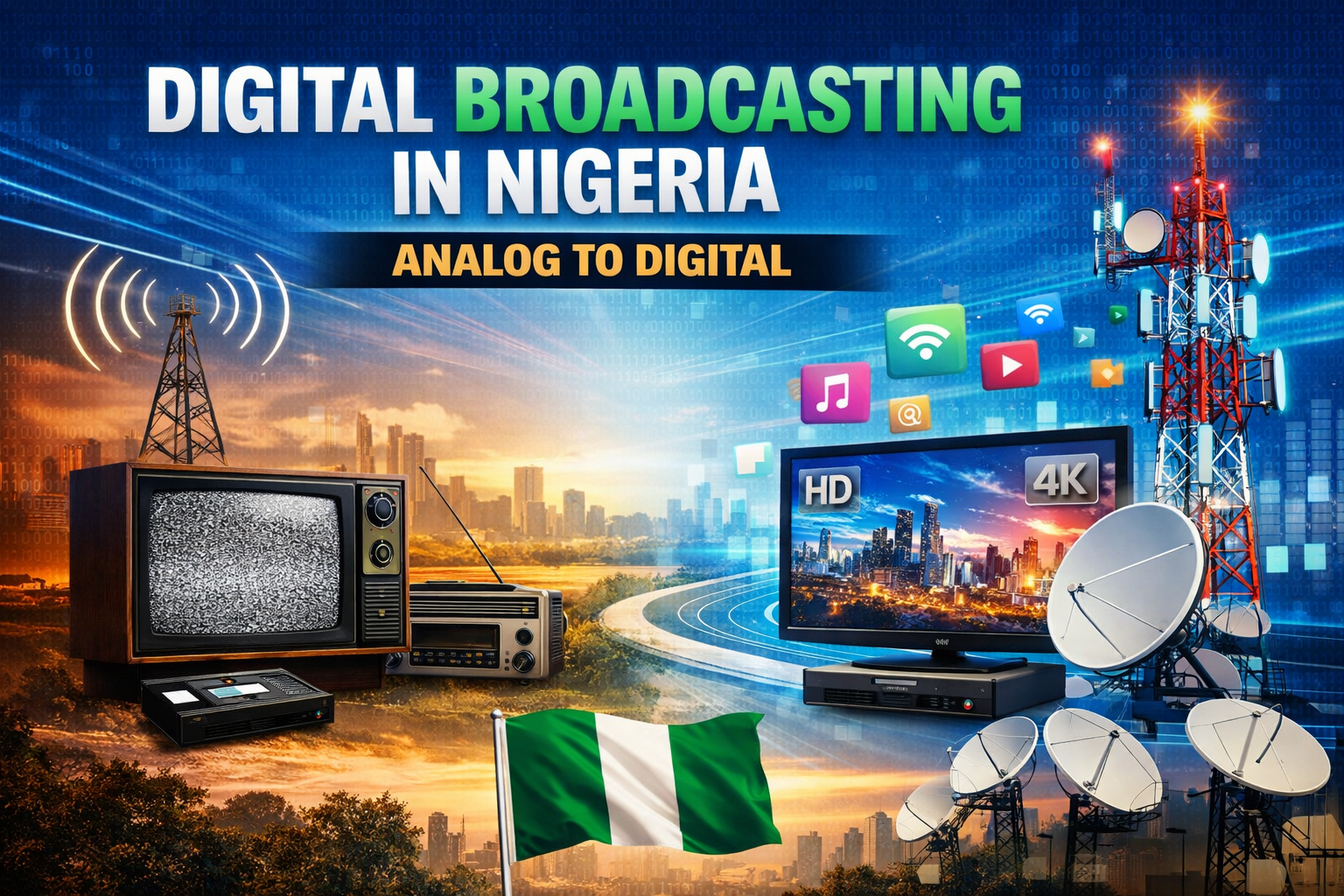
The world broadcasting industry has been experiencing a tremendous revolution as a result of the change from analog transmission to digital broadcasting technology. Nigeria, similar to other developing countries, has been on a digital migration journey of enhancing the efficiency of spectrum, signal quality and broadcast service diversification. The paper will discuss how the analog broadcasting systems in Nigeria have been replaced by the digital broadcasting systems with emphasis on the technological concepts of digital encoding, signal compression and enhanced audio-visual transmission. It further examines regulatory frameworks that are used in digital migration, the economic impacts on the stakeholders and the barriers related to the development of infrastructure and its adoption by the people. Due to a qualitative analytical methodology that relies on secondary data sources, the research presents the advantages and limitations of the digital switchover programme in Nigeria. The results indicate that, although digital broadcasting is better with a quality signal, better spectrum use, and a greater range of broadcasting, the problem of funding constraints, awareness among the masses, and the gap in infrastructure are still major obstacles. The paper will finish by addressing the future of digital broadcasting in the dynamic media landscape of Nigeria and the digital communication space in the world at large.
Keywords: digital broadcasting, digital migration, spectrum efficiency, signal compression, broadcasting technology.
Introduction
Broadcasting is a historical part of the most significant mass communications because it has always had a significant impact on the spreading of information, entertainment, education, and even the development of a nation. Radio and television broadcasting has been decades old, and at the time, the broadcasting technology was based on analog transmission, which involved the use of continuous electrical signals to transmit audio and visual information. Although the industry has been using analog broadcasting for several years, it was characterized by serious constraints, such as poor use of spectrum, degradation of the signal and small capacity of the channel.
The trend of using digital communication technologies has transformed the structure of broadcasting infrastructures across the world. Digital broadcasting systems encode audio and video signals into binary data, which is then transmitted with greater efficiency. Nigeria has been slow in embracing this technological shift, being part of an international agreement, which has been coordinated by the International Telecommunication Union (ITU) to move away to a digital broadcasting.
The introduction of Digital Broadcasting Systems in Nigeria has brought new avenues of enhancing the quality of transmission, the capacity of the channels and the use of electromagnetic spectrum. As per the studies that can be found in this resource concerning digital broadcasting systems in Nigeria, the digital migration project is aimed at modernizing the broadcasting industry in Nigeria and its adaptation to the international digital communication standards.
This paper discusses the technological, regulatory, and economic consequences of digital broadcasting in Nigeria. It discusses the effect of digital encoding and signal compression on the efficiency of the broadcasts as well as evaluating the hardships of infrastructure development, policy implementation, and social adaptation.
Literature Review
Broadcasting technology studies have always highlighted the advantages of digital migration to media industries. The International Telecommunication Union showed that digital broadcasting is very beneficial in enhancing the efficiency of a spectrum because it enables several channels to share a bandwidth that was occupied by a single analog signal.
Research by media scholars points out that digital transmission systems provide high-quality audio-visual aspects and lower signal interference than when using analog broadcasting. Digital systems are dependent on the encoding of data, where sound and images are converted to binary data, which can subsequently be compressed and transmitted more effectively.
The studies conducted on the broadcasting industry in Nigeria show that there have been a number of implementation issues with the digital switchover programme. These are poor finances, sluggishness in the implementation of infrastructure and ignorance of the digital TV services by the populace. Nonetheless, scholars believe the digital migration would be an important move to modernize the communication infrastructure in Nigeria.
Moreover, scientists observe that digital broadcasting opens new possibilities to media pluralism and economic development through the provision of other television channels, interactive services, and better advertising markets.
Theoretical Framework
The Technological Determinism theory that guides this study implies that technological innovations are at the center of the issue, defining the way societies evolve and communicate.
Technological Determinism suggests that technological changes affect the way societies inform, schedule knowledge, and use media content. The example of the transition to digital broadcasting and the analog one serves as evidence of this principle, as it shows that technological progress changes the organization and work of the system of broadcasting.
In the case of Nigeria, technologies of digital broadcasting can transform the patterns of media production, content distribution and consumption by the audience.
Conceptual Review
Broadcasting Systems Analogous
The broadcasting information of analogs is sent out as continuous electromagnetic signals, which change in amplitude or frequency to encode the audio and visual information. Although it worked well in the old broadcasting system, analogue transmission is susceptible to noise, signal interference, and the deterioration of the quality.
Digital Broadcasting Systems
It encodes audio and video messages into binary data and then transmits them. This is a digital encoding in which the broadcasters can compress the signal using specialized algorithms, which lets several channels to carry the same bandwidth.
Signal Compression
Digital broadcasting technology consists in part of signal compression. Compression methods or methods of cutting down on data needed to describe audio and video signals do not impair the quality much. This allows the broadcasters to stream high-definition content yet save on bandwidth.
Spectrum Efficiency
Digital broadcasting enhances spectrum usage since many channels share a given frequency band. This is as opposed to analog broadcasting, where a single channel usually occupies a complete allocation of frequencies.
Methodology
The research method used in this article is qualitative and is a study of secondary data. The necessary data was gathered in the form of academic journals, industrial reports, regulatory documents, and other scholarly publications pertaining to broadcasting technology and digital migration in Nigeria.
The paper evaluates these sources to understand the technological dynamics of digital broadcasting, the policies that will be in place to regulate the change and the socio-economic changes that will be experienced by the media industry in Nigeria.
Findings
Better Auditory-visual Quality
Digital broadcasting is better at presenting images and sound quality than analog transmission. The technologies of high-definition television (HDTV) and surround sound are rather helpful to enhance the experience of the viewer.
Effective Spectrum Management
Digital systems enable broadcasters to transmit many channels in one band of frequency, which enhances the services of television available.
Diversification of Broadcasting Services
Other services that can be accessed through the digital platforms include electronic programme guides, interactive television, and mobile broadcasting.
Regulatory Developments
National Broadcasting Commission is at the forefront to control the process of digital migration in Nigeria, as well as ensuring that international broadcasting standards are met.
Discussion
The adoption of digital broadcasting in Nigeria is one of the major technological achievements that the media industry of this country has ever had. The digital switchover programme enables Nigeria to be in tandem with the global broadcasting standards and enhances the quality and accessibility of broadcast services.
Nonetheless, there are a number of challenges that have been encountered during the process of migration. The cost of infrastructure development is a large variable that demands a considerable amount of money, and most broadcasting organizations find it hard to meet the expenses of modernizing equipment and transmission systems. Also, consumers need to purchase digital set-top boxes or digital television receivers in order to receive digital signals.
Awareness among the masses is also a major issue. Digital broadcasting may be tedious since not all citizens understand the technical features of this kind of broadcasting, and hinder its adoption.
Nevertheless, its advantages is enormous. Higher spectrum capacity allows governments to use freed-up radio spectrums on telecommunications, including mobile broadband, which plays a part in wider digitalization.
Conclusion
Digitalization of broadcasting in Nigeria is a dramatic change of communication infrastructure of the country. Replacing analog transmission systems with digital technologies will allow enhancing the quality of broadcasting, improving the media services, and optimizing the electromagnetic spectrum in Nigeria.
Despite the difficulties associated with infrastructure, financing, and general awareness of the population, the benefits of digital migration have long-term advantages that are paramount compared to the challenges. The government regulator, media companies and technology providers will continue to work closely with each other to ensure that a successful nationwide digital switchover is attained.
Since Nigeria is still becoming part of the global digital communication platform, digital broadcasting would become a significant contributor to the dissemination of information, economic growth, and media innovation.
References
Asemah, E. S. (2011). Selected mass media themes. Jos University Press.
National Broadcasting Commission. (2020). Digital switchover in Nigeria: Policy framework and implementation strategy.
International Telecommunication Union. (2015). Digital broadcasting migration guidelines for developing countries.
Okunna, C. S., & Omenugha, K. A. (2012). Introduction to mass communication. New Generation Books.
Uwakwe, O. (2015). Media writing and reporting. Enugu: Rhyce Kerex Publishers.