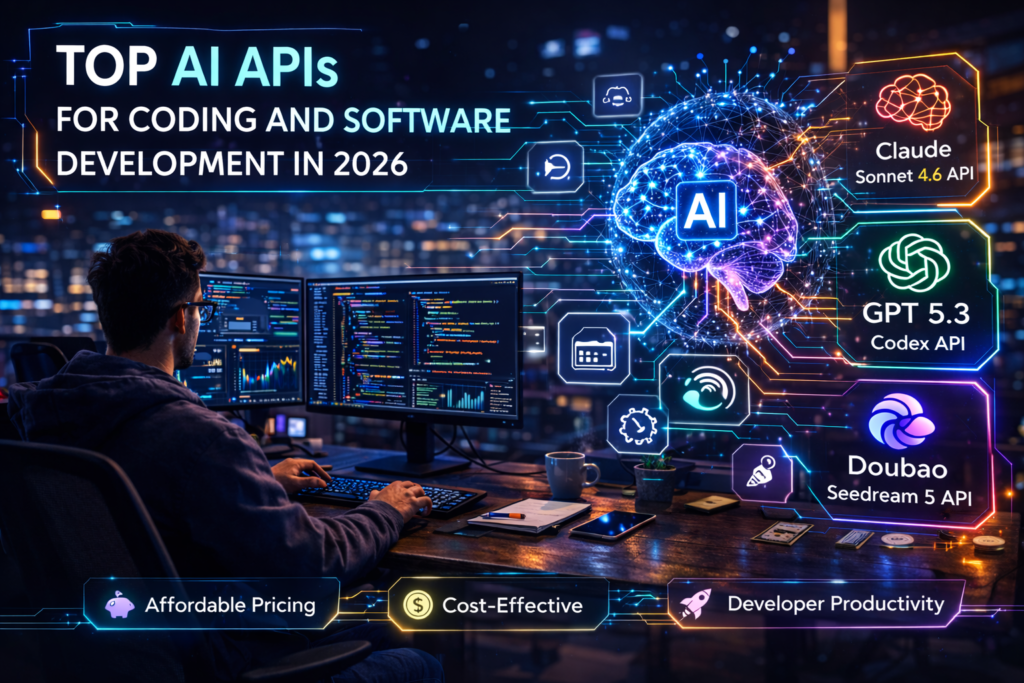
Artificial intelligence is no longer just an assistant in the coding process—it has become a true development partner. In 2026, engineering teams across startups and enterprises rely on AI APIs to write code, refactor legacy systems, generate documentation, automate testing, and even design system architecture.
The rise of advanced language models has transformed how software is built. Instead of spending hours debugging repetitive logic or scaffolding boilerplate code, developers now integrate AI directly into their IDEs and CI/CD pipelines. But not all AI APIs are optimized for coding. Choosing the right model can significantly impact productivity, accuracy, and long-term infrastructure costs.
This guide explores the top AI APIs for coding and software development in 2026, compares their strengths, and explains how cost-effective access through CometAPI makes scalable integration practical.
1. AI as a Coding Partner
In modern development environments, AI is embedded at nearly every stage of the workflow.
Developers use AI to:
- Generate boilerplate code
- Refactor inefficient logic
- Translate code between languages
- Debug complex errors
- Create API documentation
- Design infrastructure scripts
Instead of replacing developers, AI enhances their capabilities. It reduces cognitive load and accelerates iteration cycles. Teams can ship MVPs faster, test ideas more rapidly, and maintain cleaner codebases.
However, to function as a reliable coding partner, an AI model must demonstrate:
- Strong logical reasoning
- Syntax precision
- Multi-language support
- Context retention across large codebases
This is where selecting the right API becomes critical.
2. What Makes a Great Coding API
Not every AI model is built for software development. A strong coding-focused API must excel in several areas.
Technical Accuracy
Code output must compile and run reliably. Small syntax errors can undermine productivity gains.
Context Awareness
Modern applications often span thousands of lines. The model must understand dependencies and maintain structural consistency.
Structured Outputs
Developers frequently require JSON, YAML, or structured responses for automation workflows.
Low Latency
In-IDE usage demands fast responses. Delays disrupt coding flow.
Cost Predictability
Heavy development usage generates significant token consumption. A cost-effective pricing structure is essential.
With these criteria in mind, let’s explore the leading AI APIs for developers in 2026.
3. GPT 5.3 Codex Deep Dive
The GPT 5.3 Codex API stands out as one of the most powerful AI models for coding and development tasks.
This API is purpose-built for technical workflows and excels in:
- Multi-language code generation
- Refactoring and optimization
- Debugging assistance
- Infrastructure scripting
- Structured API responses
Strengths for Developers
GPT 5.3 Codex understands programming logic at a deep level. It can:
- Convert Python scripts to JavaScript
- Generate backend endpoints
- Create database schemas
- Suggest performance improvements
- Automate DevOps pipelines
Its structured output capabilities also make it ideal for automated development environments. Teams integrating AI into CI/CD workflows benefit from predictable JSON outputs.
For coding-intensive applications, GPT 5.3 Codex is often the first choice.
4. Claude Sonnet for Architecture Planning
The Claude Sonnet 4.6 API may not be exclusively coding-focused, but it excels in architectural reasoning and high-level planning.
Software development isn’t just about writing lines of code—it’s about designing scalable systems.
Claude Sonnet 4.6 is particularly strong in:
- System design planning
- Architecture comparisons
- Documentation drafting
- Technical analysis
- Long-context reasoning
For example, it can:
- Compare microservices vs monolithic architecture
- Outline distributed system strategies
- Draft technical specifications
- Review large code excerpts for logical consistency
When teams need strategic thinking alongside implementation, Claude Sonnet provides valuable depth.
5. Doubao Seedream for Multilingual Teams
The Doubao Seedream 5 API offers balanced reasoning performance with strong multilingual capabilities.
In global engineering teams, communication matters as much as code quality.
This API supports:
- Code explanation in multiple languages
- Multilingual documentation generation
- Collaborative development tools
- Balanced performance-speed tradeoffs
For distributed teams working across regions, Doubao Seedream enhances accessibility and collaboration. It can translate technical explanations, generate localized documentation, and assist in international development workflows.
Additionally, its efficient inference speed supports real-time integration into lightweight applications.
6. Comparing Output Accuracy
When comparing coding APIs, accuracy is the primary metric.
Code Generation Precision
- GPT 5.3 Codex leads in syntax correctness and structured output consistency.
- Claude Sonnet performs well in logic-heavy tasks and architectural reasoning.
- Doubao Seedream provides balanced results, particularly in multilingual contexts.
Context Handling
- Claude Sonnet excels in long-context reasoning.
- GPT Codex maintains strong structural awareness across medium-sized codebases.
- Doubao prioritizes responsiveness while maintaining adequate contextual understanding.
Reliability in Automation
For automated pipelines, structured output reliability becomes crucial. GPT 5.3 Codex often performs best when precise formatting is required.
The right API depends on whether your focus is direct code generation, architectural planning, or collaborative multilingual development.
7. Pricing Analysis via CometAPI
Performance alone doesn’t determine the best API. Pricing plays a major role—especially for teams integrating AI deeply into daily development workflows.
Heavy coding sessions generate high token volumes. Continuous refactoring, testing, and debugging multiply usage.
CometAPI offers access to GPT 5.3 Codex, Claude Sonnet 4.6, and Doubao Seedream 5 at highly competitive pricing levels.
CometAPI offers these AI APIs at very affordable pricing, making them highly cost-effective for startups and enterprises.
This cost-effectiveness matters because:
- Development teams use AI frequently and continuously.
- CI/CD automation can generate substantial token usage.
- Scaling products increases API consumption exponentially.
Affordable access ensures that AI remains a productivity multiplier—not a budget burden.
8. Developer Workflow Integration
Successful integration requires more than simply calling an API.
IDE Integration
Embed AI directly into development environments for real-time suggestions.
Version Control Awareness
Use AI to generate commit messages and review pull requests.
Testing Automation
Automate test case generation and validation.
Infrastructure-as-Code
Leverage AI to produce deployment scripts and cloud configuration templates.
Hybrid Model Strategy
Many teams combine models:
- GPT 5.3 Codex for implementation
- Claude Sonnet for architecture planning
- Doubao Seedream for multilingual documentation
This layered approach maximizes efficiency while controlling costs.
9. Conclusion
AI has become an indispensable partner in modern software development.
The top AI APIs for coding and software development in 2026 offer distinct strengths:
- GPT 5.3 Codex dominates in precise code generation and automation.
- Claude Sonnet 4.6 enhances architectural reasoning and strategic planning.
- Doubao Seedream 5 supports multilingual teams and balanced performance.
Choosing the right API depends on your development priorities, team structure, and scalability goals.
By accessing these models through CometAPI, developers gain both performance and cost-effectiveness—ensuring that AI remains an accelerator of innovation rather than a financial constraint.
In the fast-evolving landscape of 2026, the smartest development teams are those that combine intelligent APIs with strategic cost management.
AI is no longer just a tool.
It’s part of the engineering team.