Figure1:Modern 5-axis CNC technology enables the efficient production of highly complex and critical components, such as this aerospace impeller.
Introduction
In today’s competitive global manufacturing landscape, manufacturers face relentless cost pressures amid growing demand for highly complex components. Traditional multi-step machining is plagued by time-consuming setups, cumulative errors, and significant multiple fixturing costs, which severely impact profitability.
These inefficiencies stem from conventional methods’ inability to meet modern needs for part consolidation, lightweighting, and high precision. Multi Axis CNC Machining, specifically 5-axis machining centers, addresses these core challenges. This technology optimizes workflows through its unique advantages, enabling substantial cost savings and quality enhancements by transforming production capabilities.
Why Multi-Axis Machining is the Key to Overcoming Complex Industrial Manufacturing Challenges?
Modern Industrial Manufacturing, particularly in sectors like aerospace and medical devices, demands components with intricate geometries, organic contours, and monolithic structures. These designs are essential for maximizing performance, reducing weight, and improving reliability. Traditional 3-axis machining, while capable for simpler parts, hits a wall when confronted with these complexities. It requires numerous setups and manual repositioning of the workpiece, leading to alignment errors, increased cycle times, and an inability to machine undercuts or compound angles effectively.
Multi Axis CNC Machining emerges as the definitive solution to these limitations. Multi-axis machining solutions refer to advanced manufacturing processes where a cutting tool moves along four or more axes simultaneously. This capability is central to modern Precision Engineering, allowing for the complete fabrication of complex parts in a single setup. The core of this technology, the 5-axis machining center, operates on three linear axes (X, Y, Z) and two rotational axes (A and B), enabling the tool to approach the workpiece from virtually any direction. This foundational principle unlocks the potential for unprecedented design freedom and manufacturing efficiency .
How 5-Axis CNC Machining Centers Directly Save Costs by Reducing Production Steps?
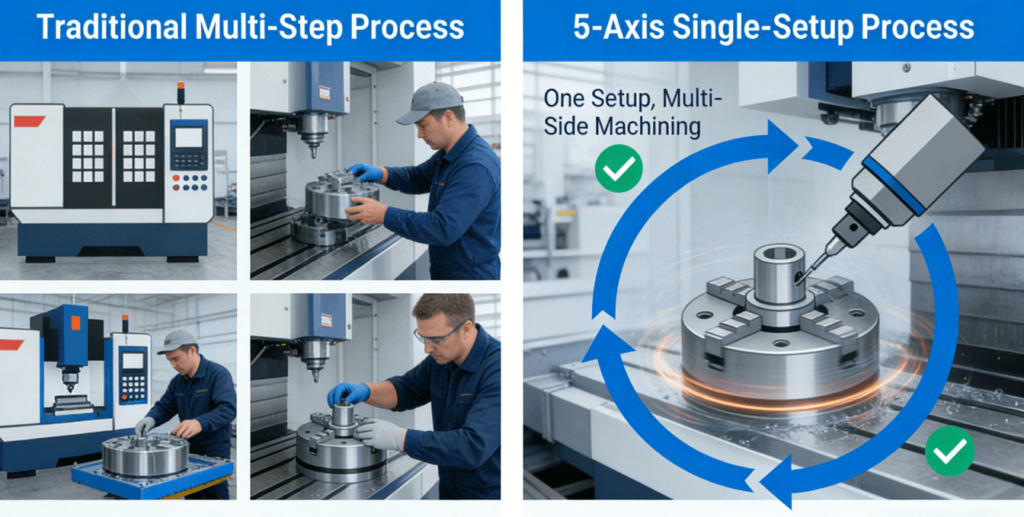
Figure 2: The “Done-in-One” philosophy of 5-axis machining eliminates multiple setups, directly reducing time, cost, and potential errors.
A significant portion of manufacturing costs is tied not to the cutting time itself, but to the non-value-added steps surrounding it. A traditional machining process for a complex part can be remarkably inefficient.
The Burden of Traditional Multi-Step Processing
Producing a part like a sensor housing or an engine bracket often requires a series of discrete operations across different machines. A typical workflow might involve: initial milling on a 3-axis machine, manual repositioning for secondary operations, transfer to a drilling station, and finally, a separate finishing process. Each transition necessitates new fixture design, calibration, and quality checks. This accumulation of steps drastically inflates lead times and labor costs while increasing the risk of errors at every stage .
The Single-Setup Paradigm of 5-Axis Machining
In stark contrast, a 5 axis CNC machining center can complete the entire part in a single clamping. This “done-in-one” philosophy is revolutionary. By eliminating the need for multiple setups, manufacturers immediately save on the costs associated with designing, fabricating, and storing numerous specialized fixtures. Furthermore, it drastically reduces the manual labor required for part handling and repositioning between machines .
- Direct Labor and Time Savings
The reduction in manual intervention directly translates to lower labor costs and shorter overall production cycles. What once took days can often be completed in hours.
- Elimination of Fixture Costs
The need for complex, multi-part fixtures is removed. A single, simpler fixture is often sufficient, leading to substantial savings in both tooling costs and setup time .
- Reduction in Queue Times and WIP
With no need to move parts between different workstations, queue times are minimized. Work-in-progress (WIP) inventory is reduced, streamlining floor space and improving workflow.
This operational efficiency is a cornerstone of modern Industrial Automation. By minimizing human intervention and creating a more continuous, automated workflow, 5-axis machining significantly lowers the probability of human error and enhances overall equipment effectiveness (OEE). According to principles highlighted in manufacturing efficiency studies, such as those related to energy intensity, reducing the number of production steps is a primary driver for improving overall resource efficiency, which correlates directly with cost reduction .
Quantifying the Cost Reduction
The financial impact is measurable. Studies and case studies indicate that by consolidating machining into a single setup, companies can see a significant reduction in total part cost. This comes from the combined effect of slashing fixture expenses, reducing machining and labor hours, and minimizing scrap rates caused by misalignment between operations .
How Material Selection and 5-Axis Machining Tolerances Impact the Final Product’s Economic Efficiency?
The pursuit of high-performance components often leads designers to advanced Multi Axis CNC Materials like titanium alloys, Inconel, or plastics such as PEEK. While offering superior strength-to-weight ratios and corrosion resistance, these materials are notoriously difficult and expensive to machine using traditional methods, where high cutting forces and temperatures lead to rapid tool wear, premature failure, and high scrap rates .
- axis CNC technology fundamentally improves the economics of processing these materials. Its key advantage is the ability to maintain an optimal and consistent cutting tool orientation relative to the workpiece. By tilting the tool or the part, the machine can present the strongest part of the cutter to the material and ensure efficient chip evacuation . This results in lighter, controlled cuts, reduced vibration, and lower cutting temperatures, which dramatically extends tool life and significantly reduces material waste, making the use of high-performance 5-Axis CNC Machining Materials far more economically viable .
Furthermore, the exceptional stability of 5-axis machines enables incredibly tight 5-Axis Machining Tolerances, often as precise as ±0.005 mm . Holding these tolerances consistently is crucial for minimizing scrap rates. It also ensures parts fit correctly in final assembly, eliminating costly rework or fitting issues downstream . The long-term economic benefit is clear: higher first-pass yield, reduced quality control costs, and more reliable products. For a deeper dive into processable industrial-grade materials, detailed guides on 5-Axis CNC Machining Materials are available . Suppliers like JS Precision often hold certifications such as ISO 9001 and AS9100D, ensuring their material management and processes adhere to the highest quality standards, which is critical for achieving these economic benefits .
How Do 5-Axis CNC Lathe Milling Compound Technology and Industrial Automation Synergize to Enhance Production Capacity?
The evolution of multi-axis machining continues with the advent of the 5 axis CNC lathe, more commonly known as a mill-turn or turning center. This equipment combines the capabilities of a CNC lathe (for rotational symmetry) and a 5-axis machining center (for complex milling) into a single, highly integrated platform. This synergy is particularly powerful for manufacturing complex components like turbomachinery parts, medical implants, and sophisticated automotive components that require both turning and intricate milling operations.
This integration is a cornerstone of flexible Custom Parts Manufacturing. Instead of shuttling a part between a lathe and a milling machine, with all the associated logistics, setup times, and cumulative errors, the entire process is completed in one clamping on a single machine. This not only slashes production time but also guarantees exceptional concentricity and positional accuracy between turned and milled features. The machine can automatically switch between turning and milling tools, performing complex operations like off-center drilling, contouring, and threading without interruption .
The true potential of this technology is fully realized when integrated into automated production systems. A 5 axis CNC lathe can be equipped with robotic part loaders/unloaders and pallet changers, enabling lights-out, 24/7 manufacturing. This seamless integration into a broader Industrial Automation strategy dramatically increases overall equipment utilization and production capacity. It allows manufacturers to respond swiftly to market demands for high-mix, low-volume production—a key requirement in today’s fast-paced environment. Research from institutions like the National Institute of Standards and Technology (NIST) on smart manufacturing system integration underscores the productivity gains achievable through such interconnected and data-driven production systems .
5: Real Case Study: How 5-Axis CNC Machining Services Achieved 28% Cost Optimization
The theoretical advantages of 5-axis machining are best demonstrated through practical application. Consider the case of an industrial equipment manufacturer that required a new, complex aluminum alloy sensor housing.
The Challenge: A Complex Part and Tight Deadline
The housing featured thin walls, deep cavities, and mounting holes requiring machining from multiple angles. The initial plan, based on traditional methods, involved producing the part as five separate components to be assembled later. This approach was projected to take five weeks from start to finish, involving multiple machines, custom fixtures for each setup, and significant post-machining assembly labor.
The Solution: Integrated 5-Axis CNC Machining Services
The manufacturer engaged a provider of integrated 5 Axis CNC Machining Services. The engineering team proposed a redesign: consolidating the five-piece assembly into a single, monolithic component that could be machined entirely in one setup on a 5-axis machine. This approach leveraged the full capabilities of Precision Engineering and Custom Parts Manufacturing from the design phase onward.
- Design for Manufacturability (DFM) Optimization
Engineers suggested slight modifications to internal corners and wall thicknesses to enhance machinability and strength without compromising function.
- Streamlined Production Workflow
The consolidated part was machined from a solid block of aluminum in a single fixture on a 5-axis center, eliminating all assembly steps.
- Quality and Precision Assurance
In-process monitoring ensured that the tight tolerances for critical features were held consistently throughout the production run.
Quantifiable Results and Cost Analysis
The outcome was a comprehensive cost optimization of approximately 28%. The breakdown of savings was as follows:
- Production Time: Reduced from 5 weeks to 3 weeks.
- Material Waste: The monolithic design used less raw material compared to the five individual parts.
- Labor: Elimination of fixture changes, part handling, and assembly labor.
- Quality: Scrap rate was nearly eliminated due to the single-setup process.
This case underscores the strategic value of partnering with expert 5 Axis CNC Machining Services that can provide DFM input. Companies exploring such efficient and economical solutions can consult specialized service providers to assess the potential for their specific projects .
Conclusion
In summary, 5-axis CNC machining technology, with its superior geometric capabilities, process simplification, and precision control, has become an indispensable tool in modern Industrial Manufacturing and Precision Engineering. It is not merely a method for producing complex parts but a strategic asset for optimizing costs and enhancing efficiency.
Manufacturing companies should proactively evaluate integrating 5-axis technology into their production systems. It is advisable to contact professional 5 Axis CNC Machining Services providers with relevant industry certifications (such as IATF 16949 for automotive parts) to obtain Design for Manufacturability (DFM) analysis and instant quotations for accurate calculation of potential return on investment.
Author Biography
This article was developed with technical support from a team of manufacturing experts. The team possesses deep experience in Precision Engineering and Custom Parts Manufacturing, leveraging advanced multi-axis machining solutions production capabilities dedicated to delivering high-quality manufacturing services from rapid prototyping to volume production for global clients.
FAQs
Q: Is 5-axis CNC machining only suitable for large enterprises?
A: Not at all. With the proliferation of technology and the rise of on-demand manufacturing services, small and medium-sized enterprises, even startups, can economically produce complex prototypes and small-batch parts by outsourcing to professional 5-axis CNC machining service providers, thereby accelerating product development .
Q: Can 5-axis machining guarantee strict tolerance requirements?
A: Yes. High-end 5-axis machining centers, when well-maintained and calibrated, can consistently hold tolerances as tight as ±0.005mm or even tighter. Achieving high precision depends on machine rigidity, tool path programming, and operator expertise .
Q: Is 5-axis CNC programming significantly more complex than 3-axis programming?
A: Programming is indeed more challenging and requires advanced CAM software and experienced programmers. However, this initial complexity is offset by a drastic simplification of the production process. For complex parts, the total development time may be shorter .
Q: Which materials are most suitable for 5-axis machining technology?
A: 5-axis technology is applicable to almost all machinable materials, from aluminum and stainless steel to engineering plastics like PEEK and composites. Its advantages are most pronounced when machining difficult-to-cut materials like titanium alloys or thin-walled parts prone to deformation .
Q: How to choose a reliable 5-axis CNC machining service provider?
A: Key factors to consider include the provider’s technical equipment, industry experience, quality certifications (e.g., ISO 9001, AS9100D), and their ability to provide design feedback (DFM). Reviewing their past project portfolios and customer reviews is an effective way to assess reliability .