
The majority of dog-training centers are not failing due to poor training. They have a problem because their systems fail to adapt to the demands of growing. A trainer who is handling five dogs every week creates routines that feel comfortable and doable. A trainer who is handling 25 dogs per week using the same routine begins to feel the cracks. Sessions are missed. Notes get lost. Clients are left feeling forgotten.
This article will explain the most frequent mistakes in dog training that occur during scaling as well as the reason they occur and what a structured operation will look like when the growth is managed correctly.
What Happens When Dog Training Businesses Start Scaling
Growth brings complexity in addition to client numbers.
When a center expands, its number of moving parts quickly expands, more clients mean more sessions which increase scheduling which requires increased communication – meaning every system that used to work at small scale now has to accommodate three times as much load.
Most training centers fail to prepare themselves for this shift. Instead, they simply continue doing what worked before and expect similar results; but this gap between old habits and the demands of their new clientele is where problems can arise. Needless to say, the business itself is not broken – its systems simply are not tailored for its new size.
Why Dog Training Business Mistakes Occur During Expansion
Processes that function on a small scale can become strain-prone with increasing demand. Early on, trainers knew each client personally, remembering each dog’s history, goals, and training schedule – something which worked when their client list was small but no longer applies when client numbers double.
Growth doesn’t create new issues; rather, it reveals those that were always there. A scheduling gap that was straightforward to address for 10 clients becomes an emergency with 40. A communication style that felt personal for five families can become less than engaging for 25. Scaling makes weak foundations visible.
Subtle Mistakes That Are Ripping Apart the Growth of Your Dog Training Business
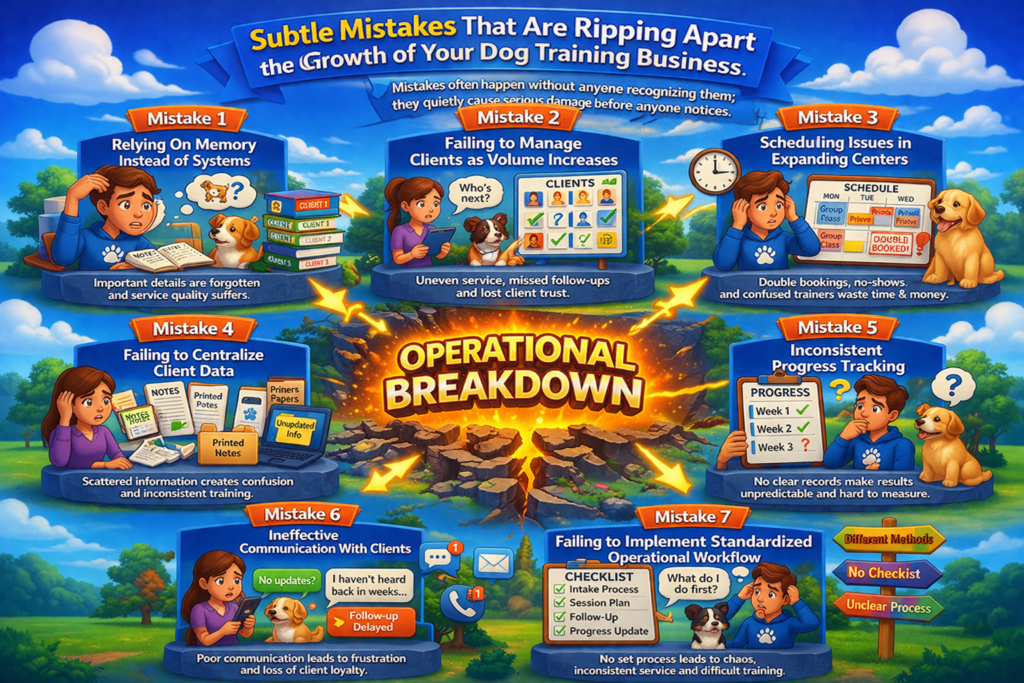
Mistakes often happen without anyone recognizing them; they quietly appear during growth and cause serious damage before anyone notices. Each error leads to another, creating an operational breakdown which no amount of training skills can fix.
Mistake 1: Relying On Memory Instead of Systems
Memory works when serving five clients; however, when serving twenty clients it becomes too cumbersome and ineffective. Dog training centers rely heavily on memory during early growth stages; their lead trainer will remember which dogs respond well to reward-based cues, which client prefers morning sessions and which pet has a reactivity trigger near other animals; all of this creates the feeling of strong service provision.
As client numbers expand, this approach becomes less effective as important session details get missed, training notes remain in someone’s head rather than recorded properly, and new staff lack any guidelines on how to handle a dog they have never worked with before.
As client numbers increase, this lack of structure pervades beyond memory remembrance into how clients are managed at every level.
Mistake 2: Failing to Manage Clients as Volume Increases
Uneven service is the result of managing multiple clients without structure. When a center grows beyond its informal systems, clients receive different levels of care: some receive follow-ups while others go weeks without hearing anything from the center; some have complete training records while others simply have handwritten notes.
Uneven client handling damages trust, with those feeling left out taking action to leave. They might also tell other pet owners in their community. A center that manages ten clients well but thirty poorly is not expanding, it’s simply increasing risk. Once client handling becomes inconsistent, scheduling issues surface.
Mistake 3: Scheduling Issues in Expanding Dog Training Centers
Scheduling is usually the first operational system that begins to falter. On a small scale, scheduling might work just fine in a notebook or shared phone calendar when there is only one trainer and few sessions; when more clients and trainers join the mix along with group classes alongside private ones, that notebook becomes an endless source of confusion and chaos.
Double bookings occur. Clients show up for sessions they weren’t told were scheduled. Trainers drive out to a facility for a rescheduled appointment but nobody updates their calendar accordingly. All these missteps cost time, money, and trust with clients alike.
Here is what scheduling failure looks like across common growth stages:
| Growth Stage | Common Scheduling Problem | Operational Impact |
| 1 to 5 clients | Manual calendar, informal reminders | Low risk, manageable |
| 6 to 15 clients | Overlapping sessions, missed confirmations | Occasional errors are fixable |
| 16 to 30 clients | Double bookings, no-show confusion | Frequent friction, client complaints |
| 30+ clients | System collapse, reactive daily management | Revenue loss, staff burnout |
Scheduling problems are often followed by deeper issues in how client information is stored and accessed.
Mistake 4: Failing to Centralize Client Data
The scattered data can cause chaos throughout the company. When client data is spread across multiple systems, employees operate in a state of confusion. One trainer might keep documents in notebooks whereas others use a notes application on their mobile while in the reception desk, there might even be printed documents which haven’t been updated for six weeks!
Staff members who work in the presence of dogs for the very first time don’t know about their history of training, behavior triggers, or techniques previously tried which is why they are beginning from scratch. This leads clients to watch this unfold and lose faith in the middle.
Centralized information is more than just a convenience: it is the basis of a consistent delivery of services.
Mistake 5: Inconsistent Progress Tracking
If there are no consistent records, the training results are unpredictable and unpredictably inconsistent. One area where rapidly expanding dog training centers could cut corners in the midst of rapid growth is tracking progress. When sessions grow rapidly trainers can skimp on recording sessions to cut time. This typically results in shorter notes on sessions and the tracking of milestones being omitted entirely.
Check-ins for clients uncover a major problem. The trainer looks over the file of a dog prior to a scheduled appointment, and she finds notes from three months ago. She can’t determine if their dog has changed, improved or changed its behaviour since then.
Consistent behavior makes it harder to show the value of your services to customers; dog owners need tangible proof that their investment has produced outcomes, not merely messages that don’t carry as much weight as a documented training documentation.
Mistake 6: Ineffective Communication With Clients
Communication gaps are evident as clients increase in number, however early-stage training facilities often excel in their personal interaction with their customers typically by sending text messages directly, delivering updates following sessions, and even visiting between sessions – thereby building solid loyalties. This approach to customer service is a positive one that creates customer experiences.
Scaling alters this pattern. Since the same owner has 40 clients on the books, personal texts are no longer delivered directly, and follow-ups are delayed. Customers who received updates from the center two times every week now have to wait for two weeks without hearing anything from the center.
Mistake 7: Failing to Implement Standardized Operational Workflow
If there aren’t any structured workflows established, every day is reactive. Without a set process and schedule in place, each morning the team has to decide what should be done that day. No checklist is in place and every trainer manages intake in a different way, while post-session follow-up is different based on the trainer who was in charge of each session.
This could lead to two major problems. The first is that the quality of service may differ based on the person working rather than the standard of service provided by the center as an average. Training new employees is more time-consuming since there’s nothing specific to instruct the new employees; they simply watch what other people do and hope to learn what they need to do. With workflows that are standardized the centers can grow without losing quality.
How These Mistakes Affect Dog Training Business Operations
The consequences of business mistakes are lower efficiency, trust among clients and growth over the long term.
If all seven errors occur at the same time, they create an effect of snowballs: poor memory results in poor records that lead to inconsistency in service; inconsistent service can lead to poor communication; and poor communication can lead to churn of clients and churn in growth is the fastest way to impede progress. Advancement must be defended in the shortest time feasible.
The center might expend energy and resources to find new customers to replace clients who are leaving and this can result in stagnant growth, burnout of staff from being constantly in a state of tension and the owner who spends more time battling fires instead of building. All of this is because of poor training, more often, it’s because their operations aren’t up to speed.
How to Avoid These Dog Training Business Mistakes
Building Structured Systems to Replace Memory
Systems ensure consistency by controlling. Each piece of information stored in a person’s mind must be stored in a place where all members of the team can find the information – notes from sessions or behavioral data, training milestones, and preferences of clients should all be documented so that there are fewer risks using only an individual’s memory. Establishing structured systems rather than relying on memory alone can eliminate inconsistencies with control, and improve accuracy for a single person.
Organization of Client Management Processes
Effective client management enhances service quality. Establish an onboarding procedure for each new client. Collect the same details at the time of intake from each dog’s owner. Establish the standard format of files to ensure all trainers are using it consistently and ensure that no client gets poor treatment because of an oversight in the process of the intake.
Fixing Scheduling Workflows
Optimizing the workflow for scheduling reduces the amount of friction that occurs daily. All scheduling should be moved into an organized system that staff and trainers are able to view and modify it in immediately; establish rules for cancelling policies, confirmation windows and how schedule changes are sent to the clients; eliminate calendars that are only stored in notebooks or phones of personal users;
Standardizing Progress Tracking
The consistent tracking of training sessions can dramatically improve the effectiveness of training. Create a template for a session note that every trainer can follow up on after each session. include information such as the behavior of participants, the techniques employed, progress markers and objectives for the following session on this sheet. Include documentation as an integral part of the task, rather than an add-on.
Improving Communication Systems
Communication that is structured builds trust between clients. Create a routine for each phase of client-client relationships. New clients should be greeted with greeting messages, confirmations of sessions as well as post-session updates, and regular check-ins on progress. Once the communication is established and constant the client no longer has to rely on someone else remembering to communicate when necessary.
Repetitive daily workflows can reduce the chance of operational errors. Record every core procedure that is in place in your center, from the way that sessions are opened and closed to the introduction of new dogs to the facility. You can then turn these documented processes into checklists that staff members use daily – checklists aren’t a sign of low trust but rather, they represent the highest standards.
Structured Systems Are Essential to Expanding Dog Training Businesses
Scaling can be managed better when the operations are driven by systems. Training centers that use methods instead of efforts alone tend to change as time passes – systems do not get old and forget or change according to who is present every day to work.
When your operation’s foundation is in place, expansion adds capacity and does not create confusion. A new trainer joins the team and is on an organized onboarding process; clients sign up and begin the process of onboarding the session, and notes are logged in a manner that team members are able to understand; the training techniques remain the same, but the ability to ensure that those skills are effectively taught across a wider client base is entirely dependent on the context in which they are delivered.
Scalability of Operations Dog Training Software
Software helps grow by removing the operational complications.
Dog training software centralizes functions that can be broken down during the process of scaling. Scheduling sessions, client sessions, records progress tracking, and communication with clients all reside in one place and employees can access updates in real-time from it all at once.
Pet business software makes the manual tasks of checking notebooks, messaging clients, and re-creating spreadsheets easier and frees up time to train instead of management. The software for pet business is not merely a necessity for large-scale operations, but is an essential tool for any facility seeking to expand while maintaining the quality of service. Software solutions can help you scale dog training centers, without impacting the quality of service. This report provides an analysis of the possibility of scaling dog training facilities employing pet business software as a possible option.
Growth is contingent on the efficiency of operations in addition to training capability.
The demand for dog training that is professional continues to grow as pet ownership increases and dog owners who are more educated realize the importance of a structured and well-structured training program for their pets. Centres that establish solid operational bases now can better keep up with this demand at size.
Centers that do not build the required foundations are bound to fall into another cycle of inexplicably long duration. The pressure of growth creates pressure. Pressure exposes the weaknesses of their systems and causes inadequate results that hinder growth. What separates effective scaling centers from counterparts that don’t are not the training of talent but more operational discipline.
Conclusion
Business mistakes in dog training don’t result from growth in itself but rather result from systems that aren’t able to adjust to the changes. Every mistake we’ve covered in this article has a common source: processes that were designed for smaller businesses were not able to handle the load of growing operations.
The process of creating systems isn’t difficult. Simply centralize your information, establish communication channels that are consistent and set up workflows so that every team member is able to follow effortlessly.
Growth in itself isn’t a problem, but expanding without control is. Service centers that view their operational structure as an integral aspect of their service can grow without losing the value they brought to their business initially.
FAQs
What not to do when training a dog?
Avoid punishment, inconsistency, and unclear commands during training. These create confusion, slow progress, and damage trust with the dog.
How can I handle too many dog training clients at the same time?
Use structured systems, scheduling tools, and standardized workflows to manage volume. This keeps operations organized without reducing service quality.
How do I avoid miscommunication with dog owners?
Set clear communication processes with regular updates and defined expectations. Consistent messaging builds trust and prevents confusion during training.
What are the most common dog training business mistakes during scaling?
The biggest mistakes include relying on memory, poor scheduling, weak communication, and a lack of systems.
These issues appear when client volume grows, but operations stay informal.
Why do dog training businesses struggle when they grow?
Growth increases complexity, but most centers keep using small-scale processes. This gap leads to missed sessions, lost data, and inconsistent client experience.