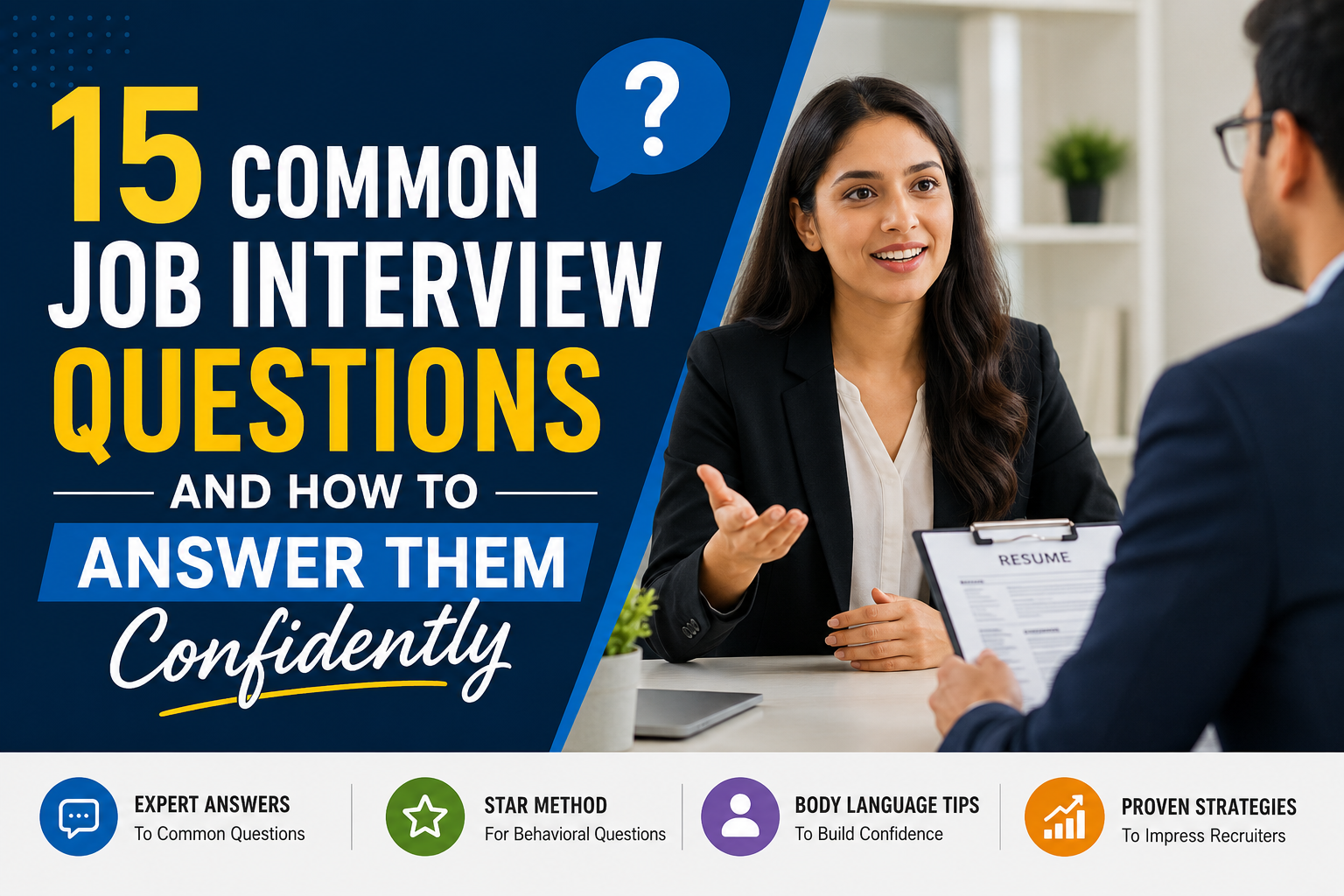
No matter how well-qualified you are, a job interview can be a daunting and frightening experience. common job interview questions and the criteria used in judging answers can lead to anxiety and therefore poorer performance. But the vast majority of interview questions are standard due to the fact that employers are attempting to determine certain qualities in individuals, including communication skills, problem-solving abilities, professionalism, and culture fit. If a candidate can grasp the psychology behind these questions, they can then prepare a well-thought-out response rather than merely memorizing a response.
The secret to a successful interview is to show confidence, self-awareness, and good communication skills rather than perfect answers. Employers look for proof of your ability to collaborate with colleagues and work effectively. Candidates can use the STAR method, rehearse answers to anticipated questions, and present themselves in the best light possible by preparing for the interview.
Why Recruiters Ask Interview Questions
A common mistake candidates make is believing the interviewers are only interested in the facts. In fact, each question is constructed to reveal aspects of your personality, your work style, your decision-making, and how you might fit into the company. What you say is not the only thing that is being assessed during the recruitment process. A lot of their impression comes from your confidence and clarity, your body language, and your tone.
There are 4 types of questions that you can expect in an interview:
- Questions about background and experience
- Behavioral questions
- Problem-solving questions
- Motivation and cultural fit questions
If you know these categories, you will be able to see what the interviewers are looking to find out.
The STAR Method: Your Secret Sauce for Behavioral Questions
The following are common examples of behavioral interview questions that start with:
- Describe an instance in which…
- Describe a situation in which…
- Give an example of…
These questions should be answered in the following way:
- Situation: Briefly describe the situation.
- Task: Discuss the problem or task you had to take on.
- Action: Describe specific actions.
- Result: Report the results and measurable outcomes if possible.
This allows you to have a no-wandering structure and makes the job of recruitment easier.
1. Tell Me About Yourself
Tell me about yourself is one of the most frequently asked interview questions. This question is asked by recruiters to assess your communication abilities, confidence, and professional concentration. The professional background, relevant accomplishments, and linkage to the job should be summarized in a strong answer.
Example:
“I am a content strategist and SEO specialist with 3 years of experience in digital marketing. In my previous role, I helped increase organic website traffic by 40% within one year. I enjoy combining creativity with data-driven decision-making, which is why I am excited about this opportunity.”
Don’t talk about unrelated personal information or repeat your resume word for word.
2. Why Do You Want to Work Here?
Employers are looking to see if you did research on the company and are really interested in the position. A strong answer should include the company’s values, mission, products, or recent accomplishments and explain how your career objectives fit into these.
3. What Are Your Greatest Strengths?
This question will assess self-awareness and confidence. Select strengths that are relevant to the job and give examples.
Example:
“Problem-solving is one of the areas I excel at. In one of my recent projects, I was able to identify workflow inefficiencies that cut down project completion time by 20%.”
4. What Is Your Biggest Weakness?
Interviewers don’t look for perfection. They want honesty and to see growth. Pick a true but achievable weakness and describe your plan to address it.
Example:
“I used to have trouble entrusting tasks to others and getting it all done right, but I learned to trust the team, and that has made them much more productive over time and improved communication.”
5. Why Should We Hire You?
This question is open for candidates to summarize and explain their value proposition. Emphasize your specific skills, experience, and achievements. A good response thoroughly outlines the ways in which your background can address the employer’s problems.
6. Tell Me About a Time You Failed
Questions about failure show resilience and responsibility. Using the STAR method, describe a mistake, explain what you learned, and demonstrate personal growth. Don’t blame others or things that are outside of your control.
7. Describe a Conflict You Had With a Coworker
Conflict questions assess teamwork and emotional intelligence. Deal with problems professionally and solve them rather than blaming others. Apply STAR to describe the role of communication and collaboration in solving the problem.
8. Tell Me About a Time You Demonstrated Leadership
Leadership is always valuable, even if you’re not going for a managerial position. Explain an occasion when you took the initiative, inspired others, or directed a project to success. Employers have come to expect that you have a proven track record of making things better.
9. Where Do You See Yourself in Five Years?
This question looks for ambition and future compatibility. Employers like candidates who have goals that match the opportunities offered by the company. Talk about career development, but not with the idea of a departure in the near future.
10. Tell Me About a Time You Worked Under Pressure
Most workplaces involve deadlines and challenges. Provide an example of how you stayed organized, prioritized tasks, and remained calm. Emphasize measurable outcomes as much as possible.
11. How Do You Handle Criticism?
People who take criticism well are highly sought after. Explain, in your own words, how constructive criticism helped improve your performance. Being flexible is a trait that can win over hiring managers.
12. What Motivates You?
The question is designed to give employers an insight into your motivation.
Good responses may contain:
- Solving problems
- Learning new skills
- Achieving measurable goals
- Helping customers
13. Tell Me About a Difficult Decision You Made
Describe a tough choice you had to make. Judgment and critical thinking skills are shown in decision-making questions. Use the STAR method to share the situation, your reasoning process, and the result. Highlight reason, responsibility, and professionalism.
14. Why Are You Leaving Your Current Job?
Employers are interested in your reasons but don’t want to hear negatives. Objectives should be geared toward expansion, promotion, training, or new challenges. Don’t speak ill of former employers.
15. Do You Have Any Questions for Us?
Effective questions show interest and enquiry.
Examples Include:
- What does success mean in this position during the first six months?
- What are the most important things the team needs to concentrate on at this time?
- What are the company’s professional development initiatives?
- What are the characteristics that your best employees possess?
Body Language Tips That Build Confidence
It’s not just what you say that is important in an interview. Nonverbal communication plays a large role in recruiters’ impressions of candidates.
Sit up straight during the interview. Do not cross your arms, and make natural movements. Facing the person and maintaining eye contact can convey confidence and interest, but too much fidgeting can indicate nervousness. A proper smile can establish a positive connection with the interviewer and put conversations at ease.
Use natural and meaningful hand movements to convey your message. Do not overuse them or leave your hands completely concealed. These are some of the things you can do in advance of an interview to enhance your overall impression.
How Tone of Voice Affects Interview Performance
Confidence conveys competence. If you speak too fast, it can appear that you are anxious, and if you speak too slowly, it can make you appear unengaging. Be careful to use a regular tempo and enunciate clearly.
Take a few seconds to consider difficult questions. This is not uncertainty; it is thoughtfulness. Generally, recruiters are pleased with candidates who take time to structure their ideas before they respond.
Enthusiasm also matters. A positive and energetic tone reflects a sincere desire to work for the organization and in the position.
Reducing Interview Anxiety Before the Big Day
The best way to minimize nervousness is to prepare. Thoroughly research the company, read the job description, and practice with the STAR technique. Try mock interviews with friends, mentors, and career counselors to become comfortable and familiar with the process.
Come to the interview early, dress properly, and keep in mind that you are not taking a test; you are talking to someone. Be aware that the recruiter is seeking someone who will add value to the company and not someone who provides the exact right answers.
Strategic preparation often makes candidates feel more at ease since they are aware of how to deal with common scenarios. Preparation and opportunity are the basis for the natural growth of confidence.
Conclusion
When you know the reasons behind typical interview questions, job interviews become much less stressful. It is not a ploy to confuse candidates but rather a way to elicit proof of skill, personality, and fit. With practice, the STAR method for answering behavioral questions, confident body language, and well-considered follow-up questions, you can make a lasting impression.
The aim is not to learn scripts but to create clear stories and illustrative examples that exhibit your skills. Preparation, confidence, and authenticity, when combined, can make interviews great tools for converting applications into offers.