A consolidation worksheet
may have many forms. As a minimum however, the worksheet should have;
may have many forms. As a minimum however, the worksheet should have;
(a) Columns for parent and subsidiary account balance (taken from their
separate financial statements or preclosing trial balances)
separate financial statements or preclosing trial balances)
(b) Columns for elimination and adjustment and
(c) Columns for the consolidated balances.
Columns may be headed
account name, parent, subsidiary, adjustments and consolidated balances. Each
line would consist of and account name, the separate balances, adjustment, and
a cross – footed balances.
account name, parent, subsidiary, adjustments and consolidated balances. Each
line would consist of and account name, the separate balances, adjustment, and
a cross – footed balances.
Obviously, more columns may
be added as necessary for additional subsidiaries, for distinguishing between
nominal example, temporary or income statement accounts and real accounts
example balance sheet accounts, and so on.
be added as necessary for additional subsidiaries, for distinguishing between
nominal example, temporary or income statement accounts and real accounts
example balance sheet accounts, and so on.
Regardless of the form,
however, worksheet are merely tools which help the accountant should always
keep in mind that when the worksheet gets too cumbersome or too complicated, it
has failed in its main purpose and should be modified in order to retain its
usefulness.
however, worksheet are merely tools which help the accountant should always
keep in mind that when the worksheet gets too cumbersome or too complicated, it
has failed in its main purpose and should be modified in order to retain its
usefulness.
The worksheet procedure
should be an aid not a hindrance to the consolidation process. Individual worksheet
adjusting entries may vary between accountants even through the financial
statements products by them are identical. The adjusting style is an individual
matter and depends upon prior training, inclination, or personal bias.
should be an aid not a hindrance to the consolidation process. Individual worksheet
adjusting entries may vary between accountants even through the financial
statements products by them are identical. The adjusting style is an individual
matter and depends upon prior training, inclination, or personal bias.
However, there are two
basic styles:
basic styles:
(a) Make an adjustment to
record each new piece of data and let the final balance in an account be the
result of the cumulative adjustment; or
record each new piece of data and let the final balance in an account be the
result of the cumulative adjustment; or
(b) Determine what the desired final balance should be and make
whatever net adjustment will accomplish the desired result. For example,
consider an inventory isN10,000;
purchasesN70,000; purchase return N5,000; and physical inventory count at
the end of the period isN9,000.
whatever net adjustment will accomplish the desired result. For example,
consider an inventory is
purchases
the end of the period is
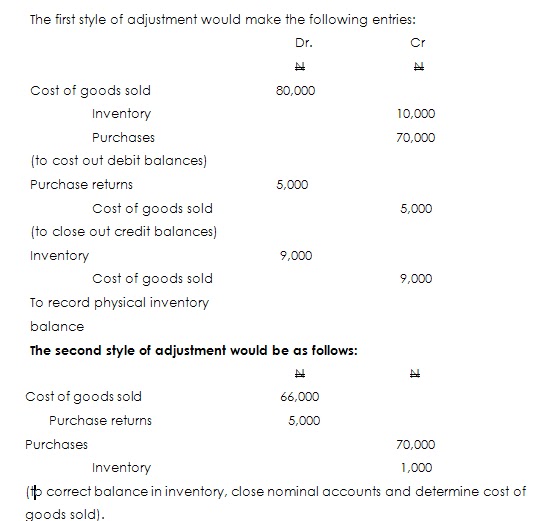
Both adjusting entries
produce the same resulting balances. Choice of adjusting style should not
confuse anyone who understands the accounting process and the underlying
circumstances. He should be able to interpret what has been done.
produce the same resulting balances. Choice of adjusting style should not
confuse anyone who understands the accounting process and the underlying
circumstances. He should be able to interpret what has been done.
Worksheet adjustment differ
depending upon whether the nominal accounts have been closed. If they have been
closed, the Retained Earning balance already reflects the results of the
current periods activity that is, given separate financial statement nominal
account adjustments also have to be reflected in consolidated retained
earnings.
depending upon whether the nominal accounts have been closed. If they have been
closed, the Retained Earning balance already reflects the results of the
current periods activity that is, given separate financial statement nominal
account adjustments also have to be reflected in consolidated retained
earnings.
But given trial balances,
nominal adjustments will automatically be taken into consolidated retained
earnings when the nominal accounts are closed.
nominal adjustments will automatically be taken into consolidated retained
earnings when the nominal accounts are closed.