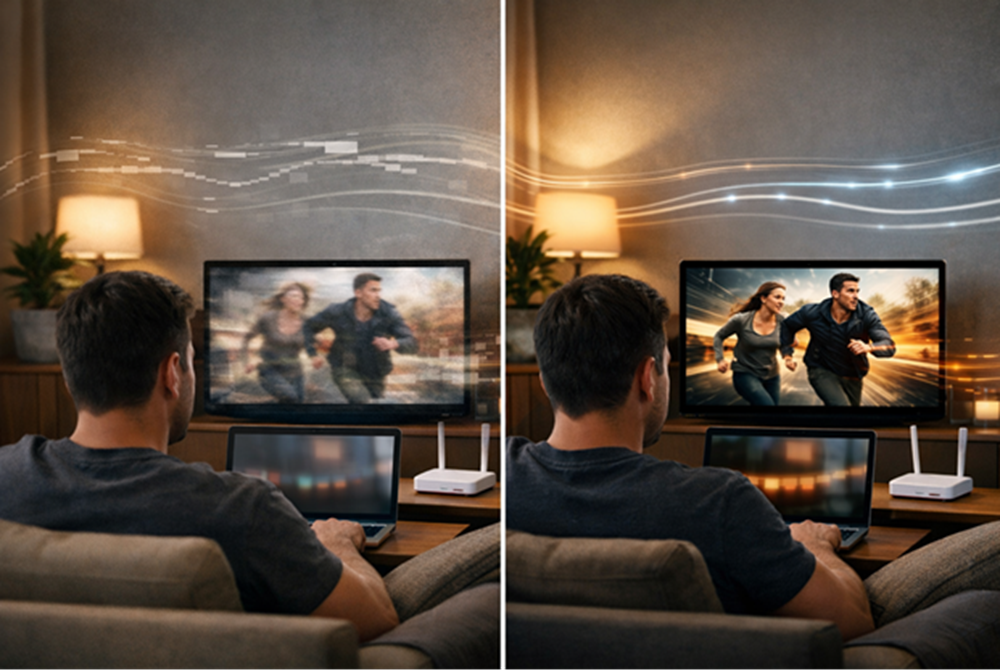
You open two streaming apps on the same Wi-Fi. One delivers crisp, vibrant video that feels almost cinematic. The other looks soft, blocky, or strangely washed out. Naturally, people blame their internet connection. But in many cases, the network is not the real problem.
The truth is simpler and more interesting: video quality differences often come down to how streaming services build and optimize their technology behind the scenes.
Let’s break down why some platforms consistently look better than others, even when you are using the exact same internet connection.
Perceived Quality Is Not Just About Resolution
Most viewers assume resolution determines quality. If both services say “1080p,” they should look identical, right? Not exactly.
Resolution only tells you how many pixels exist. It says nothing about how those pixels were compressed, transmitted, and reconstructed on your device. Two videos with the same resolution can look dramatically different depending on encoding decisions such as bitrate allocation, compression efficiency, and scene optimization.
Think of it like photos. A high-resolution image saved with heavy compression artifacts can look worse than a slightly smaller image saved carefully. Streaming video works the same way.
Bitrate Allocation Makes a Huge Difference

Bitrate is the amount of data used to represent video per second. Higher bitrates usually produce better quality because more visual information is preserved.
However, streaming platforms rarely use a fixed bitrate. Instead, they rely on adaptive bitrate streaming, which dynamically changes quality based on network conditions and device capabilities.
The key difference between services is how intelligently they manage bitrate ladders, which are sets of quality levels available during playback.
Some platforms invest heavily in optimizing these ladders per title or even per scene. Fast-moving sports footage requires more data than a static talk show. Services that tune bitrate carefully for each type of content can deliver sharper images without necessarily using more bandwidth overall.
Other platforms apply generic encoding settings across all content. The result is less efficient compression and lower perceived quality, even on strong connections.
Video Codecs Influence Efficiency and Quality
Another major factor is the video codec used to compress and decompress content.
Modern codecs such as H.264 (AVC), H.265 (HEVC), VP8, VP9, and AV1 vary in compression efficiency. Newer codecs can deliver similar visual quality at lower bitrates compared to older ones. That means better quality without increasing bandwidth usage.
However, codec choice is constrained by device compatibility. Not every phone, TV, or browser supports every codec efficiently, especially when hardware decoding is required to avoid battery drain or overheating.
As a result, streaming services often deliver multiple codec versions and select one based on the viewer’s device. Platforms that manage this selection intelligently can maintain higher visual quality across a wider range of devices.
Encoding Pipelines Are a Competitive Advantage
Large streaming providers treat encoding as a core technology, not a background task. They use advanced encoding pipelines that include:
- Per-title encoding optimization.
- Scene-aware bitrate adjustments.
- Multi-pass encoding analysis.
- Machine-learning assisted compression decisions.
These techniques allow platforms to preserve detail where viewers notice it most, such as faces, textures, and motion edges, while reducing data in less important areas.
Smaller or newer services often rely on simpler encoding workflows because advanced pipelines require significant compute resources and engineering expertise. That difference alone can explain why two platforms look very different under identical network conditions.
Content Delivery Networks Affect Stability

Even with identical internet speed, the path your video takes across the internet can differ.
Streaming services rely on Content Delivery Networks (CDNs), which store copies of video closer to viewers geographically. Better CDN coverage reduces latency, packet loss, and buffering interruptions.
If one platform has stronger CDN infrastructure in your region, it may maintain higher bitrate playback more consistently, which translates into better visual quality.
In other words, the connection might be the same on your end, but the delivery path is not.
Player Technology Matters More Than You Think
The video player itself plays a critical role in perceived quality. Modern players include algorithms that decide when to switch quality levels, how aggressively to buffer, and how to recover from network fluctuations. Poor decision-making can cause unnecessary drops in quality even when bandwidth is available.
Some players also implement perceptual enhancements such as sharpening filters, tone mapping for HDR content, and motion smoothing. These adjustments can subtly improve how video appears without changing the underlying bitrate.
It is similar to how two TVs displaying the same signal can look different depending on image processing settings.
Device Hardware Can Change the Experience

Your device is part of the equation too. Hardware decoding support allows devices to process compressed video efficiently. If a streaming service selects a codec that your device cannot decode in hardware, playback may rely on software decoding, which can reduce performance or force lower quality selections.
Screen characteristics also matter. Brightness, contrast ratio, color accuracy, and HDR support influence how video looks regardless of the stream itself.
This is why the same platform can appear better on one device than another, even on the same network.
Compression Artifacts Are Not Created Equal
Not all compression artifacts are equally noticeable. Blockiness, banding, mosquito noise, and motion blur occur when compression removes too much information. Advanced encoding systems prioritize preserving details that humans notice most, such as edges and faces, while allowing less visible areas to lose precision.
Services that optimize for human perception rather than raw metrics often look better, even at similar bitrates. This is a subtle but powerful distinction.
Startup vs Mature Platform Differences
Established streaming platforms benefit from years of data collection and optimization. They analyze viewer behavior, device usage patterns, and network conditions at massive scale. That data allows them to refine algorithms continuously.
Newer services may still deliver solid performance, but they typically lack the historical optimization depth of mature platforms. Over time, the gap often narrows as infrastructure improves.
Why “Same Internet” Does Not Mean Same Results
When you combine all these factors, the reason becomes clear. Two streaming services on the same connection can differ because of:
- Encoding quality and optimization.
- Codec efficiency and device compatibility.
- CDN coverage and routing.
- Player algorithms and buffering logic.
- Device hardware capabilities.
- Bitrate ladder design.
Your internet speed is only one variable among many.
The Bottom Line
Better streaming quality is rarely accidental. It is the result of deliberate engineering choices across encoding, delivery, and playback systems.
The next time one platform looks sharper than another, you are not imagining it. You are seeing the outcome of thousands of technical decisions working together behind the scenes.
And perhaps the most interesting takeaway is this: improving video quality does not always require faster internet. Often, it just requires smarter technology.