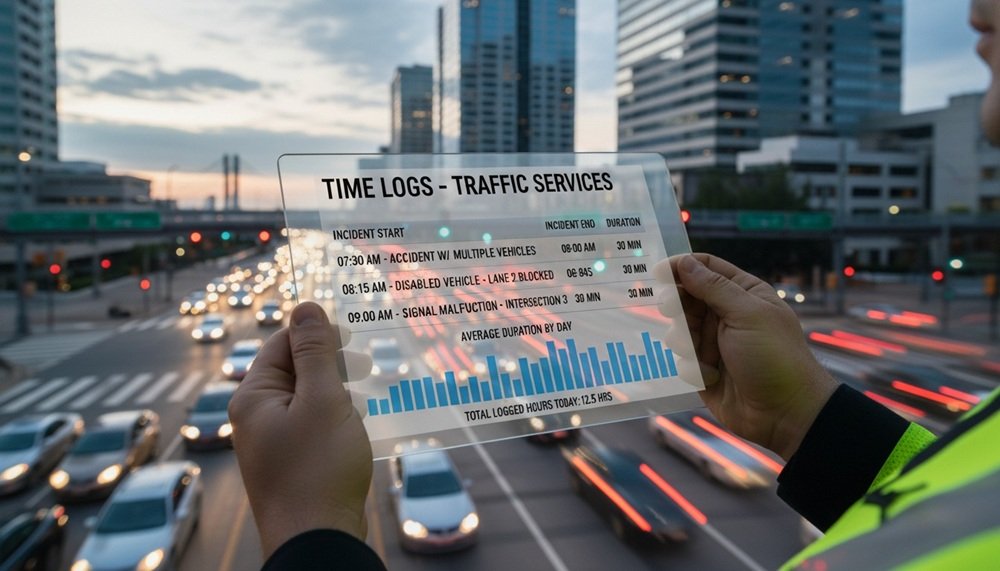
Let’s be real: running a traffic services business feels like herding cats while juggling flaming torches on a highway. Crews are managing road closures, setting up signs, and keeping drivers in check. Amid the chaos, it’s tempting to glance at a crumpled timesheet and think, “Eh, close enough.”
But here’s the hard truth: those time logs aren’t just for payroll; they are compliance documents. Messy or inaccurate logs don’t just risk payroll errors; they can trigger audits, fines, and legal headaches far worse than a Friday migraine. Even if your team is honest, accidental errors can look like fraud to an auditor.
Today, agencies and insurers are scrutinizing time records more than ever. If you’re still relying on “loose estimates” or tired guesses after a 12-hour shift, you’re playing with fire. Let’s break down why sloppy time tracking is a compliance nightmare and how to fix it before trouble strikes.
It’s Not Just About the Paycheck
In the world of traffic services, your time logs do the heavy lifting. They serve three masters at once:
- Billing: They prove to the city or the general contractor that you actually did the work.
- Compliance: They prove you followed labor laws (breaks, overtime, etc.).
- Safety: They create a timeline of who was where when things go wrong.
When your logs are precise, they are your best friend and protect you. But when they are sloppy, they become a liability. Imagine a crew claims they were on-site 30 minutes earlier than they arrived. To an auditor, that’s a red flag. If they find one mistake, they’ll dig until they find ten more, and suddenly your whole system looks as reliable as a chocolate teapot.
The 4 Big Risks of Bad Data
So, what actually happens when the numbers don’t add up? It’s not pretty. Here are the four biggest risks you face when your time logs are inaccurate.
1. The Labor Board Comes Knocking
Traffic crews work weird hours, including overnight shifts, emergency call-outs, and long days standing on hot asphalt. Because of this, strict rules apply to overtime, breaks, and rest periods. If your timesheets don’t show exactly when a worker started, stopped, or took a lunch break, you are opening the door for labor complaints.
In the worst case, regulators might think you are trying to cheat your employees out of wages. Even if you are the most honest boss in the world, poor documentation makes it hard to prove your compliance.
2. The “Refund” Nightmare
Have you ever had to give money back after you’ve already spent it? It hurts. Municipal contracts often require detailed reporting. Some agencies will conduct random audits where they compare your timesheets against GPS data or site reports.
If your guys said they were there until 5:00 PM, but the site supervisor says everyone left at 4:30 PM, you might be forced to refund those billed hours. Do that enough times, and you aren’t just losing money; you’re eroding your profit margin.
3. Losing Client Trust
Traffic services rely on repeat business. You want that general contractor to call you for the next highway project. Trust is everything. If a client realizes your time tracking is a mess, they start to question everything else. They might think, “If they can’t even track hours correctly, are they setting up the cones correctly?”
A contractor might decide they can’t rely on your reports for their own compliance, pushing them to switch to a competitor, even if your crews are amazing. In this game, paperwork is just as important as the actual work.
4. Safety Investigations
God forbid there is an accident on site. It’s the call no owner wants to get. When an incident happens, insurers and investigators look at the timeline immediately. If a flagger was involved in an accident, they will check the logs to see if fatigue played a role. If the employee was actually on hour 14 of a double shift, but the log says they were only on hour 10, you have a massive problem. You’ve lost visibility into safety risks, and now your records contradict reality. That weakens your defense and increases your liability.
Why Paper is the Enemy
If you’re nodding along thinking, “Yeah, this sounds scary,” but you’re still clutching those paper timesheets like they’re winning lottery tickets… we need to talk. Let’s be real: the “old school” way is a recipe for disaster. Picture this: It’s Friday afternoon. Your crew is itching to bolt. They dig out a crumpled, coffee-stained piece of paper and play a game called “Guess What Time I Started Work on Tuesday.”
“Was it 7:00 or 7:15?” “Eh, just put 7:00. Close enough.”
They round hours. They forget breaks. Supervisors are too busy putting out fires to inspect every single line item, so they just scrawl a signature and call it a day. Before you know it, these tiny “guestimates” pile up into a mountain of bad data. Plus, with paper, you’re basically flying a plane blind. You don’t spot the mistakes until it’s time to run payroll. By then, fixing them is a chaotic game of telephone that nobody wants to play.
How to Turn Chaos into Order
The good news? You don’t have to live like this. The most effective way to stop these compliance risks is to ditch the paper and go digital. Tools like Field Promax are designed to stop the guesswork. Instead of relying on memory, crews can clock in and out directly from their mobile phones in the field.
Here is why this is a game-changer:
- Real-Time Data: You see exactly when work starts and stops, eliminating more “Friday afternoon guessing games.”
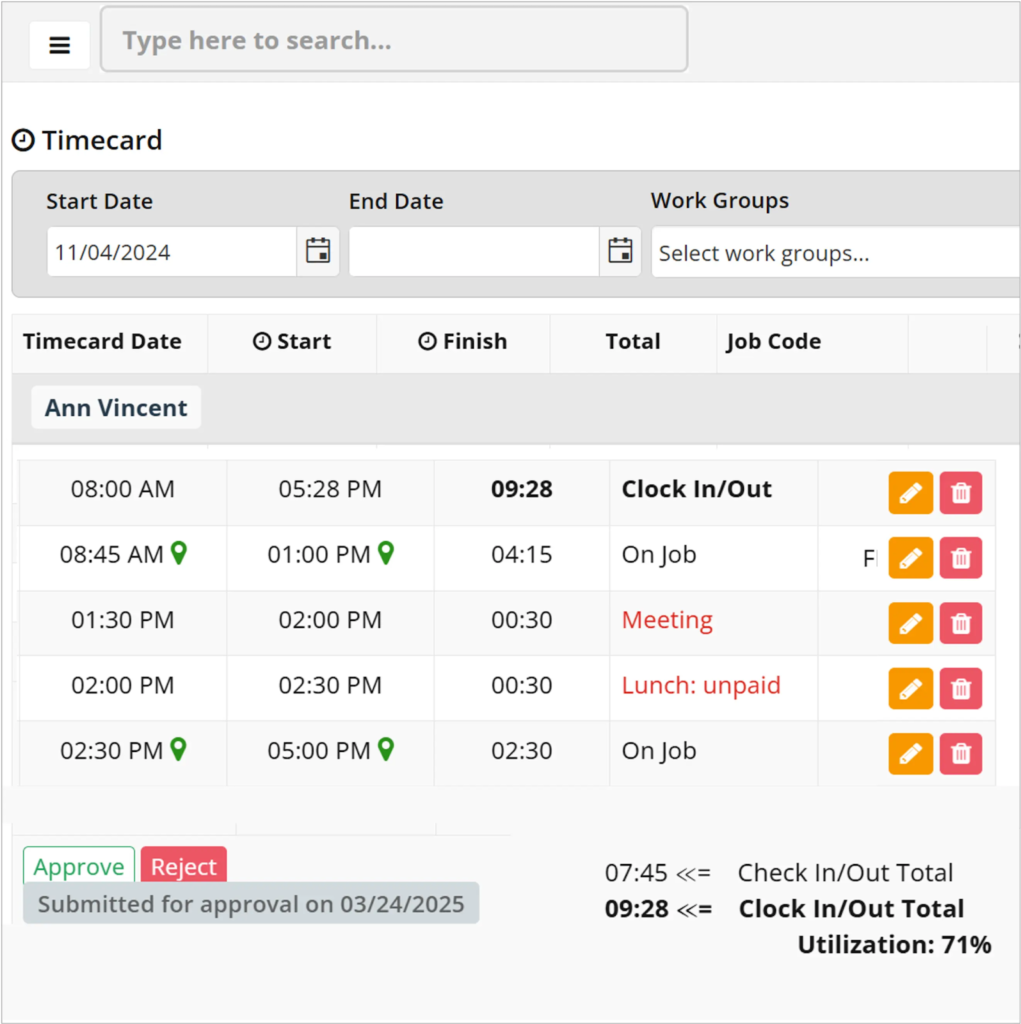
- Digital Audit Trail: Work orders capture timestamps automatically. If a dispute comes up, you have proof.
- Early Warnings: You can see when a crew is approaching overtime limits before it becomes a compliance issue.
Practical Safeguards (You Can Start Today)
Buying software is great, but you also need good habits. Here are four things you should do right now to protect your business:
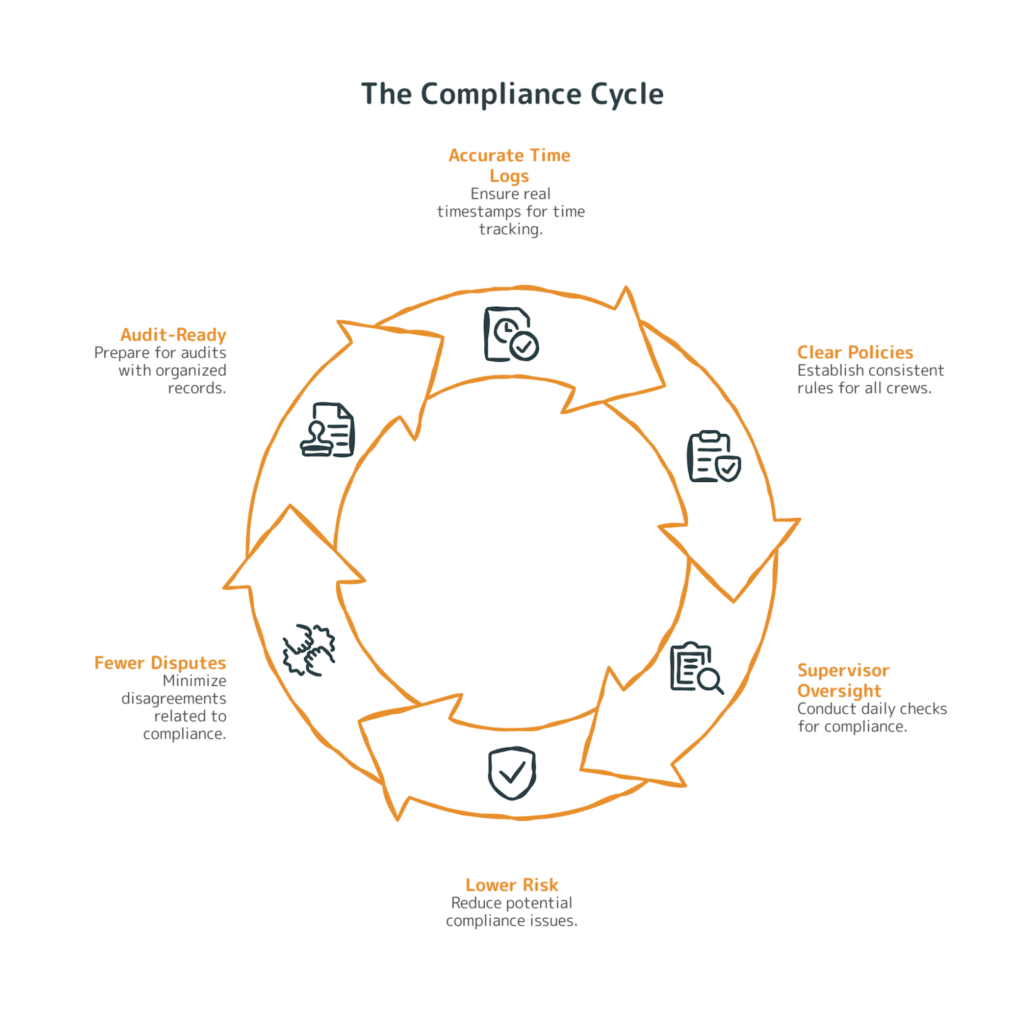
- Set the Rules: Make sure everyone knows exactly how to handle travel time and breaks. Consistency is key.
- Daily Approvals: Don’t wait until the end of the week. Have supervisors check logs daily. It takes five minutes and catches errors while memories are fresh.
- Ditch the Estimates: Train your team to log time as it happens. “Close enough” isn’t good enough anymore.
- Explain the “Why”: Tell your crews that accuracy isn’t just about money; it’s about keeping the company safe so they have a job tomorrow.
The Bottom Line
Look, nobody gets into traffic services because they love filling out spreadsheets. But accurate time logs are the foundation of a healthy business. When you clean up your time tracking, you’re not just avoiding fines; you’re gaining insight. You’ll know how long jobs actually take, which helps you bid better. You’ll spot bottlenecks and reduce payroll arguments.
Companies that treat time logs as a core metric, not just a chore, are the ones that win big contracts and earn client trust. Investing in a system like Field Promax provides peace of mind. It’s knowing that if an auditor walks in, you can smile, hand them a report, and say, “Here you go.”
Don’t let bad timesheets cost you a contract. Get your time tracking under control and get back to what you do best: keeping the roads safe.
Frequently Asked Questions
1. Why do auditors care so much about time logs?
Because time logs are official documents! They aren’t just for paying your crew. Agencies and insurers use them to verify billing, check labor compliance, and investigate safety incidents. If your logs look fabricated, the auditors will assume your whole operation is unreliable.
2. Can small mistakes really hurt my business?
Absolutely. One mistake might slide, but a pattern of them creates liability. If you constantly round hours or miss break times, it looks like poor management control. That can lead to fines, restitution, or losing contracts.
3. Is digital time tracking enough to keep me safe?
It’s a huge step, but it’s not magic. Digital tools like Field Promax give you the data, but you still need human habits. You need clear rules, supervisors who actually look at the logs, and a team that understands why accuracy matters.
4. How fast can we fix this?
Faster than you think! Most businesses see a significant improvement within a few weeks by standardizing their processes and adopting real-time digital work orders. It’s about combining better tools with better practices.