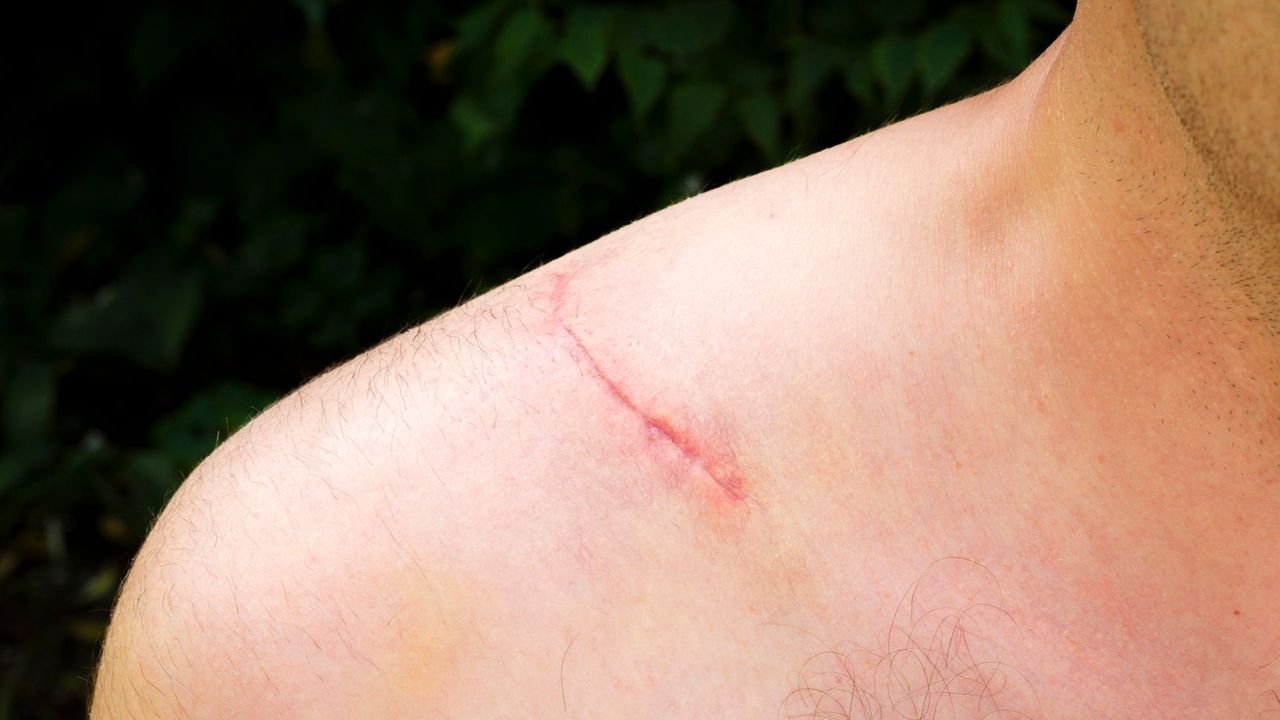
Cut a salamander’s leg off, and it grows a new one — bone, muscle, nerve, and skin, correctly arranged, in a few weeks. Cut a human’s finger off and, in almost every case, the body does something quite different. It seals the wound with scar tissue. The difference between those two outcomes is one of the more interesting unsolved problems in biology, and understanding it explains a great deal about how the human body actually works.
Repair is not the same as regeneration
Biologists draw a sharp line between two responses to tissue loss.
Regeneration rebuilds the original structure: the same cell types, in the same arrangement, performing the same function. The new tissue is indistinguishable from what was lost.
Repair does something faster and cruder. It fills the gap with fibrous connective tissue — scar — which restores the barrier but not the original architecture. Scar holds the body together. It does not reproduce what was there.
Humans are overwhelmingly repairers. With a few striking exceptions, when we lose tissue, we scar.
What scar actually is
A scar is not damaged skin. It is a different material, built quickly under pressure.
Normal skin contains collagen fibres arranged in a loose, basket-weave pattern that flexes in every direction. When a wound forms, specialised cells called fibroblasts flood the site and lay down new collagen fast — but they lay it down in dense, parallel bundles rather than the original weave. That parallel structure is strong and quick to produce, which is why the body favours it. Still, it is stiffer, weaker in the long term, and missing the original tissue’s features: no hair follicles, no sweat glands, altered blood supply, and reduced sensation.
In other words, scar is a rushed structural patch. The body has traded fidelity for speed.
Why speed wins
From an evolutionary standpoint, the trade makes sense. For most of human history, an open wound was a lethal threat — not because of the tissue lost, but because of infection and blood loss. A body that closed wounds within hours survived. A body that attempted a slow, perfect reconstruction bled out or became septic first.
Scarring is therefore not a design flaw. It is a survival adaptation optimised for a world without antibiotics or surgeons. The priority was always to close the breach now, and evolution does not optimise for the outcome you would prefer decades later.
The exceptions prove the rule
Humans are not entirely incapable of regeneration, and the places where we retain it are revealing.
- The liver can regrow a substantial portion of its mass after part is removed, restoring function.
- The surface of the skin (the epidermis) renews itself constantly, which is why a shallow graze heals without a scar while a deep cut does not.
- The lining of the gut replaces itself every few days.
- Very young children can sometimes regrow a fingertip, including the nail, if the injury is at the right level and the wound is left to heal naturally rather than being sealed — an ability that largely fades with age.
The pattern is consistent: humans regenerate tissues that face constant wear and lose that ability for structures that rarely need replacing on an evolutionary timescale. Regeneration is expensive to maintain. The body keeps it only where it earns its keep.
Why is this a live research question
Understanding why an adult human scars rather than regenerates matters because the machinery for regeneration is not absent — it is switched off. The same organism that scars over a cut contains cells capable of far more, as the liver and the young fingertip demonstrate. The scientific question is not “can human tissue regenerate?” but “what suppresses it, and can that suppression be lifted safely?”
That question sits at the intersection of developmental biology, immunology, and materials science. Why does a salamander’s wound signal “rebuild” while a human’s signals “seal”? What role does the immune response play in promoting scar tissue formation? Can the wound environment be altered to favour regeneration over repair? These are not settled matters, and they are among the reasons regenerative biology is one of the more actively researched fields in medicine.
The takeaway
Scarring is the body doing exactly what it evolved to do: close a dangerous wound as fast as possible, accepting an imperfect result in exchange for survival. It is efficient, ancient, and — most of the time — the right call. But it is not the only response the human body is capable of, and the gap between what our cells can do and what they usually do is where much of current biological research is focused.
The salamander is not doing something magical. It is doing something we can do partly, and could do more of. Working out the rest is the interesting part.
More on the biology of tissue repair and reconstruction is available at srinjoysaha.com