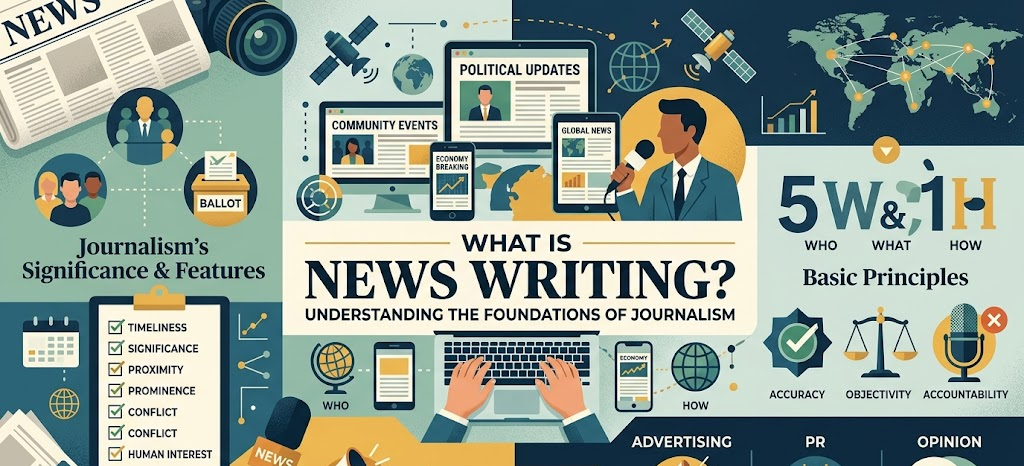
News is a key tool in educating people about the happenings in their community, country and the world in today’s information-rich age. Journalists collect facts, look into events day by day, and share stories that shape public opinion and decision-making. News writing is the communication of raw information into clear, accurate and meaningful news that can be consumed by others, which is the heart of this process. News writing is crucial for any aspiring journalist and for anyone interested in the media, communication and how society keeps informed.
News writing is not just a “writing of events. Requires critical thinking, careful research, ethical responsibility, and objectivity in presenting information. Journalism is different from personal story writing, advertising, or opinion writing, because journalism is about truth, fairness and public accountability. To be effective, news writing should allow the reader to get reliable information quickly while gaining an understanding of the context of events. As digital platforms have helped spread information and misinformation like wildfire in today’s age and media landscape, the art of responsible news writing is one of the most valuable skills in media, now and in the future.
Understanding News Writing
It is imperative to know the meaning of news writing if one is to be able to understand journalism. News writing is an activity that involves gathering, ordering, and communicating factual information about recent events clearly, concisely and objectively. It is used mainly to communicate to the public issues that impact people, communities and societies. News writing, for all intents and purposes, is a dependable link between events and consciousness, whether it’s written in newspapers, broadcast on TV, or communicated via digital media.
News writing is a disciplined and structured approach to writing, as opposed to other genres. Journalists have to be able to cut through the jargon and report the facts logically, so that readers will grasp the most salient information in the shortest time. News writing usually includes the answers to the basic questions called the five Ws and one H:
- Who is involved?
- What happened?
- When did it happen?
- What was the location of the event?
- Why did it happen?
- How did it happen?
The following six questions are the beginning of any good news report and will help you to be thorough and informative in your reporting.
The Significance of News Writing in the Society
In a democratic community, news writing is crucial as it provides citizens with timely and accurate information. All news reports are considered vital for people to know what is happening in politics, the economy, public health and world affairs. Communities would have a hard time knowing the facts from the rumors, and would have a hard time deciding on issues which impact their lives without professional journalism.
The roles played by news writing in society are:
- Making information about important events and developments available to the public
- Institutional accountability through tracking governments and institutions
- Increasing civic engagement by increasing awareness of political issues
- Putting bad things in the open through investigative reporting
- Community awareness about Social and Economic issues
- Clearing up misinformation by providing accurate information
News writing does not just convey information, it also helps to articulate public dialogue and public reaction to challenges and opportunities in society.
Distinguishing Features of News
Not all events make news. Journalists decide what’s news by means of several significant features of stories that make them interesting and important to readers.
1. Timeliness
News deals with the current or emerging events. Information needs to be up-to-date to be useful and relevant.
2. Significance
Media attention is given to stories that impact a large number of people or have significant consequences.
3. Proximity
People are more interested in events which are nearer to them or within their own communities.
4. Prominence
If it is someone who is well known, a public organization, or a public figure, the event will likely get a lot of coverage.
5. Conflict
When there are disagreements, issues and challenges, they make great news.
6. Human Interest
When stories are written in a way that captures the reader’s emotional response and are based on personal experiences, they can resonate on a strong level. A good news report may have a variety of these features, while maintaining accuracy and balance.
The Basic Principles of News Writing
Ethics underpin the practice of professional journalism and are used to direct the ways of gathering and presenting information.
- Accuracy
The most crucial rule of news writing is to be accurate. Journalists should check each fact before publishing it, such as:
- Names and titles
- Dates and timelines
- Statistics and figures
- Locations
- Direct quotations
- A set of background and context information
Even minor mistakes can lead to loss of public confidence and a journalist’s credibility.
- Objectivity
The facts should be reported without personal opinion or sentimentality (objectivity). Journalists should refrain from taking sides and should report the facts from both sides.
Objective reporting requires:
- Neutral language
- Multiple viewpoints
- Evidence-based claims
- Emotional neutrality – avoidance of emotional exaggeration
- Fair representation of all those concerned
- Accountability
It is the responsibility of the journalist to take responsibility for his/her report. If a mistake is made, corrections should be made as soon as possible and openly.
The Uniqueness of Journalism In Terms Of Communication
Journalism is an enterprise that is sometimes mistaken with other communication professions, but has a distinct function and standards.
- Journalism vs Advertising
Journalism is about providing objective information to the public; advertising is about getting people to purchase products or services.
| Journalism | Advertising |
| Knows details | Knows how to convince |
| Public interest | Commercial interest |
| Editorial Independence. | Paid messaging |
- Journalism vs Public Relations
Public Relations aims to foster positive images for an organisation or individual, but journalism looks into and reports facts, whether good or bad.
- Journalism and Opinion Writing
Persons’ interpretations and comments are included in opinion pieces. In news writing, however, a focus on neutrality and factual reportage is demanded.
The Basic Components of a News Story
News writing is structured in a regular form to get the reader’s attention to the main points.
1. Headline
The headline encapsulates the key event and is attention-grabbing.
There must be a strong headline that should be:
- Clear
- Concise
- Accurate
- Engaging
2. Lead Paragraph
The lead usually answers some Five Ws and One H questions and bears the most salient facts.
3. Body Paragraphs
The body provides:
- Supporting facts
- Context and background
- Expert opinions
- Witness statements
- Direct quotations
4. Conclusion
The conclusion can include a summary of the problem or give a suggestion about what might happen next.
The Inverted Pyramid Style
The inverted pyramid structure is one of the most common news writing structures.
How it works:
1. Items of greatest importance are listed first, and the most important information is always in bold.
2. Supporting details second
3. Background information last
This format has the following advantages:
- Readers comprehend relevant knowledge in a swift manner
- These are the tools that editors use for truncating articles
- Information is still well structured and logical
This style is still considered a mainstay in journalism due to its efficiency and clarity.
Necessary Skills for News Writing
The combining of technical, intellectual and ethical skills is a requisite of a successful journalist.
1. Research Skills
Journalists should collect trustworthy information from trustworthy sources.
2. Interviewing Skills
Well done to the journalists who secure the essential, valid data and in-depth perspectives through strong interviewing skills.
3. Writing Skills
The following criteria should be used to write a good news article:
- Clear language
- Concise sentences
- Logical organization
- Proper grammar
- Strong headlines
4. Critical Thinking
Journalists need to critically assess information and recognise its potential for misinformation or bias.
5. Ethical Judgment
Knowing how to make responsible decisions is key in reporting sensitive and controversial issues.
6. Digital Literacy
Another skill that modern journalists have to learn:
- Social media reporting
- Multimedia storytelling
- Data journalism
- Mobile journalism tools
Difficulties Facing News writing Today
The media landscape has undergone dynamic transformation, which has posed new challenges for journalists.
1. Errors and untrue information
Spreading misinformation online is rapid, and verification is more imperative than ever.
2. Pressure for Speed
With digital platforms, updates are required in real-time, which can lead to errors.
3. Declining Public Trust
Transparency and accountability are critical with regard to skepticism in media.
4. Financial Pressures
The budgets of many news organizations are cut and their newsroom staff is reduced.
5. Adapting to Digital Audiences
Journalists need to now produce material that is appropriate for:
- Websites
- Mobile apps
- Podcasts
- Social media platforms
- Video channels
The demand for credible and reliable news is high, yet the obstacles are great.
Why News Writing is still an important Skill
While technology has changed the way people communicate, news writing is still a core aspect of journalism and a career in the media.
Its value includes:
- Establishing trust and confidence in the media by providing accurate coverage.
- Promoting good governance and accountability
- Communicating information to enable people to make informed decisions
- For many occupations, communication skills are a key requirement
- Enhancing critical thinking skills and media literacy skills
In addition to journalism jobs, news writing is relevant to corporate communication, public relations, policy analysis and the creation of digital media content.
Conclusion
News writing is an essential aspect of journalism and public communication. The knowledge of news writing assists readers in grasping how information is turned into the reliable knowledge of the public. Journalists fulfill an important role in keeping societies informed and maintaining transparency of democratic institutions though the principles of accuracy, objectivity and accountability.
News writing has not changed in basic objectives; it’s still about sharing information, telling the truth and making things clear to the public. The ability to learn the basics of news writing is crucial for aspiring journalists, communication students and informed citizens, and is an important part of understanding the timeless importance and accountability of journalism.
Frequently Asked Questions (FAQs)
What is news writing?
News writing is the act of reporting factual information about current events clearly, accurately and objectively.
Why is it important for journalists to be objective?
By keeping the writing objective, there is fairness and readers can draw their own conclusions from the facts presented.
What is inverted pyramid style?
It’s a news writing style that puts the most critical information up front followed by supporting details and background.
What do the effective news writers need to have?
Skills that are important are research, interviewing, writing, critical thinking, ethical judgment, and digital literacy.
What are the differences between blogging and journalism?
Journalism is based on professional practices of verification and objectivity, while blogging may be more personal and informal.