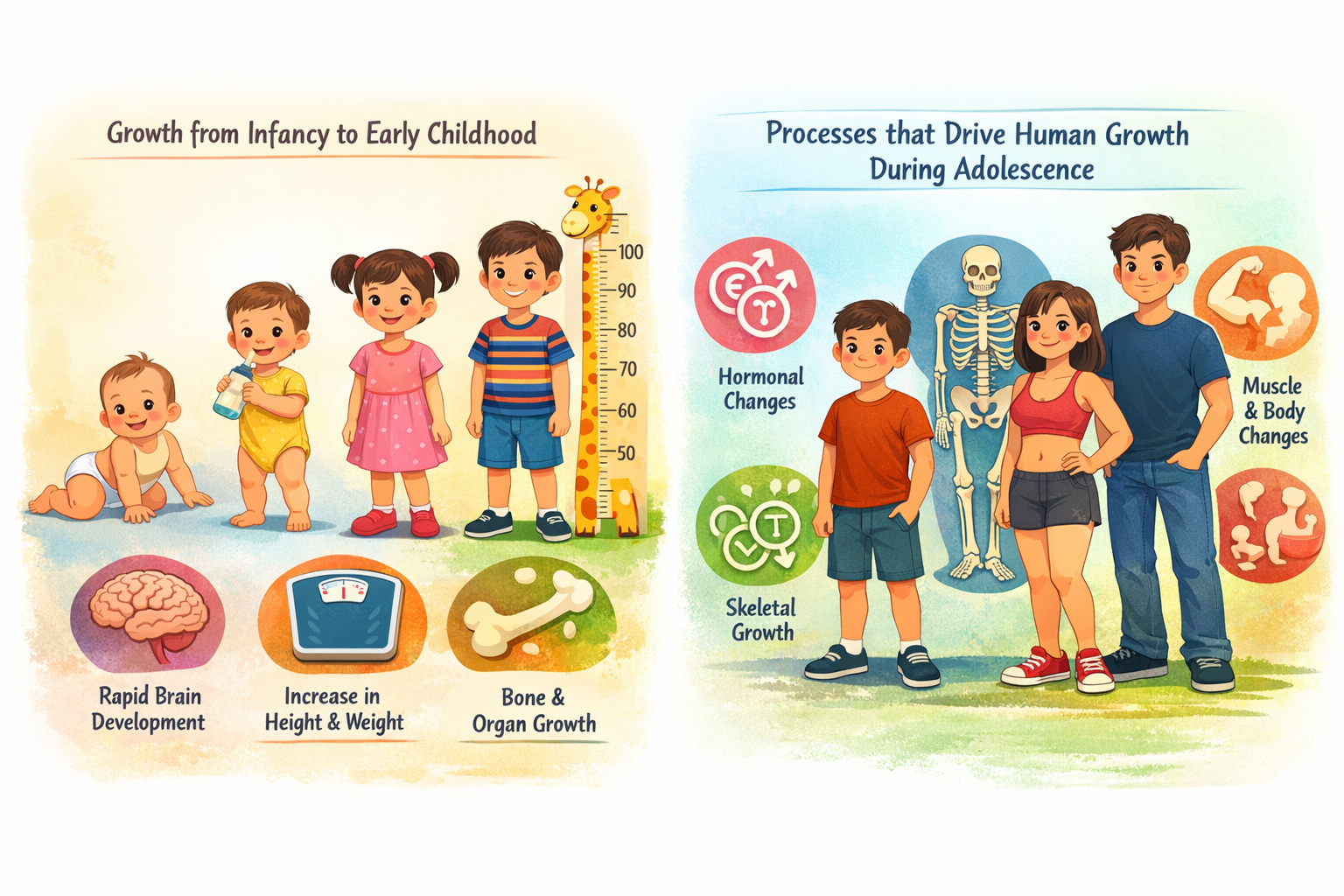
Human development is an active and well-controlled process that starts at birth through adolescence. It is a sequence of biological, physical and developmental alterations that define the size, structure and functional ability of the body. Since the infancy stage grows fast and the puberty stage undergoes hormonal changes, these are the indicators of the complex processes that propel human development, which is guided by genetics, nutrition, and the immediate environment. Learning such mechanisms can make parents, teachers, and medical professionals understand the fact that differences between people are not only natural but also healthy.
The article discusses the development of people in stages, with specific features of their height, weight, body proportions, and organ development during infancy to adolescence stage.
The Biological Basics of Human Development
An interplay of biological systems and genetic instructions mainly regulates growth. At the centre are genes, which contain the code of the predetermined height to which a person can grow, the rate at which a person grows, the development of body proportions etc. Genes however do not act alone.
Hormones are very essential in ensuring that genetic potential is translated to physical reality. At various times in life, growth is affected by growth hormone, thyroid hormones, insulin and sex hormones. Moreover, proper nutrition provides the energy and the building blocks that the tissues and organs need to grow in the right direction.
The influence of the environment on the natural path of body development can be favorable or unfavorable in terms of access to healthcare, contact with diseases, physical activity, and psychological well-being.
Infancy: The Rapidest Phase of Growth
The most rapid phase of human lifespan is during infancy which is a stage between birth and an estimated age of two years. Babies normally lose but very little weight during the initial days of birth, but the weight is soon restored within the first two weeks.
Changes in Height and Weight
The first year of life brings tremendous growth with youngsters gaining up to three times in birth weight and gaining at least 25 centimeters in length. Such a fast development is an indicator of a high level of cellular activity since tissues and organs increase in size very fast in order to adjust to life out of the womb.
In the second year, the growth is rapid although it slows down a bit. The weight gains gain consistency, and growth of height gains slower compared to the initial year.
Organ Development and System Development
As the body increases in size, there is a great development of the vital organs. The growth of the brain is dramatic during infancy, which peaks at early childhood (around 80-90% of the adult size) is achieved. The digestive system and the immune system also become developed and, as a result, infants are able to digest solid food and prevent infections more effectively.
This is a particularly critical period of nutrition. Enough consumption of fats, minerals, vitamins and proteins facilitates physical development as well as brain development.
Early Childhood: Predictable and Constant Development
Early childhood and that is mostly between the ages of two to five is a period when there is a predictable and consistent growth. As opposed to infancy, development in this phase is not very dramatic but very uniform.
Body Proportions and Motor Development
A change in body proportions is one of the most observable types of changes in early childhood. The heads of toddlers are relatively big as compared to their body and as they grow, the trunk and limbs stretch to make them look more balanced.
Better muscle strength, and coordination enable children to have gross and fine motor skills, running, jumping, drawing and handling small objects.
Influence of Environment
At this point we see the environmental factors coming into the limelight. Healthy development is aided by regular exercise, a balanced diet, and a healthy and safe challenging environment. Growth may be temporarily retarded by chronic disease, malnutrition or intense stress but most children may demonstrate catch-up growth once the conditions are rectified.
Middle Childhood: Sluggish Physical Development
The period between six years and about ten years is known as middle childhood which is gradual and stable in growth. Children tend to increase their height at the rate of 5-7 centimeters yearly and weight by 2-3 kilograms yearly.
Skeletal and Muscular Development
There is a progressive lengthening of the bones and there is a growth in muscle mass particularly when the children are exercising more. The skeletal system gets stronger with the increased bone density which forms the basis of adult height.
It is also the time of dental development since primary teeth are being slowly substituted by permanent teeth.
Cognitive and Physical Balance
Though this paper is on physical development, it is worthwhile to mention that in most cases cognitive development follows similar lines with physical developments. The brain keeps on enhancing brain connections, which facilitates better coordination, learning, and problem-solving skills.
Puberty and Adolescence: Growth Jumps and Change
The last significant stage of human development is adolescence, which starts approximately at eight up to thirteen years, depending on the person in question. The period of puberty is the time when strong hormonal processes cause rapid physical growth.
The Adolescent Growth Spurt
A growth spurt is one of the peculiarities of adolescence. At this stage, human beings can increase at a rate of 8-12 centimeters annually at the highest rate. Growth spurts tend to come earlier than boys hence it is the reason why girls will be seen to be taller in the early years of adolescence.
There is also increased weight gain which is an indication of gain in bone mass, muscle and body fat. These developments are critical towards adult body proportions and sexual maturity.
Sexual Maturation and Composition of the Body
The secondary sexual characteristics are developed by sex hormones like estrogen and testosterone. The role of estrogen in girls and testosterone in boys enhances the development of breasts and fat distribution, respectively, and muscle mass and bone size respectively.
There is also a change in proportions of the bodies. The limbs tend to form at a higher rate than the trunk during the initial stages resulting in the development of a short-term feeling of awkwardness before the proportions reach stability.
Genetics: Establishing the Potential of Growth
Genetics forms a basis on the growth patterns. Inherited characteristics are very strong in height, body structure, and time of puberty. An example is that children born into taller parents have higher chances of becoming tall although the environment can alter this.
Genetic diversity is the reason why siblings brought up in the same household can develop at different rates or become adult heights. The differences are a healthy and natural manifestation of biological variation.
Nutrition: Fuel for Growth
One of the most vital external growth determinants is nutrition. The sufficient consumption of calories, protein, calcium, iron, and vitamins helps in building the bones, muscles and functioning of the organs.
Growth and development can be delayed by malnutrition particularly in very crucial stages of development like infancy and adolescence. On the other hand, the balanced nutrition assists children to achieve their genetic development.
Notably, the effect of overnutrition on the developmental pattern may as well occur, and in some instances it may result in premature puberty or vulnerability to health problems in adulthood. It is essential not abundance but moderation.
Social and Environmental Factors
Physical development can be measured by the environment that a child is brought up in. The healthy growth is a result of clean water, sanitation, availability of healthcare, and a conducive social environment.
Stress over a long period of time, neglect or recurring disease can interfere with hormonal balance and reduce development. Conversely, normal growth patterns are facilitated by positive emotional support and stable living conditions.
To obtain additional scientific context on the biological basis of growth, a reader may look at this source about processes that facilitate human growth, which gives a summary of growth in a health and medical sense.
Why Differences in Growth are Natural
Among the most relevant arguments in the development of human lives, it is important to see that there is no particular order of human development that can be considered normal. Kids develop at varying speeds, have varying ages of puberty, and they become dissimilar adults.
The growth charts utilized by the health workers are not norms the child has to follow but a tool through which the health workers monitor change over time. When a child continuously tracks himself, the track they follow will tend to be normal even when the child is shorter or taller than the others.
Growth may have temporary decelerations or accelerations because of illness, nutrition or hormone alterations. The body in most instances self-adjusts.
Promoting Healthy Development from Infancy to Adolescence
Promoting good development means fulfillment of physical and natural needs. This includes:
- Balanced and age appropriate nutrition.
- Promoting physical exercise.
- Ensuring adequate sleep
- Motivating emotional health.
- Receiving regular medical and developmental care.
Under such circumstances, the majority of children develop according to their genetic potentials.
Conclusion
The human development period between infancy and adolescence is a multi-faceted process that is influenced by biology, genetics, nutrition and environment. It is an amazing and adaptive route of the body, through the blistering growth of infancy to the revolutionary alterations of adolescence.
Knowledge about mechanisms that guide human development assists in explaining why growth patterns are diverse in different individuals and why the difference between different individuals is both natural and normal. Through the identification of the normal milestones and influences, caregivers and professionals can appreciate the ability to support children more as they develop into healthy adults.


your article is most beautiful