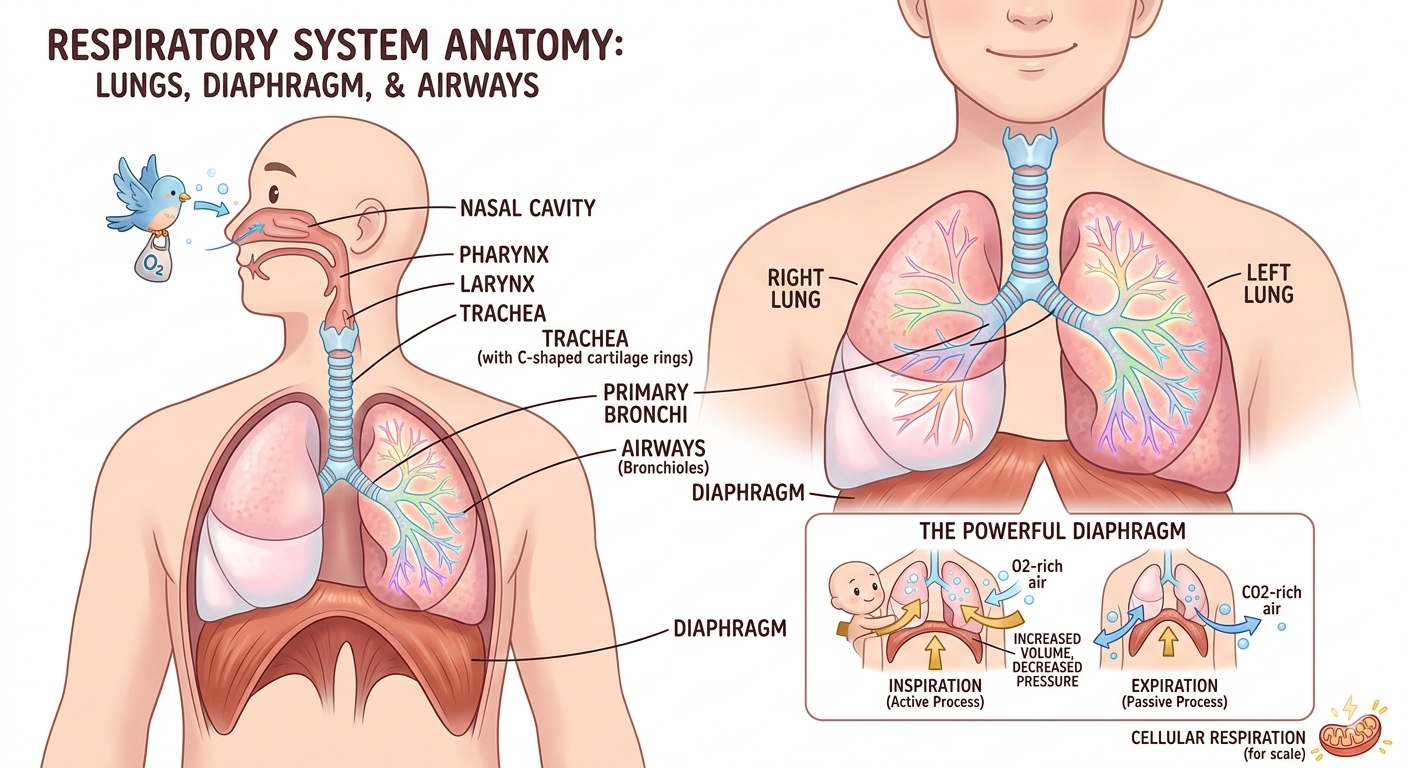
The process of breathing is not always regarded as something automatic and easy to perform but it is one of the most significant biological processes that support life. Each breath is the integration of muscular action, the conduction of airways, gas exchange, and the transport of a solution to meet the metabolic needs of the cells. The central part of this activity is the inbuilt respiratory system that is made up of the lungs, the diaphragm and the branching airways that coordinate to deliver oxygen and the removal of carbon dioxide. The absence of this specific coordination would put an end to cellular respiration the biochemical process that generates energy in the form of adenosine triphosphate (ATP).
In order to gain an insight into how the body maintains metabolic activity, one needs to explore the structural anatomy and physiological processes that enable the lungs and diaphragm to drive gas exchange. Efficiency of breathing has a direct impact on the amount of oxygen available to the cellular level and how well the metabolic waste is eliminated. By means of a systematic analysis of the mechanics of inhalation, the laws of diffusion and the integration of the circulatory system, one may begin to value the respiratory system not as a breathing apparatus, but as a metabolic engine, which sustains life at a microscopic level.
Anatomy of the Respiratory System
The respiratory system is structurally divided into upper and lower pathways which direct the air in the external environment to the alveoli where gas exchange is carried out. Air comes in via the nasal cavity or the mouth, flows through the pharynx and the larynx and reaches the trachea. The trachea splits into two main bronchi which lead to the lungs. These bronchi in the lungs further divide into smaller bronchioles creating an extended net work that looks like an inverted tree.
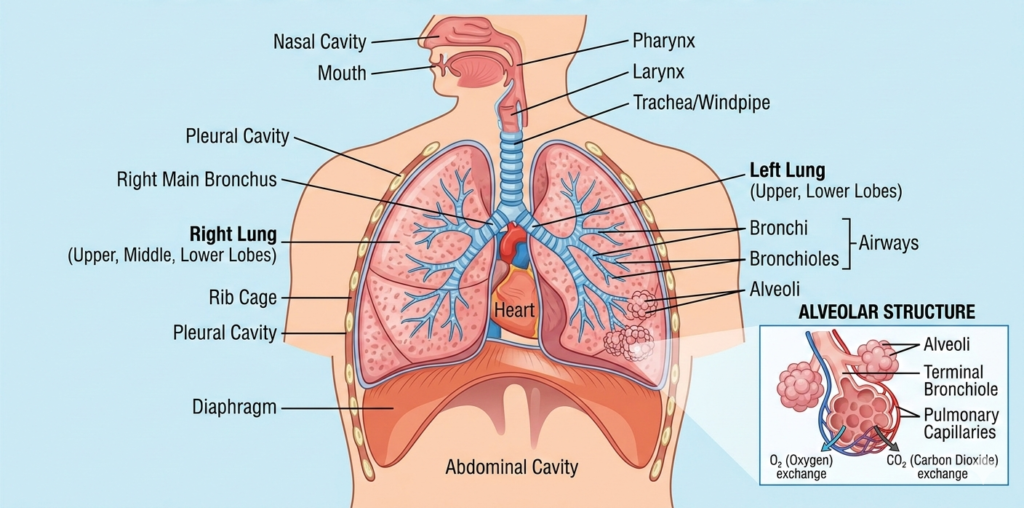
This bifurcating structure highly increases surface area and causes air to move slowly and ready inhaled air to be diffused efficiently. Millions of microscopic air sacs are found at the terminal ends of bronchioles. The thin walls of alveoli and their proximity with pulmonary capillaries provide an ideal interface of the gas exchange. Structural specialization is also such that oxygen can get into the blood fast and carbon dioxide out.
The thoracic cavity which is surrounded by the rib cage and driven by respiratory muscles, the most prominent of which is the diaphragm, aids in supporting this delicate architecture. It is the integrity of these parts of the anatomy that makes mechanical ventilation in line with microscopic diffusion processes.
The Diaphragm: The Preeminent Ventilatory Muscle
The diaphragm may be described as a dome-shaped skeletal muscle which is located below the lungs. It divides the thoracic cavity with the abdominal one and serves as the main breathing mechanism. The diaphragm flattens downwards contracting during inhalation, expanding the size of the thoracic cavity. This increase violates the internal pressure against the atmospheric one and the air moves to the inside.
As the diaphragm regains its original shape, it changes to its dome shape, reduces the thoracic volume and raises pressure inside the lungs. This pressure gradient forces the air out in breathing. In spite of the fact that other muscles help in exerting force during breathing, in the resting situation, diaphragm does most ventilations.
Rapid contraction and relaxation of this muscle form the mechanical basis within which gas exchange takes place. Lack of diaphragmatic motion would not result in the occurrence of airflow and supplies of oxygen to the cells would be affected.
Inhalation and Exhalation Mechanics
Breathing works according to the pressure gradient laws that are dictated by the Boyle law that the pressure and volume are inversely related. When inhaling, the thoracic cavity expands reducing the intrapulmonary pressure to a lesser pressure than atmospheric pressure. The air passes naturally through the body into high and low pressure respectively.
Exhalation is usually passive when one is breathing restfully. When the diaphragm relaxes and the elastic lung tissue returns the thoracic volume becomes smaller. The intrapulmonary pressure increases to exceed that of the atmosphere and thus the air is expelled. This is an ongoing process, which keeps the body in a dynamic interaction with the outside world.
The respiratory process requires elasticity of the lungs, the ability to open the airways and the effectiveness of the muscles. A disturbance of either of these structures can cause a defect in the delivery of oxygen or the excretion of carbon dioxide to influence the stability of metabolism.
Alveoli and Gas Exchange
Alveoli form the functional center of the respiratory system. Their walls have one layer of epithelial cells and are enclosed by a decentralized network of capillaries. This low resistance permits the gases to diffuse quickly depending on the concentration gradient.
As well as this, when oxygen saturated air flows into the alveoli, the oxygen tension within the alveolar volume is higher in this place than in the non-oxygenated blood that comes in through the pulmonary arteries. Diffusion of oxygen molecules across the alveolar membrane into capillary blood happens and binds to hemoglobin in red blood cells. At the same time, the carbon dioxide that exists in higher levels in blood is diffused in the alveoli when it is to be removed through exhalation.
This exchange is brought to efficiency by the surface area, membrane thickness and appropriate ventilation-perfusion matching. The structural design is such that the millions of alveoli work together to achieve adequate space to maintain systemic metabolic demand.
Distribution of Oxygen and Cellular Respiration
When oxygen gets into the blood system, it is taken to tissues around the body. Oxygen is brought to tissues by haemoglobin molecules to systemic capillaries with low oxygen concentration, which allows oxygen release. Oxygen is then diffused to cells and further to mitochondria, the organelles that are involved in the cell respiration.
Cellular respiration is a complex biochemical process, which is used to break down glucose and oxygen to produce ATP, water and carbon dioxide. ATP is the major energy currency of cells, which facilitates muscle contraction, neural transmission, and biochemical synthesis.
In the absence of constant supply of oxygen through the respiratory system, the production of ATP would be stopped, which would cause dysfunction of the cells. In this way, breathing aids in the formation of energy on the molecular level.
Removal of Carbon Dioxide and Acid-Base Equilibrium
Carbon dioxide is a byproduct of the cellular respiration. The surplus would upset acid-base and inhibit physiological performance. The respiratory system is important in maintaining the pH of blood through the control of carbon dioxide release.
The carbon dioxide moves out of the tissues into the lungs either dissolved or as bicarbonate ions. It is diffused in alveoli in pulmonary capillaries and expelled through exhalation. Changes in breathing rate may quickly affect the levels of carbon dioxide, which is a short-term control of the blood acidity.
This regulative role emphasizes the contribution of the respiratory system other than the provision of oxygen. It plays an active role in chemical stability required in the enzyme reaction and metabolic processes.
Efficiency and Metabolic Demand of respiration
Respiratory efficiency is the efficiency of lungs towards delivering oxygen in comparison with the metabolism needed. Oxygen uptake is very high in the process of exercise. The contraction of the diaphragm becomes stronger, and the accessory muscles help in ventilation. The rates and depths of breathing are raised to satisfy the cellular needs.
Efficient gaseous exchange makes sure that energy production needs are in line with the oxygen supply. In case of reduced respiratory capacity, the fatigue sets in at a faster pace because of lack of ATP production.
Large alveolar surface area, structural features like the elastic lung tissue and the coordinated functioning of the muscles optimize performance across the different physiological conditions.
The Circulatory System Interaction
The cardiovascular system works hand in hand with the respiratory system. The deoxygenated blood that contains the heart is pumped to the lungs by the pulmonary circulation and the oxygenated blood is pumped to the tissues by the systemic circulation.
Ventilation and cardiac output should be synchronized. This coordination makes the uptake of oxygen and the elimination of carbon dioxide efficient. The complexity of the maintenance of cellular respiration can be highlighted by the interdependence of these systems.
Any interruption to the circulation or ventilation may impair the delivery of oxygen proving the need to have an integrated physiological process.
Mechanisms of Structural Adaptation and Protection
Airways have cilia and mucus producing structures which entrap and eliminate particles and shield the vulnerable alveoli against destruction. Mechanical injury to lungs is prevented by the rib cage, and alveoli collapse is prevented by surfactant that lowers the surface tension.
These structural changes do not compromise the respiratory efficiency, but help to maintain the optimal gas exchange conditions.
Conclusion
Lungs, diaphragm, and the airways are coordinated to form a respiratory system, which drives cellular respiration via the specific mechanical and biochemical processes. Exhalation and inhalation help to produce airflow, the alveoli diffuses oxygen to blood and carbon dioxide is eliminated to maintain chemical balance. Delivery of oxygen keeps the ATP production in the mitochondria that support the cellular activity in all the organs systems.
An insight into this combined framework shows that the anatomics of efficiency is metabolic. Ventilation is propelled by the diaphragm, the lungs offer large open areas to facilitate exchange, and the circulatory systems deliver and eliminate gases to and out of the tissues respectively. A combination of these processes sustains life at a cellular level.
Breathing could sound easy but it is a complex physiological process that keeps the human being alive in every single moment.