Introduction
Modern restorative and preventive dentistry relies on dental materials, which are the key ingredients and also the foundation of good treatment and the restoration of function, aesthetics and health to the oral cavity. Each filling, crown, denture, adhesive, and implant is composed of incredibly precise materials that are extremely hard to withstand the high complexity and high stress of the mouth. It is therefore easy to see that understanding of the behavior, limitations and benefits of these materials is closely related to the success of any dental procedure. If you’re a young professional, building a solid base of scientific understanding is key for making sound clinical decisions—ones you know will lead to good long-term results. If this information isn’t available, then material selection is not evidence-based practice, but rather guesswork which may lead to loss of treatment effectiveness and patient satisfaction.
The scientific basis of dental materials is essential to strong understanding and involves chemistry, physics and biology to develop materials that will perform their purposes in the oral cavity. The scientific principles of dental materials predict the way that the material changes in response to forces, temperature, moisture and chemicals over time.
In clinical practice it is vital for young clinicians to know this information so that they can make their own prediction of the clinical behaviour of a material without only relying on the manufacturer’s claims. Understanding this base also helps in the selection of the choices – in the case of restorative options – of composites, amalgams, ceramics, and polymers. The scientific approach also guarantees predictability of the results, reduced failure rates, and enhanced long-term patient care due to the match between material properties and clinical requirements.
Physical Properties of Dental Materials
Physical properties are those that are measured changes in dental materials when tested under certain environmental and structural conditions without them changing chemically. They possess properties like density, thermal conductivity, solubility, dimensional stability etc. In the mouth, materials face continual temperature, cavity formation and saliva interaction and mechanical stresses from chewing. Poor thermal compatibility can cause discomfort or damage to the pulp, and high solubility can make the material deteriorate overtime and result in restoration failure. Another important consideration is dimensional stability, which can lead to secondary caries if there is any expansion or contraction. Clinics can rely on these physical characteristics when deciding in vivo performance of materials and choose those that are able to withstand the oral environment. Examples of this include ceramics which are very temperature resistant or resin materials which are very flexible, but with a potentially higher water absorption.
Mechanical properties and their clinical importance.
Mechanical properties are fundamental in the consideration of how well the material will resist functional forces in the mouth. These are elasticity, strength, toughness, hardness, resistance to wear and fracture. The oral cavity is a high stress area particularly in the posterior regions, and restorative materials should be able to withstand occlusal loading set up when biting and chewing food. For posterior filling, for example, compressive strength is important and for areas experiencing pull, tensile strength becomes important. The elastic modulus dictates how much a material undergoes when a load is applied, which is important for its fit with tooth structure. However, materials that are too hard can pass the stress on to other parts of the tooth and may result in fractures. However, it isn’t flexible enough, it can fail under load. The knowledge of mechanical properties makes it possible for clinicians to choose the suitable material for the intended application, so that they will be long-lasting and will function well in various oral conditions.
Physical and mechanical properties of dental materials are directly related to their chemical composition. In general, these materials consist of metals, ceramics, polymers, or of composite materials that contain a combination of materials to obtain desirable properties. A composite resin, for instance, is made up of a mixture of copper, tin and silver with polymer matrix, which in turn is held up by the inorganic particles of the filler. Ceramics are mainly used as silicates and oxides, which give a good looking and hardness. Most of the time adhesive systems contain monomers like Bis-GMA or UDMA – they are polymersized to create strong bonds. They all interact and dictate the manner in which a material sets, sticks and withstands stress. This knowledge of chemical make-up can help predict polymerisation shrinkage, corrosion or degradation, all important factors in the success of restorations within the oral environment.
The human body’s interactions with materials in the mouth.
The oral cavity is a very dynamic and complex site, constantly altering its conditions for the dental materials. Saliva composition, pH changes and changes, activity of bacteria and mechanical forces play an important role on the material performance. Materials suffer from exposure to wet and dry, food-induced temperature shifts and enzymatic breakdown. These can cause corrosion in the metallic restorations, hydrolysis in the polymeric, and surface wear in the ceramics, with time. Further, biofilm associated with dentition can also alter the integrity of the surface and lead to secondary caries around the commodities. These are factors that a material must withstand for longevity in a clinical situation. By understanding the behavior of these materials, the clinician can predict where breakdown may occur and choose materials which will be resistant to chemical and biological breakdown while still being strong to ensure stability and protection of the oral cavity over time.
Major Types of Dental Materials
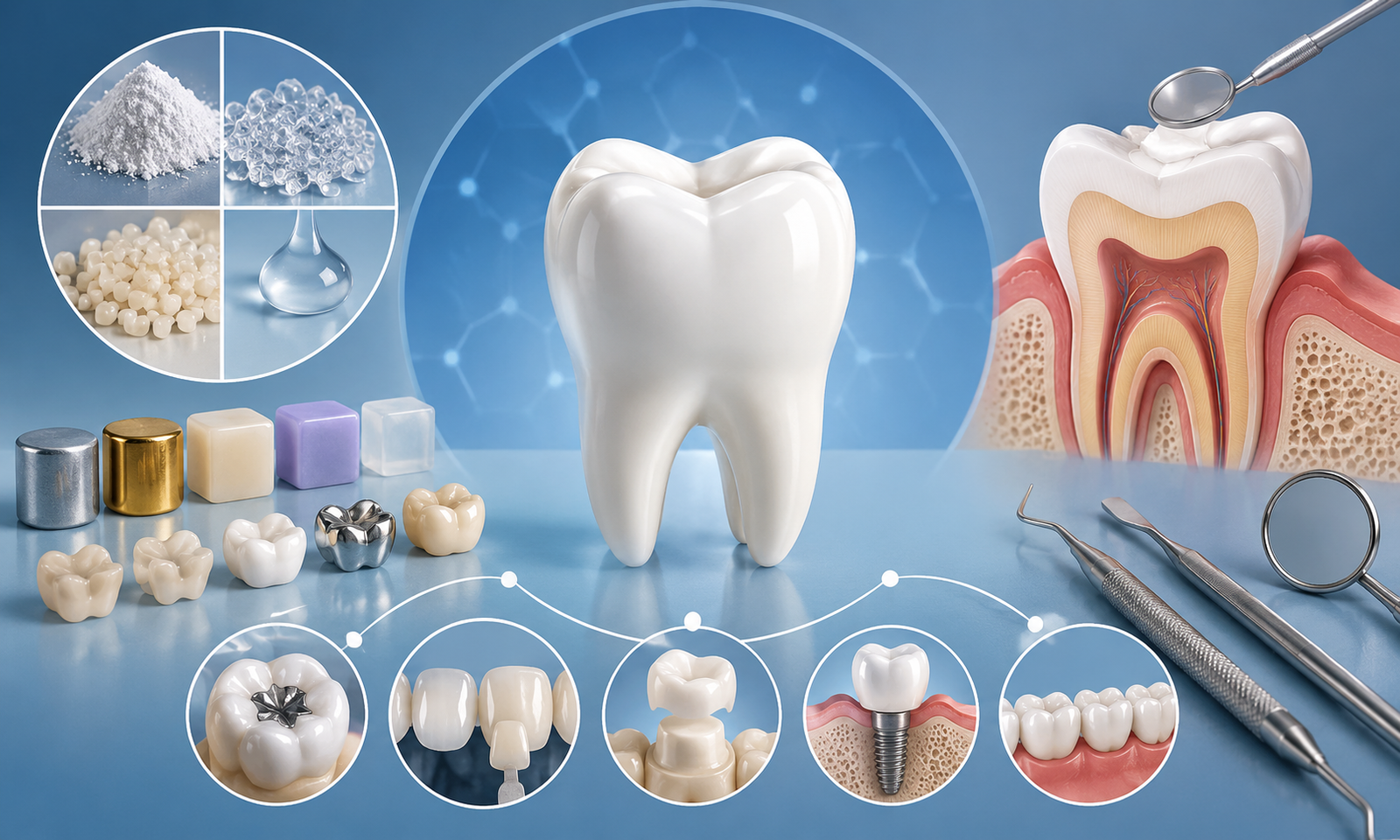
There are many dental materials, which can be classified into metals, ceramics, polymers and composites with their different advantages and restrictions. The metals, like gold alloys and amalgam, are extremely durable and strong but may not be a pretty looking color. It is known, however, that ceramics have better aesthetics and biocompatibility, but might be brittle at high stress. Acrylics are used extensively in dentures and temporary restorations because they are very versatile, handle easily and bond quickly. Composite materials consist of an organic component and an inorganic component to balance strength, esthetic qualities and adhesion of the material, and are widely used for direct restorations. Each one is used for different clinical indications, and the understanding of the differences between them will enable the clinician to use the most suitable material in each clinical case. This often comes down to the needs of the function, esthetics and individual patient characteristics of occlusion and oral hygiene.
Considerations for the selection of materials in clinical practice.
Despite the numerous clinical factors to consider, some are especially important when choosing a dental material, such as location of restoration in the mouth, occlusal load, esthetic requirements, and patient’s habits. For instance, posterior restorations will need a high compressive strength, whereas anterior restorations might need to be aesthetically pleasing and translucent. Another important consideration is moisture control when placing: Some materials are extremely susceptible to contamination. Moreover, material durability is related to the clinician’s skills and knowledge in selecting comparable materials to the biological and functional requirements of the tooth. Other factors that affect decision making include patient factors like bruxism and caries risk and ease of use and cost. In clinical practice, using a systematic approach to material selection, the possibility of restoring with materials that are not functional, not durable and not biologically compatible is reduced, thus minimising failure risk to enhance the overall treatment outcomes.
Restorative Dentistry – Applications
There are many applications of dental materials in the area of restorations including filling, crowns, bridges, veneers and implant-supported restorations. The aesthetic nature and high bond of composite resin is used as a material in direct restorations to restore caries and fracture showing teeth. Cerams are used and combined with metal, for the indirect restorations (crowns and bridges) to attain strength and durability. Acrylic resins are important in producing denture bases, and titanium is important in implant dentistry because of its excellent biocompatibility and osseointegration properties. The types of materials involved in each application have to be carefully chosen depending on the functional requirements and patient’s expectations. Time stability and the ability to integrate with the natural dentition are crucial for the success of these procedures and illustrate the significance of material science in day-to-day clinical practice.
Recent advances in Dental Material Science
The last decade has witnessed significant advances in the science of dental materials, their performance and reliability. New dental technology (nanotechnology) has improved the mechanical properties and wear resistance of composite materials, and bioactive materials are now used to induce remineralization and regeneration of tissue in the same composite materials. CAD/CAM technology has revolutionized the production of ceramic restorations to enable the fabrication of electronically designed and precisely fabricated prosthetics of improved fit and esthetic outcomes. In addition, improvements in the adhesive system has enhanced bond strength and minimized microleakage, which has more solidified restorations. Scientists are also investigating intelligent materials which alter their properties in response to the environment, for instance materials sensitive to pH; using a pH-sensitive material in the dye that changes its shape in acidic environments so that it releases fluoride. These developments also illustrate how the field of dental materials is constantly developing to deliver more durable, aesthetic, and biologically-active materials that lead to better patient success and streamline clinical workflow for clinicians.
Conclusion
Therefore, any dental clinician who strives to deliver top-quality, evidence-based care must possess a solid knowledge of dental materials. The clinical success of each of these are important in their physical and mechanical properties, chemical composition and behaviour in the oral cavity. Understanding dental materials science enables informed decision-making to optimize the longevity of restorations, aesthetics, and patient comfort. The realm of dental materials will continue to grow with even more advanced possibilities to take care of restorative issues. The fundamental principle does not vary – functional and biological needs of materials are matched for effective clinical practice. This knowledge will serve as a solid base for continuing clinical success and flexibility in a constantly evolving dental field for young professionals.


