Silver is one of the most dynamic and versatile precious metals on Earth. Unlike gold, which is primarily held as a store of value, silver plays a dual role: it is both a prized precious investment and an indispensable industrial commodity. Because of this unique identity, silver prices experience frequent, sometimes volatile shifts every single day.
Whether you are tracking the Silver Rate Today to buy physical bullion, comparing it against the Gold Rate Today for portfolio diversification, or exploring the precious metals market for strategic silver investment, understanding what drives these fluctuations is essential. By looking beyond short-term market noise, savvy investors can interpret market signals more accurately.
Quick Answer (Featured Snippet)
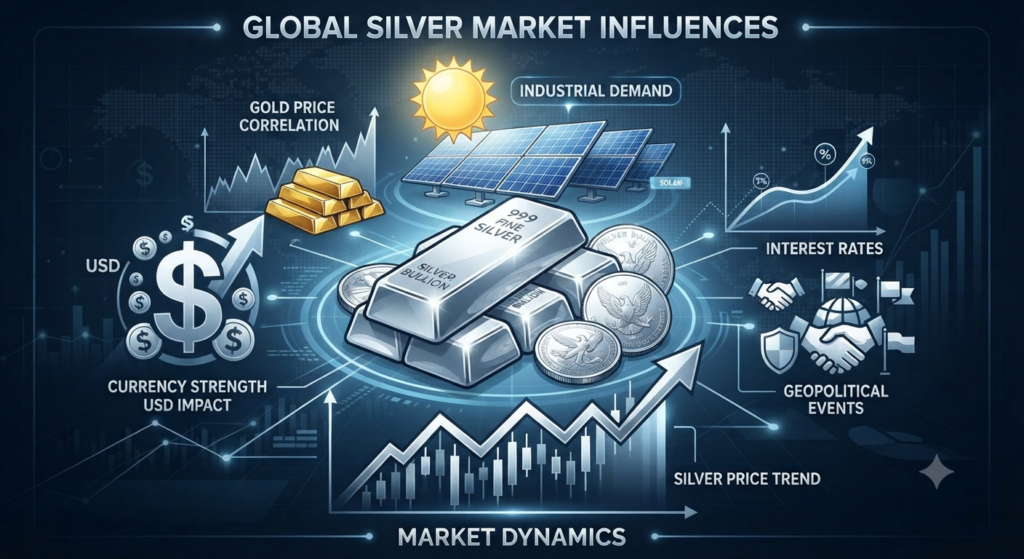
What are the top factors that affect silver prices? The biggest factors influencing silver prices include:
- Supply and mining production
- Industrial demand (especially solar and electronics)
- Gold prices and the gold-silver ratio
- US Dollar strength and exchange rates
- Inflation and purchasing power
- Interest rates and central bank policies
- Global economic conditions and recessions
- Investment demand (physical bullion, ETFs, and futures)
- Geopolitical events and trade tensions
Table of Contents
- Silver Supply and Mining Production
- Industrial Demand
- Gold Prices
- US Dollar Strength
- Inflation
- Interest Rates
- Global Economy
- Central Bank Policies
- Investment Demand
- Geopolitical Risks
- How to Track Silver Rate Today
- Should You Check Gold Rate Today Before Buying Silver?
- FAQs
- Conclusion
1. Silver Supply and Mining Production
How Silver Mining Impacts Prices
The fundamental law of supply and demand heavily dictates the precious metals market. When silver supply tightens, prices naturally face upward pressure. Conversely, a production surplus can weigh heavily on the spot silver price.
- Global Production: Unlike gold, the vast majority of silver (roughly 70% to 75%) is mined as a byproduct of extracting other base metals like copper, lead, and zinc. This means silver supply does not always respond directly to high silver prices; miners produce it based on the demand for industrial metals instead.
- Mining Disruptions: Labor strikes, environmental regulations, geopolitical conflicts, or unexpected operational shutdowns in major silver-producing nations (such as Mexico, Peru, and China) can instantly constrict supply and trigger price spikes.
- Recycling Supply: Scrap silver sourced from old electronics, photography, and silverware also feeds into the market. High prices often incentivize more recycling, helping to balance out shortages.
Key Takeaway: Because most silver is a byproduct, supply cannot easily scale up to meet sudden demand surges, making silver prices highly sensitive to mining bottlenecks.
2. Industrial Demand
Why Industries Need Silver
Silver boasts unmatched electrical and thermal conductivity, reflectivity, and antibacterial properties. This makes it a critical component in modern technology, leading to robust, inelastic industrial consumption.
- Solar Panels (Photovoltaics): The global transition toward green energy relies heavily on silver paste used in solar photovoltaic cells. Even as manufacturers attempt to economize, solar adoption remains a massive pillar of industrial demand.
- Electric Vehicles (EVs): EVs use significantly more silver than traditional internal combustion engine vehicles, spanning wiring, charging infrastructure, and power control systems.
- Electronics: Smartphones, computers, switches, and household appliances all consume millions of ounces of silver annually.
- Medical Equipment: Silver’s natural antimicrobial properties make it invaluable in wound dressings, surgical instruments, and medical device coatings.
- Artificial Intelligence Hardware: The booming data center and AI hardware infrastructure boom requires high-end electrical components, subtly boosting tech-driven silver consumption.
Expert Insight: Industrial demand operates independently of investor sentiment. Even during economic downturns, long-term technological transformations—like the green energy transition—keep a structural floor under silver consumption.
3. Gold Prices
Relationship Between Gold and Silver
Silver and gold share a deeply intertwined historical and market relationship. Investors frequently evaluate Why silver prices change by looking at what gold is doing.
- Gold-to-Silver Ratio: This metric tracks how many ounces of silver it takes to buy one ounce of gold. Historically, a high ratio suggests silver is undervalued relative to gold, while a low ratio indicates silver is outperforming.
- Safe-Haven Demand: When macroeconomic uncertainty strikes, investors rush to safe-haven assets. Gold typically moves first, and silver quickly follows in its wake, often posting sharper percentage gains due to its smaller market capitalization.
Mention: Always cross-reference the Gold Rate Today with the Silver Rate Today to spot valuation discrepancies in the precious metals market.
4. US Dollar Strength
Dollar vs Silver
Globally, commodities—including silver—are priced in US Dollars (USD). This creates an inverse relationship between the strength of the greenback and the price of silver.
- Why Silver is Priced in USD: Because international contracts settle in dollars, a strong US dollar makes silver more expensive for buyers holding foreign currencies (like Indian Rupees, Euros, or Yen), dampening international demand and driving prices down.
- Strong Dollar vs Weak Dollar: Conversely, when the US dollar weakens or faces inflationary pressures, foreign buyers find silver cheaper, and investors pivot toward precious metals to preserve purchasing power, sending the spot silver price upward.
5. Inflation
Why Investors Buy Silver During Inflation
Inflation erodes the real value of fiat currency. When the cost of living climbs and central banks print excess money, investors look for tangible assets that hold intrinsic value.
- Purchasing Power: Unlike paper money, which can be devalued by government decree, physical silver has a finite supply.
- Hedge Against Inflation: Historically, during periods of persistent or unexpected inflation, silver acts as a reliable wealth preserver. Investors look at silver investment as a shield against shrinking fiat purchasing power.
6. Interest Rates
Federal Reserve Decisions
Interest rates set by central banks—most notably the US Federal Reserve—exert powerful gravitational pull on non-yielding assets like silver and gold.
- Rate Hikes: When interest rates rise, government bonds and fixed-income investments offer attractive, guaranteed yields. Because silver does not pay interest or dividends, holding it carries an “opportunity cost.” Higher rates generally pressure silver prices downward.
- Rate Cuts: When central banks lower rates, yields on cash and bonds drop, making zero-yield precious metals much more attractive to institutional and retail investors alike.
7. Global Economic Conditions
Recession vs Economic Growth
Because silver straddles the line between a monetary metal and an industrial input, global economic health sends mixed signals to the market.
- Investor Sentiment: During recessions or banking crises, fear drives investors toward precious metals as safe havens.
- Manufacturing Demand: On the flip side, a global economic slowdown can crush industrial output. If factories slow down production, industrial demand drops, which can offset safe-haven buying. This dual identity makes silver notoriously volatile.
8. Central Bank Policies
Monetary Policy Impact
Central bank balance sheets and macroeconomic policies dictate overall market liquidity and currency valuation.
- Liquidity and Quantitative Easing: When central banks inject massive liquidity into the financial system through quantitative easing, fears of long-term currency devaluation mount. This environment is typically bullish for precious metals.
- Inflation Expectations: Shifts in central bank tone regarding monetary tightening or loosening instantly reflect in currency valuations, cascading directly into daily silver price predictions.
9. Investment Demand
Where Investors Buy Silver
Investment demand can cause rapid, short-term price rallies independent of industrial needs. Investors channel capital into various vehicles depending on their trading style:
- Silver ETFs: Exchange-Traded Funds allow retail and institutional investors to hold paper-backed silver without dealing with physical storage.
- Physical Silver: Coins, rounds, and bullion bars are favored by long-term wealth preservers.
- Futures & Derivatives: Traders use platforms like MCX Silver in India to speculate on short-term price movements and hedge risk.
Mention: Active traders tracking MCX Silver contracts must stay alert to domestic currency fluctuations and import duty adjustments in India.
10. Geopolitical Events
Global Uncertainty
Sudden shocks to the global order instantly redirect capital flows into safe-haven assets.
- Wars and Conflicts: Active military conflicts or regional instability create immediate supply chain anxiety and currency flight.
- Trade Tensions and Tariffs: Trade wars, import restrictions, or export bans on raw materials disrupt the flow of industrial metals, creating localized pricing anomalies.
How to Track Silver Rate Today
To make informed decisions, you need to know how silver is priced across different market tiers:
- Spot Price: The global benchmark price for immediate delivery of unallocated physical silver, quoted in troy ounces and USD.
- MCX Price: The futures price on India’s Multi Commodity Exchange (MCX Silver), which incorporates domestic currency exchange rates (USD/INR) and import duties.
- Local Jeweller Price: Physical retail prices quoted by local bullion dealers, which include fabrication charges, GST, and dealer margins.
- State-Wise Silver Prices: Taxes and logistics can cause minor regional variations in retail silver rates across different states in India.
Should You Check Gold Rate Today Before Buying Silver?
Evaluating the precious metals market requires looking at the broader picture rather than silver in isolation.
- Gold-Silver Ratio: A historically high ratio signals that silver is cheap relative to gold, often prompting value-driven investors to accumulate silver.
- Investment Comparison: While gold offers greater stability and central bank backing, silver offers higher volatility and potentially explosive percentage gains during economic recoveries.
- Portfolio Diversification: Combining both metals provides a balanced hedge against inflation, currency depreciation, and stock market corrections.
Pro-Tips for Silver Investors
- Monitor Silver Rate Today daily before investing to understand short-term trends.
- Compare movements with Gold Rate Today to calculate the prevailing gold-silver ratio.
- Watch inflation prints and central bank interest rate announcements closely.
- Track industrial demand trends, especially from the solar, EV, and electronics sectors.
- Avoid making investment decisions based solely on short-term price swings.
FAQs (AEO Optimized)
Why do silver prices change every day?
Silver prices change continuously because global spot markets trade 24 hours a day, reacting in real-time to shifts in currency values, industrial demand, supply updates, geopolitical news, and investor sentiment.
Does gold affect silver prices?
Yes. Gold and silver share a strong historical correlation. When gold prices rise due to safe-haven demand or inflation fears, silver typically follows, often experiencing magnified price swings because of its smaller market size.
What is the biggest factor affecting silver prices?
There is no single dominant factor; rather, it is a tug-of-war between industrial consumption (which consumes over half of annual supply) and macroeconomic investment demand (driven by US Dollar strength, interest rates, and inflation).
Is silver a good investment during inflation?
Yes, silver has historically served as an effective hedge against inflation because its physical supply cannot be artificially inflated like fiat currency, preserving purchasing power over the long term.
Why does the US dollar impact silver prices?
Because silver is globally priced in US dollars, a stronger dollar makes the metal more expensive for international buyers (reducing demand and lowering prices), while a weaker dollar makes it cheaper (boosting demand and raising prices).
Should I check Gold Rate Today before buying silver?
Checking the Gold Rate Today helps you calculate the gold-silver ratio, allowing you to determine whether silver is currently underpriced or overpriced relative to gold.
How can I track Silver Rate Today in India?
You can track Indian rates via financial portals, commodity exchanges like MCX Silver, or dedicated tracking pages like Silver Rate Today.
Will silver prices increase in the future?
While specific future price predictions depend on unpredictable variables, structural drivers like the clean energy transition (solar and EVs) and persistent global debt suggest strong long-term fundamentals for silver.
Conclusion
Navigating the precious metals market requires looking past daily noise to understand the foundational pillars that drive valuations. From heavy industrial consumption in solar panels and electronics to macroeconomic influences like US Dollar strength, inflation, and interest rates, silver’s dual personality makes it a fascinating asset.
Before making any investment decisions, make it a habit to monitor both Silver Rate Today and Gold Rate Today. By understanding these 10 core factors, you can move away from emotional, reactive trading and build a resilient, well-informed investment strategy.
This guest post was contributed by the Malik Times Desk. Malik Times is your trusted digital platform for real-time market updates, financial insights, commodity rates, and trending business stories across India and globally. Stay connected with our latest updates to navigate the financial markets with confidence.