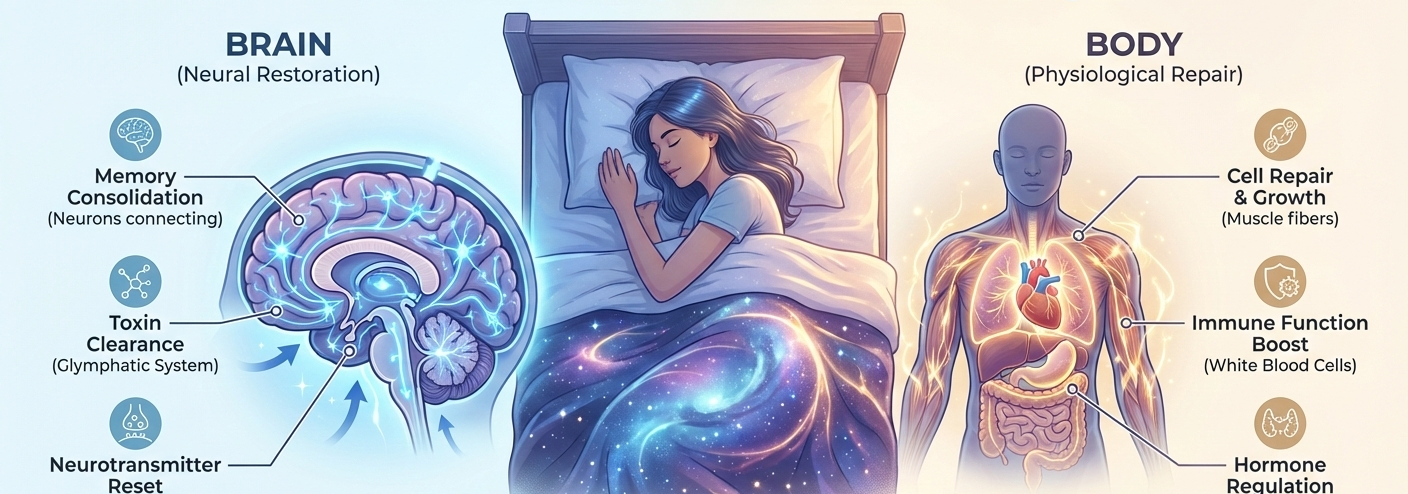
Sleep is commonly confused with sleep that is a passive state of the body where the body just goes dead. As a matter of fact, sleep is a dynamic and highly coordinated physiological process, which can help to provide physical repair, cognitive performance, immunity, and metabolic regulation. Contrary to being optional, sleep is not a bargaining point when it comes to human survival and the survival of the long term.
Neuroscience as we know it today has shown that sleep occurs in organized cycles that consist of the different sleep stages and each stage plays a unique role in the restoration. They are Non-Rapid eye Movement (NREM) sleep and Rapid Eye Movement (REM) sleep. They concertedly plan a process of nightly recovery, which affects almost all systems in the body.
This article will discuss the mechanisms of sleep physiology and neurology, how the brain and the body regenerate themselves through the night.
Sleep as a dynamic Biological Process
It is, during the state of being awake, that the brain is always processing information, responding to the environment, and controlling the other bodily systems. During a day, byproducts of metabolism build up, neural connections either become stronger or weaker, and tissues become worn and torn.
Sleep enables the body to enter into the restive state. The activity of the brain does not stop but changes. There are precise rhythms of hormonal levels. During the sleep, cells undergo repair mechanisms that can hardly be maintained during wakefulness.
Instead of being an indication of inactivity, sleep is a well-timed process of reorganizing neural processes and physiological repair.
Learning about the Sleep Cycle
Sleep is done in a 90 minutes cycle. Every cycle has REM and NREM levels. These cycles occur many times every night with the percentage of each stage varying with the night.
- NREM Sleep
The NREM sleeping is further subdivided into three phases:
- Stage 1: Light transitional sleep.
- Stage 2: Stable light sleep
- Stage 3: Deep slow-wave sleep
- REM Sleep
REM sleep is a type of sleep that is characterized by rapid eye movements, intense dreaming, and the brain is more active as it is during the period.
All the phases have different functions in preserving the general health.
NREM Sleep: Sleep Physical Restoration and Repair
Stage 1: Transition to Sleep
At Stage 1, there is the transition of vigilance into sleep. Brain waves become slow, there is less movement of the muscles and consciousness of the environment also decreases. The stage does not take very many minutes.
Despite being short, Stage 1 enables the nervous system to stop being responsive to external factors and get ready for more profound restorative functions.
Stage 2: Neural Adhesion and Coordination
Stage 2 is a further relaxation state. The pulse rate decreases, body temperature goes down and the brain activity becomes more coordinated.
The brain also forms sleep spindles which are small waves of brain activity that are believed to be involved in processing and structuring memories and the organization of the neural system.
Stage 2 occupies a considerable amount of total sleep time and promotes underlining rest.
Stage 3: Deep Slow-Wave Sleep
The most restorative period is the slow-wave sleep or stage 3. The brain waves are slow and monotonous. It is hard to wake up at this stage.
This stage supports:
- Muscle repair and tissue repair.
- Release of growth hormone
- The strengthening of the immune system.
- Cellular regeneration
Growth hormone is secreted most when a person is in deep sleep and it helps in the synthesis of proteins as well as the reconstruction of tissues. The immune system also becomes hyperplastic resulting into the generation of cytokines which are beneficial in protecting against infection.
Slow wave sleep plays a vital role in the preservation of physical well being.
REM Sleep: Cognitive Re-energization and Emotional Processing
REM sleep usually starts approximately 90 minutes after one sleeps. At this stage, the activity of the brain is enhanced and vivid dreaming takes place. Though the muscles are paralyzed momentarily to avoid movement the brain is rather active.
REM sleep contributes to:
- Memory consolidation
- Emotional processing
- Neural integration
- Learning enhancement
Memory Consolidation
Information received throughout the day is processed and encoded by the brain.
Neuronal links which are related to significant experiences are reinforced and redundant connections are cut.
This re-arrangement enhances learning and retaining information.
Emotional Processing
REM sleep is involved in mood and emotional stability regulation. The brain diminishes the intensity of stressful memories with reprocessing of emotional experiences under a safe neurological setting.
Lack of REM sleep can also be one of the causes of irritability and lack of emotional strength.
Cellular Maintenance and Tissue Repair
During the course of the NREM sleep, most notably the slow-wave sleep, the body focuses on physical repair. Protein synthesis helps in repairing damaged tissues. After straining every day, muscle fibers are regenerated.
The cells are also involved in the detoxification processes. Sleep leads to an increased glymphatic activity of the brain, which removes the formation of metabolic waste products which build up when people are awake.
This process of cleansing could potentially promote the long-term neurological well-being.
Strengthening of the immune system
Sleep improves immune functioning in a variety of ways. The cytokines which are generated by sleep facilitate the regulation of inflammation and immune responses coordination.
The lack of sleep over time may impair the immune system, making an individual prone to infection. Regular and good sleep enhances the body to react to pathogens.
Signaling Hormones in Bed
Sleep controls the important hormones that control growth, hunger, stress and metabolism.
Growth Hormone
The growth hormone is released mainly when a person is in deep slumber and helps in repairing of tissues and building body muscles.
Cortisol
The level of cortisol drops when one is asleep and increases towards the morning. The correct sleep regulates the stress.
Leptin and Ghrelin
These are hormones that control hunger and satiety. Lack of sleep affect their balance and may elevate their appetite and change their metabolic control.
It is important to keep the hormones and metabolism at a healthy level through maintaining sleep cycles.
Metabolic Homeostasis and Energy Homeostasis
Sleep has effects on glucose metabolism and insulin sensitivity. Deep sleep will help with healthy regulation of blood sugar.
The sustained limitation of sleep has been associated with metabolic imbalances such as low insulin sensitivity.
Sleep adequately helps to use the energy and the whole metabolic condition.
Neural reorganization and Brain Plasticity
Sleep is associated with neural plasticity which is the capacity of the brain to respond and restructure. REM sleep improves neural circuits that are used in learning.
This process reinforces significant pathways and gets rid of unnecessary ties. The outcome is increased thinking capacity.
The Implications of Sleep disturbance
The lack or poor sleep phases disturb the NREM and REM cycles. Less slow-wave sleep suppresses physical renewal.
Poor REM sleep affects memory and control of emotions.
Prolonged disturbance of sleep can have an impact on immune system, hormone levels, and metabolic equilibrium.
Knowing the biological need to sleep, it is important to emphasize the need to take sleep seriously.
The Biological Necessity of Sleep
Sleep is not just the rest period between the waking periods. It is a very well-structured biological process, which is vital to survival.
The interaction between NREM and REM stages guarantees the fully complete restoration. The organized sleep cycles are necessary in physical repair, defense of the immune system, hormonal regulation, consolidation of memories as well as metabolic balance.
The position of sleep as a choice negates its deep importance in health. Sleep is a priority that helps in resiliency in all body systems.
Applied Implications of Healthy Sleep
In order to achieve optimal restorative sleep:
- Sleep on regular basis.
- Avoid too much exposure to bright lights before going to sleep.
- Specialize in calming down sleep.
- Do a lot of physical exercise.
The practices help in natural sleep cycles and in maintaining balance in passing through the various stages of sleep.
Conclusion
The science of sleep has shown that it is a complex dynamic process that is restoring the brain and the body every night. Sleep enables the repair of tissues, strengthening of the immune system, memory formation, hormonal balance and metabolic homeostasis through systematic waves of NREM and REM sleep.
Sleep is one of the strongest recovery processes in the body as opposed to being a passive state. Learning of its biological value motivates regular prioritization of rest as a basis of long-term well-being and mental functioning.