The act of breathing is among the most basic physiological activities in the human body that most people do not give much consideration to how they breathe. This is automatic by the coordination of the respiratory muscles, lung tissues, and the neural control systems. Nevertheless, the effectiveness of this process may be different according to breathing patterns and technique. Diaphragmatic breathing is one of the breathing patterns that has been gaining more and more attention in the clinical and wellness field.
Abdominal breathing also known as the diaphragmatic breathing entails the active involvement of the diaphragm in the process of drawing air deep into the lungs. This is the opposite of shallow chest breathing that uses accessor muscles of the upper chest and shoulders as the main ones. Knowing the biomechanic of diaphragmatic breathing, one can see why it is so frequently regarded as a more effective and more physiologically advantageous method of breathing.
It has been indicated that diaphragmatic breathing may enhance lung volume, increase exchange of oxygen and the parasympathetic nervous system. These effects are beneficial not only to the respiratory system but physiological balance in general. With the knowledge of how this breathing method operates and how it may be applied, people will be able to breathe more effectively and even promote healthier results.
Learning the Respiratory System and Breathing Mechanics
The respiratory system is tasked with the role of supplying the body with oxygen and get rid of carbon dioxide that the cell machinery generates. The air gets in via the nose or mouth and passes across the trachea which then splits into the bronchi and bronchioles in the lungs. The terminal end of these airways is the alveoli or small air sacs where the lungs and blood exchange gases.
The breathing process needs to involve the co-ordinated contraction of respiratory muscles especially the diaphragm and intercostal muscles that are between the ribs. The contraction and relaxation of these muscles in a rhythmic manner alters the pressure of the thoracic cavity. With these changes in pressure, air is able to move both in and out of the lungs.
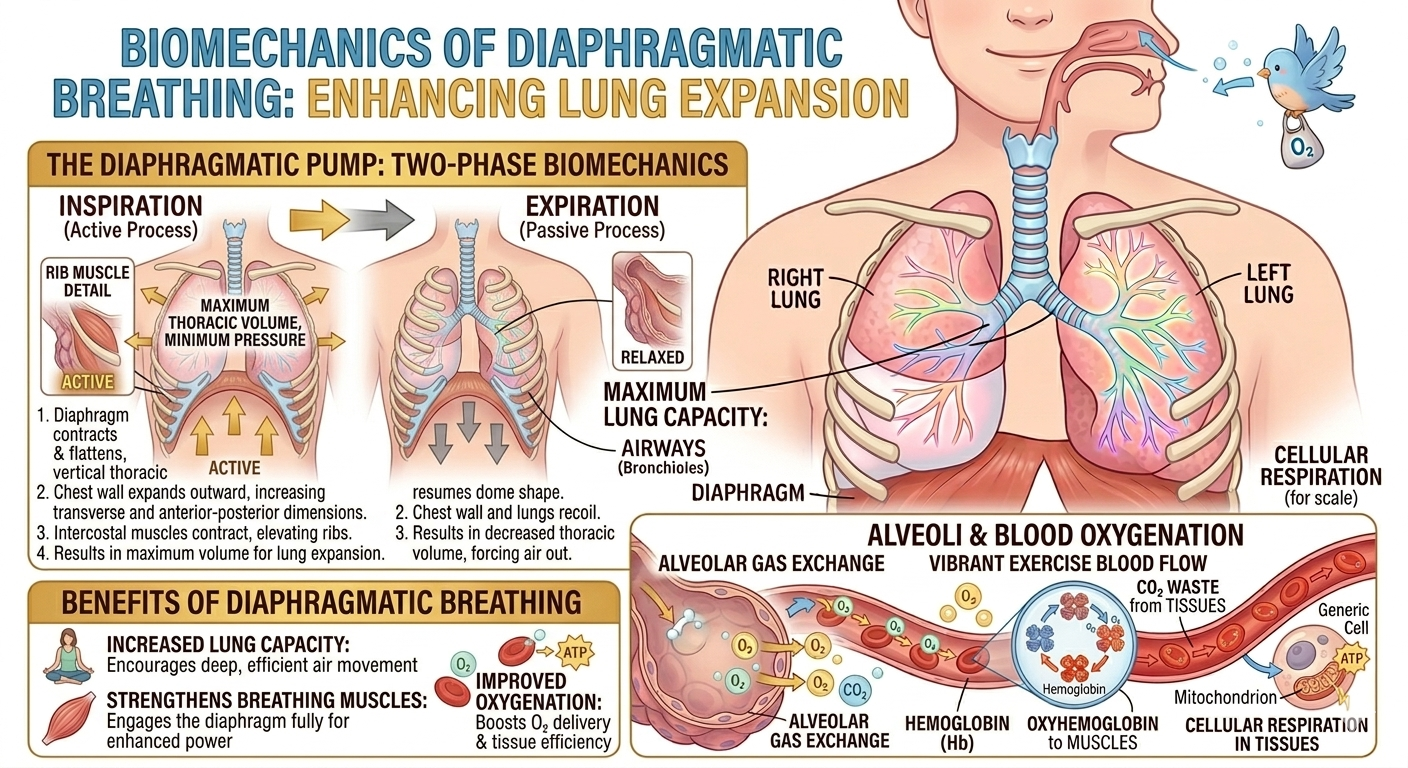
Diaphragmatic breathing revolves around a diaphragm which is a muscle in the form of a dome below the lungs. The diaphragm shrinks and shifts downwards in the process of inhalation enlarged the size of the chest cavity. This growth produces a negative pressure sucking the air in the lungs. The movement of the diaphragm when the lungs are exhaled causes it to move upwards and expel the air.
The process is very effective when there is the diaphragm that does much of the breathing. Nevertheless, the breathing habits of most people are more dependent on the upper chest and the accessory muscles. The distinction between the two breathing styles can be used to explain why diaphragmatic breathing can enhance respiratory efficiency.
What Is Diaphragmatic Breathing?
Diaphragmatic breathing is a breathing method in which the down zone movement of the diaphragm during inhalation is stressed. The organs in the abdomen move a little lower and outward as the diaphragm contracts and the diaphragm moves downwards and outwards. The expansion of the abdomen accompanied by a comparatively stable chest is a result of this movement.
This manoeuvre enables the lungs to become wider especially in their lower parts where blood pool is usually the most copious. Since, in the alveoli, the exchange of gases takes place, the larger the lungs are expanded, the more the surface area, which is used in the exchange of gases.
Diaphragmatic breathing biomechanics hence favour better oxygen uptake and better carbon dioxide removal. Diaphragmatic breathing encourages slow, deep offers as compared to the quick shallow breaths that fill the upper part only part of the lungs hence the maximum capacity of the lungs.
During most relaxation, yoga style and respiratory therapies, the breathing occurs at the diaphragm to enhance more efficient breathing and eliminate physiological stress. It is also a common method of teaching the technique during pulmonary rehabilitation programs of patients with respiratory disorders.
The Differences between the Diaphragmatic Breathing and the Shallow Chest Breathing
Shallow breath denotes a typical type of breathing mainly in cases where people are subjected to stress, low back, or in inactive lifestyles. Here, it is the upper shoulders and chest muscles that are mainly involved in inhalation and not the diaphragm.
The lungs fail to expand fully when the people breathe in shallowly. Consequently, there is reduced supply of air to the lower parts of the lungs where there are a large number of alveoli. This may restrict the effectiveness of oxygen exchange and it can raise the effort used in breathing.
On the contrary, diaphragmatic breathing spreads the air more evenly in the lungs. The lungs are free to contract and expand, making the quantity of air inhaled to be more.
Biomechanics of diaphragmatic breathing thus allow a more effective breathing pattern. Since diaphragm is a big and strong muscle, it is capable of producing higher changes in pressure inside the thoracic cavity than smaller accessory muscles. This gives more efficient ventilation and deeper inhalation.
With time, the development of habitual chest breathing may lead to the tension of the neck and shoulders muscle and the diaphragmatic breathing promotes the natural and simple breathing system.
Better Expansion of Lung and Oxygen Exchange
Expanded lung capacity is one of the greatest advantages of diaphragmatic breathing. The lungs can be lowered down to the abdominal cavity when the diaphragm contracts to its fullest extent. This movement swells up the volume of air that can be able to fill the lungs at each breath.
An increase in lung expansion implies that a larger number of alveoli are involved in gaseous exchange. Since the oxygen has to enter the bloodstream via the alveolar membranes, the more the alveoli that are functioning the more oxygen can be taken in.
Diaphragmatic breathing also has better biomechanics that aid the lower lung areas to be better ventilated. Such areas tend to have an increased flow of blood owing to the force of gravity and patterns of blood circulation to the lungs. Diaphragmatic breathing enhances the synchronization of ventilation and blood supply by directing the air to such regions.
This has enhanced the ventilation-perfusion balance whereby oxygen is taken more efficiently into bloodstream and carbon dioxide is eliminated more efficiently. Consequently, the respiratory efficiency and work of breathing can be improved with the help of diaphragmatic breathing.
To conduct further research on breathing methods and respiratory physiology, refer to the following source: biomechanics of diaphragmatic.
The Parasympathetic Nervous System is activated
Breathing pattern is not only a factor that has an impact on the lung but also on the autonomic nervous system that oversees most of the unconscious physiological functions. The autonomic nervous system is composed of two major subsystems namely the sympathetic and the parasympathetic nervous system.
The sympathetic system links with the fight or flight system that prepares the body to take action in stressful circumstances. The parasympathetic system, on the contrary, stimulates relaxation, digestion and recovery.
Parasympathetic activity can be triggered by slow and deep breathing exercises like the diaphragmatic breathing. Biomechanical properties of diaphragmatic breathing make the breathing rate slower and the exhalation prolonged which makes the body transition to a more relaxed physiological state.
When the parasympathetic system is activated, the heart rate can be lowered, blood pressure can be reduced, and stress hormone levels can be lowered. The above effects confer diaphragmatic breathing as an effective stress management, emotional well-being, and respiratory health tool.
Practical Strategies on how to Practice Diaphragmatic Breathing
The process of learning diaphragmatic breathing is to be conscious of the movement of the diaphragm as they occur during breathing in and out. The technique is not in the first instance familiar to many people, since they are used to breathing in the chest.
The easiest method would be to lie back with one hand over the chest, and the other over the abdomen. When inhaling, the aim would be to make the abdomen to elevate whereas the chest is mostly immobile. Such movement means that the diaphragm is pulling air into the lungs.
The physiology of breathing is supported by diaphragmatic breathing with slow and slow breathing. Slowly breathing in by the nose and out by the mouth stimulates deeper breathing and further movement of the diaphragm.
With time, by practicing this method on a regular basis, breathing patterns can be re-trained to make the diaphragmatic breathing more natural. This practice is included in the relaxation program by many individuals, in meditation programs or warm-ups during exercises.
Diaphragmatic breathing into Everyday life
Though the diaphragmatic breathing usually happens deliberately when one is doing relaxation exercises, it can also be incorporated into normal routine. The diaphragm is more free to move in the abdominal cavity, and this is best achieved by maintaining good posture e.g.
Walking, yoga, and swimming are common physical exercises that tend to make one breathe in a deeper manner. Through these activities the strength of the diaphragmatic breathing is reinforced as they move.
Learning to breath in a new habit is important in consistency. Daily routine diaphragmatic breathing over a few minutes has the potential to build gradual awareness of the breathing workings and enhance the diaphragm.
“ practice that proves the biomechanics of the diaphragmatic breathing technique”
With time, the person will start to experience that breathing becomes more comfortable and effective, especially when there is exercise or under pressure.
“illustration of biomechanics of diaphragmatic breathing to enhance lung expansion”
The mentioned advances point to the fact that the knowledge and practice of the biomechanics of diaphragmatic breathing can be used to improve not only breathing but also overall body health.
Conclusion
Breathing is a very necessary process that helps to sustain all the processes in a human body, but the manner in which people breathe can largely determine the effectiveness of respiration and physiological comfort. Diaphragmatic breathing is a method that helps to optimize the natural abilities of the diaphragm in an attempt to promote fuller, more effective breathing.
Focusing on the biomechanics of the diaphragmatic breathing this technique facilitates better expansion of the lungs, more efficient oxygen uptake and increased activation of the parasympathetic nervous system. Such physiological advantages are not only related to lungs, but also to organ systems, such as cardiovascular functions, stress, and health.
Compared to shallow chest breathing, diaphragmatic breathing makes the air more evenly distributed across the lungs and makes the breathing process less demanding. This technique may be learnt and practiced to assist people in forming healthier breathing patterns and improving the natural potential of their bodies to maintain the level of oxygen and carbon dioxide in the air.
Finally, diaphragmatic breathing is an easy but effective technique of enhancing respiratory mechanics and physiological balance in the long term. Through the incorporation of this practice into the everyday activities, people will be able to reinforce their breathing habits and facilitate the increased efficiency in delivering oxygen across the body.