Introduction
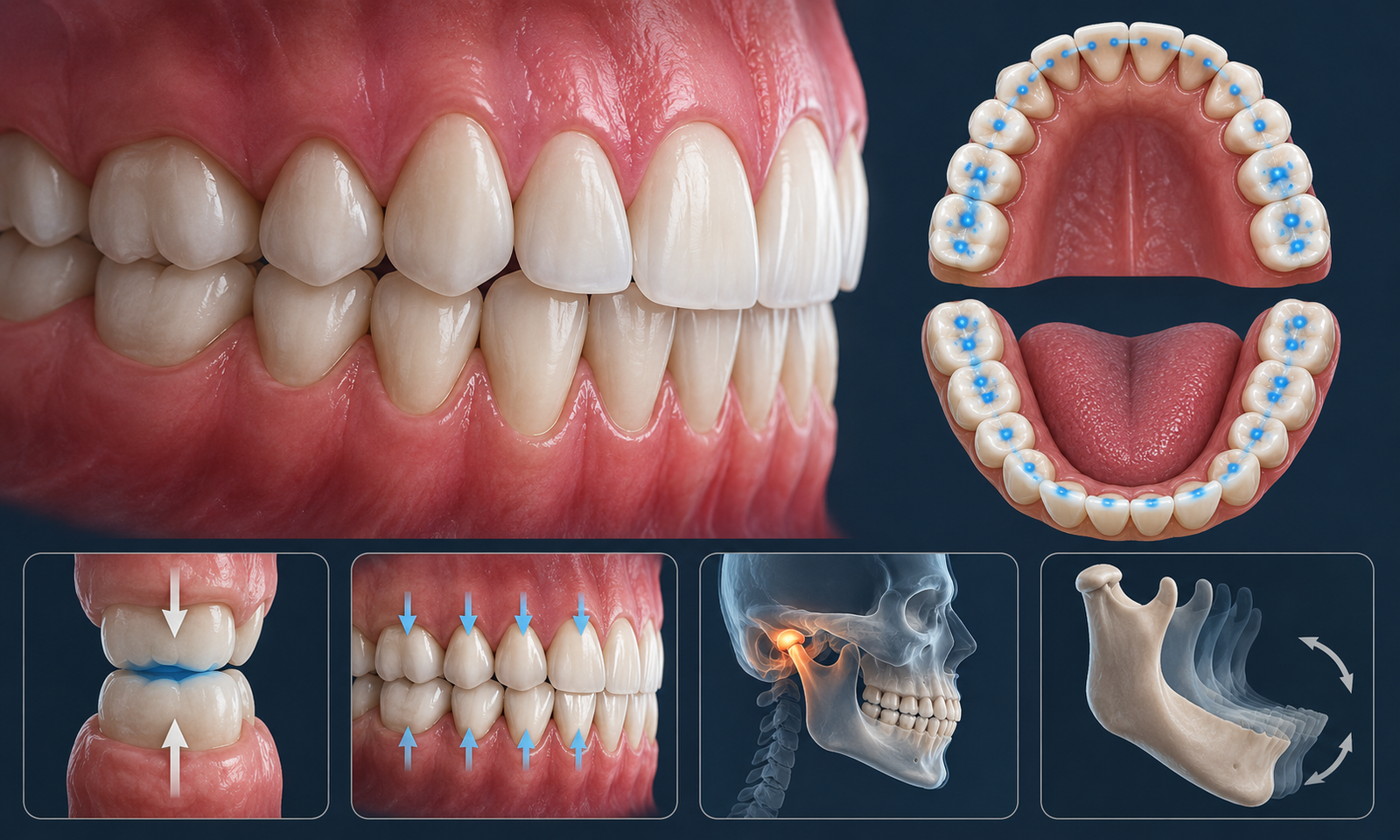
The human dentition is a very elegant and well coordinated mechanical system that can function as a chewing machine, a speech tool, a swaller, and a balance of the facial muscles. Each tooth, each cusp, each ridge and each contact point plays a role in balancing the relationship of the upper and lower arches of the mouth. This relationship is called the concept of occlusion, which is one of the basic principles in dentistry and describes the relationship of the teeth during functional and non-functional jaw movements.
Occlusion is not the same as teeth touching, it is much more. It is the coordinated action of the teeth, muscles, temporomandibular joints (TMJ) and other surrounding oral structures. Occlusion is balanced and the oral system works well and feels comfortable. If there are disturbances in the occlusion they can however lead to tooth wear, muscle pain, temporomandibular disorders, headaches and mastication difficulties.
Occlusion is highly important in modern dentistry, due to its direct contribution to the field of rehabilitative, prosthodontic and orthodontic treatments in the field of restorative dentistry. The concept of occlusion can be used to make detailed predictions of its effect on long-term treatment success, which is crucial when planning for restorations and treatment.
Recognize and explain the concept of occlusion.
Occlusion is the way the upper (maxillary) and lower teeth (mandibular) engage. It contains static relationships at the closed jaws and stationary position, and dynamic relationships, in movement when jaws are in motion like chewing or speaking.
Occlusal Analysis involves the analysis of forces over the teeth and supporting tissues. Proper occlusion also ensures that when eating, the forces are distributed evenly and do not place excessive force on any one tooth or joint.
There are several anatomic and functional factors that affect occlusion:
- Tooth morphology
- Jaw alignment
- Temporomandibular joint function
- Neuromuscular coordination
- Periodontal support
- Facial skeletal relationships
Stable and functional occlusion is created when these components act together in an efficient manner.
Types of Occlusion
Ideal Occlusion
This is what is called an ideal occlusion and occurs when the upper and lower teeth are frictionlessly aligned. In this arrangement:
- Superimposition of lateral margins of the upper and lower teeth in an overlapping manner.
- Midlines align correctly
- Opposing fossae harmoniously develop cusps.
- Forces are evenly distributed
Ideal occlusion occurs only rarely in nature but it is a useful guide in clinical dentistry.
The characteristics of an ideal occlusion that extend beyond the single perfect smile are explored.
- Stable tooth contacts
- Proper intercuspation
- Limited stress to TMJs
- Efficient chewing function
- Balanced muscle activity
Orthodontists and/or restoratively inclined dentists frequently will set ideal occlusion as a treatment objective for their work.
Normal Occlusion
Occlusal relationship that works well when there is some minor irregularity is known as normal occlusion. There are many people with minor rotations of the teeth who don’t have issues.
Keeping everything aligned correctly a patient may not have straight perfect occlusion and still have:
- Comfortable jaw movement
- Efficient mastication
- Absence of pain
- Healthy periodontal tissues
This is significant as the goal of treatment should be function and health—not perfection.
Malocclusion
Malocclusions are incorrect relationships or contact of teeth. It can happen for various reasons, including genetics, development, environmental or behavioral influences.
The most common causes of malocclusion are as follows:
- Hereditary jaw discrepancies
- Thumb sucking
- Premature tooth loss
- Crowding
- Trauma
- Improper dental restorations
Classification of Malocclusion
Edward Angle, D.D.S., M.D., invented a system for classification which is widely accepted today.
Class I Malocclusion
The molar relationship is not aligned and there is crowd or spacing or rotations.
Class II Malocclusion
Tops of upper jaw or teeth extend far over the bottom teeth.
Class III Malocclusion
The lower jaw sticks out from the upper jaw, which can cause an under bite.
There are many possible consequences to each classification, including speech, chewing, appearance, and oral health.
The under or over-buxies of teeth.
Static Occlusion
Static occlusion is a tooth contact when the jaws are closed and not moving. Centric occlusion, or the maximum intercuspation position, is one of the salient features of the static occlusion.
In this position:
- When teeth make their best contact.
- Occlusal forces are levelled out.
- Mouth is still
Static occlusion is examined by dentists when restoring teeth to provide balanced contacts.
Dynamic Occlusion
Dynamic occlusion is a combination of the interaction of teeth and movements of the jaw, which occurs when the jaw moves as the teeth move and interact with each other during function such as:
- Chewing
- Speaking
- Swallowing
- Lateral movements
- Protrusive movements
Dynamic occlusion is very important since the teeth don’t sit still during the day.
Types of Dynamic Movements
Protrusive Movement
The mandible slides forwards. This movement ideally takes place guided by the anterior teeth and disconclusive by the posterior teeth so as to lessen the negative forces being applied.
Lateral Movement
Jaws slide up and down. Canine guidance or group function are important elements of effective occlusal forces distribution.
Retrusive Movement
The mandible rocks slightly backwards from the resting position. Bespoke dynamic occlusion allows for posterior teeth and TMJ to not be under excessive stress.
Mouth functions in chewing food.Function of chewing of food in mouth.
Incisors
The incisor teeth have special functions for cutting and shearing food. Their incisor edges are sharp, so that they can bite through food into small chunks.
Canines
Tearers and guides of lateral jaw movement are canines. They have long roots so as to give good lateral protection.
Premolars
Premolars help to crush and masticate food. Their transitional anatomy is a combination of the tearing and grinding.
Molars
Mastication (chewing) uses the majority of the molars. They have wide, flat chewing surfaces, each with many cusps, to efficiently break food apart.
These groups of teeth work together for effective chewing, but without overworking the mouth.
Causes of occlusion and TMJ function.
The temporomandibular joints link the mandible to the skull, and are critical to jaw motion. Occlusion and TMJ function are intricately related. Extenuating forces can occur if the occlusion is not stable, into the joint and its surrounding muscle groups. This can help lead to temporomandibular conditions (TMDs).
The signs of TMJ Dysfunction include the following:
- Jaw pain
- Clicking sounds
- Limited mouth opening
- Headaches
- Muscle tenderness
- Ear discomfort
Unbalanced occlusal relationships may aggravate symptoms of TMDs in susceptible individuals, although it is important to note that occlusion is not always the cause of TMDs.
The following auxiliary armamentarium is used
Occlusal Interference is an abnormal contacting that interferes with the smooth jaw movement.
Types of Interferences
Protrusive Interference
Back teeth get in the way when the mandible moves forward.
Working Interference
Indesirable contacts happen on the side that the jaw is moving towards.
Non-Working Interference
Contacts take place on the opposite side of the mandibular movement, and can be harmful as they lead to stress.
Occlusal Interferences can have a variety of consequences:
Untreated occlusal interference can can cause:
- Tooth wear
- Fractured restorations
- Muscle fatigue
- Bruxism
- Tooth mobility
- TMJ discomfort
Occlusal adjustments are common in dentistry to fix any problematic contacts and bring in harmony.
Occlusion in Restorative Dentistry.
Restorative procedures should maintain or restore Occlusal Relationships. Small inaccuracies in restorations can have an effect on occlusion balance.
Dental Fillings and Crowns
High restorations can create early contacts that can change the occlusion. Patients may feel uncomfortable or painful while chewing.
As long as all the parts are shifted in an appropriate way during occlusion, it ensures:
- Even force distribution
- Comfortable function
- Protection of adopting tissues.
Fixed Prosthodontics
Changes to occlusion will never make the teeth look the same with crowns and bridges as they did without. A prosthesis that was not designed correctly could place undue forces on the teeth, or create interference.
Restorative dentists evaluate:
- Cuspal anatomy
- Contact points
- Excursive movements
- Vertical dimension
All of these are essential to success over the long-term.
Complete Dentures
Balanced Occlusion may be of great importance in the wear of complete dentures because of the absence of the periodontal ligament function.
Balanced occlusion helps:
- Improve denture stability
- Prevent tipping
- Enhance chewing efficiency
- Reduce sore spots
Artificial teeth are carefully placed by dentists that ensure simultaneous bilateral contacts during movement.
Occlusion in Orthodontics
The goal of orthodontic treatment is for aesthetics and function.
The goals of Orthodontic Occlusion.
- Correct malalignment
- Improve bite relationships
- Enhance mastication
- Reduce abnormal wear
- Promote long-term stability
Before developing the treatment plans for cases, orthodontists evaluate the skeletal and dental relationships.
Functional Occlusion in Orthodontics
Functional success does not depend just on the straight teeth! Orthodontic treatment should also determine:
- Stable intercuspation
- Proper anterior guidance
- Balanced muscle activity
- Harmonious jaw movements
The risk of relapse is reduced and joint discomfort is minimised due to functional considerations.
The significance of balanced occlusion.
Balanced occlusion is optimum contact between teeth that is carried out without harming the structures of the mouth.
The advantages of B.O.
Efficient Mastication
Client side cusp-client regions are extra effective at digestion and chewing when they are optimized for their cusp contacts with fossa.
Reduced Tooth Wear
The balanced distribution of forces minimizes abnormal wear and tear.
TMJ Protection
A stable occlusion will minimize joint and muscle strain.
Restoration Longevity
Balanced force restorations are more long-lasting.
Improved Patient Comfort
Although the patients are unstable, they generally have improved functional stability.
Occlusion and Bruxism
A bruxism is the involuntary grinding or clenching of teeth, frequently at night.
While bruxism may be multifactorial, occlusal discrepancy can exacerbate these effects of bruxism.
Effects of Bruxism
- Tooth wear
- Cracked teeth
- Muscle pain
- Headaches
- Restoration failure
Occlusal splints often help to support the teeth or decrease muscle fatigue.
Modern approaches to occlusal analysis
Improvements to the assessment of occlusion as a result of technological innovations have emerged.Technological developments have facilitated the assessment of occlusion.
Digital Occlusal Analysis
Measures that can be made by process of the computer:
- Bite force distribution
- Timing of tooth contacts
- Pressure intensity
These tools offer more accurate evaluations than using paper articulation masks alone.
Articulators
The dental articulators are used to show how the jaws can move when not in the mouth. They help the clinician to create a proper occlusion while planning restorations.
There are good articulators in:
- Prosthodontics
- Full-mouth rehabilitation
- Orthodontics
- Occlusal equilibration
Preventing Occlusal Problems
Maintaining functional occlusion is extremely important and preventive dental treatment helps with this.
Preventive Strategies
- Regular dental examinations
- Early orthodontic intervention
- The replacement of missing teeth.
- Properly adjusted restorations
- Treatment of abnormal habits: Interference of “rusty” habits during treatment.
Complications from occlusion can be prevented if it is detected early.
Conclusion
Occlusion is a key area of science for understanding the function of teeth, muscles and joints as a systems integration. Facial stability and speech and the stability of mouth structure depend on the interaction between the upper and lower teeth which affects the chewing efficiency as well. With a stable and balanced occlusion, the forces are distributed well and do not stress the teeth and supporting structures unduly.
The term occlusion is of paramount importance in all aspects of dentistry including orthodontics, prosthodontics, restorative and preventive care. Whether working on a malocclusion or creating crowns, making dentures or dealing with temporomandibular disorders, the structures of the dentition need to be considered dynamically as they relate to their interaction during function.
With the advent of new digital technologies and the benefits of using state-of-the-art diagnostic devices in dentistry, it is now returned to a high level of precision when analyzing and reaching a balance between the opposing forces of occlusion. However, just as important as being considered successful as far as appearance goes, is a successful dental treatment that is able to perform its functions in the entire stomatognathic system.