Introduction
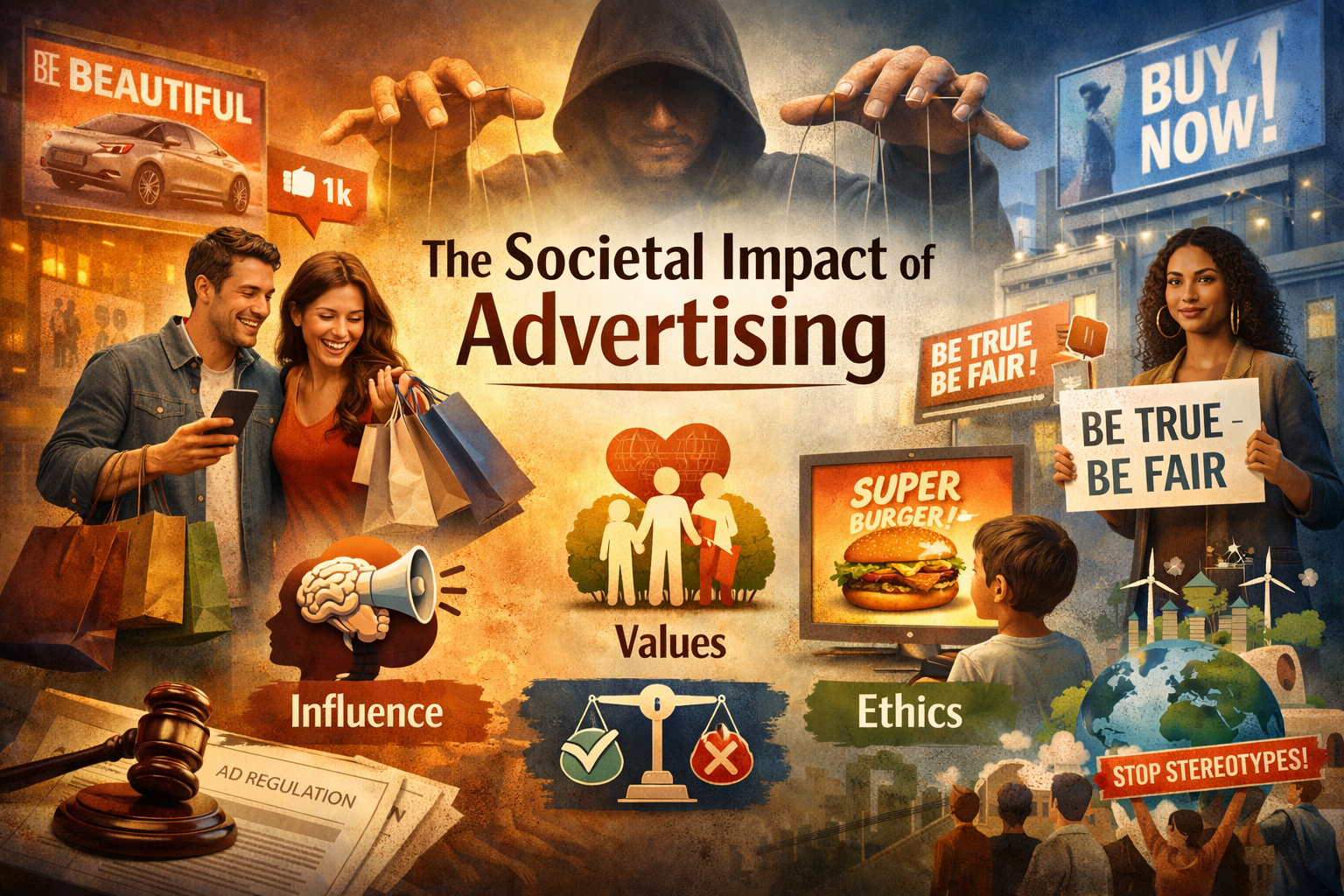
Advertising has become an inseparable element of modern society, which directs not only to the selection of consumers, but also to the formation of the culture, social values and daily lifestyle. Whether in the form of billboards and television commercials, social media efforts, and influencer marketing, advertising surrounds people implicitly and explicitly at all times. It has a tremendous extent of reach and shapes the way individuals live, think and relate with the surrounding world. However, issues surrounding the role of advertising in society is a two-sided problem that needs to be critically evaluated.
As much as advertising is an effective means of dissemination of information and economic development, it also imposes a moral issue of falsehood, stereotyping and manipulation.
This article will discuss the societal impact of advertising, the ethical aspects of advertisement and the ethical burden that comes with its influence.
Advertising as a Social Influence Mechanism
Shaping Consumer Behavior
Fundamentally, role of advertising is aimed at consumer behavior. It is used to introduce products and services, report their positive side, and convince audiences to make buying decisions. Advertisements, with repetition, emotional appeal and careful message placement, make a need, even with the products that are not always necessary.
Contemporary advertising is more than mere information to the consumer. It exploits the psychological motivators like fear, lust and ambition. As an example, luxury brands tend to identify their products with success and status that tempt consumers to identify ownership with individual success. This is a process that is slowly accumulating purchasing patterns and entrenching consumerism as a social norm.
Influence on Lifestyles
Advertising sells not only goods, but also lives. Fitness brands spread images of health and physical perfection, and the technology companies are focused on efficiency and connectivity. In the long run, such messages shape the way people understand success, happiness, and self-worth.
To give an example, in the advertisements often there can be a perfect image of life: perfect houses, perfect looks and perfect happiness. Although such images may motivate people, they may also develop false hopes, and disillusionment and comparison.
Cultural and Social Value Formation
Advertising as a Cultural Mirror
Advertising tends to mirror the societal values and beliefs. It embraces cultural values, language, and culture to appeal to certain audiences. In that regard, it can be seen as a reflection, reflecting the existing societal norms and tendencies.
Nevertheless, this contemplation is not necessarily neutral. Advertisers can choose which values to emphasize and which ones to forego thus supporting prevailing ideologies. As an example, the advertising in most of the areas focuses on material success, which, in turn, popularizes a notion that being wealthy makes one happy.
Reinforcing and Challenging Norms
Although advertising can support the status quo on social norms, it can equally undermine it. Gender equality campaigns, environmental sustainability and social justice campaigns have shown that advertising can play a role in the positive social transformation.
The brands that position themselves in relation to the social issue tend to draw the attention of the audience and favor. Nonetheless, these attempts have to be genuine. The extent to which companies apply social causes as mere marketing tools without internal interest may cause the consumers to question their authenticity and react negatively about the issue.
Positive Contributions of Advertising
Innovation and Economic Growth
The role of advertising in the society constributes in the growth of economy. It helps the business to get in touch with the potential customers and gain sales and grow the market. This, on the other hand, will provide job opportunities as well as promote innovation.
Advertising is especially helpful to small businesses that have an opportunity to be seen in the competitive market. Online marketing has also made advertising more democratic, and the small businesses can compete with the reputable brands based on their targeted advertisements.
Information and Awareness
The ability to inform is one of the most important advantages of advertising. It is through advertisements that consumers get to know about new products, services and technology improvements. Advertising methods are also employed in the public service announcements to facilitate health, safety and social welfare.
Indicatively, road safety, disease prevention and environmental conservation campaigns have created awareness and behavioral change. When this happens, advertising has greater use in the society than commercial gain.
Ethical Concerns in Advertising
Truthfulness and Misleading Claims
The question of truthfulness is among the major ethical concerns of advertising. In a few advertisements, the product advantages are over-stated, or some vital details are omitted which makes consumers make unfinished or distorted decisions.
False advertising is destructive to the consumer as well as to the confidence of the brands and the industry. Guidelines are usually established by the regulatory bodies to ensure accuracy, and the implementation may be different in different areas.
Stereotyping and Representation
Advertisement has always been accused of reinforcing gender, racial and socio-economic stereotypes. Women, in particular, have been stereotyped to have fewer roles and some ethnic groups have been underrepresented/misrepresented.
This kind of depiction can reinforce the negative stereotypes and restrict the development of society. Over the last few years, the need to have more inclusive advertising that is more representative of diverse identities and experiences has been on the rise.
Manipulation and Psychological Effect
Emotional Appeals and Vulnerability
Emotional appeals are common in the advertisements to reach the consumers. Although this will make messages more relatable, there is the question of manipulation. Emotions may be exploited to influence consumption through advertisements that target the vulnerable demographic a group such as children or people with financial problems.
Children especially are very impressionable and may not comprehend fully the intent of persuasion. This also predisposes them to advertising messages, which is a matter of ethical concern regarding the targeting of the young audience.
Creating Artificial Needs
The other issue is that of artificial needs creation. The advertising usually makes the consumers feel that they need products that they have never thought they needed. This may cause excessive use, economic burden and environmental impacts.
There may also be a cycle of dissatisfaction due to the constant bombardment of adverts where people feel a need to constantly update their goods to attain the perceived standards.
Advertising and Social responsibility
Corporate Accountability
Much power comes with much responsibility. The firms should be aware of the influence their advertisements have on the society and take action. Ethical advertising is characterized by integrity, openness and regard to the audience.
Organizations are now more and more accountable of the messaging they do. Customers have become knowledgeable and skeptical and in certain cases require genuineness and moral conduct on the part of a brand.
Regulation and Self-Government
Ethical advertising heavily depends on governments and regulatory authorities. Industry standards are upheld with the aid of policies with regard to truthfulness, data privacy, and consumer protection.
Besides regulation by an external body, most businesses have self-control mechanisms including codes of ethics and internal audit procedures. These activities are aimed at avoiding the impact of harmful or misleading information on the population.
The Digital Age and New Problems
Specialized Advertising and Data protection
New ethical issues have emerged as a consequence of the emergence of digital advertising. Advertisers are able to make very specific campaigns with access to large volumes of user data. Although this makes it more relevant, it also brings in the issue of privacy and data security.
The fact that consumers do not always know how their data are being collected and used begs the question of consent and transparency. The problem of personalization versus privacy is one of the major issues of the current advertisement.
Influencer Marketing and Authenticity
The use of influencer marketing has been a trend especially in social media. The influencers are the ones who frequently advertise products to their fans, making it difficult to distinguish between a personal suggestion and a paid advertisement.
Such promotions may create deceit in the audiences when lacking transparency. It is also necessary that sponsored content should be clearly disclosed to ensure ethical actions and trust.
Finding Balance between Influence and Responsibility
Advertising is a multidimensional concept in society. On the one hand, it will stimulate economic growth, educate consumers and may facilitate desirable social change. Conversely, it can be deceptive, manipulative and support negative stereotypes.
The balance can be attained through the cooperation of the advertisers, regulators, and consumers. With the help of ethical advertising, which is practiced, and informed audiences, it is possible to make the impact of advertising positive and not harmful.
Conclusion
Advertising is much more than a business instrument; the role of advertising influences the society on a very deep level. It also has the impact not only on the purchasing decisions, but also on the cultural values, social norms and individual identities.
Although the positive side of advertising is hard to deny, the ethical aspect should also be considered. Such problems like lying, stereotyping, and manipulation demonstrate that responsible practices in the industry are needed. With more and more developments in the field of advertising especially in the digital age, accountability and transparency are even more important.
After all, it is not the advertisers only who are to blame but also the whole society. Through promoting ethical values and critical thinking, one can use the role of advertising to influence the positive outcome and reduce its negative influence.