Introduction
Tangible vs intangible fixed assets are vital in accounting and financial reporting because they help to establish the value and operational capacity of a company in the long run. These assets are crucial to businesses as they enable them to not only make money, but also to create competitive advantage and long-term sustainability. It is important that stakeholders, such as investors, managers and regulators, understand how these assets are identified, measured and reported.
The non-current assets or fixed assets are those resources that give economic benefits more than a single accounting period. They are generally categorized into two; tangible and intangible. Whereas tangible assets are present in a physical form, intangible assets are not physically present but have an important economic value. This paper discusses the major variations between these asset classes, their recognition criteria, the ways they are valued and how they are presented in the financial statements.
Fixed Assets (tangible and intangible) Explained.
What are Tangible Fixed Assets?
Physical assets that are utilized by a company to make goods or services are known as tangible fixed assets. They are quantifiable in nature and can be observed and felt. Examples include:
- Machinery
- Buildings
- Land
- Vehicles
- Office equipment
These assets are needed in the day to day running of the business and in most cases, they constitute a large part of capital investment in a business. As an example, a manufacturing firm is very reliant on machinery and factory facilities to manufacture products.
What are Intangible Fixed Assets?
On the other hand, intangible fixed assets do not have physical forms and are assets that benefit a business in the long term. They are not always easily measurable or valued as are tangible assets. Examples include:
- Patents
- Trademarks
- Copyrights
- Software
- Goodwill
Though intangible assets cannot be touched physically, they play a very important role in the establishment of brand identity, technological advantage, and customer loyalty. An example is that a brand name with great reputation can greatly affect the consumer behavior and income.
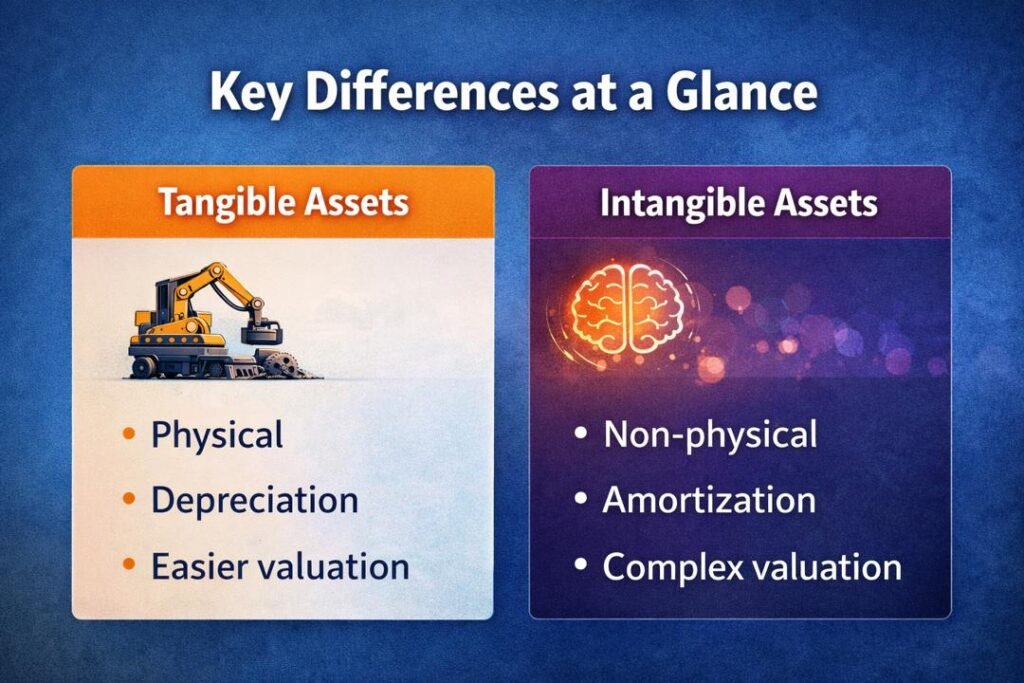
Major Differences between Tangible and Intangible Fixed Assets.
The knowledge of the distinctions between these asset classes is useful in making correct financial reports and decisions.
1. Physical Existence
- Tangible assets have a physical presence.
- Intangible assets do not have a physical form.
2. Valuation Complexity
- It is easier to value tangible assets since cost and depreciation of such assets can be quantified.
- If the asset is intangible, then the asset may need to be estimated or assumed, such as in the case of goodwill.
3. Depreciation vs. Amortization
- The tangible assets are depreciated against the useful life.
- Amortization of intangible assets, with the exception of those having indefinite useful life (e.g. goodwill) is done instead of impairment testing.
4. Risk and Uncertainty
- Tangible assets tend to be less uncertain of valuation.
- The uncertainty associated with intangible assets is more because of changes in the market and technology.
The recognition of Fixed Assets
Recognition is a process of reflecting an asset in financial statements. The tangible and intangible assets need to satisfy certain requirements in order to be recognized.
Recognition Criteria
An asset is recognized:
- Likely, economic gains will trickle down to the entity in the future.
- The price of the asset is measurable.
Tangible Assets Recognition
The purchase cost of tangible assets is recognized and it includes:
- Purchase price
- Import duties
- Installation costs
- Transportation costs
An example is when a company purchases machinery, all costs that are incurred to make the machine work are capitalized.
Intangible Assets are recognized
Intangible assets are considered in different ways based on the acquisition methods:
- Purchased intangible assets: Intangible assets are recorded at cost.
- Internal generated assets (such as research and development) are not recognized unless they satisfy some criteria.
The cost of research is normally expensed and the cost of development can be capitalized provided it satisfies recognition criteria.
Measuring Fixed Assets
Measurement is a process that involves coming up with monetary value to which assets are recorded and reported.
Initial Measurement
Assets (both tangible and intangible) are initially measured at cost.
Tangible Assets
The cost covers all expenses required in putting the asset to the proper use. For example:
- Equipment cost
- Delivery charges
- Installation fees
Intangible Assets
The cost includes:
- Purchase price
- Legal fees
- Registration costs
Subsequent Measurement
Once the first recognition is made, the assets can be measured with the help of various models.
1. Cost Model
In the cost model:
- Carrying amount of assets is the cost of the assets less accumulated depreciation and amortization and impairment losses.
This model is commonly used due to its simplicity.
2. Revaluation Model
At the revaluation model:
- Assets are not only fair valued but reduced by depreciation or amortization that has taken place afterward.
This model is more regularly used on concrete assets like buildings and land. Real assets which are intangible are not revalued easily unless there is an active market.
Depreciation and Amortization
Tangible Assets Depreciation
Depreciation is a method used to write off the cost of an asset that is in the form of a tangible asset. Common methods include:
- Straight-line method
- Reducing balance method
- Units of production method
The depreciation is an illustration of the usage, wear and tear of the asset.
Amortization of intangible assets
The amortization is the same case as depreciation with the exception that it is used on intangibles. It allocates the cost of the asset to its useful life.
Not all intangible assets are, however, amortized such as goodwill. Rather, they are tested on impairment yearly.
Impairment of Assets
Tangible and intangible assets can be affected negatively in terms of their value over time due to a number of factors.
Impairment of Tangible Assets
The impairment of an asset occurs when its carrying amount is in excess of its recoverable amount. Causes may include:
- Physical damage
- Technological obsolescence
- Market decline
Intangible Assets impairment
The intangible assets are highly susceptible to impairment by:
- Modifications in the market demand.
- Changes in the law or regulations.
- Technological advancements
Goodwill should be impaired on an annual basis, where there is no indication of impairment.
Reporting in Financial Statements
Balance Sheet Presentation
Assets including both tangible and intangible are noted in the balance sheet as non-current assets.
Tangible Assets
Reported under property, plant and equipment (PPE) including:
- Land
- Buildings
- Machinery
Intangible Assets
Reported individually and may involve:
- Patents
- Trademarks
- Goodwill
Income Statement Impact
- Depreciation and amortization are expenses that decrease net income.
- Impairment losses as well are considered as expenses.
Disclosure Requirements
Companies must disclose:
- Accounting policies used
- Useful lives of the assets.
- Depreciation and amortization practices.
- Impairment losses
In the case of intangible assets, other disclosures can be made:
- Nature of the asset.
- Remaining useful life
- Impairment testing assumptions
Tangible and Intangible Assets and their roles in Business
Tangible Assets in Operations
Production and service delivery are based on tangible assets. For example:
- The manufacturing companies are dependent on machinery and factories.
- Vehicles and warehouses are relied upon by logistics companies.
The assets are directly related to revenue generation.
Intangible Asset in Operations
The intangible assets bring some strategic benefits, including:
- Brand recognition
- Intellectual property protection
- Customer relationships
One such case is where a patented technology can make a company have a competitive advantage in the market.
Strategic Importance of Asset Classification
It is necessary to classify assets properly and in order to:
- Accurate financial reporting
- Investment analysis
- Tax planning
- Business valuation
The ratio of tangible and intangible assets is commonly used to evaluate the risks profile and growth prospects of a company by investors.
Difficulties in Accounting for Intangible Asset
The intangible assets pose certain challenges, such as:
- Valuation Difficulties: The determination of the value of intangible assets may be subjective.
- Recognition Issues: Intangible assets generated by the company might not necessarily qualify to be recognized.
- Rapid Obsolescence: Increase in the value of intangible assets can be very fast due to technological developments.
Conclusion
To conclude, tangible vs intangible fixed assets are the key elements of a financial structure and long-term success of a company. The tangible assets are the ones that provide the physical means of production and operations, whereas the intangible assets are those that enhance the innovation, brand value and the competitive advantage.
Appreciating their recognition, measuring and reporting provide proper financial statement and decision making. Although tangible assets are more easily quantifiable and manageable, in the knowledge-based economy of the present day, the intangible assets are usually the key to future growth and differentiation.
To be successful in the long term, businesses have to balance physical investment in infrastructure, and the development of intangible resources. Correct accounting of these assets does not only improve transparency but also boosts the stakeholder trust on financial reporting.
Get more well researched information about Tangible vs Intangible Fixed Assets here.