Introduction
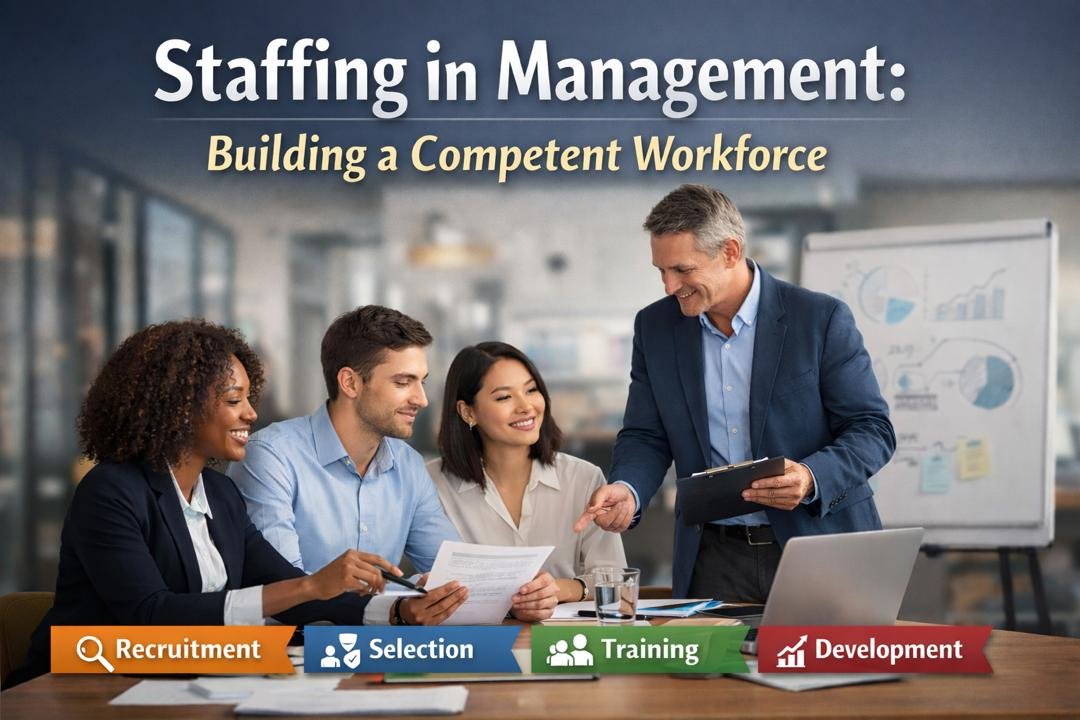
Human resources are the most important asset in any given organization, whether it is small, medium, or large-scale. People drive performance, innovation and organizational success though buildings, machines, capital, and technology may aid the effort. This is why staffing takes a central place among the management essential functions. Staffing entails determining the requirements of the organization in terms of human resources of the organization, recruitment, selection of the most appropriate personnel, training and constant refining of the skills of the personnel to achieve the present and future objectives of the organization. The best organizational plans and structures cannot work without proper staffing.
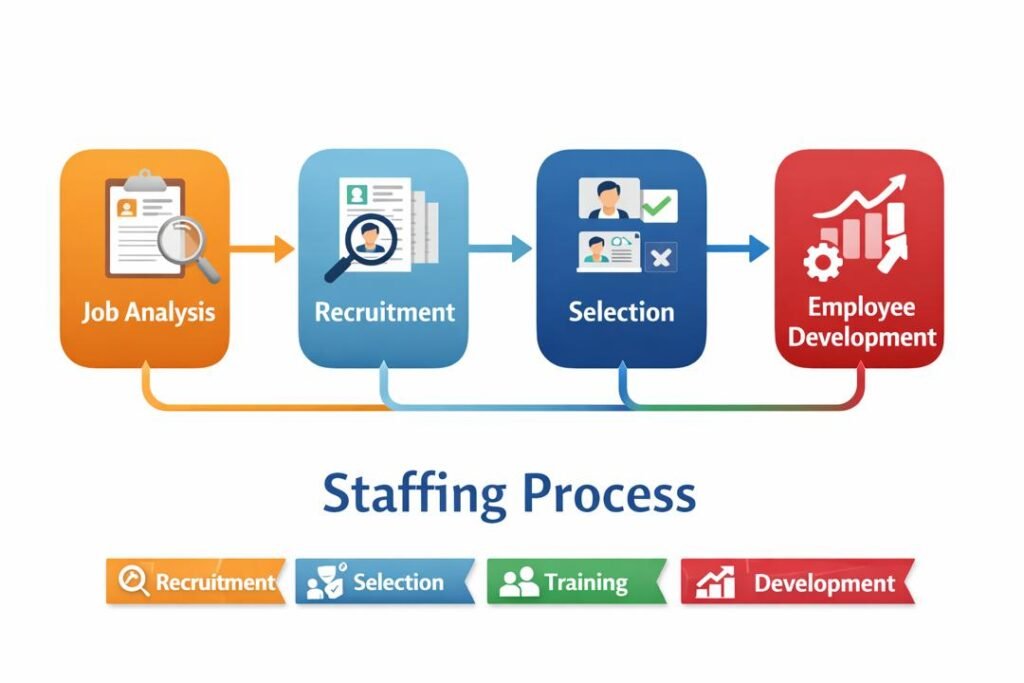
This paper will discuss staffing as a critical managerial practice that is important in ensuring that the right individuals select the right positions at the right time. It includes the key elements of staffing recruitment selection training and employee development and discusses how an effective staffing process boosts productivity, improves employee performance and contributes to long-term organizational growth.
Staffing as a Managerial Function
One of the five classical functions of management is staffing that are used along with others, which are planning, organizing, directing, and controlling. It focuses on controlling the human aspect in an organization. Staffing starts once objectives of the organization are established and structures are drawn because managers need to know how many employees, and of what type, they need in order to meet established objectives.
Staffing on its part is workforce planning, recruitment, selection, and placement, orientation, training, performance appraisal, promotion, compensation, and employee development. Staffing decisions involve managers at every level but the human resource departments often offer expertise and coordination. Effective staffing also makes sure that the employees have skills, knowledge, attitudes, and competencies that they need to carry out their work effectively.
In order to have a better insight into staffing as a crucial managerial task one should consider its purpose and role in the management of organizations.
Importance of Managerial Responsibility in Staffing
Staffing has been considered to be a critical management task since it directly affects organizational performance and sustainability. Managers do not just give out tasks but also make sure that qualified individuals meet their tasks. Inefficiency, low morale, high employee turnover and the inability to meet organizational goals are some of the possible outcomes of poor staffing decisions.
Among the reasons why staffing is important is the fact that it helps in aligning the human resources with the organizational strategy. Organizations need employees who now have new skills and competencies as the organizations grow, diversify, or embrace new technologies. Sound staffing offers the capabilities of the workforce to change according to the requirements of the organization. Also, the continuity is aided by staffing, which is preparing employees via training and development to occupy new leadership and technical positions in the future.
Moreover, the issue of staffing leads to employee satisfaction and motivation. When people are put in the position where they suit, they have more chances to work well and to stay loyal to the organization. Therefore, staffing is beneficial to the organization and the personal interest, which is why it is one of the foundations of successful management.
Recruitment: Finding the Right Talent
The recruitment is the initial operation stage of staffing. It entails conducting the identification and attraction of potential recruits who has the qualifications and competencies needed by particular job positions. Recruitment is aimed at developing a pool of the right candidates who the organization can choose the best candidates.
Recruitment may either be external or internal. Internal recruitment is the process in which vacancies created within the organization are filled either by means of the promotion, transfers or internal advertisements. The strategy encourages employees, helps to save money on recruitment and enables companies to save institutional knowledge. On the other hand, external recruitment refers to the process of obtaining candidates who are not in the organization via advertisements, employment agents, schools and colleges, as well as through the internet. Recruitment on an external basis provides new ideas, different views and skills.
Job analysis and job description are a must in effective recruitment. The managers should determine job requirements, job roles, and skills, and then find applicants. Lack of clarity in the roles usually causes hiring the wrong person, which causes low performance and job dissatisfaction. Hiring should, thus, be organized well and in accordance with the organizational goals so that only qualified candidates are drawn.
Selection: Selecting the Best Fit
Selection is a process that comes after recruitment and it entails the process of picking the most appropriate candidate among the applicants. Whereas recruitment is meant to bring a significant number of qualified people, selection is meant to bring the best person to fill that job and the organization. This step is very important since any decision made that is wrong can be expensive and disruptive.
The selection process is normally done through screening of the applications, interviews, aptitude tests, skill tests, background checks and medical check-ups (where applicable). All steps assist managers to assess the qualification, experience, abilities, and character traits of the candidates. A good selection will not just give one employees who are technically competent, but also fit within the culture and values of the organization.
Managers are also instrumental in the selection process as they determine and evaluate the suitability of the candidates to that particular position and how they will adjust to the organization. Equitable, impartial, and consistency is required when making the selection to prevent favoritism and discrimination. When the selection is done efficiently, the organizations enjoy better performance, low turnover, and increased commitment.
Training: Improving the Competency of Employees
Staffing includes training which is critical in enhancing knowledge, skills and abilities of the employees to undertake the current job well. The most qualified employees also need training to get acquainted with organizational processes, technologies, and standards.
The training programs can be performed at the time of employee orientation, promotions or when some new systems and methods are presented. On-the-job training, workshops, seminars, mentoring and e-learning programs are the common forms of training. Training is not always done to improve individual performance but also to achieve coherence and organization throughout the organization.
Good training results to more productivity, less errors and confidence in employees. It also shows the interest of the management in developing the employees that may enhance morale and motivation. Training needs to be continuous in fast changing business environments where the employees need to be updated and remain competitive.
Employee Development: Future Preparation
Whereas training is geared towards imparting the current job needs, employee development is directed towards long-term growth and career development. Employee development entails equipping persons to take up their future responsibilities through propping up their leadership, problem-solving and decision making skills.
Leadership training, job rotation, coaching, succession planning and professional education are some of the development activities. The employee development helps organizations to establish a pool of competent employees who can take up an elevated position within the organization as it grows or when there is a vacancy.
The development of the employees contributes to the long run organizational development as continuity and reliance on external recruitment is minimized. It also builds the loyalty of the employees, since they may be better inclined to stay within organizations that are willing to invest in the personal and professional development of such employees. Managers with employee development as the main focus bring about the culture of learning that promotes innovation and flexibility.
Staffing and Improvement of Productivity
Proper staffing has a direct impact on productivity in an organization. When the employees are fitted to their functions, developed properly and assisted by development programs, they will be more efficient in their work, more precise. Correct staffing helps to decrease role ambiguity, conflict, and enhance coordination among the team members.
Also, staffing facilitates optimal utilization of the human resource by avoiding overstaffing and understaffing. Overstaffing makes the operations expensive and understaffing causes work overload and burnout. Effective staffing done by managers will guarantee equal workloads and effective use of employee skills.
Productivity due to efficient staffing leads to competitiveness of the organization, profitability, and customer satisfaction. Staffing is therefore a strategic instrument to realization of operation efficiency and organizational excellence.
Employing and Long-term Company Development
The long-term organizational development is based on the possibility to attract, keep, and train qualified employees. Staffing is strategic in the development of a sustainable workforce, which will be able to adjust to the changing market conditions and technology. Workforce planning enables managers to look ahead and plan with regard to the future requirement of the human resource. The succession planning will fill the key roles in the organization at the right time when the positions become vacant. Training
and developing on a continuous basis helps the organizations to adapt to the changes in the environment without interfering with the operations of the organization.
In addition, good staffing promotes the organizational culture and values. Managers focus on hiring people that supports the mission of an organization by doing so, shared beliefs and behaviors that inform employee behavior have been enhanced. This fit improves organizational viability and sustainability.
Conclusion
Management staffing is not just an administrative task but is an important managerial task that has a direct impact on organizational performance and sustainability. Through proper management of recruitment, selection, training and employee development, the managers are able to ensure that the right individuals are assigned to the right positions at the right time. Staffing techniques can boost productivity, enhance employee satisfaction and facilitate organizational growth in the long term.
The current competitive and dynamic environment does not allow organizations to allow poor staffing decisions. The managers need to be strategic in his or her approach to staffing by ensuring that human resource is aligned with the objectives of the organization and that employees are continuously developed. Finally, where staffing is considered an essential managerial activity, organizations are in a better position to attain excellence, flexibility and long-term success.
Get more well researched information about Staffing in management here.