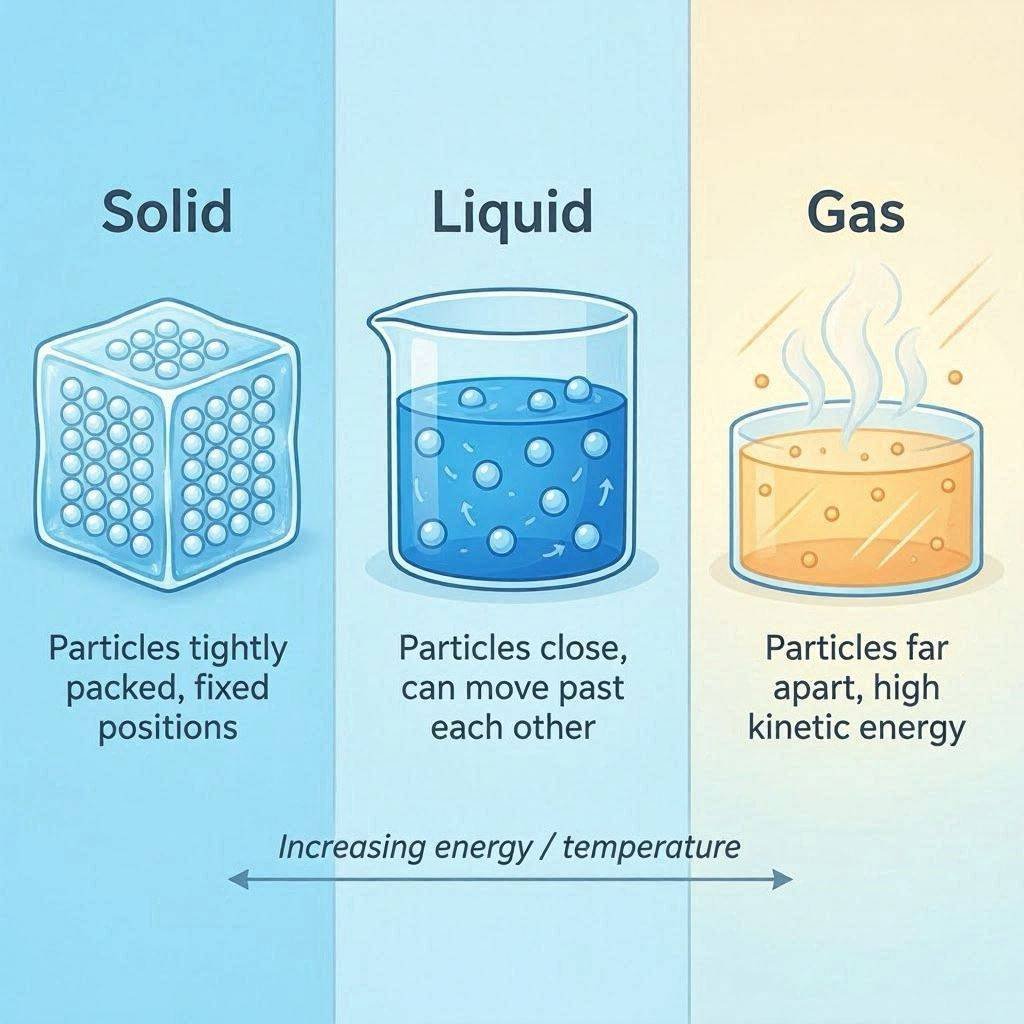
All things around us are matter. A chair you sit on, water you drink, air you breathe, your body – all of these are types of matter. Matter is defined by scientists as anything that takes up space and has mass. The study of the physical state of matter is one of the most important methods of understanding matter. Solid, liquid and gas are the three common states of matter. The differences in these states are due to the change in behaviour of the particles composing matter in different circumstances. The behavior of these particles in terms of their motion, interaction and response to temperature and pressure changes can be used to account for many common events. The states of matter affect many things in our everyday lives, such as ice cubes in a glass melting, or steam rising from a kettle.
The concept of the study of matter and its behavior is one of the fundamental concepts in physics and chemistry. Students are introduced to the fact that solids, liquids and gases are different; this helps them to develop some understanding of more complex science issues. States of matter describe the reason why some materials have a definite shape and others flow freely or disperse throughout a room. They also provide explanations for weather, industrial processes, cooking, and biological processes. The behavior of matter is easy to observe but of great value in understanding the way nature works.
Solid, Liquid, Gases: Basic physics and chemistry concepts.
Which Factor Affects the State of Matter?
The arrangement of particles and the amount of energy they have are important factors in determining their state of matter. All matter consists of tiny particles such as atoms and molecules. These particles are in constant motion but the speed and mobility of the particles is dependent on the state. The influence of temperature is significant because it affects the energy of the particles. Particles increase in energy if they gain energy, and they can change from one state to another. As the particles lose energy, their speed decreases and they can change to another state.
The physical properties of matter are also influenced by the arrangement of the particles. In other materials, the particles are close together and can only vibrate. In some, the particles move around each other, or may flow freely through a large space. These differences account for the fact that ice is hard, water flows easily and steam diffuses quickly into the atmosphere. The behavior of particles is a very simple yet very powerful way to help understand the properties of solids, liquids and gases.
Understanding Solids
Solid materials have a definite shape and volume. That is, a solid has a definite shape until its shape is altered by an outside force. Rocks, books, tables, pencils and ice cubes are all solids. Solids hold their shape because the particles are arranged in a definite way and are close together. The particles are constantly vibrating but cannot move freely between different positions. Particles are tightly packed and resistant to deformation due to their strong attraction to each other
Solids are generally hard to compress due to their compactness. When pressure is applied to a solid, there is very little empty space between the particles, so applying pressure does not greatly change the volume of the solid. The hardness, flexibility and strength of different solids vary, but all solids have the property of having a fixed shape. Ice is a good example of a solid every day. Although it is the same water molecules as in liquid water and steam, its particles are in a fixed formation that determines its physical properties.
Understanding Liquids
Liquids are an intermediate state between solids and gases. Like solids, liquids have a definite volume—the amount of space that they occupy is relatively constant. Solids, however, do not have a definite shape, like liquids. Instead, they take the shape of the container in which they are placed. Examples of liquids that we encounter in our daily lives are water in a glass, milk in a bottle, and cooking oil in a pan.
By studying the movement of particles, the behaviour of liquids can be explained. The particles in a liquid are not fixed but they still do not move far apart from each other. Rather, they can move about each other but stay bound together by attractive forces. This mobility enables liquids to move and adjust to the shape of the container. Liquids are not easily compressed as the particles do not move too far apart. Without the ability to flow, liquids are vital in natural systems, in transportation, in manufacturing and in biological systems.
Water is one of the most interesting substances to observe in a liquid state. It can be channeled between containers, move through pipes and rivers, and sustain life on the planet. Although it can be made flexible, the volume of water will not change unless water is added to it or subtracted from it. This fluidity along with the volume stability is what sets liquids apart from the other states of matter.
Understanding Gases
Gases are very different from solids and liquids in that they don’t have a fixed shape or volume. Gases, however, when allowed to expand, fill the space available. Examples of gases in everyday life are air, oxygen, carbon dioxide and water vapour. Gas particles are relatively far from each other and move randomly in all directions.
Many properties of gases can be understood due to their high energy and high freedom of the gas particles. Gases are easy to compress compared to solids and liquids, since their particles move quickly and are far apart. If gas is added to a container, the particles expand to fill the container. That’s how perfume is able to permeate a room and why air permeates a balloon.
An example of a gas is steam. If heated enough, the particles of water get enough energy to break free from the forces that hold them together. The resulting water vapor travels around freely in the air. This change in energy can lead to a change in the form of matter and new physical properties.
Students will learn about the processes of evaporation and condensation
Changes in matter involve changing the state of the matter, this is called a phase change. These changes are the result of the gain or loss of energy by particles. In general, heating causes the particles to move faster and cooling causes them to move slower. Many common phenomena happening in daily life are explained by the knowledge of the phase changes.
When a solid absorbs heat energy until it turns to a liquid, it is melting. A common example is when you have ice melt on a warm day. Freezing refers to the change of state from a liquid to a solid; that is, when heat is removed from a liquid to cause it to freeze. The particles of water in a freezer melt down and crystallize into ice. The transitions illustrate the effect of temperature on the behaviour of the particles and on their physical properties.
The transitions between liquids and gases are evaporation, and condensation. Evaporation is a process in which a liquid changes into a gas because the liquid particles have enough energy to escape from the liquid into the air. Open containers of water will slowly lose water over time. When the particles in the gas state lose energy and change to a liquid, it is called condensation. Water droplets are formed when water vapour condenses on a cold surface. They are important processes in weather, the water cycle, and many industrial uses.
The states of matter we see in our everyday lives
The states of matter do not have to take place in a science classroom. They impact on many activities and processes that we are exposed to daily. There are many examples of the states of matter and the particles, in them, changing when they are cooked. Drinks melt into ice, water boils in cooking, food steams. All of these events involve a change in the arrangement and energy of particles.
The study of matter is also extremely important to transportation and manufacturing. The fuel gases are used in engines, the liquid chemicals are used in industry and the solid materials are used in construction. The movement of gases in and out of the lungs is even a part of breathing. Being able to describe states of matter in normal circumstances will enable pupils to make links between science and the real world.
Weather is another great illustration. Ice in snow, liquid in rain, and gas in the air’s moisture. These cycles are driven by continuous water movement between these states, which affect climate patterns all over the world. Students develop an appreciation of the processes that affect their environment by understanding how matter changes and behaves.
Why States of Matter Matter in Science
The study of matter is the basis of many disciplines of science. States of matter are used in physics to describe how energy is transferred, how it compresses or expands, and how it moves. The behaviour of particles is fundamental to understanding reactions, bonding and properties of materials. In Biology, they study how solids, liquids and gases behave in living things. All natural processes involve matter and knowledge of the states of matter can be used as a basis for learning of more advanced scientific concepts.
The mastery of these principles equips students for understanding more advanced concepts like atomic structure, chemical reactions, thermodynamics, and environmental science. The particle model is also a model that can be used to encourage logical thinking and observation in relation to the states of matter. Learners can learn the reasons for materials reacting in particular ways rather than just recalling facts. This new understanding helps to facilitate scientific learning and problem-solving in the long term.
Conclusion
The states of matter – solid, liquid and gas – is one of the most fundamental concepts in science to comprehend the surrounding world. All the states have their own properties that result from the arrangement and movement of particles. Solids have fixed shapes because their particles stay in place, liquids have flowing shapes because the particles can move around each other and gases expand to fill the container because the particles move freely through the space. These differences account for a variety of natural and man-made phenomena.
Building on familiar examples (ice, water, and steam), learners will observe how changes in energy affect matter and how they lead to changes in state. The concepts of States of Matter are important in the formation of future studies in Physics, Chemistry, Biology and Environmental Sciences. The behavior of particles aids in the development of scientific knowledge and provides an understanding for many experiences in everyday life. In this straightforward and impactful approach, students learn about the physical world’s structure and behavior.



Wow amazing blog layout How long have you been blogging for you made blogging look easy The overall look of your web site is magnificent as well as the content