Introduction
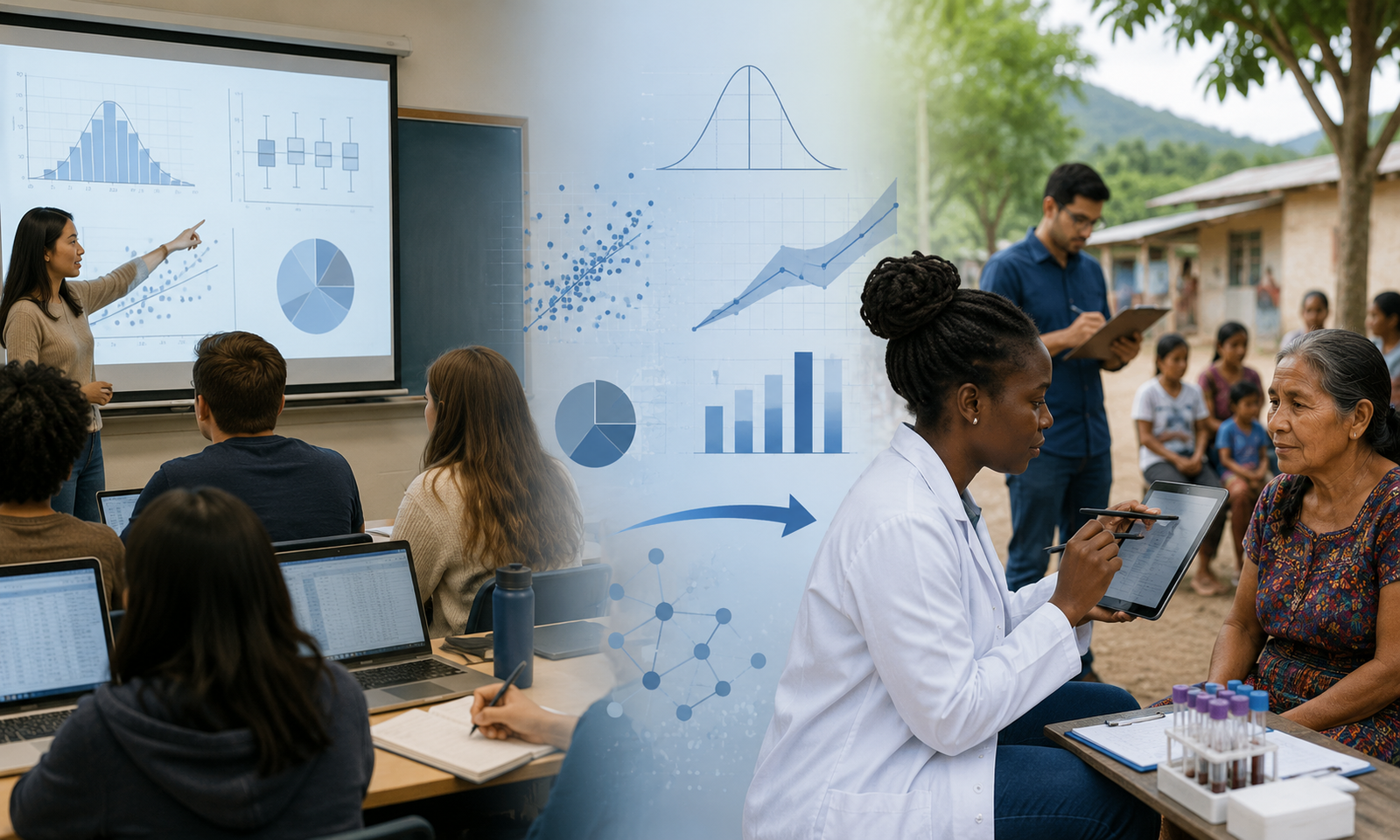
In health related fields, where decision making based on data could save or cost human lives, going from the classroom to the real world of application is particularly vital. An important aspect in which this shift is noticeable is Biostatistics. Students frequently first learn the formulas, data interpretation techniques and rules for probability in lectures and exercises. The meaning and the real power of these lessons, however, can be appreciated in the context of clinical studies, disease monitoring and policy making.
In actual practice, biostatistical methods lead to the creation of studies, interpretation of results, and decision making for patient care and health of the population. This article examines the translation of the basics of biostatistics from theory to practice, their relevance to clinical trials and to epidemiological studies and public health interventions.
From Theory to Practice – Why Biostatistics Matter?
Students can learn about such concepts as probability distribution, hypothesis testing, confidence intervals, and regression analysis in the classroom. You might think that these subjects are too far removed from questions of health, but they are the foundation of evidence-based research in health.
Medical data is used in real world settings and Biostatistics guarantees that whatever conclusions may be drawn from it are valid, reliable and generalizable. If the statistical techniques involved aren’t used properly the findings can mislead studies and lead to ineffective treatments or misinformed public health strategies.
By having a solid understanding of underlying concepts, researchers can be able to:
- Design robust studies
- Addressing bias and errors;
- Interpret complex datasets
- Support evidence-based decision-making
Students become effective health researchers and analyzers when they make this linkage between theory and practice.
Basic biostatistical concepts
Programming exercises familiarize students with the most important statistical tools employed in health studies. These fundamental concepts of biostatistics are descriptive statistics, probability theory, sampling methods and inferential statistics.
These ideas are not practiced in isolation, in practice. Rather than that, they are used as a way to complete real-life questions like:
- Is the new drug effective in lowering blood pressure?
- What makes the diabetes risk of a population of people higher?
- How effective is a vaccination program in preventing disease spread?
All parts of each question are statistical and the data must be interpreted.
Applying Biostatistics in Clinical Trials
Clinical Trials is one of the most crucial applications for Biostatistics.
Study Design and Randomization
The idea of randomization is applied in clinical trials to distribute subjects to control or treatment groups. This helps to avoid making the results of the study biased because of pre-existing differences of the participants. Random sampling is introduced in school, and it is extremely important when conducting experiments in medicine to make them fair and valid.
When the practitioner should seek to test a hypothesis related to treatment evaluation. The hypothesis testing is used to check whether a new or new development is statistically different from existing treatments in clinical research. For example:
- The null hypothesis will be: The new drug will not have an effect.
- Research hypothesis: The new drug will have a positive impact on the patient.
Researchers use statistical testing to determine if changes relatively are chance-based or due to the actual treatment’s effect.
Interpreting Confidence Intervals
Confidence intervals can provide researchers an interval of values to estimate the range of the value of the effect of the treatment. This might be more useful than a simple numerical estimate for making real world health decisions, since it incorporates uncertainty in the data.
Epidemiology: Surveillance of disease patterns using data.
Another important application of biostatistics is Epidemiology. Statisticians are heavily used in the field of epidemiology to find out the distribution and factors determining the distribution of diseases.
Descriptive Epidemiology
Within the classroom, students are taught to use the means, medians and standard deviations to summarize data. In epidemiologic terms these will be used to describe:
- The prevalence of a disease in a population.
- Distribution of those affected by age
- Geographic clustering of outbreaks across or within counties or bi-counties.
- Analytical Epidemiology
Logistic regression is used to develop statistical models which help researchers identify risk factors associated with diseases. For instance, they could see if smoking makes a difference in the incidence of lung disease, after they have accounted for other factors.
Outbreak Investigation
In disease outbreaks, it is the need of the hour to analyse data quickly. Use of biostatistical methods to trace the source of infection, forecast the pattern of infection and assess the effectiveness of containment measures.
Interactions with public health and utilization of evidence for decision making
Biostatisticians are key players in both designing and assessing interventions in Public Health.
Program Evaluation
Public health officials rely on the process of statistics to decide health program effectiveness. For instance, they can assess the effectiveness of a nutritional program in preventing malnourished children.
Resource Allocation
Statistical models are used to assist in policymakers’ decisions on allocating limited healthcare resources in an efficient manner. This involves the location of hospitals, vaccine distribution and the needs of communities which require immediate attention.
Monitoring and Surveillance
Continuous systems of data collection and analysis are central to health surveillance systems. Biostatistics can be used to identify patterns in disease occurrence and to alert as needed to new health threats.
Connection between Learning in School and Practice in Research.
A problem for the students was to use theoretical knowledge to convert them into research skills. Lectures teach formulas and techniques for applying them; and critical thinking and problem solving skills are needed in real life situations.
Data Quality
Real-world data often has missing, corrupted, or biased data, as opposed to textbook data. There are a number of things which researchers need to know to:
- Handle missing data
- Detect outliers
- Address measurement errors
These struggles involve a call for thinking skills not just memorized facts.
Write-Analyze-Design Software & Statistical Tools.
Biostatisticians use the software R, SPSS, or Python to analyze data, in practice. So, even if a tool simply outputs data, having an understanding of basics will enable researchers to interpret the data accurately.
Research in the present day is conducted in multifarious branches of science. Besides doctors, epidemiologists and policy makers, biostatisticians are partners. It is vital that statistical outcomes are clearly communicated to enable strong collaboration.
In addition to calculation, a main focus of biostatistics is interpretation and reasoning. Failures in interpretation of data can give misinformed conclusions – even if the calculations are mathematically correct.
For example:
- Statistically significant results doesn’t necessarily mean clinically significant.
- Correlation does not imply causation.
The advancement of analytical thinking helps the researcher to prevent errors that can be made in the understanding of the research data.
Discuss a study evaluating a new vaccine. They gather data on thousands of persons, and compare the infection rates of the vaccinated with the unvaccinated.
They employed the biostatistical approach and:
- Calculate infection rates
- Use the concept of hypothesis testing to make a decision regarding significance.
- Estimate vaccine efficacy (controlled for relative risk)
- Adjust for other factors that might influence the study results (confounders)
The concepts of school learning are applicable to real life decisions that save lives.
Conclusion
It’s crucial to help build up good health researchers to be able to apply what they’ve learned in class to everyday situations. Biostatistics offers the methods for analyzing data, interpreting the findings and potentially supporting evidence-based decision making as applied to clinical trials, epidemiology, and public health.
Students learn the basics of biostatistics and are able to transcend theory and make significant contributions toward healthcare improvement and disease prevention. In the end, the power of biostatistics goes beyond the numbers, and extends to the power of numbers working to increase the health of humans and save lives.