Introduction
A sound budget is what every small business needs. As you start a new venture, expand an existing company, or run a proven small business a practical budget is your guide for making informed financial decisions. Without a budget which is structured and realistic businesses often see themselves in a position of over spending, cash flow issues, poor investment choices, and hard time in responding to the unexpected. A budget turns financial planning into a strategic exercise which supports sustainable growth at the same time as it puts business owners in the driver’s seat of their finance.
Many business owners think of budgeting as a tool to cut costs which is only part of the picture. In fact we see that good budgeting is what you use to efficiently allocate resources, to spot growth opportunities, to better profit, and to have enough cash for day to day functions. It also serves to compare what we project to what we achieve financial terms, to identify issues as they arise and to change tactics before small problems grow into large ones. As you go about to put together an operating budget we recommend you familiarize yourself with the material in this guide which will in turn help you to develop a financial plan that supports not only this year’s operations but also the company’s growth in the years to come.
This practical guide goes through the process of creating a small business budget from start to finish. We cover forecasting revenue, estimating expenses, putting together an operating budget, monitoring variances, and making adjustments which in turn will keep your business in good financial health all year.
Why all Small Businesses should have a Budget.
A business budget is a financial plan which puts out what is expected in terms of income and what will be spent over a set time frame typically monthly, quarterly, or yearly. Instead of waiting for financial issues to present themselves which may catch a business off guard, with budgeting business owners are able to see what is coming and put in place solutions in advance. This proactive approach also reduces the element of chance in business finance which in turn allows companies to put their resources in places where they will produce the best results.
Beyond the issue of money control, budgeting improves innumerable aspects of business performance. We see that which products to put into production, which markets to expand into, which machines to buy, or which people to hire. Also investors and lenders look at a business which puts together a budget as a more stable option because of the2 which displays structure and responsible use of resources. Also a detailed budget which is put out for all to see encourages responsibility by setting out measurable goals which in turn which improves performance and efficiency within the company.
Study of Various Business Budgets
Before you create a budget which of course is to know that businesses use many budgeting approaches based on what they are trying to achieve. The operating budget is the most used which pays attention to the day to day business operations, which includes what income is expected and what expenses will be. Also we have other types of budgets like the cash flow, capital expenditure and project budgets which in turn support the operating budget in dealing with particular financial issues.
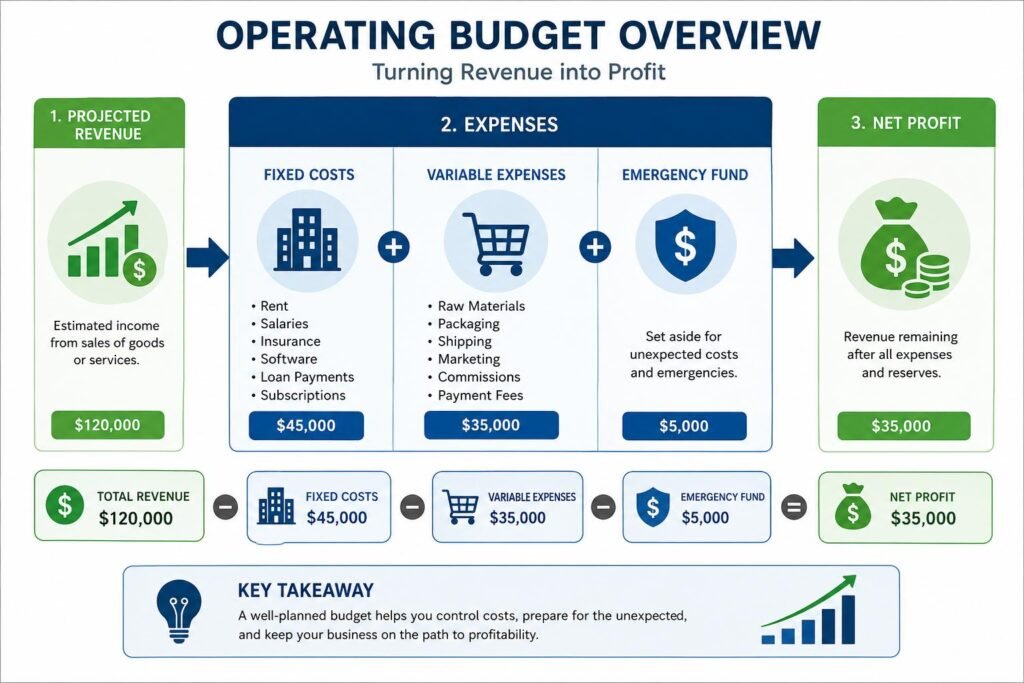
An operating budget projects sales revenue and at the same time takes into account repeatable expenses which include salaries, rent, insurance, utilities, inventory purchases, marketing costs, software subscriptions, transportation, and admin expenses. It also gives a full picture of what to expect in terms of profit for the set time frame. Also while it is typical for large companies to prepare separate budgets for each department, small businesses usually start out with a master operating budget which includes all main income and expense categories. By being aware of these differences entrepreneurs may choose the best budgeting structure for their business and also avoid the over complicity which may not be necessary at this stage.
Step 1: Set out what your business aims are.
Every time a budget is put together it should start with clear business goals. What we see is that financial planning is much easier when spending is in support of those which are measurable instead of short term wants. Business owners must determine what they are looking to achieve during the budget year. That may include growing revenue, opening a new location, increasing online sales, improving customer retention, purchasing new equipment, adding to the staff, reducing operating costs, or increasing profit.
Goals must be realistic, which means they also have to be measurable and at the same time fit with the resources that we have. For instance when we aim for a 20% increase in annual sales we also have to put in place the needed investments in for example marketing, inventory, staffing or technology. Also we see that without connecting financial resources to strategic goals budgets turn out to be just a list of expenses rather than useful tools for management. By defining what we want to achieve first we can make sure each dollar spent is used in a way that will produce results and in that way also reduce on that which does not add to our long term value.
Step 2: Collect past financial reports.
Accurate budgeting is based on solid financial information. Businesses with a past track record should look at the financial reports from past months and years before they put together a new budget. Historical records display sales trends, seasonal variations, regular expenses, and which areas see the most over spend. This info gives you a base to predict future financial performance.
Key in reports we use income statements, cash flow statements, balance sheets, bank statements, payroll reports, sales reports, tax records, supplier invoices, and utility bills. Also which may not have historical data yet, that is fine for startups which can put together industry benchmarks, competitor research, market analysis, supplier quotes, and estimates of operating costs in order to develop accurate models. What we see is that using real financial info as opposed to assumptions greatly increases budget accuracy also which in turn also reduces the risk of unexpected financial short falls during implementation.
Step 3: Prognosis of Revenue Realistically.
Revenue projection is a key element of a balanced business plan as this is the base that which almost all decisions regarding expenditure are based from. We see that improper overestimate of income which causes inflated budgets that in turn support over spending, also at the other end we see that poor estimate of revenue will not grow the business as much as it may have. It is recommended for small business to base their forecast of income on what has proven to be true from past sales, also look at what is reported by the market, what the customers are doing, what they are charging for the product and what the economy is doing also.
Businesses must take into account seasonal trends which play into what customers want throughout the year. In retail we see great increase in revenue during holidays, within service based companies we may see slower times during breaks or economic down turns. Founders should look at present customer agreements, recurring subscriptions, upcoming marketing campaigns, new product releases, and planned price changes when they are to00’ing out revenue. Also by developing many revenue scenarios which include best case, most likely, and worst case forecasts businesses can prepare for the uncertain and at the same time keep financial flexibility should real sales differ from what is put forth in the projections.
Step 4: Determine Fixed Costs.
Fixed costs are fairly stable which is what makes them a reliable element in the budgeting process. We see these regular outgoings which include office rent, salaries, insurance premiums, software subscriptions, loan repayments, internet services, equipment leases, and some licensing fees. Also because they don’t fluctuate much they are usually what we can count on to be fairly easy to forecast as compared to variable costs.
Although fixed costs may seem like a constant, companies should still go over them often for what may be improved cost savings. Leasing terms, reworking loan terms, changing out software providers, or looking at insurance plans may reduce overall operational costs over time which in turn does not have to mean a drop in service quality. Also including detailed forecasts of fixed costs allows businesses to see what their minimum monthly financial responsibilities are which in turn they may use that info before they put money into non-essential spending or growth projects.
Step 5: Determine Variable Expenses.
Variable costs change with the level of business activity and in many cases requires more intense monitoring than fixed costs. These include raw material purchases, shipping which also may go out as delivery, packaging products, commission plans, marketing budgets, utility use, travel and entertainment, production inputs, freelance and consulting services and payment related charges. As they are dependent on sales volume and operational needs, we put in place detailed models for their prediction.
Business owners should look at past spending trends which in turn include inflation, supplier price increases, anticipated promotions, and changes in production volume. We recommend that moderate contingency provisions be included in variable expense projections which in turn will absorb unexpected cost rises without disturbing overall financial health. Also by accurately estimating variable expenses business owners improve pricing strategies, protect profit margins and reduce the chance of going over budget during times of rapid growth.
Step 6: Include also Emergency and Contingency Funds.
Unpredictable expenses are a fact of life in business. Equipment failure, legal action, emergency repair, cyber-attacks, supply chain breakdown, or sudden market shift can put financial health at risk when companies do not have set aside enough in reserves. Including contingency funds in the budget improves financial resilience and also reduces the impact of unexpected events.
Many experts in the field of finance recommend putting out a portion of what is earned each month into an emergency reserve until you have built up sufficient working capital. Also it is the case that even small monthly deposits will over time grow your financial security. Businesses which have set aside money for unexpected events are in a better position to react quickly to them without going to expensive loans or at the same time interrupting what is routine in their business. This proactive approach also improves over time the stability of the business’ finances and at the same time reduces the stress which comes from economic uncertainty.
Step 7: Prepare the operations budget.
Once we determine the projected revenue and estimate the expenses we put together the operating budget. The operating budget reports what we project to bring in, what we will be putting out, and we include our projection of net profit or loss for the budgeting period. This document is the main financial planning tool we use through the year.
A usual budget plan includes what we project in terms of sales revenue, cost of goods sold, gross profit, payroll expenses, rent, utilities, marketing costs, administrative expenses, insurance, depreciation, professional fees, software subscriptions, transportation expenses, taxes, and we also include in it what we project for net income. By organizing the budget by month business owners are able to see seasonal trends, which in turn allows for better financial performance tracking and also the chance to make quick corrections which in turn prevents small finance issues from growing into large operational problems.
Step 8: Watch Budget Variations Regularly.
Creating a budget is a start to good financial management. In practice companies must constantly compare actual financial performance with what was budgeted for which is to identify variances. A variance is that which plays out between what was planned and what we see play out in reality. Positive variances may report higher than expected revenue or lower expenses at the company, while negative variances usually point out that we are spending more than we budgeted or that sales are down.
Monthly reporting of budgets which business owners use to identify the cause of large variances and to determine what correct actions to take. For instance if marketing spend goes over budget without seeing an increase in sales we may adjust our promotional strategies. Also higher than expected revenue may allow for greater investment in inventory or staffing. Regular variance analysis transforms budgetary documents into living tools which support better in the moment decisions all through the year.
Step 9: As business conditions change so do the budget.
No budget will be perfect over the course of a full year as business conditions are in constant flux. Customer preferences change, supplier prices go up or down, the economy has unpredictable turns, competitors put out new products, and also we see unexpected opportunities. What we put forth in budget must be a flexible document which we update as we go along instead of a set of unchangeable assumptions.
Business professionals may put out new revenue projections, expense plans, and investment which is in the best interest of the company based on what is really happening and what the market is doing. Quarterly budget reviews may present a good middle ground between sticking to what we said we would do and also including the new info we have. By updating the budget companies keep their financial plan current which helps them to proactively address risks and opportunities at the same time that they are also thinking about the big picture strategy.
Common Budgeting Errors Small Businesses should Avoid.
Many issues with budgeting do not come from the budgeting process itself but from simple errors which put a dent in what would be great financial plans. We see often that people overestimate coming in revenue and at the same time put forth low estimates for expenses which in turn presents picture of revenue that is not real which later causes cash flow issues. Also we see that large scale are ignored small recurring costs which over time turn into large annual expenses if left out of the picture.
Some companies also do not separate personal from business finances which in turn makes accurate budgeting a tough task. Also we see that some ignore regular budget reviews which cause financial issues to go unaddressed for great lengths of time. Also it is noted that not having emergency reserves in place leaves businesses at the risk of unstable growth. By identifying these issues we see that entrepreneurs may put in place better budgeting practices which in turn improve financial health, raise profitability, and support sustainable business growth in the long term.
Best ways to keep your Budget on Track.
Maintain a solid budget which requires consistency, discipline, and financial awareness at all times. Business owners should post to the accounting records in a timely manner, do regular bank account reconciliations and prepare monthly financial reports which support budget analysis. Also using cloud based accounting software which updates in real time tracks income, expenses, invoices, payroll and financial reports which in turn simplifies the budgeting process.
It is of equal importance to include key employees and department managers in the budgeting process when we have that option. We find that staff which includes purchase, operation, marketing or production teams bring to the table great input which it is of our benefit to hear. Also we put in place regular financial review meetings which serve to improve accountability and at the same time we keep budgeting as a live management tool as opposed to a yearly compliance requirement.
Conclusion
Creating a small business budget which is to work well it takes more than performing income estimates and simply logging expenses. Effective budget models include base sales and income projections, exact expense outlays, strategic planning, regular performance analysis, also continuous adjustments related to change in business environment. When properly put together and kept at that which they are intended to be budgets become a wonderful resource for decision making. They help entrepreneurs control their costs, improve profitability, reduce financial uncertainty, also confidently pursue business growth.
Instead of seeing budgeting as a restrictive function, we see in successful business owners that it is a base for long term financial growth. By setting clear goals, using accurate financial information, tracking budget variances, maintaining emergency funds, and revising financial plans regularly they are able to develop stronger, more resilient businesses which in turn weather out economic storms better. A practical and managed budget provides the financial transparency required to make informed decisions, support sustainable growth, and achieve long term business success.
Get more well researched information about Small Business Budget here.