
Short circuit
Short circuit
occurs when two points in an electric circuit are connected together by a
metallic wire as shown in figure 1. Whenever a ‘short’ occurs in a circuit, the
short has practically zero resistance. Since the resistance is practically
zero, it gives rise to the emergence to two important facts.
occurs when two points in an electric circuit are connected together by a
metallic wire as shown in figure 1. Whenever a ‘short’ occurs in a circuit, the
short has practically zero resistance. Since the resistance is practically
zero, it gives rise to the emergence to two important facts.
1.
The voltage across the ‘short’ is zero because
The voltage across the ‘short’ is zero because
V = IR = I x 0 = 0
2.
The short circuit current which is the current flowing through the short
is very large (theoretically, infinity).
The short circuit current which is the current flowing through the short
is very large (theoretically, infinity).
Open circuit
Open circuit
occurs between two points in an electric circuit when there is no direct
connection between them as shown in figure 2. The open circuit represents a
break in continuity in the emergence of two important facts.
occurs between two points in an electric circuit when there is no direct
connection between them as shown in figure 2. The open circuit represents a
break in continuity in the emergence of two important facts.
1.
There occurs an infinite resistance between the two points.
There occurs an infinite resistance between the two points.
2.
There is no flow of current between the two points.
There is no flow of current between the two points.
‘Shorts’ in a series circuit
Since there is
almost zero resistance in a short circuit, it causes a problem of excessive
current in a series circuit which, in turn, causes power dissipation to
increase many times and circuit component to burn out. The effect of short
circuit in a series circuit is shown with illustration below
almost zero resistance in a short circuit, it causes a problem of excessive
current in a series circuit which, in turn, causes power dissipation to
increase many times and circuit component to burn out. The effect of short
circuit in a series circuit is shown with illustration below


Because of the
resulting excessive current due to the effect of the short (almost 5 times the
normal value), connecting wire and other circuit components can become hot
enough to ignite and burn out
resulting excessive current due to the effect of the short (almost 5 times the
normal value), connecting wire and other circuit components can become hot
enough to ignite and burn out
‘Shorts’ in a
parallel circuit
parallel circuit
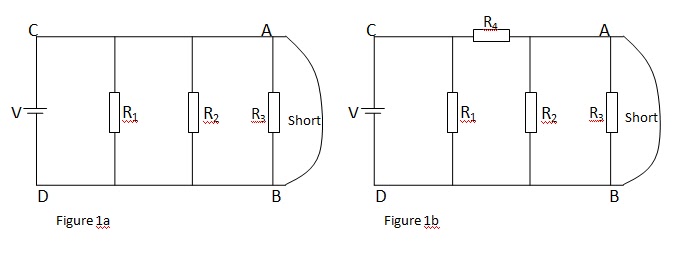
Suppose a
short is placed across R3 as shown in Figure 1a above or any other
resistor, the circuit will work as though the short is connected across the
battery and draws infinite current because the resistance of the wire used in
the short and all other connecting wire in the circuit becomes negligible. Due
to the infinite current, the wire may get very hot and burn out unless the
circuit is protected by a fuse. The infinite current in the short uses the
principle which states that the rate of flow of current through any branch in a
parallel network of resistors is inversely proportional to their resistance.
Consequently, the current will avoid every other branch due to their high value
of resistance and flow through the short.
short is placed across R3 as shown in Figure 1a above or any other
resistor, the circuit will work as though the short is connected across the
battery and draws infinite current because the resistance of the wire used in
the short and all other connecting wire in the circuit becomes negligible. Due
to the infinite current, the wire may get very hot and burn out unless the
circuit is protected by a fuse. The infinite current in the short uses the
principle which states that the rate of flow of current through any branch in a
parallel network of resistors is inversely proportional to their resistance.
Consequently, the current will avoid every other branch due to their high value
of resistance and flow through the short.
From the
above, the following points are worth noting:
above, the following points are worth noting:
1.
The short appearing in R3 doesn’t mean that only R3
is shorted but both R1 and R2 are also shorted out. This
means that in a parallel network of resistors, a short across one branch means
a short across all branches.
The short appearing in R3 doesn’t mean that only R3
is shorted but both R1 and R2 are also shorted out. This
means that in a parallel network of resistors, a short across one branch means
a short across all branches.
2.
There is no current flowing through the shorted resistors. This means
that if they were three bulbs, they will not glow.
There is no current flowing through the shorted resistors. This means
that if they were three bulbs, they will not glow.
3.
The shorted components are not damaged. For example if we had three
bulbs in figure 1a, they will glow again when the circuit is restored to normal
condition by removing the shorted circuit.
The shorted components are not damaged. For example if we had three
bulbs in figure 1a, they will glow again when the circuit is restored to normal
condition by removing the shorted circuit.
The circuit in
figure 1b is worthy of note. The short at R3 shorts out R3 and
R2 but not R1 because it is protected by R4.
figure 1b is worthy of note. The short at R3 shorts out R3 and
R2 but not R1 because it is protected by R4.
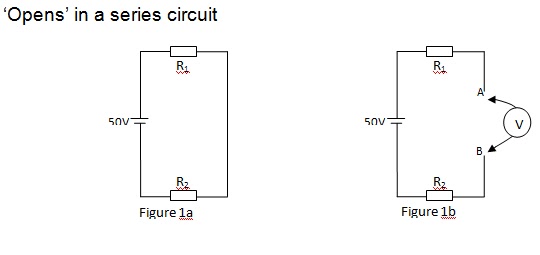
In a normal
series circuit like that shown in Figure 1a above, there exist a current flow
and the voltage drops across each of the resistors are directly proportional to
their resistance. If for any reason, the circuit becomes open at any point as
in the case of figure 1b, the following effects are produced.
series circuit like that shown in Figure 1a above, there exist a current flow
and the voltage drops across each of the resistors are directly proportional to
their resistance. If for any reason, the circuit becomes open at any point as
in the case of figure 1b, the following effects are produced.
1.
Since ‘Open’ offers infinite resistance, circuit current becomes zero.
Consequently, there is no voltage drop across R1 and R2.
Since ‘Open’ offers infinite resistance, circuit current becomes zero.
Consequently, there is no voltage drop across R1 and R2.
2.
The whole of the applied voltage (i.e. 50v in this case) is felt across
the ‘open’ which is across terminal A and B in figure 1b.
The whole of the applied voltage (i.e. 50v in this case) is felt across
the ‘open’ which is across terminal A and B in figure 1b.
The reason for this is that R1 and R2
becomes negligible as compared to the infinite resistance of the ‘open’ which
has practically whole of the applied voltage drop across it (as per voltage
divider rule). Hence a voltmeter connected across the terminal will read nearly
50V i.e. the supply voltage.
becomes negligible as compared to the infinite resistance of the ‘open’ which
has practically whole of the applied voltage drop across it (as per voltage
divider rule). Hence a voltmeter connected across the terminal will read nearly
50V i.e. the supply voltage.
Opens in a parallel circuit
Since an
‘open’ offers infinite resistance, there would be no current in that part of
the circuit where it occurs in the main line or in any of the parallel branch.
‘open’ offers infinite resistance, there would be no current in that part of
the circuit where it occurs in the main line or in any of the parallel branch.
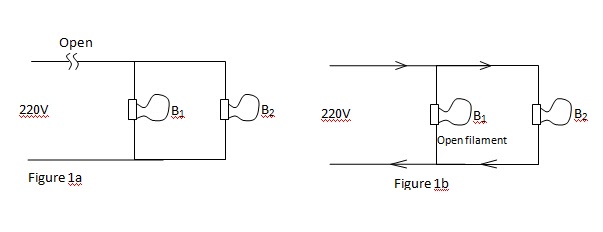
In Figure 1a, an open occurs at the main line this
prevent the flow of current to all the branches hence, neither of the two bulbs
will glow. However, the full voltage applied (i.e. 220v in this case) is
available across the open.
prevent the flow of current to all the branches hence, neither of the two bulbs
will glow. However, the full voltage applied (i.e. 220v in this case) is
available across the open.
In figure 1b, the ‘open’ occurs in branch circuit
of B1. Since there is no current in the branch, B1 will
not glow but the bulb at B2 will glow. However, as the other bulb
remains connected across the voltage supply, it would keep operating normally.
of B1. Since there is no current in the branch, B1 will
not glow but the bulb at B2 will glow. However, as the other bulb
remains connected across the voltage supply, it would keep operating normally.
It may be noted that if a voltmeter is connected
across the open bulb, it will read full supply voltage of 220V.
across the open bulb, it will read full supply voltage of 220V.