Introduction
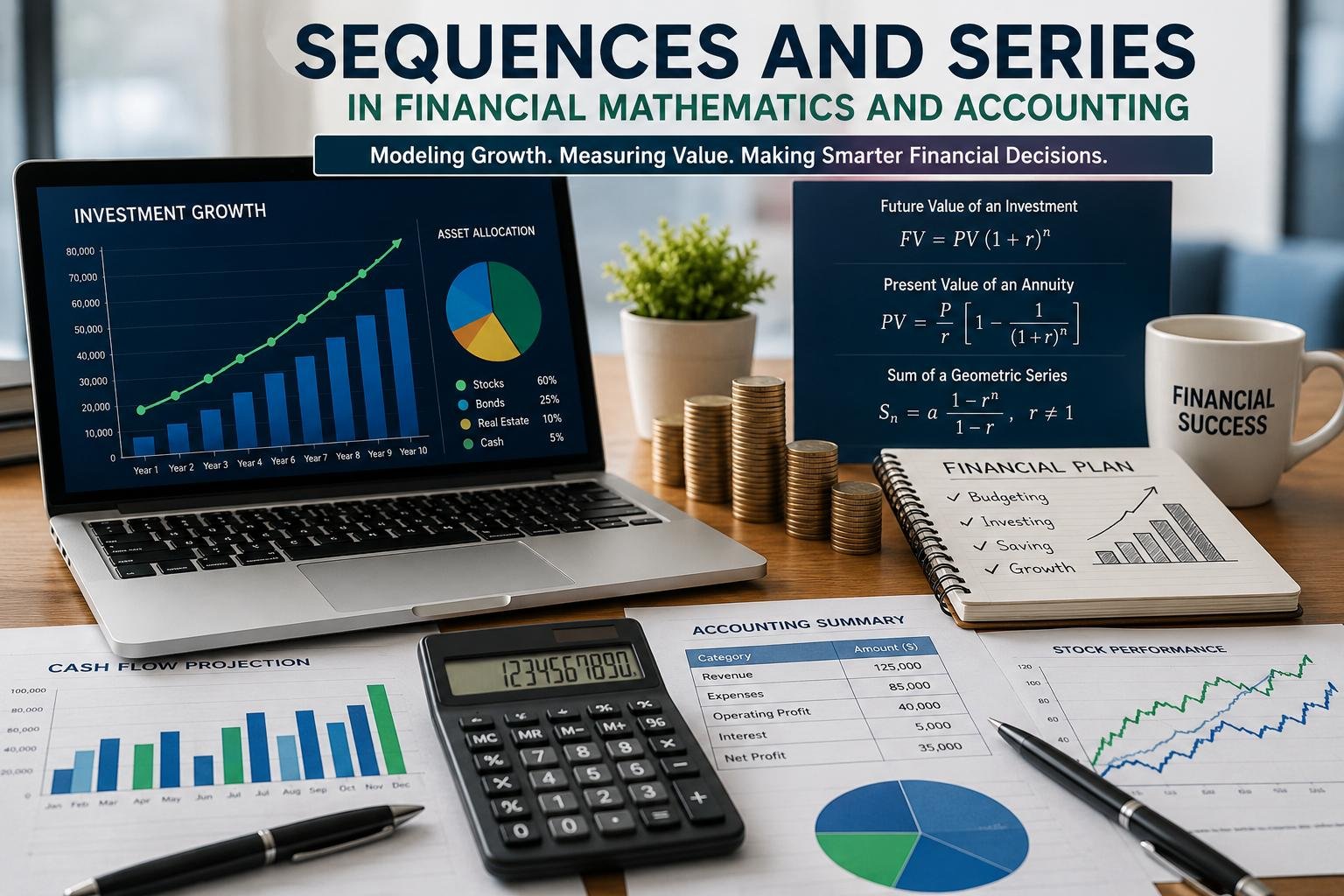
Sequences and series in financial mathematics are a key part of what we use to represent trends and total values over time. Although in the classroom these concepts may seem very theoretical, in practice they are very much the backbone of finance and accounting. Companies, investors, accountants, and financial analysts use sequences and series to forecast results, determine pay back, project income, and manage large scale financial growth.
A sequence is a set of numbers which follow a certain rule or pattern, and a series is what you get when you add up the terms of a sequence. We use these in finance to see how money changes over time. In accounting and finance which includes loan repayment, annuity math, budgeting, investment analysis and economic forecasting we see these concepts a great deal.
Understanding of finite and infinite sequences as well as that of convergent and divergent series is what professionals use to make informed decisions in business settings. In present day financial systems we see the use of mathematical models which help us to determine future values, assess risk, and improve in long term planning. In this article we look at these math concepts and we also look at how they play out in the practical accounting and finance.
Understanding Sequences
A sequence is a set of numbers which follow a particular pattern. Each number in the sequence is known as a term. Sequences may go up, down, or back and forth based on the rule that governs their structure. In the world of finance and accounting what we see are sequences which represent cash flows, payment schedules, profit trends, or yearly investment growth. Financial data has a natural time element to it which makes sequences very useful in the organization and interpretation of info.
Finite Sequences
A finite sequence is one which has a determinate number of terms. It is also characterized by having a defined start and end point. In accountancy we see that finite sequences play a large role in issues related to reporting on projects or financial responsibilities which are for a set time.
For instance, a company paying off a five year loan does a payment plan which is for a set term. Each monthly or annual payment is an element of that set sequence which comes to an end once the loan is paid in full.
Other examples include:
- Yearly depreciation of assets over their useful life.
- Salary growth during a fixed term contract.
- Annual quarterly reports for fiscal year.
- Installment payments for equipment purchases
Finite sequences are also of great importance to business which often work within the parameters of set budgets, contracts, or accounting periods.
Infinite Sequences
An infinite series goes on forever without breaking. We see these in many cases of financial modeling and long term forecasting. For example in the case of economists and financial analysts they may look at the long term growth of an economy or the gradual appreciation of investments over many decades. As these processes do not have a clear end point infinite sequences are the right framework for analysis.
Infinite sequences also appear in:
- Continuous investment growth
- Long-term pension planning
- Perpetual business earnings
- Population and market growth studies
Financial markets see also very large scale models used in which they predict future trends and to assess investment sustainability.
Understanding Series
A series is formed when we add up terms of a sequence. Instead of looking at individual values, series look at total accumulation. In finance and accountancy we see that series are very much a tool of trade as it is the total which is built up over time which financial professionals pay the most attention to rather than standalone numbers.
For example:
- Over the course of many years the total amount paid on a mortgage.
- The total value of regular savings deposits.
- Over a series of accounting periods the total revenue generated which.
- Total distributions from investment.
Series which enable organizations to look at total financial performance and base strategic decisions on that which is accumulated.
Arithmetic Sequences and Series in Accounting
An arithmetic sequences and series in financial mathematics is that which results when the difference between consecutive terms is constant. This constant increase or decrease is a feature of many accounting issues which display uniform change over time.
Applications in Accounting
Arithmetic sequences are widely used in:
- Straight-line depreciation
- Fixed annual salary increments
- Regular installment plans
- Budget projection at steady growth rates.
For instance a company may give out the same raise to an employee each year. The salary progression in this case is an arithmetic sequence which has a constant difference between years. Also in the same way that straight line depreciation which is the practice of writing off the value of an asset evenly over each year. We see in accountancy this is a useful structured approach which they use to determine and report asset values exactly.
Importance in Financial Planning
Arithmetic sequences and series in financial mathematics are used by accountants to present the total of repetitive financial actions. In the business setting they for instance use these to project total expenses, which in turn are used for operational cost analysis and in the development of long term budgets. In many cases of accounting which have to do with regular and predictable changes we see that arithmetic structures improve the quality of financial report and in turn better for decision making.
Geometric Sequences and Series in Finance
A geometric sequence is one in which each term is the product of a constant and the previous term. Also in contrast to arithmetic patterns which are based on additive growth or decline, geometric patterns see multiplicative growth or decay. Geometric progressions are very much at the core of finance which we see in how money grows via percentages which do not add a fixed amount.
Applications in Investment Growth
Investment returns usually display a geometric trend. As interest compounds over time the value of an investment grows in a proportional rather than linear fashion.
Examples include:
- Compound interest investments
- Savings account growth
- Inflation adjustments
- Business revenue expansion
- Stock market appreciation
If over time an investment grows by a consistent percentage the investment values will be in a geometric sequence.
Business Forecasting
Companies also put geometric series to work in forecasting future earnings and expansion. Also see how businesses which experience steady percentage growth use geometric models to project future profits.
Financial analysts turn to these calculations when they assess:
- Startup growth potential
- Revenue projections
- Market expansion strategies
- Long-term investment opportunities
These math models we see as a very solid base for which to make practical accounting and financial management choices in the small and large scale organizations.
Convergent and Divergent Series
In financial math one of the key differences is between convergent and divergent series.
Convergent Series
A convergent series will approach a set value as more terms are included. Although the series may go on forever, in the end the sum will settle at a certain point. Converging series are useful in finance as they allow us to determine long term financial values without which to go on forever with calculations.
Financial Applications of Convergent Series
Converging series are used in:
- Perpetual investment valuation
- Bond pricing
- Discounted cash flow analysis
- Pension fund estimation
In the case of a business that is expected to produce income for the long term financial analysts tend to use similar concepts to determine present value of future cash flows. These results help investors to see which projects are worth putting money into and which are not.
Divergent Series
A divergent series does not converge to a single value. Instead the sum may grow without bound or may fluctuate without settling. Divergent series play a key role in identifying unstable financial conditions.
Financial Applications of Divergent Series
In finance and accounting which may be seen as:
- Uncontrolled debt growth
- Hyperinflation
- Rapidly increasing business losses
- Unsustainable spending patterns
Accountants and financial managers pay close attention to these trends which in turn may indicate of financial instability or future economic risk. Identifying signs of difference early out gives companies a chance to put in corrective actions before it’s too late.
Loan Repayment Schedules
Loan repayment models are a very clear example of sequences and series in financial mathematics. When people or companies take out a loan what they usually do is pay it back in regular installments over time. These payments make up a sequence and at the end the total amount repaid forms a series.
Fixed Payment Loans
In many cases borrowers make the same payment at set intervals. Accountants and financial institutions use mathematical progressions to put together repayment schedules and determine:
- Payment amounts
- Interest portions
- Remaining balances
- Loan duration
Loan payment schedules which benefits both lenders and borrowers by clarifying financial terms.
Mortgage Calculations
Mortgages use geometric principles which play a role in how interest accumulates over time. Financial institutions apply these math models to determine accurate long term repayment plans.
Understanding these patterns enables accountants to:
- Estimate future liabilities
- Evaluate borrowing costs
- Compare financing options
- Prepare debt management strategies
In the absence of sequences and series in math we would have great difficulty with complex loan systems.
Annuities and Retirement Planning
An annuity is a sequence of equal payments at regular intervals. In finance and accounting which are very much into regular cash flows an annuity is very common.
Types of Annuities
For example:
- Pension payments
- Insurance settlements
- Retirement savings plans
- Monthly rent income
- Scholarship disbursements
Each payment is a term in a sequence which in turn forms a series.
Importance in Retirement Planning
Financial advisors use annuity models to plan out their clients’ retirement. By looking at what the client puts in and what they may get in the future, they determine if the client’s retirement fund is going to be adequate.
Accounting professionals also use annuity calculations to:
- Evaluate pension obligations
- Manage employee benefit plans
- Estimate future liabilities
- Plan long-term investments
Since in retirement planning you are making consistent payments over many years which also grow, sequences and series are key analysis tools.

Investment Valuation
Investment value is a function of sequences and series which is a result of financial assets’ performance over many periods.
Stock and Bond Valuation
Investors use models to determine the value of stocks and bonds which in turn base their assessment on future income. That income is presented as a series which we then analyze to determine present value.
For example:
- Dividend payments create income sequences
- Bond coupon payments display a structured pattern.
- Rental income from real estate investments is a regular source of income.
Financial markets’ players use these patterns to determine if an investment is a good play or over the top in price.
Discounted Cash Flow Analysis
Discount in price analysis is what we use in finance the most for valuing companies. It is a method which looks at present value of that which is to come in terms of earnings. This approach uses present value methods which adjust future cash flows over time to their current terms.
Businesses use DCF analysis when:
- Purchasing companies
- Evaluating investment projects
- Assessing expansion opportunities
- Estimating future profitability
Sequences and series also play a role in strategic financial decision making at all levels.
Financial Forecasting and Budgeting
Financial prediction based on analysis of past economic data and mathematical models.
Sequences and series in financial mathematics help companies to determine:
- Future revenues
- Operating expenses
- Market growth
- Consumer demand
- Cash flow trends
Budget Preparation
Budgeting is about recognizing financial trends over time. Accountants study past patterns of income and outgo to project future financial requirements.
For example:
- Seasonal sales trends
- Monthly operating costs
- Yearly tax obligations
- Inventory consumption patterns
These financial reports also see organizations do a better job at resource allocation.
Risk Assessment
Forecast also in the area of what businesses do which is to manage through uncertain times. By looking at growth trends and financial performance analysts are able to see issues before they grow into large scale problems.
Mathematical series help companies: Mathematical series which companies use:
- Predict economic downturns
- Detect unsustainable spending
- Estimate future liabilities
- Improve financial stability
As companies grow to rely more on data, the importance of mathematical forecasting is also growing.
Importance in Modern Accounting Systems
Modern in the field of accounting and financial technologies math is very much a part of what we do. We see a great deal of math in the forms of sequences and series which we use to improve efficiency in the treatment of financial info.
Examples include:
- Loan amortization software
- Payroll systems
- Tax estimation programs
- Financial forecasting tools
- Investment management platforms
These technologies do complex financial calculations with ease and also improve accuracy in reporting. Today accountants must master the math that powers these systems to properly interpret financial data and put forth informed advice.
Challenges in Financial Applications
Although we see value in what sequences and series do, also there are issues.
Unpredictable Economic Conditions
Financial markets see the impact of unpredictable events like:
- Inflation
- Recessions
- Political instability
- Technological disruptions
- Global crises
These variables may cause people’s financial decisions to not play out as models predict.
Assumptions and Accuracy
Many financial models base growth rates on a stable scale or what is predictable. In fact economic conditions tend to surprise us. Thus accountants and analysts must use professional judgment in addition to mathematical analysis for financial decisions.
Conclusion
We see the basic elements of sequences and series in financial mathematics which play a fundamental role. They are used to present financial data in an organized way, to model growth trends, to determine future values, and to improve in strategic planning.
Finite as well as infinite sequences present to accountants and financial analysts tools with which they may study different time periods’ activity, also arithmetic and geometric structures which in turn present outlays and percentage based changes.
Convergent and divergent series play a role in issues of financial stability, investment sustainability, and long term economic behavior. We see their use in loan payment schedules, annuities, retirement planning, investment valuation, budgeting, and forecasting.
In present day financial markets math is a large component of what we see in accounting systems and in financial management practices. What we see is that through the study of sequences and series professionals are able to do better prediction, manage resources more efficiently, and in turn make better business decisions.
In fact these models close the distance between academic theories and practical finance which in turn shows how very abstract ideas play a key role in which successful accounting and financial performance is based.
Get more well researched information about Sequences and Series in Financial Mathematics here.