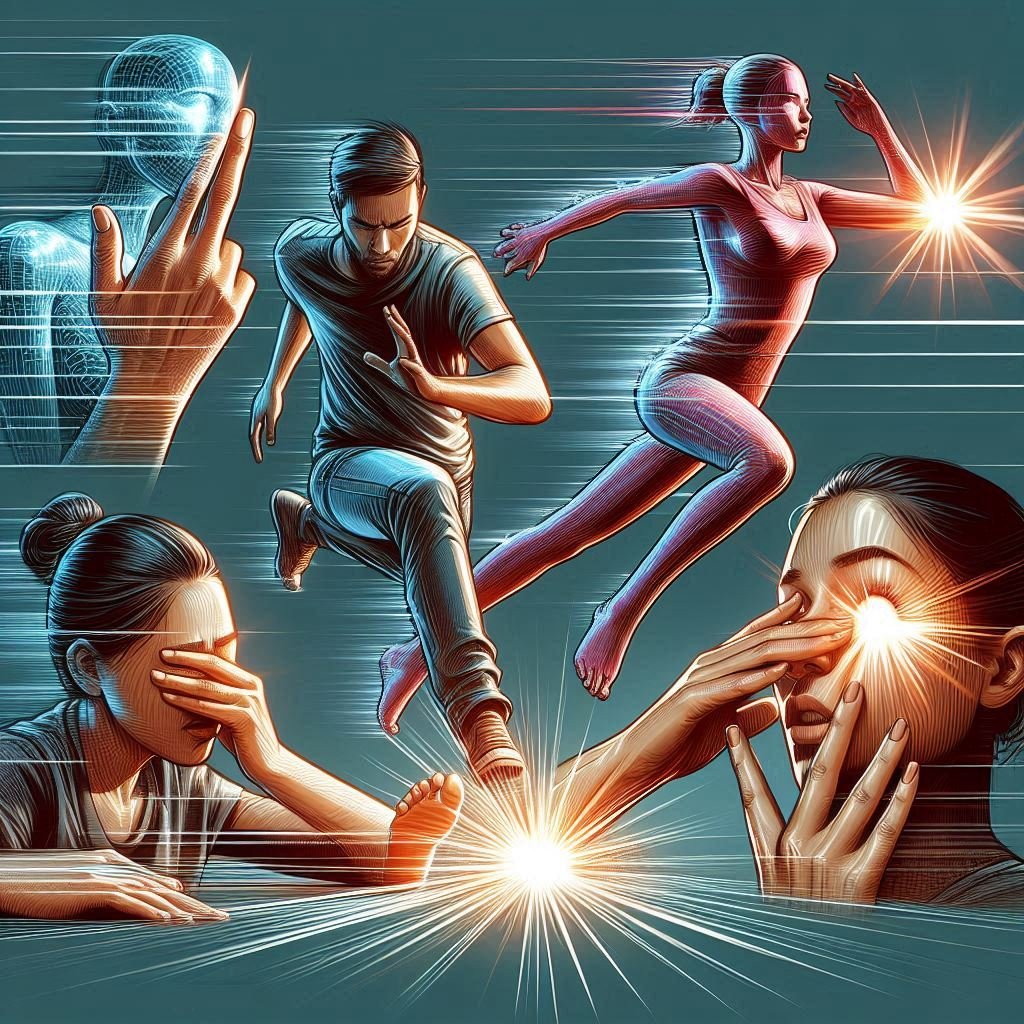
One of the most interesting and crucial characteristics of the human nervous system is the reflex actions, which enable the body to react to the stimuli nearly instantly without thinking. Such automatic reactions are crucial to survival and assist humans to prevent harm, keep their balance, and respond to environmental variations within milliseconds. Reflex actions are described as the way signals pass through select brain circuits that do not go through conscious brain processing, allowing instant responses. Reflex actions whether it is moving your hand off a hot object or blinking as an object is moving toward your eyes are evidence that the body is well-designed to defend itself. The learning of the concept of reflex actions give an insight into the organization of the nervous system and why it considers speed and safety more important than making decisions in critical situations.
What are Reflex Actions?
Reflex actions are automatic, quick reactions to external or internal stimuli, which are not controllable. The spinal cord and lower brain centers control these activities and not the cerebral cortex which is the center of conscious thinking. The idea of reflex actions is based on the notion that the body needs to respond quicker than the brain can process complex information in some circumstances. As an illustration, when you inadvertently come in contact with a sharp object, you pull away even before you can experience the complete pain. The reason is that the sensory signal does not go through the higher brain processing but rather is directed by a reflex arc which causes an immediate motor response. Reflexes are not behavioural responses but biologically-based responses that are naturally present at birth and are aimed at providing rapid protective measures in case of threats of harm.
Reflex actions are not only important in the case of withdrawal responses. They are also instrumental in the maintenance of posture, control of internal body processes and coordination when it comes to motion. An example of this is the reflexes that are used to stabilize your body when you fall or to change your posture when standing on an uneven surface. Employing these automatic responses, human beings would have to consciously process each and every little change, which would render existence and everyday life highly inefficient. The reflex actions concept thus emphasizes the speed and accuracy balance of the nervous system by assigning the urgent responses to the automatic neuron systems and assigning the complex decision-making process to the higher brain functions.
The Nervous System and how it produces Reflex Actions
It is a very well-organized and efficient pathway in which the nervous system generates reflex actions. This pathway usually involves a sensory receptor, sensory neuron, interneuron (in some instances), motor neuron and effector organ like a muscle or gland. When a stimulus is perceived, e.g., heat, pressure or pain, sensory receptors translate it into an electrical signal. This signal is sent to the spinal cord via sensory neurons where it is processed without engaging the conscious centers in the brain. A response signal is then transmitted back to the effector organ by the motor neuron, and an immediate action is caused e.g. the contraction of a muscle.
Reflex actions are so rapid because of the effectiveness of this system. Since the signal does not have to be sent to the brain to be interpreted, the response time is greatly decreased. In most scenarios, the brain does not get to know until the reflexive response has already taken place, hence the reason why you would realize when your hand has been taken out of a potentially dangerous stimulus a little bit later. The idea of reflex actions highlights this bypass mechanism as a survival tool, by way of making sure that the body responds in milliseconds instead of seconds. This mechanism also eases the use of the brain to process information as the brain can concentrate on more difficult tasks as the spinal cord takes care of immediate protective actions automatically and effectively.
Pathways in the Biology of Reflex Actions
Neural communication between peripheral receptors and the central nervous system is the center of the biological pathways that are involved in reflex actions. The basics of this process are the reflex arc, which is the circuit that forms the basis of all reflex responses. The information transmitted by receptors in the skin, muscles or internal organs to the spinal cord is conveyed by sensory neurons. The signal can be processed by interneurons within the spinal cord and sent immediately to motor neurons which cause a response by activating the muscles or glands. All this is done within a few seconds and this is the remarkable speed of neural communication.
The spinal cord is central to this pathway as it is the central processing unit of the reflex actions. It is also strategically programmed to respond swiftly without involvement of the higher cognitive centres in the brain. This separation of labor is necessary to be efficient, this enables reflexes to take place without conscious thought. Neurotransmitters are chemical messages that are used to pass signals between neurons at synapses, and are also involved in the concept of reflex actions. These chemicals make sure that the electrical impulse is conducted swiftly and with precision throughout the reflex pathway. In the absence of this specific biological tune, reflex actions would be less efficient and slower, affecting the response of the body to danger.
Significance of Reflex Actions in Survival and Prevention of Injuries
Reflexes are essential in the survival of human beings as they provide instant defense against stimuli that may be detrimental. Injury prevention is one of their most crucial functions. As an example, reflex actions will make the body react immediately to be damaged as much as possible when subjected to a sharp object or extreme temperatures. This is required to respond quickly as any delay of few seconds may lead to serious injury. The principle of reflex actions describes how evolution has been biased towards such automatic reactions as a survival strategy to maximize the chances of survival in hostile environments.

In addition to physical protection, reflex actions also play a role in ensuring homeostasis and stability of the body. They assist in posture management, balance, and coordination and make the body stable during movement. An example is that reflexes in the inner ear assist in maintaining balance when walking or running and stretch reflexes in muscles prevent overstretching and injury. These automatic responses are never turned off even when an individual is not consciously aware of the same. In the absence of reflexes, human beings would be much more susceptible to accidents, falls and environmental risks and daily life would be much more risky and less productivity.
Typical Reflexes in humans
Human beings also undergo a lot of reflexes in their day to day lives and mostly without even knowing it. Among the most frequent ones is the withdrawal reflex, when an individual quickly withdraws at the presence of a painful or hot stimulus. Another famous one is the knee-jerk reflex, whereby when the patellar tendon is tapped, the lower leg will kick forward automatically. Blinking is a reflex movement as well, which guards the eyes against dust, intense light, or an unexpected object that is moving towards the face. These are just a few ways in which the notion of reflex actions is deeply ingrained in human behaviours.
Reflexes are not only associated with external stimuli; reflexes also control internal body processes. The reflex of the pupil is an example where the size of the pupils is changes according to the intensity of light in order to save the retina. Likewise, sneezing and coughing are reflexes, which aid in clearing the respiratory tract of irritants. Such behaviors happen unconsciously, but they are critical to stay healthy and avoid damage. Reflex actions vary greatly to show the extent to which the nervous system uses automatic responses to guarantee survival, efficiency and safety in an ever evolving environment.
Conclusion
The idea of reflexes display the remarkable effectiveness of the human nervous system to deal with quick reactions to stimuli without thinking. In particular, the body is able to respond immediately to potentially dangerous conditions through special neural pathways called reflex arcs, which guarantee survival and minimize risk of injury. These reflexes are not only necessary to provide protection but are also critical in balance, posture, and internal control. Reflex actions bypassing slower decision-making processes in the brain reveal the partnership between the spinal cord and the peripheral nervous system to give priority to speed and safety. The knowledge of reflex actions can be of a great value in understanding the biological intelligence of human body and underlining the complexity of design which enables a human being to safely and effectively interact with the environment at any given moment of the day.