Introduction
No need to rent a shop, purchase expensive equipment, and hire a large staff to start a business. A lot of prosperous entrepreneurs start off in their home with just a little investment and slowly build up their business as demand grows. Working from home can require less of an investment in overhead and provides the flexibility to test the idea before committing to a huge investment.
The main issue for those who want to become business owners is picking a business model that aligns with their abilities, the local demand, and budget. It’s better to go small and prove it first and then reinvest the profits into growth rather than risking a lot of money right off the bat.
Here are some of the best home based businesses that you can do and are actually profitable, and the ones that are easy to get started on a low budget. You will be able to learn about how each business operates estimated start-up costs, important equipment, acquisition of customers, licensing considerations, pricing strategies and daily operations.
For those of you looking into the field of low capital small business, these are a few things that can help you find some viable opportunities with a manageable risk.
Home Businesses Continue to Grow for Various Reasons.
The rise in popularity of home businesses has been welcomed because it eliminates numerous of the costs of a retail business. By eliminating commercial rent, minimizing transportation costs and having greater control over their schedule, entrepreneurs can save a lot of money.
Technology has also provided greater opportunities to work remotely. Business owners can communicate directly with customers using social media sites, online marketplaces, digital payment systems and messaging applications. That’s a chance for entrepreneurs to be able to sell products, take orders and offer customer service without the need for a storefront.
But, of course, careful planning still is the key to success! All business concepts must be backed up by market research, suitable pricing, local regulations and customer service. It’s critical to test demand before scaling as businesses with low startup costs can end up being costly when they have poor inventory, equipment or marketing management.
Evaluating a Home Based Business Opportunity
When deciding on an idea for a business, there are a number of considerations to take into account.
First, determine a problem that customers would like to have solved. Convenience, time saving, improved quality and values are the keys to business success.
Secondly, estimate the cost of starting up realistically. Determine equipment costs, buying of initial inventory, packaging materials, transportation costs, marketing costs and emergency funds.
Thirdly, see if the business suits your everyday time table. Certain companies need to get up early or deliver goods multiple times a day or keep in touch with customers all day long.
Lastly, assess demand prior to major investment. Try a pilot program or service area to begin with. Collect Customer feedback and make operation changes based on customer needs, not guesses.
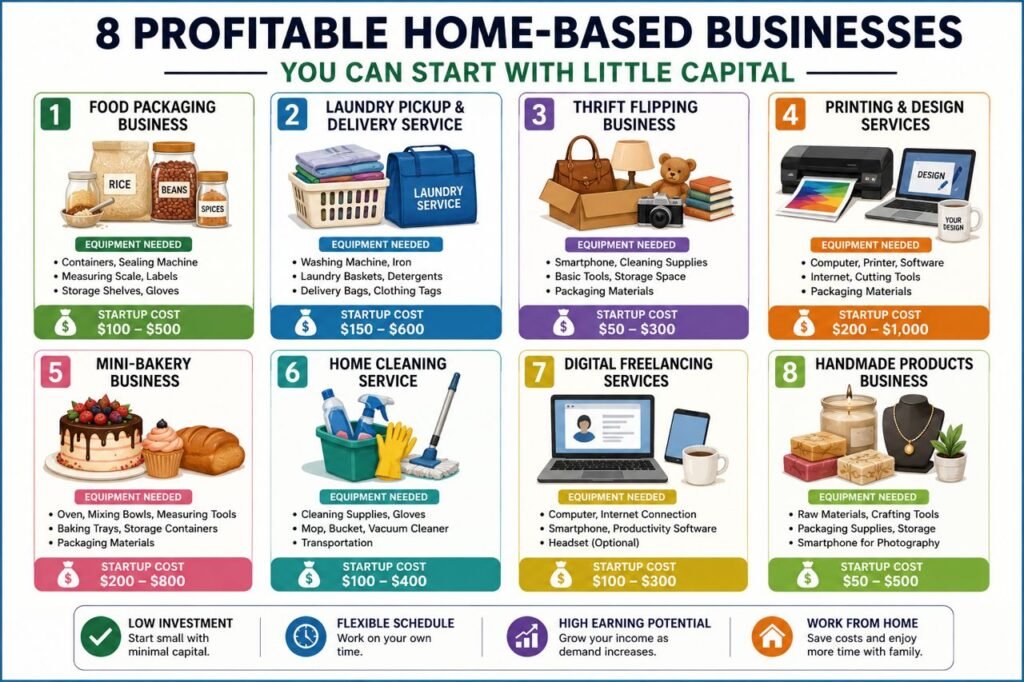
1. Food Packaging Business
Food packaging is a process of bulk buying food products and then repackaging them in small and economical quantity for the customers.
This business is particularly well loved because many families would like to purchase smaller-sized packages as a way to fit their budget. Common products consist of rice, beans, spices, cereals, flour, dried fish and snacks.
The initial capital investment is not too high as the start-up can start with a small amount and gradually build up the stocks.
Basic Equipment Needed
- Food containers and food packaging materials.
- Measuring scale
- Sealing machine
- Storage shelves
- Labels and markers
- Disposal gloves and hairnets.
The estimated cost of start-up is $100 to $500, depending on product and product quantity, and varies with the company.
The origins of First Customers
Neighbors, friends, local offices and schools and social media contacts are often initial customers. Groups and community groups in WhatsApp can be useful in advertising products.
Licensing and Operations
Typical food businesses will need to adhere to local health regulations. Depending on the location, food handling permits/business registration might be required.
The daily activities include sourcing products, ensuring cleanliness, packing stock, order taking and delivery.
Product cost, packaging cost, transportation cost, profit margin should be taken into consideration when pricing.
2. Laundry pickup and delivery service.
Lots of busy people and families have trouble finding time to wash their laundry. A laundry pickup service overcomes this challenge by picking up the clothes from the customers, washing them at its home or using the partner Laundromats and returning them to the customer’s home.
If you already have a washing machine, ironing equipment, then you need very little equipment for this business.
Basic Equipment Needed
- Washing machine
- Iron and ironing board.
- Laundry baskets
- Detergents and Fabric Softeners.
- Clothing tags
- Delivery bags
Typically, the startup costs are anywhere from $150 to $600.
The origins of First Customers
The apartment complex, office, student or local neighborhoods are great markets to choose from.
Social media pages, referral and word of mouth clients are usually the first clients.
Licensing and Operations
Regulations on Business Registration are different across regions. Good policy is vital on damaged and lost goods, delivery dates etc.
The activities performed daily involve picking up and sorting clothes, washing, ironing, folding and packing and delivering the orders.
The pricing may be tied to the weight of the items, number of items or it may be a service package.
3. Thrift Flipping Business
Thrift flipping is a business practice that consists of buying used goods at a cheap price, enhancing their looks or usage, and selling them for a profit.
Common items include clothing, furniture, shoes, handbags, books and electronics.
Entrepreneurs love the business because they aren’t burdened with high costs of inventory, and have the potential of making large profits.
Basic Equipment Needed
- Smartphone that has a good camera.
- Cleaning supplies
- Basic repair tools
- Storage space
- Packaging materials
The costs of a startup can be $50 to $300.
The origins of First Customers
Initial sales can be captured through online marketplaces, social media platforms, community groups and personal networks.
You need to have good product photos and descriptions to make your products appealing to shoppers.
Licensing and Operations
Maintain proper records of buying and selling to monitor profits.
They source and clean or fix items, take photos of products, list items, talk to buyers and organize deliveries every day.
Cost of acquisition, refurbishment costs, platform fees and profit margins should all be taken into account when pricing.
4. Printing and Design Services
Business cards, flyers, invitation cards, personalized mugs, T-shirts, stickers, and banners are just a few of the types of printing that can be ordered.
Many home-based businessmen begin by outsourcing bulk printing assignments and take care of the customer service and designing the work themselves.
Basic Equipment Needed
- Computer or laptop
- Graphic design software
- Printer
- Internet connection
- Cutting tools
- Packaging materials
The typical startup costs are between $200 and $1,000.
Where first customers come from
Printing is a common need for small businesses, schools, churches, event planners and students alike.
Early growth is frequently through social media marketing and referral.
Licensing and Operations
Make sure to print branded material in compliance with copyright laws.
In addition to design, production, coordination with suppliers, printing, quality control, and customer service, other daily duties involve taking orders, processing orders, and customer support.
Design time, cost of printing, delivery and profit margin should be part of the pricing.
5. Mini-Bakery Business
From a home kitchen a mini bakery can be established and may do cakes, cookies, bread, pastries, snacks and be a success.
Specialization can be beneficial to profitability. Don’t sell all products, sell a few and establish a reputation for quality.
Basic Equipment Needed
- Oven
- Mixing bowls
- Measuring tools
- Baking trays
- Storage containers
- Packaging materials
Typically the start-up costs are around $200 to $800.
Where first customers come from
Family activities, school, office, religious, neighborhood groups can offer a steady demand.
Repeat business can come from social media and customer referrals.
Licensing and Operations
Permits/inspections may be required for food safety regulations.
Everyday tasks involve ingredient sourcing, baking, packaging, order management, coordination of delivery and customer communication.
Ingredients, utilities, packaging, labor and overhead should all be included in the cost.
6. Home Cleaning Service
Residential cleaning, also known as a home cleaning service—provides cleaning solutions for households that are very busy.
There is no need to invest in a ton of cleaning supplies to start this kind of business; you can start and begin offering more specialized cleaning services, including deep cleaning or move-in cleaning services.
Basic Equipment Needed
- Cleaning supplies
- Wearing gloves and other protective equipment.
- Buckets and mops
- Vacuum cleaner
- Transportation
The startup cost is typically $100 – $400.
Where the first customers come from
Business can come from neighbors, apartment complexes, property managers and referrals.
Positive customer reviews and pictures of the product before and after can have a huge impact on credibility.
Licensing and Operations
Depending on the regulations, insurance coverage may be a helpful option.
The daily activities involve setting up appointments, cleaning homes, replenishing supplies and customer follow-up.
There are two different types of pricing: hourly or property sized.
7. Digital Freelancing Services
Content writers, virtual assistants, social media managers, bookkeepers, data entry workers, and graphic designers are just a few of the job functions freelancers can perform remotely from their homes.
The investment model is relatively low since the main investment is on skills development.
Basic Equipment Needed
- Computer notebook or computer desktop
- Reliable internet connection
- Smartphone
- Productivity software
Costs of starting up can be between $100 and $300.
Where first customers come from
Initial projects often come from freelance marketplaces, LinkedIn, social media and word of mouth.
It is essential to develop a portfolio to get the customers.
Licensing and Operations
Have clear contracts, payment terms and service agreements.
The day to day activities include client communication, project management, service delivery, invoicing and marketing.
Prices may be pay by the hour, project- or retainer-based.
8. Handmade Products Business
Entrepreneurs can convert their creative talents into income through selling handmade products.
Candles, jewelry, soaps, home decor, gift baskets, and customized items are all popular items.
The reason it is a good business is that it’s a product that can be manufactured in small quantities.
Basic Equipment Needed
- Raw materials
- Basic crafting tools
- Packaging supplies
- Storage containers
- Smartphone for photography
Costs of getting started are usually between $50 and $500.
Where the first customers come from
Use craft fairs, social media, online market places and local events to make some early sales.
Word of mouth or referrals can be a significant source of expansion.
Licensing and Operations
Compliance to labeling regulations/safety standards may be required for some products.
These daily activities involve production, inventory, packing, taking photos, marketing, and providing customer service.
Materials, labor time, packaging and overheads all need to be taken into consideration in pricing.
The Art of Pricing Products and Services
Many new business owners are tempted to include the prices of their competitors, but fail to pay attention to the cost of their business.
The first step in any business is to work out all of the direct costs of the project such as materials, packaging, utilities, transportation, marketing, and labor.
Then, decide what your target profit margin is.
The basic formula for pricing is:
Total Costs + Desired Profit = Selling Price
Check prices on a regular basis when prices fluctuate.
Don’t break down the price to sell. Sustainable pricing will allow your business to be profitable and continue to grow.
Testing Demand before Scaling
Among the greatest benefits of home-based businesses is the fact that they can be started small.
Rather than putting a lot of money into the business, try a basic version of the business and see how customers react to it.
There are several methods to test the demand:
- Providing friends and family with products
- Running pre-orders
- Conducting social media polls.
- Spending time in the community
- Accepting limited orders at first purchase.
- Tracking customer feedback
Keep track of the products that are always in demand and which strategies are most effective for marketing.
Recommendations should be made on basis of customer insights to enhance products/services rather than adding inventory or equipment.
Conclusion
With a small amount of investment, a business can be started at home, as long as the business people are aware of the problems that need to be solved and careful to manage the costs.
Opportunities to make money with minimal financial risk including food packaging, laundry pickup, thrift flipping, printing services, mini-bakeries, cleaning services, freelancing and handmade products.
The best businessmen start with thorough research, slowly introduce new products to the market, and reinvest profits wisely.
Knowing what licenses are required, how to run your business daily, how to acquire new customers and the basics of pricing will help you create a profitable business from home without wasting money on unnecessary expenses.
Select one concept consistent with you interests and resources, take it slow and work on a regular basis based on customer feedback and market demand.
Get more well researched information about Profitable Home-Based Businesses here.