Introduction
In the present digital age data is at the base of almost all systems from banking software and health care platforms to e-commerce sites and educational tools. Also it is very much a fact that the value of data is in its accuracy and reliability. We see that which data is incorrect or is handled poorly may cause large scale issues, poor decision making, and system breakdowns. That is why it is so important to know how data is collected, checked, and validated before it is put through the system. These actions play a team role in that they put in place what it takes to prevent errors in information systems and also to maintain the trust which the public has in the results which the systems produce.
What Is Data Capture?
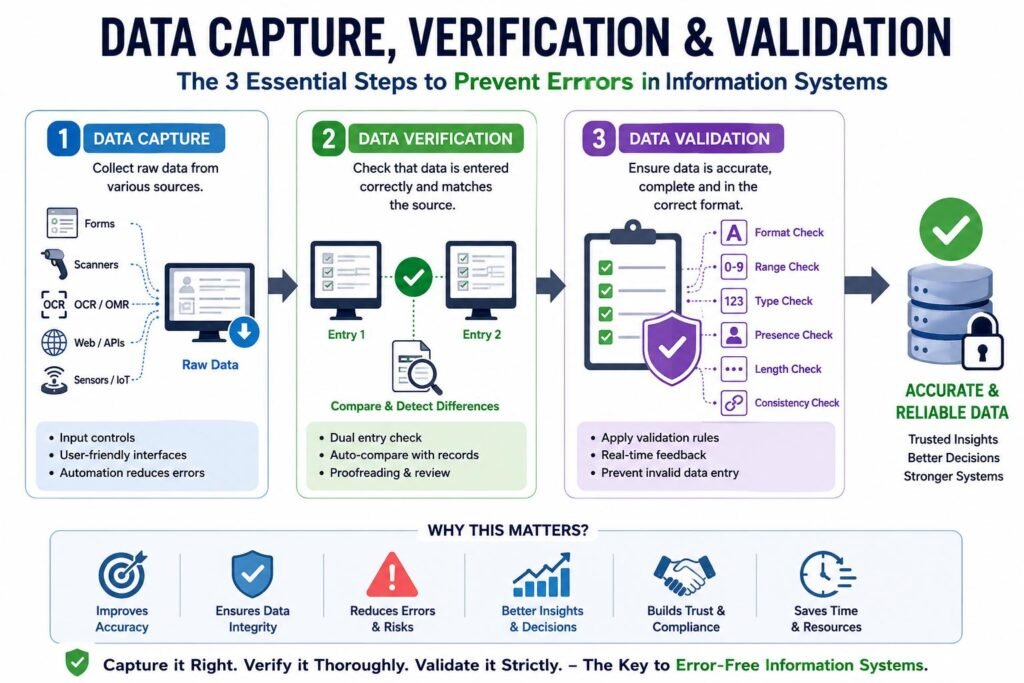
Data collection is the process of which we gather raw data from many sources and input it into a format which computers can work with. It is the first step in the data life cycle and also plays key role in the quality of information which comes out.
Types of Data Capture
Data is collected in many ways which depend on the system and context:
1. Manual Data Capture
This includes when people put in data into a system which they do via filling out forms for example. Also very common is this which at the same time is very prone to human error which in turn may result in typos and missing fields.
2. Automatic Data Capture.
Technologies which include barcode scanners, RFID systems, sensors, and IoT devices do so to collect data. They may also report human error reduction but still have technical issues.
3. Optical Character Recognition.
Tools like Optical Character Recognition (OCR) and Optical Mark Recognition (OMR) which scan in data from physical documents and scans. These are used in exam and survey settings as well as for digitization of documents.
4. Online applications and APIs.
Web based forms and application programming interfaces (APIs) which in real time collect data from the users or other systems.
Importance of Accurate Data Capture
If into the wrong data a system gets at this stage it causes a chain reaction which in turn leads to faulty analysis and decisions. That is why we see organizations put in structured forms, automation, and user friendly interfaces to reduce errors at the data capture stage.
Understanding Data Verification
Data check is a process which we use to see that the information which we put in is indeed what we meant to put in, we do this by looking at the original source or a duplicate entry. It also serves to confirm that which was captured is what was meant to be.
Common Verification Methods
1. Dual Entry Check.
In this process we have data entered by the same or different people. The system which we use to do that which in turn identifies issues in the two sets of data.
2. Proofreading and visual inspection of the material.
Humans go over data by hand to find out which elements don’t fit or are incorrect which in turn is a practice which we see in small scale datasets.
3. Auto compare
Systems that input data is checked against present records or reference databases for accuracy.
Why Verification Matters
Verification is a process that catches input errors while the data is still in transition to permanent storage. Also we see in cases like when a user puts in a wrong phone number, the verification systems play a role to which the error is detected and thus prevented from being saved into the database.
What Is Data Validation?
Validation ensures that the data is acceptable. It answers questions like this, Is this data accurate?
Types of Data Validation
- Format Validation: Ensures that information is in a specific format. For example email addresses include and a domain name.
- Range Validation: Checks if a value is in a set range. For example age values may range from 0 to 120.
- Type Validation: Ensures which the data type is what is expected (e.g. numeric fields do not have letters).
- Presence Check: Required fields are confirmed to be filled out.
- Length Check: Ensures that we don’t go over or under a set character count.
- Check for consistency: Compares which data across fields to check for logical consistency (e.g. a start date should not be after an end date).
The Role of Validation in Systems
Validation is a gate which stops wrong or out of context data from getting into the system. By putting in robust validation rules organizations see large reductions in errors and improvement in data integrity.
The issue of Data Capture, Validation and Verification
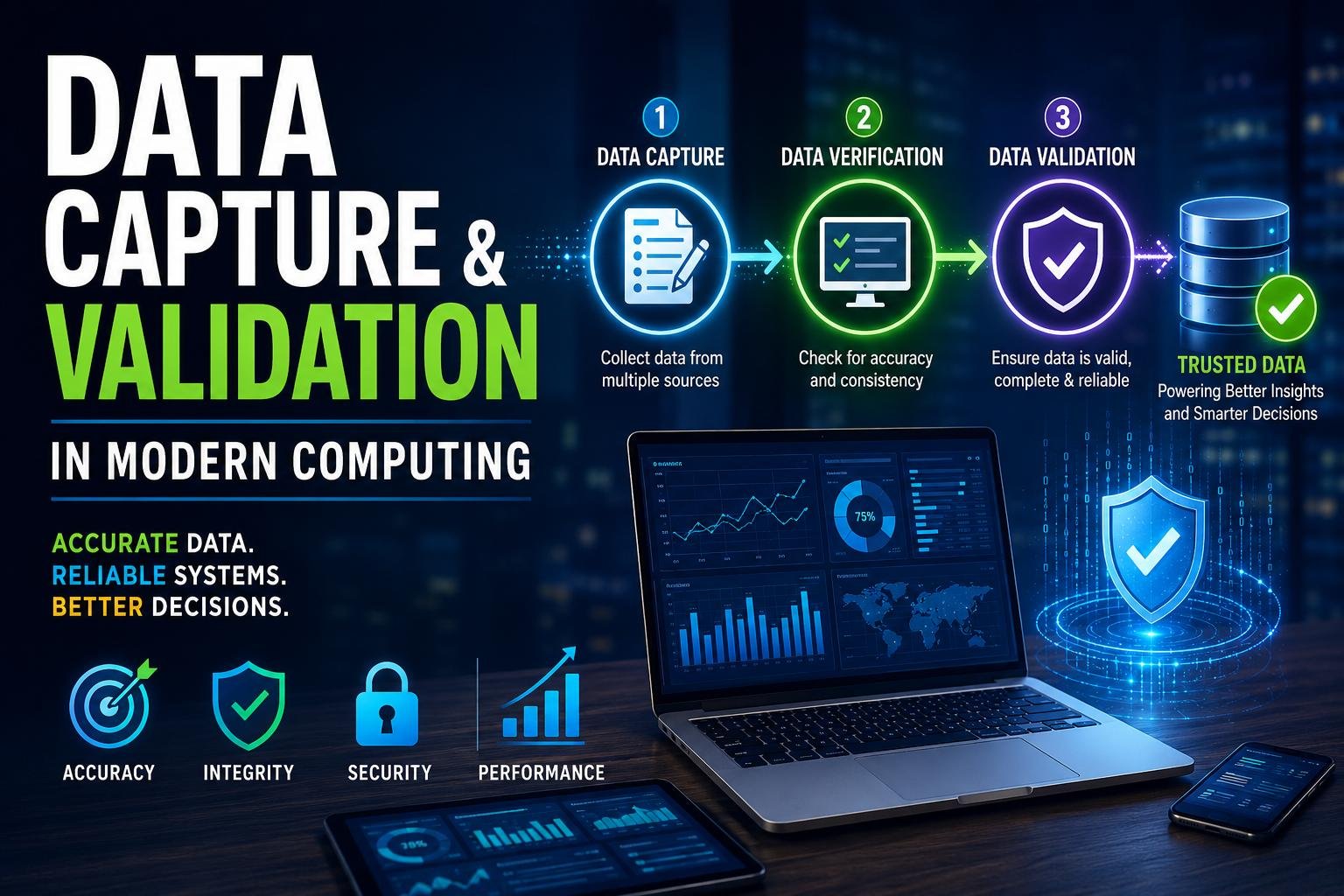
These three processes are interrelated and they form a key element in data handling:
- Data Capture gathers raw data.
- Data check to make sure it was entered correctly.
- Data validation is what we do to check.
They also present a strong base which is put in place for maintaining data quality and reliability.
To avoid errors in information systems what is required is a cohesive implementation of all three processes which should be put in place instead of using only one.
Strategies to Reduce Errors in Information Systems
Today’s computing systems use a variety of methods to reduce data related errors. These techniques are very important in the performance of the systems and in the accuracy of the results.
1. Input Parameters.
At the point of data entry we have input controls which are also rules and mechanisms. For example:.
- Pull down menus to limit user choices.
- Input which is masked for structured data (e.g., phone numbers).
- Default settings which minimize manual input.
These controls minimize entry of wrong data.
2. Real-time Validation.
Real time validation as data is entered which gives instant feedback to the user. For instance if a password does not meet the length requirement, the system will alert the user immediately.
3. Error Indicators and Prompts.
Proper and detailed error messages that guide users to correct their mistakes. Also note that poor design in this aspect may confuse users and cause them to repeat errors.
4. Data Cleaning.
Data cleaning is a process which identifies and fixes errors in present datasets. In large databases which may have accumulated errors over time this is of great importance.
5. Standardization
Standard weeding out of different data formats which may vary from system to system. For instance instead of having multiple date formats we go with a single one like DD/MM/YYYY which eliminates confusion and errors.
6. Automation and AI.
Advanced systems at present use artificial intelligence and machine learning to identify anomalies and predict errors. They are also able to see patterns which may human eye miss.
Challenges in Data Capture and Validation
Although we have seen great tech advances, still we have:
Human Error
Even at the hand of validation rules users still do mistakes which mostly happen in manual data entry.
Inconsistent Data Sources
Data which is collected from many sources comes in many formats and of many qualities which in turn makes validation more complex.
System Limitations
In older systems which do not have advanced validation features this increases the risk of errors.
Data Volume
As we see an increase in data volume that which is to be managed and validated also increases.
Best Practices for Ensuring Data Accuracy
To preserve high data quality organizations should do the following:
Design User-Friendly Interfaces
Reducing complex forms and getting rid of extra fields will minimize user errors.
Implement Layered Validation
Use many validation methods to catch different types of errors.
Train Users
Training users on proper data entry will greatly reduce errors.
Regular Audits
Periodical checks in which we look at and fix errors in stored data.
Use Reliable Tools
Investing in state of the art data management solutions is the key to better accuracy and efficiency.
Real-World Applications
Healthcare Systems
Exact patient data is of the essence in health care. Wrong info may result in misdiagnosis or improper treatment.
Financial Institutions
Banks use accurate data for transactions, risk assessment, and compliance which is a must. We see errors to result in financial losses or legal issues.
E-Commerce Platforms
Product info, pricing, and customer data has to be accurate for seamless operations and customer satisfaction.
Education Systems
Student records, grades and attendance data must be accurate.
The Future of Data Validation
As technology advances data validation is growing in sophistication. We see:
AI-Driven Validation
Machine learning algorithms are able to identify outliers in large data sets which traditional methods do not.
Blockchain Technology
Blockchain has the feature of secure and transparent data verification which in turn reduces the risk of tampering.
Real-Time Data Processing
Systems are now able to validate data in real time which in turn improves efficiency and accuracy.
Conclusion
Data collection, validation and verification are basic elements in today’s computing which see to the accuracy and quality of information systems. Without them, we see the systems’ performance and credibility at risk.
By which in to greatly prevent errors in information systems, companies may put in place robust validation rules, use present day technologies, and follow best practices. In the end what it takes to prevent errors in information systems is not just a technical issue; it is a very important element of creating reliable, efficient and trust worthy digital environments.
As we see data play a role in which decisions are made across all sectors that role will only grow. We put in today the effort into robust data management which in turn will produce better results and greater confidence in the systems we will see tomorrow.
Get more well researched information on how to prevent errors in information systems here.