Introduction
In present day’s competitive business world companies can no longer turn to intuition for key decisions. At each turn which may include that of expanding operations, rolling out new products, cutting costs, or increasing profitability, we see the need for precise financial info. This is what management accounting tools are used for. While financial accounting is mostly about reporting past performance to external parties, management accounting puts forth relevant and timely financial info to internal decision makers for use in planning, control, and strategy.
In today’s dynamic marketplace which is a result of tech advances, global integration, customer demand, and economic instability modern businesses operate. For growth and survival managers must base their decisions on data. Effective management accounting is the tool which allows companies to see into their cost structure, which in turn allows for better resource allocation, performance evaluation, and future planning. It is the process of turning large sets of financial data into action oriented information which in turn shapes business strategy.
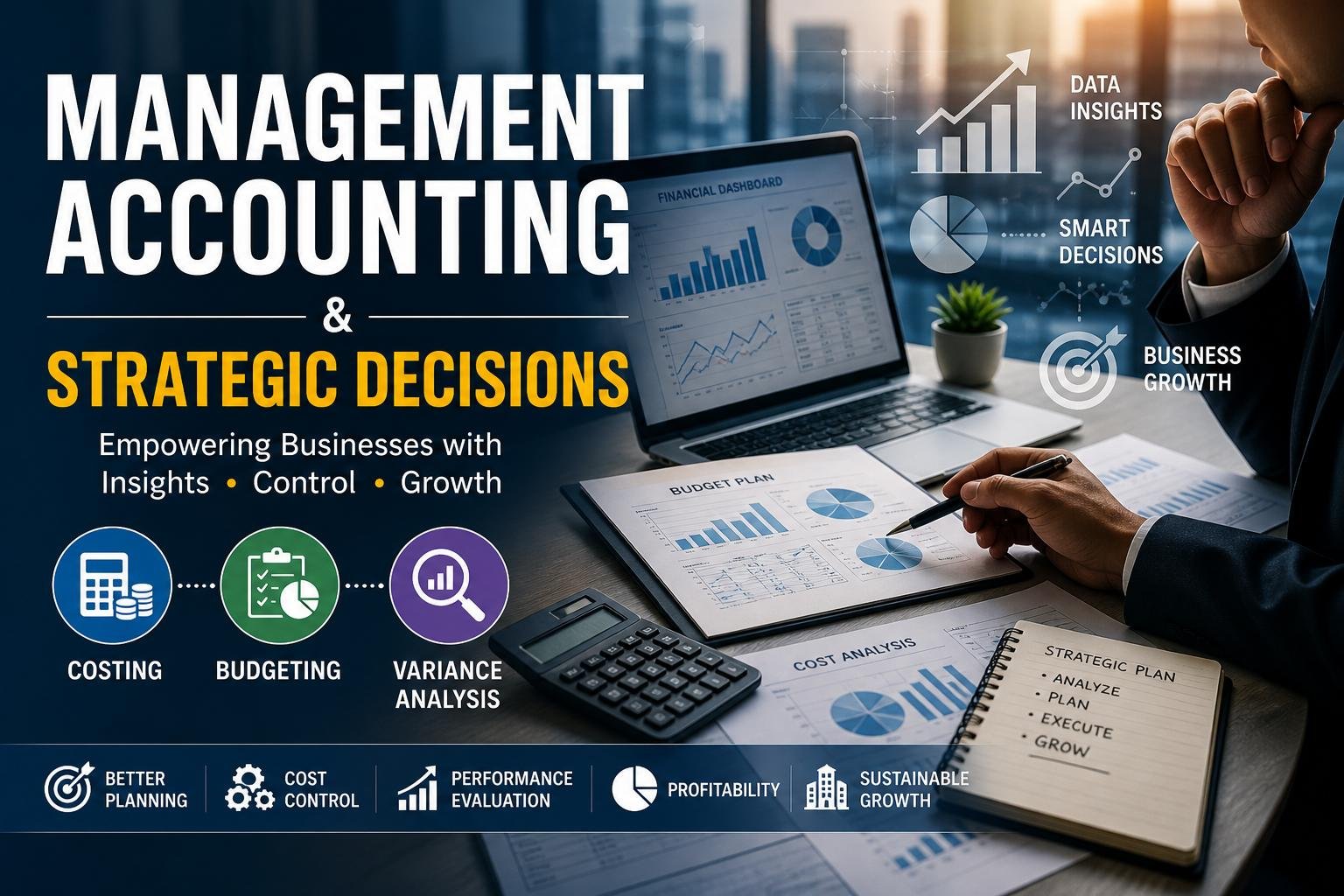
In the core of this process we have management accounting tools. These tools also serve to run operations, manage expenses, identify waste, and to support long term goals. Costing systems, budgetary tools, and variance analysis all play a role in giving a full picture of the health of the company and its performance.
This article looks at the role of management accounting in strategic business decision making. We see how costing, budgeting, and variance analysis play a role in organizational success also we report on the importance of accurate financial info for sustained growth.
Understanding Management Accounting
Management reporting which is what we do to put together financial and non-financial info for the use of internal management. We do this to support planning, decision making, and performance evaluation. As against financial accounting which is regulated and looks at past transactions, management accounting is flexible and looks to the future.
Management reporting which is used in companies to answer key questions like:
- Which of the products is the most profitable?
- What are some ways to reduce operational costs?
- What is the volume at which we break even?
- Is the company reaching its financial targets?
- Which department is underperforming?
- Should the company go after growth or innovation?
Through in depth financial analysis management accounting supports strategic planning and operational efficiency.
Strategic Decision-Making in Business
Strategic decisions are which play out over a long term and which set the path and success of a business. These decisions also often include large investments, risk, and resource allocation. For example:
- Entering a new market
- Introducing a new product line
- Expanding production facilities
- Acquiring another company
- Investing in technology
- Reducing operational costs
Such in that which we put forward is that for sound results which in turn lead to growth and sustainability quality financial data is a must because which management puts forth is that which is reported by the accountants’ community. Also we have in our report that which management accountants do give to managers the material they need to look at risks, study different options and in turn make informed decisions.
Strategic Management Accountant’s Tool
Costing is a very key element of management accounting tools. We put out there what costs we have which are related to production of goods or services we offer. Also accurate costing which we do allow businesses to determine our profitability, set prices and improve efficiency.
Importance of Costing in Strategic Decisions
Costing helps managers:
- Determine product profitability
- Set competitive prices
- Control operational expenses
- Eliminate waste
- Improve resource allocation
- Identify profitable and unprofitable activities
In the absence of proper costing systems businesses may put out poor price points, over spend on operational costs, or not notice areas of inefficiency.

Types of Costing Methods
Absorption Costing
Absorption costing puts in to product costs all manufacturing costs which include both fixed and variable. This practice is very much the norm for financial reporting and inventory valuation. For instance, if a furniture company produces chairs absorption costing includes materials, labor, rent, and factory overhead in the total product cost.
Marginal Cost Analysis
Marginal cost analysis looks at only variable costs in the product cost calculation. Fixed costs are dealt with separately. This approach allows managers to see how changes in production level affect profit.
Marginal cost analysis is particularly for short term decisions like:
- Accepting special orders
- Determining contribution margin
- Break-even analysis
- Product mix decisions
Activity Based Costing (ABC).
Activity Based Costing which we also call ABC looks at what causes us to incur overhead costs and assigns those based on which activities use the most resources. Rather of distributing all overhead equally, the focus is on the real agents that bring about those costs. For example a manufacturing company may find out that one product has higher machine setup time than other products. ABC gives a better picture of product profitability.
Costing and Competitive Advantage
Firms which know their costs are in a better position to make strategic decisions. Through accurate costing companies are able to:
- Reduce unnecessary spending
- Optimize production processes
- Improve pricing strategies
- Increase profit margins
For instance a business that notices high production waste as a result of cost analysis may put in place efficiency measures which in turn will reduce costs and improve competitiveness. Cost leadership strategies in which companies determine to use large scale detailed cost analysis to put out affordable prices yet still report high profits. Companies which include low cost retailers and manufacturers use in depth cost studies.
Budgeting and Strategic Planning
Budgeting is a key element of management accounting which supports strategic business decisions. A budget is a financial plan which puts out estimates of future income and expenses for a certain time frame. Budgets help companies to allocate resources, coordinate activities, and track performance.
The Importance of Budgeting
Budgeting serves in many key functions within an organization:
- Supports long-term planning
- Controls spending
- Improves financial discipline
- Encourages coordination between departments
- Helps measure performance
- Assists in risk management
A carefully put together budget is a roadmap to achieve organizational goals.
Types of Budgets
Operating Budget
An operating budget includes day to day business functions such as sales, production, and operating expenses. For instance a restaurant may plan out food supplies, employee wages, utilities, and expected revenue.
Cash flow Budget
A cash flow budget which reports on in and out going cash is a tool to keep a company’s liquidity in good health. Cash flow issues may cause operations to suffer, payments to be delayed, and supplier relationships to be damaged. A cash budget is a tool which may be used to prevent such issues.
Capital Expenditure Budget
This budget includes funds for large scale investments in areas like equipment, structures, or technology. For example a manufacturing firm that is going to buy new equipment will see if it fits in with our strategic plans.
Flexible Planning Budget
A flexible budget changes with the level of activity. In which sales or production are very variable we see this as a very useful tool.
Budgeting as a Strategic Tool
Budgets are more than just financial reports; they are tools of strategic management. They help businesses:
Align business processes with organizational goals.
- Forecast future performance
- Prepare for economic uncertainty
- Evaluate investment opportunities
- Improve accountability
For instance a business which is expanding into international markets will use budgeting to determine market entry costs, staff requirements, marketing expenditures, and projected revenue.
Zero-Based Budgeting
In zero based budgeting managers’ start from the zero point and present case for each expense instead of using the past budgets as a base. This approach is what promotes efficiency and reduces unneeded spending. Companies in a financial pinch tend to use zero based budgeting to reduce waste and improve profit.
Variance Analysis and Performance Evaluation
Variance analysis consists in the comparison between what actually happened and what was planned or expected. It is a tool which managers use to point out differences, determine causes, and put in place corrective actions. Variance analysis is a key to organizational control and continuous improvement.
Types of Variances
Cost Variance Report
Cost variance is a measure of what was supposed to cost as compared to what it actually cost. For instance should material costs go beyond what was budgeted for, managers may look into supplier prices or production efficiencies.
Sales Variance
Sales variation which reports actual sales performance against what was expected. A negative sales variance may be a sign of low market demand, also of poor marketing, or of increased competition.
Labor Variance
Labor variance is a look at which compares what we thought our labor costs or productivity should be to what they actually were. This allows companies to assess workforce efficiency and staffing decisions.
Overheads Variance
Over run variance of indirect operations costs. Managers use the data to control utility costs, maintenance expenses, and administrative spending.
Importance of Variance Analysis
Variance analysis supports strategy development which for businesses:
- Monitor operational performance
- Identify inefficiencies
- Improve cost control
- Strengthen accountability
- Respond quickly to problems
- Enhance profitability
Without variance analysis managers may miss out on early signs of declining performance until it is too late.
Real-World Example of Variance Analysis
In a manufacturing company which budgeted 65,000. That’s an unfavorable variance of $15,000.
Management may look at which factors are causing it:
- Increased supplier prices
- Material wastage
- Poor inventory management
- Production inefficiencies
Once the issue is identified we may put in corrective measures to prevent further losses.
The Importance of Accurate Financial Data
Strategic choices are only as good as the information which goes into them. For successful management accounting accurate financial data is a must.
Low quality data can cause:
- Incorrect pricing decisions
- Ineffective budgeting
- Misallocation of resources
- Financial losses
- Poor strategic planning
Reliable financial reports increase confidence in decision making and reduce uncertainty.
Benefits of Accurate Financial Information
- Better Forecasting: Precise historical data that businesses use to do better trend prediction.
- Improved Resource Allocation: Managers can better use resources of funds, labor, and materials when financial reports are reliable.
- Faster Decision-Making: Timely access to information allows organizations to react quickly to market changes.
- Increased Investor Confidence: Businesses which have accurate financial reports are more likely to attract investors and lenders.
- Enhanced Operational Efficiency: Financial reporting is a tool to identify waste, inefficiencies, and also what areas see opportunity for improvement.
Technology and Modern Management Accounting
Technology has restructured management accounting. Today we see that which was once a manual process is now handled by modern accounting software and large scale data analysis tools which also do a better job at speed and accuracy.
Digital tools support:
- Real-time reporting
- Automated budgeting
- Predictive analytics
- Financial forecasting
- Cost tracking
- Performance dashboards
Cloud based accounting systems also improve on the area of collaboration and access across departments.
Data Analytics in Strategic Decisions
Data analysis for businesses identifies patterns, customer behavior, and operational trends. For instance retail companies look at sales data in order to determine which products are the most profitable. Also manufacturers use analytics to improve supply chain performance and reduce production costs. Through use of financial data in business intelligence tools organizations are able to make better strategic decisions.
Challenges in Management Accounting
Though it has its benefits management accounting also faces difficulties.
- Data Quality Problems: In some cases data which is not full or exact will result in bad decisions.
- Quickly Evolving Markets: Businesses need to continuously revise forecasts and budget for economic changes.
- Resistance to that which is new: Employees and also managers may resist to adopt new accounting systems or processes
- High Price Tag: Small businesses may find advanced accounting software and analytics systems to be expensive.
The Future of Management Accounting
The future of management accounting is in that of technological innovation and strategic business transformation.
Emerging trends include:
- Artificial intelligence in financial analysis
- Automation of accounting processes
- Big data analytics
- Sustainability accounting
- Real-time financial reporting
Management accountants today are in a different space as they transform from traditional number crunchers to strategic advisors. They are involved in analyzing data, supporting innovation, and in the development of long term business strategy.
Conclusion
Management accounting tools is at the core of business strategy which sees to it that managers have access to precise, timely and relevant financial info. In cost and budgeting we see that companies are able to assess performance, control costs, put resources to best use and plan for growth.
Costing helps companies look at what is profitable and also improve what they do. In terms of budgeting it is a tool for plan out, get different teams on the same page and also to instill financial discipline. Also we have variance analysis which is for watching how we do versus how we said we would do and to take corrective action as needed. As a whole these tools create a great base for making informed strategic decisions.
In today’s competitive and data rich business environment companies which put in place effective management accounting systems do better for the long term. What we see is that accurate financial data improves decision making which in turn enhances adaptability, efficiency and profitability.
As technology transforms the business world, management accounting tools play an even greater role in which it guides organizations through uncertain times and supports sustainable growth. Which businesses that successfully implement management accounting tools will see a great benefit in achieving their strategic goals and in turning out to be long term competitive.
Get more well researched information about management accounting tools here.